My mother-in-law slapped my two-year-old daughter hard enough to make her nose bleed because she reached for her cousin’s hot dog. When I confronted her, she called my baby a “spoiled little pig” and said boys deserved more because they carried the family name. I finally snapped and told her, “My daughter was not born to carry your contempt.” But when my husband called, he did not ask whether Olivia was safe. He ordered me to apologize to his mother. What he did not know was that the living-room camera had recorded everything—and by nightfall, the police, his employer, and our entire family would hear the truth.
Part One: The Question Michael Asked
“My mother-in-law hit my two-year-old daughter over a hot dog… and I finally snapped: ‘My daughter was not born to carry your contempt.’”
“She’s a spoiled little pig, and that’s why I hit her!”
Sarah’s voice bounced off my living room walls like she still thought she was the injured one. I came running from the kitchen with tomato soup, onion, and dish soap still clinging to my hands because I had heard a flat, awful smack from the other room.
Not a thud. Not a toy dropping. A slap.
The kind of sound that reaches a mother’s body before her brain has permission to understand it.
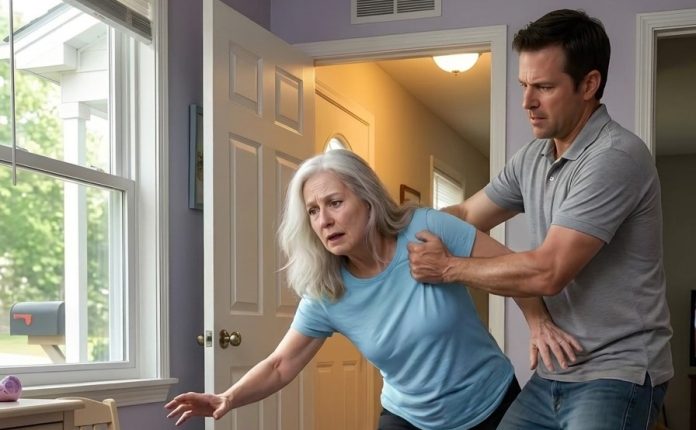
My daughter Olivia, barely two years old, was on the hardwood floor clutching her stuffed bear with both fists. Blood was running from her little nose, and five red fingerprints were already rising across her cheek.
That Sunday was supposed to be quiet in our small suburban house. My husband Michael was away at a work retreat, and the only people home were Sarah, her favorite grandson Tyler, and my baby girl.
I had been making vegetable soup because Sarah had spent three straight days complaining about her stomach, her blood pressure, and how nobody cared for her “the way family should.” She lived under my roof. She ate from my pantry. She slept in the guest room I had painted myself, the one with the small American flag outside the porch window catching the pale afternoon light.
She used the supplemental medical plan I paid for through my handmade skincare business.
And somehow, in every room of my house, she still acted like the martyr.
Tyler lived with us too. He was Michael’s brother’s son, and Sarah insisted he needed our public school district, our routine, our extra space, and our money. I bought his school clothes. His sneakers. His field-trip forms. The tablet he spent half the day staring at on my couch.
Olivia was just a toddler. Soft-cheeked, curious, still walking with those careful little wobbly steps, always looking around for someone to smile back at her.
“Sweetheart, go play in the living room while Mommy finishes lunch, okay?” I had told her.
Not even five minutes later, I heard the smack.
I ran in and found Olivia shaking on the floor. Sarah stood above her with both hands planted on her hips. Tyler was still on the couch, eating the hot dog like nothing in the room had changed.
“What did you do?” I shouted, scooping my daughter into my arms.
Sarah did not even lower her eyes.
“I taught her a lesson,” she said. “She grabbed Tyler’s hot dog. If you don’t correct her now, tomorrow she’ll be stealing out of people’s purses.”
Something in me split cleanly in two.
“She’s two, Sarah.”
Sarah gave a dry little laugh. “So? Girls need to learn early where they stand. Tyler is a boy. He carries this family’s name. Your daughter is going to grow up, get married, and leave.”
For four years, I had swallowed her comments. Olivia cried too much. Girls were expensive for no reason. Tyler needed bigger portions because “boys grow strong.” My business only worked because Michael “let me play office.”
Some people do not hate you loudly at first. They tap the walls. They test the locks. They keep pressing the soft places until they find the one nobody has defended.
But seeing my daughter’s blood on my blouse ended every ounce of patience I had left.
I sat Olivia in the armchair and pressed a clean dish towel gently beneath her nose. I told her to close her eyes. My hands were shaking so badly the towel trembled, but I moved slowly because I did not want my daughter to learn that rage was always the loudest person in the room.
Then I turned toward Sarah.
“What are you staring at, ungrateful girl?” she snapped. “When Michael gets home, he’ll put you in your place.”
I did not answer.
I raised my hand and slapped her.
Sarah stumbled back, one hand flying to her cheek.
“You hit me! Your own mother-in-law!”
I slapped her again.
“The first one was for making my daughter bleed,” I said, looking straight into her eyes. “The second was for thinking a little girl is worth less than a little boy in my house.”
Tyler started crying then, not from pain but from the shock of seeing the rules finally break in a room where Sarah had always made them.
Sarah screamed that she was calling the police, that I was unstable, and that Michael would throw me out by dinner.
The living room froze around us. The soup kept bubbling in the kitchen. The old wall clock clicked above the entryway. Tyler’s half-eaten hot dog sat on a paper plate, mustard smeared across the edge like proof nobody could wipe clean. Olivia whimpered into my shoulder while Sarah’s mouth kept moving and no apology came out.
At 1:42 p.m., I took my phone from my back pocket and called the number printed on the benefits card I kept in my wallet.
“I need to cancel the supplemental medical card under Sarah Mitchell’s name,” I said. “Yes, effective immediately. Please document the request on the account file.”
Sarah stopped screaming.
Her face went pale.
“You can’t do that,” she whispered. “I have a gallbladder procedure next month.”
“Then ask your son,” I said. “Or ask your favorite heir.”
She pressed one hand to her chest. “Emily, please. I’m sick.”
I picked Olivia up again, careful of her cheek, and walked toward my bedroom.
“My daughter is hurt,” I said. “And she was attacked by the woman I opened my front door to.”
I locked the bedroom door while Sarah cried in the hallway, begging for Michael to come home and save her.
But that was only the beginning.
Because at 2:06 p.m., my phone buzzed.
Michael’s name lit up the screen.
And the first thing he said was not, “Is Olivia okay?”
It was, “What the hell did you do to my mother?”
For a moment, I could not speak.
Olivia was curled against my chest, her thumb pressed to her lips. The bleeding had slowed, but one side of her face was swelling. A faint red line crossed the bridge of her nose.
“Michael,” I said carefully, “your mother hit Olivia.”
“I heard there was an incident.”
“An incident?”
“Mom says Olivia grabbed Tyler’s food, started screaming, and you attacked her.”
“She slapped our two-year-old so hard she fell.”
“You slapped my mother twice.”
My throat closed.
Somewhere in the background of his call, men were laughing. Glasses clinked. His work retreat was being held at a lakeside hotel two hours away, and I suddenly pictured him standing outside a conference room, one hand in his pocket, embarrassed not because his daughter had been hurt but because his mother had called him with a family problem.
“Ask me whether Olivia is okay,” I whispered.
“What?”
“Ask me whether your daughter is okay.”
There was a pause.
Then Michael exhaled sharply. “Of course I care about Olivia, but you are the adult here. Mom is sixty-eight years old. You can’t just assault her because you lost your temper.”
I looked down at our daughter.
Her little bear was stained with blood near one ear.
“She called Olivia a spoiled pig.”
“You know how Mom talks when she’s upset.”
“She said girls need to learn where they stand.”
“Emily, stop turning this into one of your feminist speeches.”
The words landed with a strange quietness.
That was when I understood that Sarah had not been operating alone.
Michael had spent years acting as her translator. When she insulted me, he called her old-fashioned. When she criticized my business, he said she did not understand entrepreneurship. When she favored Tyler, he said she had always wanted a grandson nearby.
He had not failed to notice her cruelty.
He had renamed it until I was expected to live with it.
“Come home,” I said.
“I’m trying, but you need to calm down before I get there.”
“I am taking Olivia to urgent care.”
“Do not involve doctors until we talk.”
I nearly laughed.
“Why?”
“Because they’ll ask questions.”
“They should.”
“Emily, think about what you’re doing. You hit an elderly woman. If Mom reports you, it could become a legal issue.”
“Your mother made our child bleed.”
“And you retaliated. You both made mistakes.”
Both.
The word told me everything.
A two-year-old had reached for food. A grandmother had hit her. A mother had reacted. And Michael had already arranged those facts into equal piles because equality was easier than confronting his mother.
“Olivia and I will be gone when you get home,” I said.
His voice changed. “What does that mean?”
“It means I am taking her somewhere safe.”
“You are not taking my daughter anywhere.”
“She is already in danger inside this house.”
“You’re being dramatic.”
The bedroom door shook.
Sarah was knocking from the hallway.
“Michael!” she shouted. “Tell her she cannot throw me out!”
He heard her.
“Put Mom on the phone.”
“No.”
“Emily, put my mother on the phone.”
“No.”
“If you leave with Olivia, I will call the police and report that you kidnapped her.”
That threat should have frightened me.
Instead, it cleared the final fog from my mind.
“Do it,” I said. “And make sure you tell them why I left.”
Then I ended the call.
I packed one bag.
Diapers. Olivia’s medicine. Two changes of clothes. My laptop. Business records. Passports. Birth certificates. The external drive where I backed up my company accounts.
I called my older sister, Rachel.
She answered on the second ring.
“Can Olivia and I stay with you?”
Her tone sharpened immediately. “What happened?”
“Sarah hit her.”
There was a pause.
Then: “Send me a picture. I’m calling the pediatric emergency clinic. Get in your car.”
No debate.
No accusation.
No request that I make the facts gentler.
I carried Olivia through the hallway. Sarah stood outside the guest room with her suitcase open on the bed, but she had not packed anything. She had placed Michael on speakerphone instead.
“You are not leaving,” he said.
I kept walking.
Sarah stepped in front of me.
“You’re destroying this family over one slap.”
I looked down at Olivia’s swollen cheek.
“No,” I said. “I’m refusing to let you destroy her.”
Sarah reached for my arm.
Before she touched me, Tyler spoke from the couch.
“Grandma hit her really hard.”
Everyone froze.
Tyler stared at his knees.
Sarah’s voice turned sharp. “Be quiet.”
He looked up.
“She didn’t just tap her. Olivia fell down.”
“Tyler,” Sarah warned.
His lower lip shook. “And Grandma said girls eat after boys.”
Michael’s voice came through the phone.
“Mom?”
Sarah’s face changed.
Just for one second, the injured grandmother vanished, and the woman who had struck my child returned.
“You ungrateful little liar,” she hissed at Tyler.
I took out my phone and began recording.
“Say that again,” I told her.
Sarah saw the camera.
She stepped back.
And that was when a small blue light above the living-room bookshelf caught my attention.
The indoor security camera.
Michael had installed it three months earlier after a package disappeared from our porch. He had angled it toward the entryway, but the wide lens captured most of the living room.
Including the armchair.
The couch.
The place where Olivia had fallen.
And the sound that had made me run from the kitchen.
Part Two: The Camera Did Not Love Sarah
I drove to the pediatric emergency clinic with Olivia strapped into her car seat and Rachel following behind us. Every few seconds, I looked in the rearview mirror.
Olivia had stopped crying.
That frightened me more than the crying.
She sat unnaturally still, clutching her bear and watching the houses slide past the window. Every time we stopped at a traffic light, she whispered, “Mama?”
“I’m here, baby.”
“Gamma mad.”
“Grandma cannot hurt you now.”
The doctor examined her nose, cheek, eye movement, and jaw. Olivia cried when the doctor touched the swollen area, then buried her face against my chest.
The X-rays showed no fracture, but she had a bruised cheek, a small tear inside one nostril, and swelling consistent with being struck by an open hand.
The doctor asked how the injury happened.
I told her.
I also told her I had slapped Sarah afterward.
There was no point protecting myself with half a truth while demanding that everyone believe my daughter’s full one.
The doctor listened without expression. Then she explained that because Olivia’s injury had been caused by an adult caregiver, she was required to make a report to child protective services.
“I understand,” I said.
Rachel sat beside me, holding my purse.
“Do whatever you need to do,” she added.
A nurse photographed Olivia’s injuries with a measuring scale beside the fingerprints. She gave me written care instructions and told me what warning signs would require an emergency room visit.
While we waited, I logged into the home security app.
The camera had recorded continuously.
At 1:27 p.m., Olivia wandered into the living room holding her bear. Tyler sat on the couch with a hot dog. Sarah was in the armchair watching television.
Olivia reached toward Tyler’s plate.
Tyler pulled it away and said, “That’s mine.”
Olivia made a small frustrated sound.
Then Sarah stood.
She grabbed Olivia’s wrist, jerked her away from the couch, and said, “Greedy little thing.”
Olivia began to cry.
The slap came next.
Even though I knew it was coming, my body recoiled when I watched it.
Sarah’s hand swung from shoulder height.
Olivia’s head snapped sideways.
She fell onto the hardwood floor.
The stuffed bear rolled beneath the coffee table.
For two full seconds, Sarah simply looked down at her.
Then she said, “That will teach you.”
Tyler stopped chewing.
Olivia reached toward her grandmother and cried, “Mama!”
Sarah leaned over her.
“Your mother has spoiled you rotten.”
That was when I appeared in the doorway.
The camera captured everything that followed—Sarah admitting she had hit Olivia, calling her a spoiled pig, and saying boys carried the family name while daughters eventually left.
It also captured me slapping Sarah twice.
I watched that part with my stomach twisting.
The first slap was fast and instinctive.
The second was deliberate.
No matter how furious I had been, I knew exactly what I was doing.
Rachel touched my shoulder.
“You need to save the whole recording,” she said. “Do not edit anything.”
“I hit her.”
“Yes.”
“What if they arrest me?”
“Then you tell the truth.”
I downloaded the video to my phone, my laptop, and the external drive. I emailed a copy to myself and to Rachel. Then I sent it to Michael with one sentence:
Watch from the beginning.
He called three minutes later.
I declined.
He called again.
I declined again.
Then the messages started.
Why didn’t you tell me the camera caught it?
Mom says Olivia had already hit Tyler.
You should not have struck her.
Answer me.
Not once did he say, I saw what she did to our daughter.
Not once did he say, I am sorry I doubted you.
At 4:18 p.m., a police officer arrived at the clinic.
Sarah had called them.
She reported that I had assaulted her, canceled her medical coverage in retaliation, and fled with Olivia after threatening to keep Michael away from his child.
The officer was calm. He asked me to explain what happened and whether I had evidence.
I handed him my phone.
He watched the video twice.
The second time, he turned up the sound.
When Sarah’s hand connected with Olivia’s face, the officer’s jaw tightened.
When I slapped Sarah, he paused the recording.
“You understand that striking her may still be considered assault,” he said.
“Yes.”
“Did she physically threaten you at that moment?”
“No.”
“Then I need to document your actions too.”
“I understand.”
He continued watching.
At the end, Tyler’s voice could be heard telling us Sarah had hit Olivia hard and ordered girls to eat after boys.
The officer asked whether Tyler was still at the house.
“Yes.”
“Who is his legal guardian?”
“His father, Daniel. But he works overseas on construction projects. Tyler has been staying with us for eight months.”
“And Sarah provides most of his daytime care?”
“Yes.”
The officer stepped into the hallway and made a call.
Within an hour, another officer went to our house with a child welfare investigator.
Sarah was no longer only accusing me.
She was being investigated for striking a toddler in front of another child under her care.
Michael arrived at the clinic just before six.
He still wore the navy polo shirt from his company retreat. His conference badge hung from a cord around his neck, and his face was red from the two-hour drive.
He walked into the examination room and looked first at me.
Not Olivia.
Me.
“Can we talk outside?”
Rachel stood.
“No,” she said. “You can look at your daughter first.”
Michael’s eyes flicked toward Olivia.
She was asleep against my chest, her cheek swollen and darkening from red to purple.
His expression cracked.
He reached for her.
Olivia woke, saw him, and began to cry.
“Daddy,” she whispered.
Michael’s face folded.
He crouched beside us. “I’m here, sweetheart.”
“Gamma hit.”
“I know.”
“She mad hot dog.”
“I know.”
Olivia touched her cheek.
Michael looked at me.
For the first time that day, I saw shame in his eyes.
“I watched the video,” he said.
“And?”
“And Mom was wrong.”
“Wrong?”
His shoulders dropped. “She assaulted Olivia.”
Rachel crossed her arms.
Michael rubbed his forehead. “I didn’t know it was that hard.”
“You heard me say there was blood.”
“Mom said you were exaggerating.”
“And you believed her.”
“I was two hours away. I was trying to understand both sides.”
“There were not two sides between a grown woman and a bleeding toddler.”
He looked toward Rachel, perhaps hoping she would soften the room.
She did not.
“Where’s Mom?” he asked.
“At the house, unless the police removed her.”
His head snapped up. “Police?”
“She called them.”
“I told her not to.”
“She accused me of assault. I showed them the full recording.”
Michael stared at me. “You gave them the video?”
“It shows the truth.”
“It also shows you hitting her.”
“I know.”
“Emily, do you understand what this could do to us?”
There it was again.
Not what Sarah had done to Olivia.
What the truth might do to the family’s appearance.
A social worker entered before I answered. She introduced herself as Ms. Patel and asked to speak with Michael and me together.
She explained that Olivia could not return to a home where Sarah remained present. She also wanted to assess whether Tyler was safe.
“Sarah is leaving,” I said.
Michael hesitated.
It lasted only a second.
But Ms. Patel noticed.
“So there is disagreement?” she asked.
“No,” Michael said quickly. “My mother will leave.”
“Tonight?”
He swallowed. “Yes.”
“And where will she stay?”
“I’ll arrange a hotel.”
“Because of the video and medical documentation, Sarah should have no unsupervised contact with Olivia while the investigation is open.”
Michael nodded.
I watched him agree because an official had said the same thing I had been saying all day.
That hurt almost more than the phone call.
When we finally left the clinic, Rachel took Olivia to her house in her car. I rode with Michael because I needed to collect more belongings and confirm that Sarah was gone.
For most of the drive, neither of us spoke.
Then Michael said, “You canceled her health plan.”
“She used coverage I paid for while abusing our child.”
“She has surgery scheduled.”
“She can purchase her own plan.”
“She doesn’t have that kind of money.”
“Then you pay for it.”
He gripped the steering wheel.
“My salary already covers most of the mortgage.”
“And my business covers groceries, childcare, Tyler’s expenses, your mother’s prescriptions, and the extra insurance.”
“I’m not saying you don’t contribute.”
“You let her call it playing office.”
“I never said that.”
“You never stopped her.”
Silence.
The farther we drove, the more clearly I saw our marriage.
Michael had not been cruel in the obvious ways. He did not scream at me. He did not control my money. He did not forbid me from seeing family.
He simply expected me to absorb the impact of his mother so that he would never have to stand between us.
My patience had been the foundation of his peace.
When we pulled into the driveway, a police car was still parked outside.
Sarah sat on the porch beside two suitcases.
Her cheek was pink where I had hit her.
She looked at Michael and began to cry.
“My son,” she said. “Look what she has done to me.”
Michael stopped walking.
I waited.
He looked at Sarah.
Then he looked through the front window toward the place where Olivia had fallen.
“Mom,” he said, “did you watch the video?”
Sarah’s tears stopped.
“That camera does not show what happened before.”
“It shows Olivia walking into the room.”
“She attacked Tyler.”
“She reached for his plate.”
“She has no discipline.”
“She is two.”
Sarah’s face tightened.
Then she said the sentence that ended any possibility of misunderstanding.
“If you had given me authority in this house from the beginning, I would not have needed to hit her so hard.”
The police officer standing near the doorway heard every word.
So did Michael.
And so did the child welfare investigator holding Tyler’s overnight bag.
Part Three: What Tyler Had Been Taught
Sarah was served with a temporary no-contact order that evening.
She protested until the officer warned her that refusing to leave could lead to arrest. Michael drove her to a hotel without asking me to come.
I stayed behind with the investigator and Tyler.
He sat at the dining table, staring at the wood grain while Ms. Patel asked him questions in a gentle voice.
“Has Grandma ever hit you?”
He shook his head.
“Has she hit Olivia before?”
Another shake.
“Has she said things that made you uncomfortable?”
He glanced toward me.
“You’re not in trouble,” I told him.
His fingers worried the hem of his shirt.
“She says boys are supposed to be strong.”
“What does that mean?” Ms. Patel asked.
“She gives me more food. She says I’m more important because I’m a Mitchell.”
“Does she say anything about Olivia?”
Tyler whispered, “She calls her the spare child.”
The room changed.
“What does that mean?” I asked.
Tyler shrugged. “She says Uncle Michael should have had a son, but at least I’m here.”
I felt physically sick.
Sarah had not simply favored Tyler.
She had recruited him into a hierarchy where his comfort depended on Olivia’s humiliation.
“Does she tell you to take things from Olivia?” Ms. Patel asked.
“Sometimes.”
“What kind of things?”
“Her toys. The tablet. Snacks.”
“Why?”
“She says girls need to learn sharing.”
“Do you have to share your things with Olivia?”
Tyler shook his head.
The social worker wrote something down.
“Has Grandma ever told you not to tell Emily or Michael something?”
Tyler’s eyes filled with tears.
“She said Aunt Emily would send me away if she knew I broke the lamp.”
I remembered the lamp.
Sarah had told me Olivia knocked it over while playing, even though Olivia had been asleep in her crib.
“What else?” I asked.
He began to cry.
The secrets came out slowly.
Sarah had taken cash from my business envelope and blamed the cleaning woman.
She had told Tyler to say Olivia drew on the hallway wall, though Tyler had done it.
She had eaten snacks I prepared for customer gift boxes and claimed the shipping company damaged the order.
Small things.
Petty things.
But all of them followed the same pattern.
Sarah created a problem, assigned blame to the person with the least power, and trained the others to accept her version before the truth could speak.
“Why didn’t you tell us?” I asked.
Tyler wiped his eyes.
“Grandma said you already didn’t want me here.”
That accusation cut deeply because it was partly built from something real.
I had not wanted Tyler to move in permanently without a clear plan. I cared about him, but taking responsibility for another child while running my business and raising a toddler had overwhelmed me. Whenever I tried to discuss a schedule or ask Daniel for financial support, Sarah accused me of rejecting her grandson.
She had turned boundaries into cruelty.
Tyler had heard enough of those arguments to believe I resented him.
I sat beside him.
“I was never angry that you needed help,” I said. “I was angry that the adults made decisions without asking me and expected me to do everything.”
“Are you sending me away now?”
The question sounded too practiced.
“No. But your dad needs to know what has happened. We need a safe plan for you.”
He nodded, but fear remained in his face.
Michael returned around nine.
He looked ten years older.
“Mom is at the hotel,” he said.
“Did she apologize?”
He did not answer.
Ms. Patel explained what Tyler had disclosed.
Michael listened with both hands pressed over his mouth.
When she mentioned the stolen business money, he lowered his hands.
“Mom wouldn’t steal.”
Tyler flinched.
I saw it.
So did Ms. Patel.
“Michael,” I said quietly, “do not do that again.”
“Do what?”
“Tell a child his memory is wrong before you have even checked.”
“I’m not calling him a liar.”
“You just did, politely.”
Michael sat across from Tyler.
“Did you see Grandma take money?”
Tyler nodded. “From the brown envelope in Aunt Emily’s office.”
“What did she do with it?”
“Put it in her purse.”
Michael looked at me.
I walked to my office closet and pulled out the ledger from the previous month. Three hundred dollars had gone missing. Sarah had insisted our housekeeper, Ana, must have taken it.
I had dismissed Ana the next week.
The shame hit me so hard I had to grip the desk.
Ana had worked for us for nearly two years. She had cried when I accused her. She kept repeating that she would never steal from a family whose baby she loved.
I had believed Sarah because Sarah was family.
I called Ana that night.
She did not answer, so I left a message.
“I owe you an apology. I found evidence that the money was taken by someone else. I should have believed you when you told me you were innocent. I will pay you for the weeks you lost, and I understand if you never want to work for us again.”
After I hung up, Michael stood in the doorway.
“You didn’t need to do that tonight.”
“Yes, I did.”
“You’re emotionally exhausted.”
“Being tired is not an excuse to postpone telling someone the truth.”
He looked away.
That sentence was not only about Ana.
At ten, Rachel brought Olivia back because I refused to sleep in a house where my child’s belongings remained but she did not. We locked the doors, turned on the security system, and put Olivia in our bed.
Michael lay beside her on the opposite side.
For a while, he watched her breathe.
Then he whispered, “I failed her.”
I did not comfort him.
“Yes.”
His eyes closed.
“I thought Mom was exaggerating because she was upset.”
“You thought I was exaggerating.”
He said nothing.
“You chose the version of the story that required the least courage from you.”
His face tightened.
“That’s not fair.”
“Fairness is not the problem tonight.”
“I came home.”
“After I showed you a video.”
“What do you want me to say?”
“I want you to stop asking me to write your apology for you.”
He sat up.
“I said I failed her.”
“And tomorrow?”
“What?”
“What happens tomorrow when Sarah says she is sick? When she says she has nowhere to go? When relatives call you cruel? When she says the slap was an accident and I provoked her?”
“She can’t come back here.”
“Can’t, or won’t?”
Michael stared at me.
I continued.
“I need to hear you say that your mother is not coming back into this house. Not after the investigation. Not after an apology. Not because she has surgery. Not because she is lonely.”
His voice was quiet.
“She’s my mother.”
“And Olivia is your daughter.”
“That doesn’t erase my responsibility to Mom.”
“No. It puts it in the correct order.”
He stood and paced toward the window.
“I can find her an apartment.”
“You can help her from a distance.”
“She’ll say you forced me to choose.”
“I am not forcing you. She already chose when she struck Olivia.”
Michael looked back at our sleeping daughter.
Finally, he said, “Mom will never live here again.”
I studied his face.
“And no unsupervised contact?”
“None.”
“And you will tell your family what happened before she tells them I attacked her for no reason?”
He hesitated.
There it was.
His lifelong fear.
Sarah’s real weapon had never been money, illness, or even anger.
It was the possibility that she would tell a story about him.
“I’ll call them tomorrow,” he said.
“No. We call them together. Tonight.”
Within twenty minutes, Michael’s brother Daniel, his aunt Rebecca, and two cousins were on a group video call.
Sarah had already contacted all of them.
According to her version, I had slapped her during an argument over discipline, thrown her out while she was ill, and manipulated Olivia into appearing injured.
Michael looked as though he might vomit.
Then I played the recording.
No one spoke afterward.
Daniel was the first.
“Where is Tyler?”
“With us,” Michael said.
“Is he okay?”
“He’s safe.”
Daniel’s eyes hardened. “Why was Mom allowed to discipline my son?”
Nobody answered.
Because the truth was embarrassing.
We had let Sarah rule the house because resisting her was exhausting.
Daniel continued.
“She told me Emily agreed with everything.”
“I didn’t,” I said.
Michael looked down.
His aunt Rebecca whispered, “Sarah has always been difficult.”
“No,” I said. “Difficult is complaining about dinner. She hit a toddler and taught another child that being male made him more valuable.”
Rebecca began to cry.
“She did similar things when we were young.”
Michael looked up.
“What do you mean?”
Rebecca rubbed her forehead.
“She used to make me eat in the laundry room when boys visited because she said I chewed like an animal. Our father stopped her when he found out.”
“You never told us.”
“Your mother said I was jealous because she was prettier.”
The family’s history opened like a door no one had wanted to touch.
Sarah had not invented her cruelty in our living room.
She had carried it for decades, protected by everyone who called it tradition, personality, stress, or family business.
At the end of the call, Daniel said he was returning from his project overseas as soon as possible.
“Tyler is my responsibility,” he said. “Emily, I am sorry we placed everything on you.”
It was the first apology I had received all day.
After the call ended, Michael sat in darkness at the kitchen table.
“My whole life,” he said, “she told me everyone else misunderstood her.”
I poured out the soup that had burned to the bottom of the pot.
“She trained you to believe that understanding her meant excusing her.”
He looked toward the hallway where Olivia slept.
“And I brought that into our marriage.”
“Yes.”
He flinched, but this time he did not argue.
Then the doorbell rang.
It was almost midnight.
Sarah stood outside in her hotel robe, one hand pressed dramatically against her stomach.
And behind her was an ambulance.