Part 4: The Wedding Day That Wasn’t
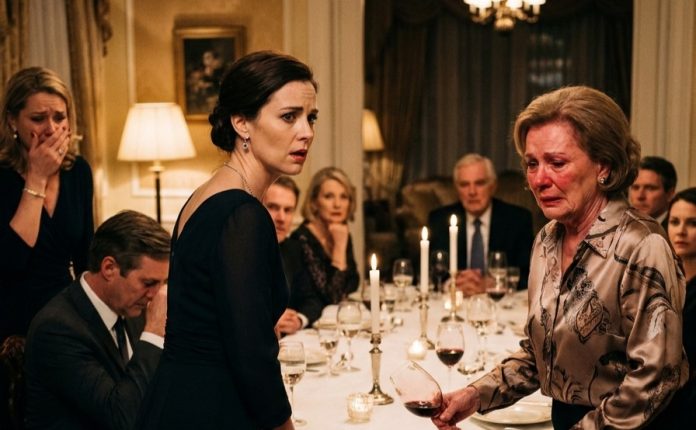
The rehearsal dinner ended without a rehearsal.
Ryan left with his parents.
Jenna remained at the country club with Mom, Paige, and several bridesmaids.
Dad asked Noah and me to stay.
I refused.
As we walked toward the parking lot, Mom followed us.
“Please talk to Jenna.”
“Why?”
“She is hysterical.”
“She should speak to Ryan.”
“He won’t answer.”
“That is not my responsibility.”
Mom grabbed my arm.
“You are her sister.”
“I was her sister when she excluded me.”
“She made a mistake.”
“She spent months lying.”
“She was insecure.”
“So she decided to destroy my reputation.”
Mom began crying harder.
“She may lose everything.”
I looked back toward the country club.
“No. She may lose a wedding.”
“To her, that is everything.”
“That is part of the problem.”
We drove home.
At two in the morning, Jenna called from Mom’s phone.
Her voice was weak.
“I’m sorry.”
I waited.
“I shouldn’t have said those things.”
“No.”
“I was angry.”
“For months?”
“I kept thinking you would apologize and then everything would go back to normal.”
“You wanted me to confess to something I didn’t do.”
“I wanted you to show that you cared about me.”
“By lying publicly?”
She became quiet.
Then she said, “Please call Ryan.”
“No.”
“Tell him I didn’t mean it.”
“You wrote the messages.”
“Tell him you forgive me.”
“I don’t.”
She began crying.
“The venue cost forty thousand dollars.”
“That has nothing to do with me.”
“Our parents spent their savings.”
“That was their decision.”
“You could fix this.”
The sentence revealed that she still did not understand.
She did not want forgiveness.
She wanted rescue.
I ended the call.
The next morning, guests began arriving at the hotel.
Many had traveled from other states.
The family still did not know whether the ceremony would happen.
At nine, Ryan sent a message to the wedding party.
The wedding was postponed.
He asked guests not to gather at the country club.
Jenna posted online that a family member had intentionally sabotaged the event.
She did not name me, but she did not need to.
Within an hour, the comments filled with sympathy.
Then Paige responded publicly.
She wrote:
This was not sabotage. The wedding was postponed after serious dishonesty was discovered.
Jenna deleted the post.
By noon, several relatives had contacted me to apologize.
Aunt Karen called first.
She said she had judged me unfairly.
I thanked her but did not comfort her.
My cousin who accused me of prejudice sent a long message explaining that Jenna had sounded convincing.
I replied:
She sounded convincing because nobody asked me.
Dad called that afternoon.
He had spent the morning canceling vendors and arranging food donations.
He apologized.
“I should have asked more questions.”
“Yes.”
“I thought Jenna was telling the truth.”
“You chose the version that required less conflict.”
He did not argue.
Mom was not ready to apologize.
She said I should have handled the situation more privately.
I reminded her that I had tried.
Jenna blocked me.
Mom asked me to call Jenna and reassure her that I still loved her.
“I do love her,” I said.
“Then tell her.”
“Love does not mean pretending this was small.”
Mom accused me of enjoying being proven right.
I ended the call.
That evening, Ryan came to our house.
Noah invited him inside.
Ryan looked exhausted.
He apologized for believing Jenna.
I told him I understood why he trusted his fiancée.
“What I don’t understand,” I said, “is why you ignored what you personally knew.”
He nodded.
“I remembered the ring meeting. I knew you had never treated me badly. But every time I questioned Jenna, she cried and said I was choosing you.”
He admitted he began limiting contact with me to avoid arguments.
He stopped asking financial questions.
He avoided sitting near me at dinners.
I had noticed the distance but assumed he was busy.
“I thought marriage meant supporting her,” he said.
“It doesn’t mean agreeing with everything.”
“I know that now.”
He asked whether I thought Jenna could change.
I told him I had no idea.
She had not lied once in a moment of panic.
She had built an entire story, recruited relatives, and demanded a public apology.
Ryan said he loved her.
He also said he did not know whether he could marry someone who used other people’s trust as a weapon.
Before leaving, he handed me a small velvet box.
Inside was a necklace Jenna had planned to give her bridesmaids.
“Why are you giving this to me?”
“You were supposed to be included.”
I closed the box.
“No. I wasn’t.”
The necklace belonged to the version of the wedding where nobody knew the truth.
I handed it back.
Ryan looked as though he understood.
Part 5: The Family Chooses Sides
The next six months divided our family.
Some relatives supported me immediately.
Others believed the wedding should have continued because the truth could have been handled later.
That argument fascinated me.
People were less disturbed by Jenna’s lies than by the timing of their exposure.
Aunt Karen said canceling a wedding was an extreme response.
I reminded her that Ryan made that decision.
She replied that I could have convinced him otherwise.
Again, responsibility moved toward me.
Our cousin Melissa stopped speaking to Jenna after learning that Jenna had also lied about her.
Jenna told the bridesmaids that Melissa had shared private details about the wedding budget.
Melissa had done no such thing.
Paige ended their friendship.
She felt guilty for believing the stories about me and for helping Jenna exclude me.
Jenna described both women as disloyal.
Mom continued protecting her.
She moved into Jenna’s apartment for several weeks because Jenna said she could not be alone.
Dad remained at home.
Their marriage became strained.
For the first time, Dad began recognizing the pattern.
Whenever Jenna caused conflict, Mom immediately focused on reducing Jenna’s discomfort.
The person harmed was expected to wait.
Dad apologized to me privately.
He also wrote to several relatives correcting the story.
Mom was furious.
She said he was humiliating Jenna.
Dad replied that the humiliation came from the lie, not the correction.
That was the first time I saw him openly disagree with her about one of us.
Jenna began therapy after Ryan said he would not consider reconciliation without it.
At first, she attended only to win him back.
Over time, according to Dad, she began discussing our childhood.
Our parents had compared us more than I realized.
When Jenna received a poor grade, Dad asked why she could not study like me.
When she quit an activity, Mom said I had always been more disciplined.
Relatives praised my quietness and called Jenna dramatic.
Jenna learned to see me not as a sister but as a standard she was failing to meet.
That made me sad.
It did not make me responsible for the lies.
After four months, Jenna wrote me a letter.
She admitted she had never believed I was romantically interested in Ryan.
She knew the photograph was innocent.
She knew I had not insulted his family.
She was afraid that Ryan admired qualities in me that she lacked.
Instead of admitting that fear, she created a reason to remove me.
She expected our parents to support her.
They did.
She expected me to apologize eventually.
I almost did.
She ended the letter by asking for forgiveness.
I read it twice.
Then I wrote back.
I told her I was sorry our parents compared us.
I told her I had never wanted to be the standard used against her.
I also told her she had made hundreds of choices after the original insecurity.
She cropped the photograph.
She posted the caption.
She lied to Ryan.
She lied to relatives.
She excluded Noah.
She demanded a public apology.
She continued accusing me after the messages were exposed.
Those were not things our parents made her do.
I said forgiveness might come with time.
Trust would take much longer.
She did not respond.
Two months later, Ryan and Jenna began couples counseling.
They did not immediately become engaged again.
Ryan moved into his own apartment.
They dated from the beginning, with separate finances and clear boundaries.
Mom treated this as a tragedy.
Dad called it sensible.
Nearly a year after the canceled wedding, Jenna asked to meet me.
We chose a coffee shop halfway between our homes.
She looked different.
Her hair was shorter, and she wore no makeup.
For once, she did not seem to be performing.
“I hated you,” she said.
The directness surprised me.
“I know.”
“No, I don’t think you do. I hated that you seemed comfortable being yourself.”
“I wasn’t always comfortable.”
“You looked comfortable.”
“That is different.”
She nodded.
She said that whenever she entered a room, she looked for signs that people preferred someone else.
If Ryan asked my opinion, she heard rejection.
If Mom praised my job, she heard criticism.
If Dad trusted me with a responsibility, she believed he was proving that she was unreliable.
She had built her identity around being chosen.
The wedding became the largest possible stage for that need.
“I wanted one day when nobody compared us,” she said.
“So you removed me.”
“Yes.”
“You could have told me how you felt.”
“I thought you would give me advice.”
I almost laughed.
She smiled weakly.
“I know how that sounds.”
We spoke for two hours.
She apologized without asking me to call Ryan or reassure Mom.
That mattered.
Before leaving, she said she and Ryan planned to marry at the courthouse if counseling continued to go well.
“You don’t have to invite me,” I said.
“I want to.”
“I’m not ready.”
Her face fell, but she nodded.
For the first time, she accepted my boundary without turning it into an attack.
Part 6: The Wedding We Eventually Had
Jenna and Ryan married fourteen months after the original wedding date.
The ceremony took place at a small courthouse on a Friday afternoon.
There were twelve guests.
Our parents attended.
Ryan’s parents attended.
Two friends came from each side.
Noah and I were invited.
For weeks, I debated whether to go.
Part of me believed attending would make it seem as though everything had been repaired.
Another part knew that refusing might become a final ending.
I did not want either choice to be controlled by guilt.
In the end, I attended because Jenna asked without pressure.
She did not mention family unity.
She did not say Mom would be heartbroken.
She simply wrote:
I would like you there, but I understand if you’re not ready.
That sentence showed more change than any apology.
At the courthouse, Jenna wore a simple cream dress.
There were no imported flowers, live musicians, or professional lighting.
Ryan wore a dark blue suit.
They looked nervous and happy.
Before the ceremony, Jenna came to stand beside me.
“I’m glad you came.”
“I’m glad I could.”
She handed me a small envelope.
Inside was a photograph from childhood.
Jenna was wearing a towel as a veil.
I stood at the end of our hallway pretending to be the groom.
On the back, she had written:
Thank you for showing up when we were children. I’m sorry I forgot you were never my competition.
I cried.
Not because the message fixed everything.
It did not.
I cried because she finally understood what had been lost.
The ceremony lasted fifteen minutes.
Afterward, we had lunch at a nearby restaurant.
There were no speeches.
Nobody compared the courthouse ceremony to the canceled wedding.
Mom almost made a comment about how beautiful the original venue would have been.
Dad touched her arm, and she stopped.
That small correction mattered.
My relationship with Mom remains strained.
She has apologized for believing Jenna, but she still struggles to admit that she knowingly supported the lie after learning the truth.
Mom says she was afraid Jenna would harm herself if the wedding collapsed.
I understand that fear.
I also believe she could have supported Jenna without sacrificing me.
Dad and I are closer now.
He no longer uses my stability as a reason to expect more from me.
When family conflict happens, he asks questions before choosing the easiest version.
Ryan and I are friendly again.
He started his electrical contracting company while keeping his original job part-time.
The business is growing slowly.
He no longer asks me for advice without including Jenna in the conversation.
That is not because Jenna controls him.
It is because they now make financial decisions together.
Jenna returned to therapy even after the wedding.
She says she still notices comparisons everywhere.
The difference is that she questions them before reacting.
We are not best friends.
We may never become the sisters people expect us to be.
We meet for lunch every month or two.
We exchange honest messages.
When she feels jealous, she sometimes says so.
When I feel guarded, I say that too.
Our relationship is smaller than it once appeared.
It is also more real.
Some relatives still describe the original wedding as a disaster.
I do not.
The canceled wedding prevented a marriage built on manipulation and silence.
It forced Ryan to see how easily support could become surrender.
It forced my parents to confront the way they had compared their daughters and then protected the conflict they helped create.
It forced Jenna to admit that she had turned insecurity into cruelty.
Most importantly, it forced me to stop accepting mistreatment because everyone believed I was strong enough to survive it.
My sister excluded me from her wedding.
At first, everyone believed it was because I looked down on her fiancé.
Then they believed I was jealous.
Then they believed I had secretly wanted him.
The real reason was much simpler and much sadder.
Jenna thought love, respect, and attention were limited resources.
If someone admired me, she believed there was less admiration available for her.
If Ryan trusted my opinion, she believed he trusted hers less.
If our parents praised me, she heard a statement about her own failure.
So she removed me from the most important day of her life and built a lie large enough to justify it.
Her reason shocked everyone in our family because it revealed that the wedding conflict had never been about anything I did.
It was about a competition our parents created, Jenna continued, and I did not know I was participating in.
I forgave my sister eventually.
Forgiveness did not mean saying the lie was harmless.
It did not mean forgetting the relatives who believed her without asking me.
It did not mean returning to the family role where I absorbed every disappointment quietly.
It meant accepting that Jenna was more than the worst thing she had done.
It also meant accepting that I could love her without making myself available for another version of the same harm.
The first wedding never happened.
In a strange way, I am grateful.
The large ballroom, expensive flowers, and perfect photographs would have hidden a relationship built on fear.
The courthouse wedding was smaller.
There was nowhere for the truth to hide.
This time, when my sister invited me, she did not need me to apologize, perform, or make her feel superior.
She simply wanted me there.
And this time, attending was my choice.