PART 5 — THE CEREMONY THAT NEVER HAPPENED
The country club ballroom glowed beneath crystal chandeliers.
Rows of white chairs faced an arch covered in roses.
At the front stood Derek in a black tuxedo, smiling as though no bank accounts had been frozen and no detectives were waiting nearby.
When he saw me enter, the smile disappeared.
Sandra walked beside me.
Rebecca followed several steps behind.
Guests turned.
Whispers moved across the room.
I recognized relatives, former neighbors, employees from my firm, and friends of Joselyn’s from college.
Many had received invitations stating that I was “unable to attend.”
My arrival changed that story before anyone said a word.
Derek approached quickly.
“You need to leave.”
His voice remained low, but his face had tightened.
“I’m here for my daughter.”
“You are not invited.”
“Joselyn asked whether I was coming.”
“She was emotional.”
“So was I when she disinvited me. You still expected the honeymoon money.”
His eyes moved to Sandra.
“What is she doing here?”
“Representing me.”
“This is a private family event.”
“You made it financial when you forged my signature.”
The color drained from his face.
He recovered quickly.
“I have no idea what you’re talking about.”
Rebecca stepped forward.
“I found the papers.”
Derek stared at his mother.
For one second, his expression revealed something raw.
Not guilt.
Betrayal.
He believed she had violated the family rule that had protected him for years.
Whatever Derek did, someone else concealed it.
“You went into my office?” he asked.
“The country club payment failed.”
“You had no right.”
“You used Frances’s name.”
“Mom, stop talking.”
Rebecca straightened.
It was the first time I had seen her refuse his command.
“No.”
Derek looked toward the ballroom entrance.
Two men stood near the doors wearing plain suits.
Detectives Hall and Ruiz.
He recognized them.
The ceremony music had not yet begun, but guests were already watching.
Derek lowered his voice further.
“You are all making a mistake.”
Sandra opened her briefcase.
“The lender has verified the forged guarantee.”
“It was authorized.”
“By whom?” I asked.
“You.”
“I was in Ohio on the signing date.”
“You signed it electronically.”
“My signature was copied.”
“You gave me permission to handle financing.”
“For one business loan. Not for personal debt, a country club, or payments to another woman.”
His eyes sharpened.
“Keep your voice down.”
“No.”
The single word carried farther than I expected.
Nearby conversations stopped.
Derek reached for my elbow.
Before he touched me, Detective Hall stepped forward.
“Mr. Mercer, keep your hands where we can see them.”
The entire ballroom became silent.
The string quartet stopped playing.
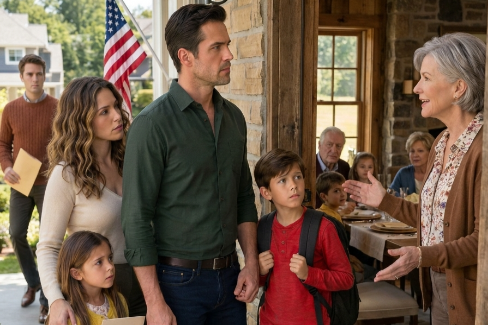
At that moment, Joselyn appeared at the entrance.
She wore her wedding dress.
Her dark hair was pinned beneath a lace veil.
For one painful second, she looked exactly as I had imagined when she was a child.
Beautiful.
Hopeful.
Standing at the beginning of a life she believed would be safe.
Then she saw the detectives.
“What is happening?”
Derek immediately moved toward her.
“Your mother brought the police.”
Joselyn looked at me.
“Mom?”
“I did not bring them to stop your wedding. I reported a forged loan document.”
Derek turned to the guests.
“This is a family disagreement that has gotten out of control.”
Detective Ruiz said, “Mr. Mercer, we need to speak privately.”
“I’m getting married.”
“We need to speak now.”
Derek pointed at me.
“She is doing this because she hates me.”
“I do not hate you,” I said. “I do not trust you.”
Joselyn’s gaze moved from Derek to me.
“What document?”
Sandra handed her a copy.
Her bouquet trembled as she read.
“This is Mom’s signature.”
“It is a copy,” Sandra said. “Mrs. Weber did not authorize it.”
Derek stepped closer.
“Joselyn, don’t listen to them.”
She looked at the transfer list.
“What is L. Carmichael?”
He said nothing.
“What is it?”
“It’s a vendor.”
“A vendor for what?”
“Consulting.”
Rebecca began to cry.
“Her name is Lauren Carmichael.”
Joselyn turned toward her.
“How do you know her?”
Rebecca closed her eyes.
“She worked with Derek.”
“I know that.”
“They were involved.”
Derek’s voice rose.
“Mom!”
The guests no longer pretended not to listen.
Joselyn’s face became completely still.
“Were?”
Rebecca did not answer.
Joselyn looked at Derek.
“Were you sleeping with her?”
“No.”
“Did you send her twenty thousand dollars?”
“It was repayment.”
“For what?”
“An investment.”
“What investment?”
“This is not the place.”
“You chose the place when you brought me here to marry you.”
Derek’s composure began to crack.
“You are letting your mother manipulate you.”
Joselyn stared at him.
“My mother paid for the barn.”
“She canceled it to control us.”
“You asked the barn to refund the money to you.”
His eyes shifted toward me.
That tiny movement answered her.
Joselyn’s bouquet lowered.
“You did?”
“I was trying to save the wedding.”
“By taking her money?”
“It was already allocated.”
“To whom?”
“To us.”
“She wasn’t invited.”
“I told you we should reconsider that.”
“No. You told me that if I wanted to prove I was ready to be your wife, I had to choose you.”
The sentence moved through the room like a cold wind.
Derek stepped closer to her.
“Joselyn, we can discuss this after the ceremony.”
“There is no ceremony.”
His face changed.
“What?”
She removed the engagement ring.
“No ceremony.”
“You’re upset.”
“I am.”
“You’re not thinking clearly.”
“For the first time in months, I think I am.”
She held out the ring.
Derek did not take it.
“Do not humiliate me in front of everyone.”
Joselyn laughed once.
The sound was broken.
“You were willing to humiliate my mother in front of everyone.”
“This is different.”
“Why?”
“Because she can handle it.”
I felt those words deep inside me.
Derek had built his entire plan around that belief.
Frances could handle it.
Frances would pay.
Frances would forgive.
Frances would remain quiet because mothers were supposed to absorb whatever their children placed upon them.
Joselyn placed the ring on a nearby table.
Derek looked around the ballroom.
The guests stared back.
No one stepped forward to rescue him.
He turned toward the detectives.
“I need my attorney.”
“That is your right,” Detective Hall said.
“We are not arresting you at this moment, but you are required to come with us for questioning.”
“I’m not going anywhere.”
“Then the situation may change.”
Charles Mercer emerged from the crowd.
He looked ten years older than he had at the rehearsal dinner.
“Go with them, son.”
Derek stared at his father.
“You too?”
Charles looked at Joselyn in her wedding dress.
“This has gone far enough.”
Derek was escorted from the ballroom without handcuffs.
Even so, everyone understood.
The doors closed behind him.
The room remained silent.
Joselyn stood beneath the chandeliers holding no bouquet and wearing no ring.
Two hundred guests waited to see what she would do.
She turned toward me.
“I’m sorry.”
The words were barely audible.
I crossed the room.
When I reached her, she collapsed against me.
For twelve years, I had wondered what Robert would miss most about his daughter’s wedding.
Her dress.
The father-daughter dance.
Walking her down the aisle.
I had never imagined there would be no wedding.
I held her while she sobbed against my shoulder.
“I’m sorry,” she repeated. “I’m sorry. I’m sorry.”
“You do not have to apologize right now.”
“I chose him.”
“You can choose differently.”
“I believed everything.”
“You believed someone you loved.”
“I treated you terribly.”
“Yes,” I said softly. “You did.”
She pulled back, startled by the honesty.
I touched her face.
“But one terrible decision does not have to become your entire life.”
The guests were quietly leaving.
Some approached to hug her.
Others avoided eye contact.
The caterers stood uncertainly beside trays of untouched food.
The cake waited beneath a spotlight.
Three tiers.
White flowers.
A gold letter M on top for Mercer.
Joselyn stared at it.
“What happens now?”
Rebecca wiped her face.
“The food is paid for.”
Sandra glanced toward the ballroom.
“There are nearly two hundred people here.”
Joselyn took a long breath.
Then she turned toward the remaining guests.
“There will not be a wedding today,” she announced.
Her voice shook, but it carried.
“I’m sorry to those who traveled. I’m sorry to everyone who came expecting a celebration.”
She looked at me.
“But the meal has already been prepared, and none of this is the staff’s fault. Please stay if you wish. Eat. Visit. Take flowers home.”
Someone near the back began clapping.
Then another person joined.
The applause spread slowly.
Not for the canceled wedding.
For the courage it took to stand in the wreckage and tell the truth.
We ate dinner beneath wedding decorations.
The string quartet played quietly again.
Children danced on the empty floor.
The cake topper was removed.
At Joselyn’s request, the caterer boxed dozens of meals for a local shelter.
At eight o’clock, she changed out of her wedding dress in the bridal suite.
When she returned, she wore jeans, a white sweater, and Robert’s old denim jacket, which I had brought from home in case the evening turned cold.
She sat beside me at a table near the window.
“I thought losing the wedding would be the worst thing that could happen,” she said.
“It is not.”
“No.”
Outside, the police car carrying Derek had long since disappeared.
Inside, the lights still glowed.
The structure had failed.
But we were still standing.
PART 6 — WHAT REMAINED AFTER THE COLLAPSE
The investigation lasted nine months.
Derek was eventually charged with identity theft, forgery, bank fraud, and misuse of business funds.
The lender pursued the company assets first.
Because I had reported the forged second guarantee immediately, I was not held responsible for that loan.
The original $150,000 guarantee was more complicated.
Northline Development collapsed.
The warehouse was sold.
The office furniture was auctioned.
The luxury vehicle was returned.
After the remaining assets were applied to the debt, I paid $43,000.
It was a painful amount.
But less painful than continuing to fund a lie.
Lauren Carmichael cooperated with investigators.
The money Derek had sent her was partly repayment for personal loans and partly an attempt to persuade her not to tell Joselyn about their relationship.
The affair had continued until six weeks before the wedding.
Rebecca testified about the documents she found.
Charles sold a vacation property to cover some of the country club expenses.
Their marriage survived, though not comfortably.
Their silence had protected Derek for so long that honesty felt almost unnatural to them.
Joselyn moved into my guest room two days after the canceled wedding.
At first, she barely left it.
She slept late.
She cried in the shower.
She deleted wedding photographs, then restored them, then deleted them again.
Boxes of unopened gifts filled one side of the garage.
Every morning, I made coffee.
Every evening, I asked whether she wanted dinner.
I did not demand apologies.
I also did not pretend nothing had happened.
Healing is not the same as erasing evidence.
Three weeks after the wedding, we sat at the oak kitchen table.
Robert’s chair remained across from us.
Joselyn stirred her tea until the spoon struck the cup again and again.
“I keep thinking about the message I sent you.”
“So do I.”
“I knew you were at the bank.”
“Yes.”
“I waited until then because Derek said you would send the money before reacting.”
I looked at her.
“He planned the timing?”
She nodded, crying.
“He said if I told you earlier, you might cancel everything. He said once the honeymoon transfer cleared, we could deal with your feelings later.”
The cruelty of it settled heavily between us.
“What did you think?” I asked.
“I thought you would be hurt, but you would forgive me.”
“Why?”
“Because you always did.”
There was no malice in her answer.
Only shame.
I understood then that Derek had exploited a pattern I had helped create.
Every time Joselyn behaved carelessly and I repaired the damage without consequence, I taught her that my pain was temporary and my support permanent.
Love without boundaries had not made us closer.
It had made me invisible.
“I need you to understand something,” I said.
She wiped her eyes.
“I love you. I will help you rebuild your life. But I will not rebuild it for you.”
She nodded.
“You will contribute to household expenses when you begin working again.”
“All right.”
“You will attend financial counseling.”
“All right.”
“You will repay the grocery allowance and the personal expenses I covered during the engagement.”
Her eyes widened slightly.
“Every dollar?”
“Over time.”
She looked down.
Then she said, “All right.”
“And we will go to family therapy.”
At that, she began crying harder.
“I thought you might never forgive me.”
“Forgiveness and access are different things.”
She looked at me.
“I don’t understand.”
“I can forgive you and still require change before trusting you again.”
That sentence became the foundation of our new relationship.
Joselyn found work at a nonprofit housing organization.
Her degree was in communications, but she became interested in how affordable housing projects were planned and financed.
Sometimes she visited my firm to ask questions.
The first time she stood beside my drafting table again, she picked up the yellow measuring tape she had used as a child.
“I used to think this place was just your job,” she said.
“It was also how I kept us alive after your father died.”
“I know that now.”
She began repaying me fifty dollars each month.
The amount was small.
The meaning was not.
The Robert Weber Engineering Scholarship launched that fall.
The first recipient was a thirty-four-year-old single father named Miguel Santos, who worked nights maintaining elevators and attended community college during the day.
At the scholarship ceremony, Miguel spoke about wanting to design safer public buildings.
He thanked me.
Then he thanked Robert, though they had never met.
Joselyn sat in the front row.
Afterward, she touched the plaque bearing her father’s name.
“The honeymoon money did something better than send us to an island,” she said.
I did not answer immediately.
A canceled honeymoon had been easy to redirect.
A damaged relationship required more careful work.
“I’m glad it helped someone,” I said.
The following spring, Ridgeline Barn called.
Paula told me the canceled date had been rebooked by a young couple whose original venue had burned down.
“They had very little money,” she said. “Your deposit covered part of the cancellation fee, but the remaining amount allowed us to reduce their price.”
For a moment, I imagined another bride standing beneath the hanging lights Joselyn had chosen.
I expected sadness.
Instead, I felt relief.
The place had become what it was meant to be.
A beginning.
Not ours.
But someone’s.
A year after the canceled wedding, Joselyn and I drove to the cemetery.
We carried Robert’s favorite yellow roses.
She knelt beside the stone and traced his name.
“I’m glad Dad wasn’t there to see what happened,” she said.
“I’m not.”
She looked at me.
“He would have been furious.”
“Yes.”
“At me?”
“At Derek. At me. At the entire situation.”
“Why you?”
“Because I ignored my own judgment.”
Joselyn sat on the grass.
“Would he forgive me?”
“Immediately.”
She smiled through tears.
“But he would still make you repay the money.”
She laughed.
That sound felt like sunlight entering a long-closed room.
Before leaving, I placed my hand against the top of Robert’s stone.
“Your scholarship is doing well,” I told him.
The wind moved through the trees.
For years after his death, I had spoken to Robert as though my life had stopped while his continued somewhere else.
That day felt different.
My life had not stopped.
It had bent beneath grief, responsibility, and fear.
But it had not broken.
Two years later, Joselyn met someone named Aaron at a housing conference.
He was an architect.
Quiet.
Divorced.
The father of a nine-year-old girl.
When she told me about him, she did not begin with his salary, his car, or his ambition.
She said, “He listens when I say no.”
That was how I knew she had changed.
Aaron did not ask me for money.
He did not call my firm little.
He did not study my house as though calculating its value.
The first time he came to dinner, he brought bread from a neighborhood bakery and asked about Robert.
A year later, he asked Joselyn to marry him.
She called me before answering.
Not for permission.
For honesty.
“I love him,” she said. “But I’m afraid.”
“That is understandable.”
“What should I do?”
“Examine the structure.”
She laughed.
“What does that mean?”
“Do his words match his actions? Does he accept responsibility? Can you disagree without being punished? Does he make your life larger or smaller?”
She was quiet.
“Larger.”
“Then there is your answer.”
Their wedding took place in my backyard.
Thirty guests.
White chairs on the lawn.
Dinner from a local restaurant.
No chandeliers.
No country club.
No $40,000 barn.
Joselyn paid for most of it herself.
I contributed the flowers after she asked.
Asked.
That word mattered.
Before the ceremony, she stood in my bedroom wearing a simple ivory dress.
Robert’s photograph rested on the dresser.
She handed me a small envelope.
Inside was a copy of the bank message she had sent years earlier.
Beneath it, she had written:
This was the worst thing I ever said to the person who loved me most. I cannot erase it. I can only spend the rest of my life becoming someone who would never send it again.
I folded the note carefully.
“You already have,” I said.
“No. I’m still becoming her.”
“That is what the rest of us are doing too.”
When the music began, Joselyn took my arm.
Together, we walked across the lawn.
Aaron waited beneath the oak tree Robert had planted the year our daughter was born.
The branches stretched wide above us.
A strong structure.
Deep roots.
Flexible limbs.
Enough space beneath it for a family to gather without anyone disappearing.
At the front, Joselyn kissed my cheek.
“Thank you for coming to my wedding.”
I smiled.
“Thank you for inviting me.”
The guests laughed softly.
But both of us understood the weight of those words.
After the ceremony, I sat at the center table while other people carried plates, poured drinks, and cleared dishes.
Miguel Santos, the scholarship recipient, attended with his teenage son.
He had completed his degree and accepted a position at my firm.
The scholarship fund had grown after several former employees contributed.
What began as canceled honeymoon money now helped one engineering student every year.
As evening settled over the yard, warm lights glowed between the branches.
Joselyn danced with Aaron.
His daughter danced beside them.
No one spoke about Derek.
No one needed to.
The most important consequences of his actions were not the charges, the debts, or the failed company.
It was that the people he tried to control had learned to stop cooperating.
I touched Robert’s ring beneath my blouse.
For most of my life, I believed love meant paying the cost before anyone else had to feel it.
I was wrong.
Love could be generous.
Love could be patient.
Love could forgive.
But love also had to be honest enough to let consequences arrive.
The day Joselyn disinvited me from the wedding I was financing, I thought I was losing my daughter.
In truth, I was losing the arrangement that had allowed her to take me for granted.
What eventually returned was not the old relationship.
It was something stronger.
A relationship built without hidden debt, false promises, or silent resentment.
A relationship in which both people carried weight.
As the music slowed, Joselyn looked across the yard and held out her hand.
“Come dance with us, Mom.”
Years earlier, I might have remained seated so no one would feel inconvenienced.
That evening, I stood.
I joined my daughter beneath the tree.
And for the first time in a very long while, I was not paying for a place in her life.
I simply belonged there.