PART 1 — THE PLAN THEY MADE FOR ME
One week before Christmas, I overheard my daughter say on the phone, “We’ll just drop all eight children off at Mom’s. She can watch them while we enjoy a few peaceful days away.”
On the morning of December 23, I packed a suitcase, placed it in my car, and drove toward the coast.
I’m sixty-seven, widowed, and living alone on a quiet American street lined with neat lawns, glowing decorations, and inflatable snowmen swaying in the winter wind.
For years, Christmas in my family had followed the same pattern.
The house filled with people.
The oven ran all day.
The dining table disappeared beneath plates, serving bowls, wrapping paper, and half-finished drinks.
And I spent nearly every hour in the kitchen while everyone else smiled for photographs and called it “family time.”
I planned the menu.
I bought the groceries with money from my pension.
I searched Target and the local mall for the right presents for each grandchild.
I wrapped every gift, arranged the decorations, prepared the guest beds, and made sure everyone had what they needed.
Then, when dinner was finished and the photographs had been posted online, my children usually hurried away to their next plans.
I was left behind washing dishes in an empty kitchen.
Last Christmas, I cooked for two entire days.
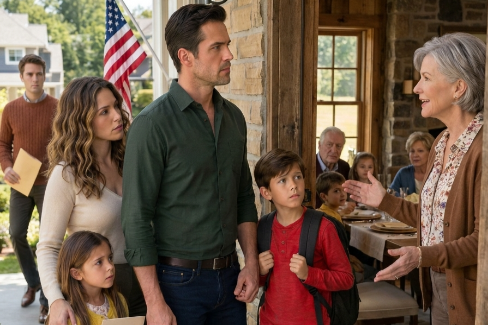
My daughter, Claire, and her husband, Jason, arrived late with their five children.
My son, Daniel, appeared with his wife, Melissa, and their three children just before the meal was served.
They ate, laughed near the tree, took several cheerful family pictures, and left early because they had somewhere else to go.
All eight grandchildren remained with me.
I spread air mattresses across the floor, found extra blankets, cleaned up the wrapping paper, and stayed awake long after midnight while the furnace hummed through the silent house.
Not one person asked whether I was tired.
No one asked how I was feeling.
This year seemed destined to be exactly the same.
I had already paid for a large Christmas dinner.
I had purchased presents for all eight grandchildren.
The pantry was full, the decorations were glowing, and holiday music played constantly on the radio.
From the outside, everything looked warm and festive.
Then one afternoon, while making coffee, I heard Claire speaking from the living room.
She sounded cheerful and excited, as though she were discussing a well-earned vacation.
“Mom has handled all eight before,” she said with a laugh. “We’ll leave them there, spend a few days at the beach hotel, and come back on Christmas Day for dinner and presents.”
I stood motionless in the kitchen, still holding my mug.
It was not the first time my family had made plans for me without asking.
But something about her tone changed the way I heard it.
She did not speak about me as her mother.
She spoke about me like a free service that would always be available.
For most of my life, I had been the reliable one.
The patient one.
The person who always fixed the problem and never said no.
That afternoon, I sat on the edge of my bed and asked myself a question I had avoided for years.
What would happen if, for once, I stopped doing what everyone expected?
I did not confront anyone.
I made no emotional announcement.
I simply opened a notebook, made several calls, and quietly changed my plans.
My first call was to a small seaside inn my husband, Robert, and I had visited for our thirtieth wedding anniversary.
The Blue Heron Inn stood on a quiet section of the North Carolina coast, with white balconies overlooking the water and rocking chairs facing the dunes.
Robert had loved that place.
He used to wake before sunrise, make two cups of coffee, and persuade me to walk along the beach while the sky turned pink.
After he died, I never returned.
When the woman at the reservation desk told me there was one room left for Christmas, I almost believed it was Robert telling me to go.
“I’ll take it,” I said.
My second call was to a local charity that served Christmas meals to families in need.
I donated the turkey, ham, potatoes, canned vegetables, pie ingredients, and most of the other food I had purchased.
A volunteer named Susan came by that evening to collect everything.
“You’re helping feed at least four families,” she told me.
For the first time in years, the groceries I had bought for Christmas felt as though they were truly being appreciated.
I kept the presents for my grandchildren.
They had done nothing wrong.
I placed every wrapped gift inside the locked guest room and taped a note to the door.
These gifts belong to the children. They will receive them when I return.
Then I removed the spare key Claire kept beneath the flowerpot beside my back door.
On December 23, I woke before dawn.
I packed warm clothes, a navy dress, Robert’s old wool scarf, and the novel I had been promising myself I would read for six months.
I unplugged the Christmas tree but left the outdoor lights on.
Before driving away, I stood in the driveway and looked at the house.
For a moment, guilt pressed against my chest.
I imagined the children arriving with their little suitcases.
I imagined their disappointment.
Then I reminded myself that they were not being abandoned.
They were arriving with their parents.
The same parents who had planned a vacation without arranging proper care for them.
I locked the front door, started the car, and drove toward the highway leading to the sea.
Behind me, the Christmas lights continued blinking.
Ahead of me was something I had not given myself in years.
A holiday of my own.
PART 2 — THE LOCKED DOOR
I had been driving for nearly two hours when my phone began ringing.
Claire’s name appeared on the screen.
I let it ring.
Seconds later, Daniel called.
Then Claire again.
Then Melissa.
At the next rest area, I parked beneath a bare oak tree and looked at the growing list of missed calls.
There were nine in total.
A message from Claire appeared.
Where are you?
Another followed immediately.
We are outside your house. The door is locked.
Then came the message that confirmed everything.
The kids have all their bags. We need to leave by ten or we’ll lose the reservation.
Not Are you all right?
Not Did something happen?
Not even We should have confirmed our plans.
Only concern about their reservation.
I took a slow breath and called her.
She answered before the first ring had finished.
“Mom, where are you?”
“Good morning, Claire.”
“Where are you?” she repeated. “We’re standing in your driveway.”
“I’m on my way to the coast.”
There was a long silence.
“What coast?”
“The Atlantic one.”
“This isn’t funny.”
“I’m not joking.”
Through the phone, I heard children talking, car doors slamming, and Jason asking what was happening.
Claire lowered her voice.
“You knew we were bringing the children.”
“No, Claire. You never asked me.”
“I told you we had Christmas plans.”
“You told me you might visit. You did not ask me to care for eight children for three days.”
“But you always watch them.”
“Sometimes I do, when I am asked.”
“Mom, the hotel is already paid for.”
“That is unfortunate.”
Her voice became sharp.
“You can’t just disappear.”
“I did not disappear. I made plans for Christmas.”
“You’re a grandmother.”
“And you are their mother.”
The words came out more calmly than I expected.
Claire inhaled sharply.
“Are you seriously doing this to your grandchildren?”
“I am not doing anything to them. They are safe with their parents.”
“We promised them Christmas at your house.”
“Then you made another promise without consulting me.”
Jason said something in the background.
Claire covered the phone, but I heard enough.
“She’s being difficult on purpose.”
That sentence hurt more than I wanted it to.
For years, I had said yes to everything.
One no had turned me into a difficult woman.
“Put me on speaker,” I said.
“What?”
“Put me on speaker so Daniel and Melissa can hear.”
A few seconds later, the background noise became louder.
Daniel’s voice came through.
“Mom, what’s going on?”
“What is going on,” I said, “is that the four of you planned to leave eight children at my house without asking me. I overheard Claire discussing it last week.”
No one responded.
I continued.
“I am spending Christmas at the coast. You may take your children with you, cancel your trip, or make another arrangement. But I will not be providing childcare.”
Melissa spoke first.
“I thought Claire had asked you.”
Claire snapped, “Don’t start blaming me.”
“I’m not blaming you,” Melissa replied. “You said your mom was excited to have them.”
“I assumed she would be.”
Daniel sighed.
“Mom, can’t you just turn around? We’ll pay you.”
The suggestion struck me as almost funny.
They had never offered to pay before.
More importantly, he still did not understand.
“This is not about money.”
“Then what is it about?”
“It is about the fact that none of you believed I deserved to be asked.”
A child began crying in the background.
I recognized my youngest granddaughter, four-year-old Sophie.
“Grandma isn’t home?” she asked.
Claire’s voice became cold.
“See what you’re doing?”
I closed my eyes.
“Tell Sophie I love her. Tell all the children I love them. But do not tell them I abandoned them because your vacation plans failed.”
Claire gave a bitter laugh.
“You’ve changed.”
“Yes,” I said. “I believe I finally have.”
I ended the call before she could respond.
For several minutes, I remained parked with my hands resting on the steering wheel.
My heart pounded.
Part of me wanted to turn around.
That part of me had been trained through decades of motherhood, marriage, emergencies, illnesses, forgotten school projects, last-minute babysitting requests, and holiday expectations.
It whispered that a good mother solved every problem.
But another voice had finally grown loud enough to answer.
A good mother could still have boundaries.
A good grandmother could love her grandchildren without allowing their parents to exploit her.
I placed the phone facedown and continued driving.
At my house, the situation was becoming chaotic.
I learned the details later from my oldest granddaughter, Emma.
Claire and Jason had arrived first with their five children and enough luggage for several nights.
Daniel and Melissa pulled in ten minutes later with their three.
The adults had expected to unload the children, give me hurried instructions, and drive together to the beach resort.
When they found the door locked, they initially assumed I had gone grocery shopping.
Then Claire noticed that my car was missing.
After our phone call, the four adults stood in the driveway arguing while the children watched from the vehicles.
Claire blamed Melissa for not helping convince me.
Melissa accused Claire of lying about receiving my permission.
Jason complained about losing the money they had paid.
Daniel tried calling hotels to ask whether children could be added to their adults-only reservation.
They could not.
The children gradually realized that their parents had planned a vacation without them.
Eleven-year-old Noah asked, “Were you really going to leave us here and go to the beach?”
No one answered him.
Emma, who was fourteen, understood before the others did.
“You didn’t ask Grandma, did you?” she said.
Claire told her not to interfere in adult matters.
Emma replied, “But we’re the ones standing outside in the cold with suitcases.”
That ended the argument for a moment.
Eventually, Daniel took his children home.
Melissa cried quietly in the passenger seat.
Claire and Jason remained in my driveway for another twenty minutes, as if waiting for the locked house to surrender.
Then they left too.
By that time, I had reached the coast.
The winter ocean appeared beyond the dunes, gray-blue and endless beneath the pale sky.
When I stepped from my car, cold salt air touched my face.
For the first time that day, I felt my shoulders relax.
PART 3 — CHRISTMAS BY THE SEA
The Blue Heron Inn looked almost exactly as I remembered it.
White wooden railings wrapped around the building.
Garlands hung above the entrance.
Inside, a tall Christmas tree stood beside the stone fireplace, decorated with seashells, silver ribbons, and tiny glass birds.
A woman with short gray hair greeted me at the front desk.
“You must be Mrs. Turner.”
“I am.”
“I’m Margaret. We spoke on the phone.”
She handed me a brass room key with a blue wooden tag.
“You have an ocean-view room on the third floor.”
When I reached the room, I opened the balcony door and listened to the waves.
The sound filled the silence without demanding anything from me.
No one asked where the clean towels were.
No one complained about hunger.
No one handed me a baby, an empty plate, or a pile of wrapping paper.
I sat in the balcony chair wearing Robert’s scarf and watched seabirds move above the water.
For a while, I cried.
Not because I regretted leaving.
I cried because I had forgotten how it felt to sit still.
I cried because Robert should have been beside me.
I cried because somewhere between raising children and becoming a grandmother, I had allowed the people I loved to confuse my generosity with obligation.
That evening, the inn hosted a small dinner for guests.
I almost stayed in my room, but Margaret encouraged me to attend.
“There are several other people spending Christmas away from home,” she said. “Most of them are nervous about admitting they’re relieved.”
Her honesty made me smile.
The dining room held only seven guests.
There was Walter, a retired postal worker whose wife had died in March.
There were two sisters from Virginia, both in their seventies, who had decided not to cook for their grown families that year.
A middle-aged nurse named Anita was resting between hospital shifts.
There was also a young couple whose flight to Boston had been canceled.
No one knew me.
No one expected anything from me.
During dinner, we talked about ordinary things—books, weather, travel, the best way to cook cornbread.
When dessert arrived, Walter raised his glass.
“To the Christmas we got instead of the Christmas we planned.”
We all drank to that.
Later, I returned to my room and found seventeen messages on my phone.
Most were from Claire.
The first few were angry.
I hope you’re proud of yourself.
The kids are devastated.
You ruined Christmas.
Then her tone shifted.
At least tell me where the presents are.
We can celebrate at your house without you.
Why did you remove the spare key?
Daniel’s messages were different.
I’m sorry. I should have asked.
Then:
Melissa and I canceled. The kids know what happened. We’re trying to make the best of it.
A final message arrived from Emma.
Grandma, are you safe?
I called her immediately.
She answered quietly.
“Hi.”
“Hello, sweetheart. Yes, I’m safe.”
“Mom said you ran away.”
“I took a planned trip.”
“She said you wanted to punish us.”
“I would never punish you.”
“Then why didn’t you stay?”
I considered my answer carefully.
“Because your parents made plans for my time without asking me. I love all of you, but loving someone does not mean they can decide what you must do.”
Emma was silent.
Finally, she said, “Mom and Dad were going to leave us with you so they could go on vacation.”
“Yes.”
“They told us it was a family Christmas trip.”
My heart sank.
“I’m sorry.”
“Are our presents really locked in the guest room?”
Despite everything, I laughed softly.
“They are.”
“Mom is furious about that.”
“The presents belong to you children. You will receive them when I return.”
“Are you having a nice time?”
I looked toward the dark ocean.
“I think I am learning how.”
Emma lowered her voice.
“I’m glad.”
After the call, I turned off my phone.
The next morning was Christmas Eve.
I woke before sunrise, dressed warmly, and carried coffee to the beach.
The sand was cold beneath my shoes.
The horizon slowly changed from charcoal to violet, then from violet to gold.
Robert had been gone for four years, but I could almost hear him beside me.
“You always take care of everyone,” he once told me. “One day you’re going to have to learn that you count as everyone too.”
At the time, I had laughed.
Now the memory stopped me in the middle of the beach.
I closed my eyes and let the wind move across my face.
“You were right,” I whispered.
That afternoon, Anita and I walked through the small coastal town.
We visited a bookstore, drank hot chocolate, and watched children skating on a temporary ice rink in the town square.
At a gift shop, I bought myself a silver necklace with a tiny blue heron pendant.
I could not remember the last time I had chosen a Christmas present for myself without feeling guilty.
On Christmas Eve, the inn held a candlelight gathering beside the fireplace.
Margaret read a poem.
Walter played carols on an old piano.
The young couple passed around homemade cookies.
At midnight, I stood on the balcony and watched moonlight spread across the water.
My family was not with me.
Yet I did not feel alone.
Back home, Claire’s Christmas was not unfolding as she had imagined.
With the resort reservation canceled, she and Jason had returned to a house with little food prepared, no wrapped presents for the children, and five disappointed faces.
Claire had expected my house to provide everything.
Dinner.
Decorations.
Entertainment.
Childcare.
Even the feeling of Christmas itself.
Without my labor, she discovered that Christmas did not simply appear.
Someone had always been creating it.
That someone had been me.