PART 4 — THE CHRISTMAS THEY HAD TO MAKE
On Christmas morning, I woke to the sound of waves and someone knocking gently at my door.
Margaret stood in the hallway holding a tray.
“Merry Christmas,” she said.
The tray held coffee, warm biscuits, fruit, and a small vase containing a sprig of holly.
“You didn’t have to do this.”
“No,” she said. “But I wanted to.”
The difference between those two things struck me deeply.
I carried the tray to the balcony.
For years, Christmas morning had begun with alarms, ovens, lists, and anxiety.
That year, it began with coffee and the sea.
At nine o’clock, I turned on my phone.
There were photographs from Daniel.
His three children were sitting around their kitchen table wearing paper crowns they had made themselves.
The pancakes were uneven, the room was messy, and everyone looked genuinely happy.
Beneath the picture, Daniel had written:
We made breakfast together. I should have done this years ago. Merry Christmas, Mom.
Another message followed.
I am sorry I treated your work like something that happened automatically.
I read those words several times.
Then Claire called.
I hesitated before answering.
“Merry Christmas,” I said.
Her response was immediate.
“Are you coming home today?”
“No.”
“The children want their gifts.”
“They will receive them when I return on the twenty-seventh.”
“You are really going to make them wait?”
“They have gifts from you and Jason.”
Silence.
Then she said, “We didn’t buy much because you always handle most of it.”
There it was.
A truth she had never intended to say aloud.
“Then perhaps this Christmas will help you plan differently next year.”
“You sound so cold.”
“I am speaking calmly. That is not the same as being cold.”
“You embarrassed us in front of the children.”
“You arrived at my house with eight children and luggage after making plans behind my back.”
“We needed a break.”
“So did I.”
“You live alone. Your entire life is a break.”
For a moment, neither of us spoke.
The words cut cleanly.
She seemed to realize what she had said, but she did not apologize.
Instead, she continued.
“You don’t understand how exhausting it is to raise children.”
I stared at the ocean.
“Claire, who do you think raised you and Daniel?”
“That was different.”
“How?”
“You had Dad.”
“And after your father died, I had no one. Yet every Christmas, I still cooked for all of you, paid for most of the meal, bought the gifts, watched the children, and cleaned the house alone.”
“No one asked you to do all that.”
The sentence was meant to defend her.
Instead, it revealed the entire problem.
“You’re right,” I said. “No one asked. You simply expected it.”
Claire began crying.
At first, I nearly apologized.
The old instinct rose inside me.
I wanted to make the discomfort disappear.
Then I understood that her tears did not necessarily mean I had harmed her.
Sometimes people cried when they could no longer avoid the truth.
“I hope you and the children have a peaceful day,” I said.
“How can we?”
“You can begin by making breakfast.”
I ended the call.
Later, Emma told me what happened after that conversation.
Claire remained in the kitchen staring at the phone.
Then nine-year-old Sophie asked whether Christmas was canceled.
Emma said, “No. We just have to do it ourselves.”
The children began searching the pantry.
They found pancake mix, cereal, marshmallows, and a box of brownie mix.
Jason drove to a convenience store and returned with milk, eggs, frozen pizza, and batteries for the toys they already owned.
The children made decorations from printer paper.
They watched old Christmas movies.
They built a blanket fort in the living room.
At first, Claire sat apart from them, angry and humiliated.
Then six-year-old Caleb carried her a paper snowflake.
“We made this one for Grandma,” he said. “Can we give it to her when she comes back?”
Claire looked at the crooked snowflake and began crying again.
This time, Emma sat beside her.
“You should have asked Grandma,” she said.
“I know.”
“You told us she wanted us there.”
“I thought she would.”
“That isn’t the same.”
Children often see the truth adults spend years avoiding.
Claire did not answer.
That afternoon, Daniel and Melissa brought their three children to Claire’s house.
The original plan had been for the adults to enjoy cocktails at a luxury resort while I managed all eight grandchildren.
Instead, the four parents stood in Claire’s kitchen making spaghetti while the children played together.
The meal was late.
The sauce came from jars.
Several plates did not match.
No one took elegant photographs.
But for the first time in years, my children performed the labor required to create their own family Christmas.
Daniel later told me that the experience changed something in him.
He had not understood how many invisible decisions a holiday required.
When should the food be started?
Which child needed help?
Where were the clean sheets?
Who remembered the allergies?
Who comforted the tired four-year-old?
Who cleaned while everyone else relaxed?
Each task looked small.
Together, they formed the burden I had carried alone.
After dinner, the adults discussed me.
Jason remained angry.
He insisted that I had deliberately ruined their trip.
Melissa disagreed.
“She didn’t ruin anything,” she said. “We made a reservation before confirming childcare.”
Daniel admitted that he had known they should ask me directly but had allowed Claire to handle it.
Claire finally revealed what she had said during the original phone conversation.
“She’ll complain a little,” she admitted, “but once the children are there, she’ll do it.”
The room became silent.
Emma had entered the hallway unnoticed.
She heard every word.
The next morning, she sent me a message.
Mom knew you might say no. She planned to bring us anyway because she thought you wouldn’t turn us away once we were standing there.
I sat on the edge of the hotel bed reading the sentence.
That knowledge hurt.
It also removed the last of my guilt.
They had not merely forgotten to ask.
They had deliberately avoided asking because they did not want to risk hearing my answer.
My kindness had become the weapon they intended to use against me.
I typed a reply to Emma.
Thank you for telling me. None of this is your responsibility. Enjoy your day and let the adults solve the adult problem. I love you.
Then I put on Robert’s scarf and walked back to the beach.
I no longer wondered whether I had done the right thing.
I knew.
PART 5 — THE FAMILY MEETING
I returned home on December 27.
The outdoor lights were still blinking.
A thin layer of frost covered the lawn.
For the first time in many years, I arrived at my own house rested.
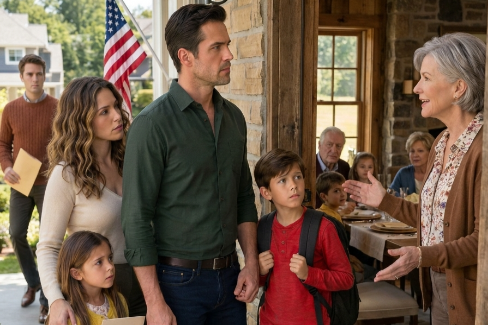
I carried my suitcase inside, made tea, and had barely removed my coat when someone began pounding on the front door.
Claire stood on the porch.
Her arms were crossed.
Jason waited in the car.
“Are you going to let me in?” she asked.
“If you can speak respectfully.”
She pushed past me before I finished the sentence.
“You made us look like terrible parents.”
“I did not tell anyone what happened.”
“The children know.”
“They were standing in the driveway.”
“You could have warned us.”
“You could have asked me.”
She walked into the living room and looked around.
The house was still decorated, but there were no mountains of dirty dishes, discarded toys, or air mattresses.
“You planned this,” she said.
“Yes.”
“You donated the food.”
“Yes.”
“You locked the presents away.”
“I protected them.”
“You knew exactly what would happen.”
“I knew you would have to care for your own children.”
Her face flushed.
“I’m your daughter.”
“That is why this hurts so much.”
She opened her mouth, but no words came.
I gestured toward the sofa.
“Sit down.”
To my surprise, she did.
I took a notebook from the side table.
Inside, I had written down the approximate amount I had spent during the previous five Christmases.
Groceries.
Gifts.
Decorations.
Extra heating costs.
Replacement bedding.
Gasoline.
I had also listed the hours spent shopping, cooking, wrapping, cleaning, and caring for children.
Claire looked at the pages.
“What is this?”
“My contribution to our family holidays.”
“You kept records?”
“I reconstructed them after I heard your phone call.”
“This makes family sound like a business.”
“No. It shows how much work you stopped noticing.”
She pushed the notebook away.
“So what do you want? Money?”
“I want consideration.”
“I already said we needed a break.”
“And you decided your break would be purchased with my exhaustion.”
She stared at the floor.
I continued.
“I love you, Claire. I love Jason. I love every one of my grandchildren. But I will no longer host holidays by myself. I will not accept unannounced overnight visits. I will not be treated as automatic childcare.”
“So you’re done helping us?”
“That is not what I said.”
“It sounds like it.”
“I will help when I am asked, when I am available, and when the arrangement is fair.”
“You were never like this when Dad was alive.”
“Your father noticed when I was tired.”
The room became quiet.
Robert had always dried the dishes.
He wrapped the awkwardly shaped presents.
He told the children to let me sit down.
After his death, everyone mourned him.
No one noticed that the work he had shared with me remained behind.
Claire’s expression softened, but only briefly.
“You should have talked to us.”
“You are right.”
She looked surprised.
“I should have spoken years ago,” I continued. “But my failure to set a boundary does not give you permission to ignore one now.”
A knock sounded at the door.
Daniel and Melissa had arrived with their children.
I had invited them for two o’clock so the grandchildren could receive their gifts.
Claire looked irritated.
“You arranged a family meeting?”
“I arranged a gift exchange.”
Within minutes, the house was filled with children.
They hugged me so tightly that I nearly lost my balance.
Sophie clung to my waist.
“Did you see the ocean?”
“I did.”
“Were there dolphins?”
“Not this time.”
“Did you miss us?”
“Every day.”
The children never asked why I had left.
They did not demand an apology.
They simply wanted to know that I loved them.
We gathered around the tree.
I unlocked the guest room, and the children carried out the gifts.
Their excitement warmed the house.
I watched them tear paper, compare toys, and thank me.
No one had been harmed by waiting two days.
Afterward, the children went to the kitchen for cookies I had purchased on the drive home.
The adults remained in the living room.
Daniel spoke first.
“Mom, I owe you an apology.”
Claire looked away.
He continued.
“I let Claire say she had everything arranged because I didn’t want the responsibility of checking. I assumed you would handle it. That was wrong.”
Melissa added, “I’m sorry too. I should have called you directly.”
“Thank you,” I said.
Daniel handed me an envelope.
Inside was a check covering part of the groceries and gifts I had purchased.
“I know this isn’t only about money,” he said. “But you should not be paying for everything.”
I accepted it.
In the past, I would have refused.
Refusing would only teach them that my contribution had no cost.
Jason finally entered the conversation.
“We lost nearly two thousand dollars on that hotel.”
“I’m sorry the hotel would not refund you.”
He stared at me.
“That’s all you have to say?”
“You made a reservation before confirming childcare.”
“She’s enjoying this,” he said to Claire.
“No,” I replied. “I enjoyed the beach. I do not enjoy this conversation.”
Daniel almost smiled.
Jason did not.
Claire stood.
“Can we stop attacking each other?”
“No one is attacking you,” Melissa said.
“You’re all acting like Mom is some kind of victim.”
Emma appeared in the doorway holding a plate of cookies.
“Grandma was a victim.”
Claire turned toward her.
“Go back into the kitchen.”
Emma remained where she was.
“You said she would complain but do it anyway.”
Claire’s face went pale.
“You were listening to a private conversation.”
“You were talking about leaving us with her.”
“Emma,” I said gently, “please join the other children.”
She looked at me, then obeyed.
Claire sat down again.
For the first time since arriving, she seemed less angry than ashamed.
“I didn’t mean it the way it sounded.”
“How did you mean it?” I asked.
She wiped her eyes.
“I meant that you always come through.”
“I did.”
“And I counted on that.”
“You counted on my inability to say no.”
She began crying.
“I’m tired all the time, Mom.”
“I believe you.”
“I feel like everyone needs something from me.”
“I understand that feeling better than you know.”
She looked at me.
That was the moment the anger finally cracked.
For years, Claire had seen me only as the person above her in the family—the mother who was supposed to provide.
She had never considered that I was experiencing the same exhaustion she resented in her own life.
“I’m sorry,” she whispered.
It was not dramatic.
It was not complete.
But it was real.
I reached across the table and held her hand.
“I forgive you,” I said. “But things will be different.”
She nodded.
Together, we created new rules.
Future holidays would rotate between homes.
Each adult household would contribute food and money.
Childcare requests would be made directly, never assumed.
Overnight stays would require at least one week’s notice except in genuine emergencies.
And when I said no, the answer would be accepted without punishment or guilt.
Jason objected to several rules.
Claire told him they were reasonable.
That mattered.
Before everyone left, six-year-old Caleb gave me the paper snowflake they had made on Christmas.
Across the center, in uneven blue letters, he had written:
FOR GRANDMA’S NEW CHRISTMAS.
I hung it on the tree.
PART 6 — THE FOLLOWING CHRISTMAS
Change did not happen all at once.
In January, Claire asked me to watch the children for an entire weekend.
When I told her I was attending a painting class on Saturday, she went quiet.
Then she said, “All right. Maybe another weekend.”
That simple acceptance felt like progress.
Daniel began inviting me to dinner without asking me to bring anything.
The first time I arrived empty-handed, I felt strangely irresponsible.
Then Melissa placed a glass of tea in front of me and said, “You are the guest.”
I nearly cried.
Jason remained distant for several months.
He had viewed my availability as part of the family structure, something as dependable as electricity or running water.
When that availability disappeared, he considered it a personal betrayal.
Eventually, even he adjusted.
He never apologized for the hotel argument, but he began asking instead of telling.
I learned that boundaries did not always make people understand you.
Sometimes they simply taught people what behavior would no longer work.
I returned to the Blue Heron Inn in April.
This time, Claire knew about the trip.
She asked whether I was going alone.
“Yes.”
“Won’t you be lonely?”
“No.”
She thought about that answer.
“I’d like to learn how to do things alone without feeling guilty.”
“You can.”
“I don’t know where to start.”
“Start with one afternoon.”
She did.
A week later, she went to a café by herself while Jason stayed home with the children.
It was a small thing.
But small things had changed my life too.
By the following December, our family looked different.
Daniel and Melissa volunteered to host Christmas.
They sent a group message with a menu and a list of what each household should bring.
Claire chose the desserts.
Jason offered to prepare the ham.
I was assigned dinner rolls.
Only dinner rolls.
On Christmas morning, I dressed slowly.
I wore the navy dress I had taken to the coast and the blue heron necklace I had bought for myself.
Before leaving, I looked around my quiet house.
The tree was smaller that year.
There were fewer decorations.
The guest room contained no air mattresses.
The silence felt peaceful rather than empty.
When I arrived at Daniel’s house, the children rushed to greet me.
The kitchen was loud and chaotic.
Daniel was checking the turkey.
Melissa was arranging vegetables.
Jason stood beside the stove glazing the ham.
Claire was covered in flour.
For one nervous moment, I almost walked into the kitchen and began fixing things.
Then Daniel pointed toward the living room.
“Sit down, Mom.”
“I can help.”
“You brought the rolls.”
“They only needed to be warmed.”
“Your work is complete.”
He handed me a cup of coffee.
I sat beside the tree while my grandchildren showed me their ornaments.
The adults cooked.
Someone dropped a spoon.
A pie crust burned around the edges.
The turkey took forty minutes longer than expected.
No one panicked.
More importantly, no one expected me to rescue them.
When dinner was finally served, there was a place set for me in the center of the table.
Not near the kitchen door.
Not at the end where I could jump up easily.
In the center.
Daniel raised his glass.
“To Mom,” he said. “Who taught us that family traditions should include the person creating them.”
Everyone lifted their glasses.
Claire looked at me.
“And to asking before making plans.”
The children laughed.
Even Jason smiled.
After dinner, I began gathering plates out of habit.
Claire touched my arm.
“Leave them.”
“There are a lot.”
“We have four capable adults.”
“And eight children,” Daniel added. “Some of whom are old enough to load a dishwasher.”
The grandchildren groaned.
I returned to my chair.
From the dining room, I listened to dishes clattering, water running, and adults discussing where the serving bowls belonged.
For the first time in decades, Christmas dinner ended without me standing alone at the sink.
Later, Claire handed me a small wrapped box.
Inside was a framed photograph.
Margaret from the Blue Heron Inn had taken it the previous Christmas.
I was standing on the beach in Robert’s scarf, the ocean behind me, my face turned toward the sunrise.
I looked peaceful.
More than peaceful.
I looked free.
“How did you get this?” I asked.
“I called the inn,” Claire said. “You mentioned Margaret’s name.”
Beneath the photograph, Claire had placed a card.
Thank you for teaching me that love is not the same as endless sacrifice. I’m sorry it took me so long to see you.
My eyes filled with tears.
Claire sat beside me.
“I hated you for leaving that day,” she admitted.
“I know.”
“Then I hated myself because I knew why you did it.”
I took her hand.
“You do not need to hate either of us.”
“I’m trying.”
“So am I.”
Across the room, the grandchildren were building a tower from empty gift boxes.
Daniel and Jason were arguing cheerfully about the correct way to load the dishwasher.
Melissa was dividing leftover pie into containers for everyone to take home.
The house was noisy, imperfect, and warm.
It was real family time.
Not because I had exhausted myself creating a perfect photograph.
Not because everyone received exactly what they expected.
It was family time because everyone was contributing to it.
At eight o’clock, I put on my coat.
Claire looked surprised.
“You’re leaving already?”
“Yes. I have plans tomorrow morning.”
“What plans?”
“I’m meeting Walter and Anita at the coast.”
She smiled.
“Your Christmas friends?”
“My friends.”
“Will you be gone long?”
“Three days.”
She hugged me.
“Have fun, Mom.”
No guilt.
No complaint.
No last-minute request to take the children.
Just permission I no longer needed but was still glad to hear.
As I drove home, Christmas lights glowed along the streets.
Inflatable snowmen leaned in the wind.
Families gathered behind bright windows.
At a red light, I looked at the framed photograph resting on the passenger seat.
For years, I had believed keeping my family happy required me to make myself endlessly available.
I had believed saying no would make me selfish.
I had believed resting meant I was failing someone.
But one locked door had taught all of us something.
My children learned that holidays did not magically appear.
My grandchildren learned that love could exist alongside boundaries.
And I learned that choosing myself did not mean I loved my family less.
It meant I had finally included myself in the family I was trying so hard to care for.
The next morning, I placed Robert’s scarf in my suitcase and drove toward the sea again.
Behind me, my house was quiet.
Ahead of me, the ocean waited.
And this time, I did not feel as though I was running away.
I was simply going somewhere I wanted to be.