PART 4 — WHAT MY PARENTS HAD TAKEN
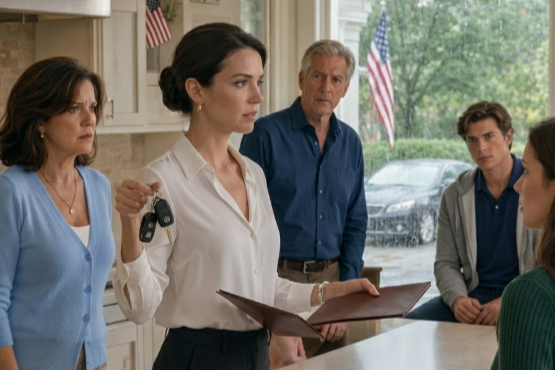
Mom came running outside.
Neighbors had begun appearing behind curtains and screen doors. Across the street, someone raised a phone.
“Everyone needs to come inside,” Mom said.
“No,” I replied.
She stopped.
I picked Grandma’s green box off the pavement.
“You have spent my entire life deciding what I’m allowed to know. We’re talking here.”
Dad pointed at Daniel.
“He is trying to turn you against us.”
“You already did that yourselves.”
Tyler appeared in the doorway, his ankle wrapped in ice.
Daniel looked at him, then back at Dad.
“This does not involve your son.”
“It involves my family.”
“It involves Emma.”
Mom began gathering certificates from the driveway.
Her hands shook.
“I’m sorry,” she whispered.
I watched her smooth a wrinkled debate award against her knee.
“Did you know Dad forged Daniel’s letter?”
She froze.
Dad spoke first.
“Be careful what you accuse people of.”
Daniel removed his phone.
“I still have the forensic report.”
Dad went silent.
Mom sat on the front step.
“At first, I believed the letter,” she said.
Her voice was barely audible.
“Robert told me Daniel had asked him to deliver it personally because he was too much of a coward to face me.”
Daniel stared at the ground.
“I was devastated. Then I realized I was pregnant.”
“You told Daniel I wasn’t his.”
Mom nodded, tears running down her face.
“Robert said Daniel would take you away.”
“Why would you believe that?”
“Daniel’s father was wealthy and powerful. Robert said they would use lawyers to prove I was unstable. He said I would never see you again.”
Daniel’s expression tightened.
“My father did not even know Laura was pregnant.”
“I didn’t know that,” Mom said.
“You could have asked me.”
“I was twenty-two and terrified.”
Her explanation sounded possible.
It did not sound sufficient.
“When did you learn the letter was forged?” I asked.
She looked toward Dad.
He answered for her.
“Years later.”
“How many?”
Mom wiped her face.
“You were six.”
The number struck harder than anything else.
For six years, she may have believed a lie.
For twelve more, she had chosen it.
“How did you find out?”
“Your grandmother gave me a box shortly before she became ill. It contained Daniel’s returned letters.”
“Why didn’t Grandma give them to you earlier?”
“She said Robert convinced her Daniel’s family was dangerous. Later, she began to suspect she had made a terrible mistake.”
Grandma Rose had died when I was fourteen.
That meant Mom had held those letters for eight years while Grandma was alive.
“You had Daniel’s letters,” I said. “You knew he hadn’t abandoned you.”
Mom began sobbing.
“I had a husband. Two children. A mortgage. I didn’t know how to destroy everyone’s life.”
“So you destroyed mine quietly instead.”
“I loved you.”
“You watched Dad treat me like an inconvenience.”
“He provided for you.”
“He humiliated me.”
Dad stepped forward.
“I put food on the table. I gave you my name.”
“You also knew I might not be yours.”
His silence confirmed it.
Tyler stared at him.
“Is that why you hated her?”
“I never hated her.”
“You called her graduation a loser’s parade,” Tyler said.
Dad turned on him.
“Don’t you start.”
Tyler removed the ice pack from his ankle.
“All you talk about is my basketball career. You made me believe she was jealous because she couldn’t do anything important.”
He looked at me.
“She did everything.”
Dad’s face darkened.
“You would be nothing without what I invested in you.”
Daniel’s gaze sharpened.
“What did you invest?”
Dad looked away.
The question seemed ordinary, but Mom’s reaction changed.
She went completely still.
Daniel noticed.
“Laura?”
Mom clutched the certificate in her hands.
“Robert, tell them.”
“Tell us what?” I asked.
Dad walked toward the house.
Daniel blocked his path without touching him.
“What did you use to pay for Tyler’s training?”
Dad’s nostrils flared.
“My money.”
“No,” Mom whispered.
Tyler looked between them.
“What is she talking about?”
Mom turned to me.
“After your grandmother died, she left a college account for you.”
I remembered Grandma telling me she had “put aside a little something.”
Whenever I asked about it, Mom said medical expenses had consumed the estate.
“How much?” I asked.
“Eighty-four thousand dollars.”
The driveway seemed to shift beneath me.
Dad had repeatedly told me we could not afford application fees, tutoring programs, or travel expenses for national competitions.
I had paid for my own university applications with library wages.
“What happened to it?”
No one answered.
Tyler did.
“My travel teams.”
Mom nodded.
“And the private coach. The summer camps. The car.”
Tyler looked toward the red sports car parked beside the garage.
Dad had given it to him on his seventeenth birthday.
I had received a twenty-dollar bookstore card.
“You stole her college fund for me?” Tyler asked.
“It was family money,” Dad snapped. “I allocated it where it had the best return.”
I had heard Dad discuss investments before.
He used the same tone when talking about stocks.
I looked at him.
“You considered Tyler a better return.”
“He had professional potential.”
“And I didn’t?”
“Books don’t make people special, Emma.”
Daniel’s composure finally broke.
“You took money left by a dying woman for her granddaughter and spent it trying to manufacture a professional athlete?”
Dad pointed at him.
“You don’t get to judge me. You disappeared with your family’s millions while I stayed and raised your mistake.”
The words hung in the air.
Mom covered her face.
Tyler stepped backward as if Dad had struck him.
My mistake.
Not daughter.
Not child.
Mistake.
Daniel moved toward Dad, but I stepped between them.
“No.”
Daniel stopped immediately.
That mattered.
Dad looked almost disappointed that he had failed to cause a scene violent enough to make Daniel appear dangerous.
I turned to Mom.
“Did you sign the withdrawal documents?”
She nodded.
“Some of them.”
“Some?”
“Robert signed the others.”
“The account required Emma’s authorization after she turned sixteen,” Daniel said.
Mom’s eyes widened.
Dad said nothing.
A cold certainty settled over me.
“You forged my signature.”
He folded his arms.
“You lived under my roof. Everything you had came from me.”
Daniel called his attorney.
By evening, I had packed two suitcases and moved into Nina’s guest room.
Mom stood on the porch begging me not to leave.
Dad remained inside.
Tyler carried my boxes to Nina’s car.
Before closing the trunk, he handed me his car keys.
“Sell it,” he said.
“What?”
“The car was bought with your money.”
“I don’t want it.”
“Neither do I.”
He placed the keys on top of my suitcase.
“I thought they gave it to me because they believed in me.”
He looked toward the house.
“Now it feels like they bought it by making sure you couldn’t leave.”
Three days later, the DNA results arrived.
The probability of paternity was 99.9998 percent.
Daniel Pierce was my biological father.
He read the result in his attorney’s office while sitting across from me.
For several seconds, he said nothing.
Then he covered his eyes with one hand.
His shoulders shook.
I had never seen a grown man cry so quietly.
“I’m sorry,” he said.
“For what?”
“For every birthday I missed, even though I didn’t know there was a birthday to miss.”
I moved around the desk and hugged him.
It felt awkward.
Unfamiliar.
Real.
He did not squeeze too tightly.
He did not call me his daughter before I was ready.
He simply held on.
PART 5 — THE FAMILY THAT SHOWED UP
The viral video changed my life in ways I had never anticipated.
By the end of the week, my speech had been viewed more than forty million times across several platforms.
Messages arrived from students, teachers, foster parents, grandparents, coaches, and strangers.
Some wrote about graduating without parents.
Others described weddings, hospital rooms, award ceremonies, and birthdays where the people they loved had failed to appear.
A national morning show asked to interview me.
I declined.
A publishing company offered to turn the speech into a gift book.
I declined that too.
The moment had been real.
I didn’t want to sell it before I understood it.
What I did accept was an invitation to work with the Pierce Foundation on a program for students facing family neglect or financial sabotage.
Daniel did not announce our biological relationship.
He allowed me to decide when and whether that information became public.
Unfortunately, Dad made the decision for us.
A week after graduation, he posted a long statement online accusing Daniel of using wealth and influence to “steal a vulnerable girl from the only father she had ever known.”
He called my speech calculated.
He said I had embarrassed my family for attention.
He claimed the empty seats were caused by a “previously scheduled athletic commitment,” leaving out the fact that the foundation had informed him months earlier that Daniel would attend.
Then he made the mistake that ended everything.
He wrote, Daniel Pierce has spent years obsessed with my wife and now intends to use Emma as revenge.
Reporters began investigating.
Daniel’s attorney released the forged breakup letter, the returned envelopes, the paternity results with my consent, and the email in which Dad called my graduation a minor local event.
The court filing regarding Grandma Rose’s missing college account became public shortly afterward.
Dad’s employer placed him on administrative leave.
He worked as a financial services manager.
A company that trusted him with client accounts could not ignore credible allegations of forgery and misuse of funds.
Mom called me twenty-seven times in two days.
I answered on the twenty-eighth.
“Your father is losing everything,” she said.
I was sitting in Nina’s backyard beneath a striped patio umbrella.
“You mean Robert?”
She inhaled sharply.
“He raised you.”
“He resented me.”
“He changed your diapers. He stayed up when you were sick.”
“He also stole from me and called me a mistake.”
“He was angry.”
“That sentence has excused his behavior my entire life.”
Mom began crying.
“I don’t know how to fix this.”
“You can start by telling the truth.”
“I have told the truth.”
“No. You have admitted the parts that became impossible to hide.”
She went quiet.
I looked across the yard at the white roses Daniel had sent after the DNA results. They stood in a glass vase on the patio table, their petals beginning to open.
“Why did you favor Tyler?” I asked.
“I love both of you.”
“That wasn’t my question.”
She sighed.
“Tyler was easier.”
“Because he was Dad’s?”
“Because celebrating him didn’t create conflict.”
There it was.
Every time she praised me, Dad became cold.
Every time I resembled Daniel—in my grades, my ambition, my face—Dad punished the reminder.
Mom had protected her marriage by teaching me to become smaller.
“You let me pay the price for your choices,” I said.
“I was trying to keep the family together.”
“A family held together by sacrificing one child is not a family.”
She had no answer.
“I’m not ready to see you,” I told her. “You need therapy. You need to cooperate with the financial investigation. And you need to stop asking me to rescue Robert from consequences he created.”
“He’s your father.”
“No. He’s the man who raised me. That should have meant something to him.”
I ended the call.
Two days later, Tyler arrived at Nina’s house carrying the green wooden box.
He had repaired the broken hinge and organized every certificate by date.
“You missed one,” he said, handing me a folded paper.
It was a drawing I had made in kindergarten.
Four stick figures stood outside a house.
Mom.
Dad.
Me.
And a baby labeled TYLER.
Above us, in uneven purple letters, I had written MY FAMILY LOVES EVERYONE.
“I found it under Dad’s desk,” Tyler said.
I stared at the drawing.
“Why are you here?”
“To give you the box.”
“That’s not what I mean.”
He sat on the patio step.
Without the expensive shoes, varsity jacket, and car keys, he looked younger than seventeen.
“I quit the travel team.”
“You love basketball.”
“I like basketball. Dad loves what basketball makes him feel.”
“You don’t have to quit because of me.”
“I didn’t quit because of you.”
He picked at a loose thread on his jeans.
“The scout thing was mostly a lie. One assistant from a small college emailed Coach months ago. Dad turned it into this huge story about multiple recruiters.”
“That sounds like him.”
“I’ve been pretending too.”
He looked up.
“My knee has been hurting since January. Dad knew. He made me keep playing because he said scouts wouldn’t wait for an injury.”
I sat beside him.
“Have you seen a doctor?”
“Mom’s taking me tomorrow.”
“That’s good.”
He nodded.
“I’m sorry I made fun of you.”
“You already apologized.”
“No. I said I was a jerk. That’s not the same.”
He took a breath.
“I watched the full speech again. When you talked about strangers applauding before family, I realized I had never once gone to your debate competitions.”
“You weren’t required to.”
“I was your brother.”
For years, I had imagined Tyler finally understanding.
I thought it would feel like victory.
Instead, it felt sad.
“You were a kid too,” I said.
“So were you.”
That was true.
We sat in silence.
Finally, he asked, “What is Daniel like?”
“Careful.”
“Careful?”
“He asks permission before doing things.”
Tyler smiled faintly.
“That must be weird for you.”
“It is.”
Daniel had offered me a room in his home.
I declined.
He offered to buy me a car.
I declined that too.
He did not become offended.
Instead, he helped Nina’s mother prepare a temporary rental agreement so I would feel like a resident rather than a charity case.
He also paid Nina’s family fair market rent for the room only after I agreed.
He never presented money as proof of love.
A month after graduation, the Pierce Foundation held a private reception for the scholarship winners.
I wore a simple navy dress and Grandma Rose’s silver pendant.
Daniel waited near the entrance.
“May I introduce you as my daughter?” he asked.
My throat tightened.
“Yes.”
His eyes filled, but he smiled.
When he led me into the room, people applauded.
This applause felt different from the graduation crowd.
It was not sympathy.
It was welcome.
Principal Harris attended.
Mrs. Alvarez came.
Mr. Coleman wore a suit that looked older than I was.
Nina filmed everything, of course.
Tyler came on crutches after minor knee surgery.
Mom did not attend.
Neither did Robert.
The foundation announced a new initiative called The Empty Seat Fund.
It would provide emergency grants, housing assistance, legal referrals, and mentoring for high-achieving students whose families withheld financial support or attempted to control them through money.
I had helped design it.
When Daniel invited me to speak, I walked to the podium.
This time, I did not look for empty seats.
Every chair was full.
PART 6 — WHAT HAPPENED AFTER THE APPLAUSE
Robert was charged with identity fraud, forgery, and unlawful withdrawal of protected funds.
His attorney negotiated a plea agreement that spared him prison, but he lost his job, surrendered his financial licenses, and was ordered to repay the college account with interest.
The sports car was sold.
Most of the money went into the restitution fund.
Tyler insisted.
Mom avoided criminal charges because investigators concluded that she had authorized only the withdrawals made before I turned sixteen. She cooperated with the case and filed for divorce six months later.
I did not celebrate their marriage ending.
Too much of my childhood had already been spent living inside the ruins of their decisions.
Mom began therapy.
For several months, our communication consisted of short emails.
She stopped defending Robert.
She stopped saying she had done everything out of love.
Instead, she began naming what she had done.
I was afraid.
I chose the easier child.
I protected my marriage instead of protecting you.
I allowed your achievements to make Robert uncomfortable, then treated his discomfort as more important than your happiness.
I am sorry.
The apology did not repair eighteen years.
But it was the first one that did not demand immediate forgiveness.
I eventually agreed to meet her at a quiet restaurant.
She looked older.
Not because of gray hair or wrinkles.
Because she no longer had Robert’s certainty to hide behind.
“I don’t expect you to call me every week,” she said. “I don’t expect holidays. I know I may never be the mother you needed.”
“You can’t change the past.”
“I know.”
“But you can stop lying about it.”
She nodded.
That became the beginning of something cautious.
Not reconciliation exactly.
Possibility.
My relationship with Daniel developed slowly too.
He attended orientation when I began college at Hawthorne University.
He carried boxes into my dorm until I reminded him that billionaires were probably not supposed to struggle with plastic storage bins.
“I’m a foundation chairman,” he said, breathing heavily. “Not a wizard.”
Tyler came with us.
His knee had healed, but he had decided not to pursue college basketball.
He enrolled in a physical therapy program at a community college and began coaching children at a neighborhood recreation center.
Without Dad narrating his life, Tyler discovered he was patient with younger kids.
He also discovered that he hated protein shakes.
On move-in day, he placed Grandma Rose’s green box on my desk.
“Try not to become unbearable now that you’re famous,” he said.
“I was unbearable before.”
“True.”
We hugged.
It was the first time we had done so without an adult forcing us.
Daniel stood near the doorway, pretending to inspect a bookshelf so we would have privacy.
Before leaving, he handed me a small envelope.
Inside was a photograph of him and Mom at the lake cabin.
On the back, he had written:
The past explains us, but it does not have to own us.
Beneath it was another photograph taken at the scholarship reception.
Daniel, Tyler, Nina, my teachers, and me stood together beneath a banner for the Empty Seat Fund.
I placed both pictures inside the green box.
My graduation speech eventually passed one hundred million views.
Schools began playing it at senior assemblies.
Teachers printed the final lines on classroom posters.
Students sent photographs of themselves sitting beside empty chairs representing people who had failed to support them.
But the message changed as it spread.
At first, everyone focused on the people who had not attended.
Over time, they began posting about those who had.
A bus driver who came to a student’s graduation after both parents forgot.
A nurse who attended the ceremony of a teenager she had cared for during cancer treatment.
A neighbor who worked a double shift, then drove three hours to watch a child receive a diploma.
A librarian.
A coach.
A foster parent.
A brother who arrived on crutches.
The Empty Seat Fund helped more than six hundred students during its first year.
Some needed application fees.
Some needed emergency housing after parents threw them out.
Some needed legal help accessing money that had been left to them.
Others simply needed an adult to sit in the audience.
I spent my first summer working at the foundation.
Daniel never placed me in an executive office.
I answered emails, reviewed grant applications, organized files, and made coffee like every other intern.
On the final day, he asked whether I resented that.
“No,” I said. “I would have resented being treated differently.”
He smiled.
“You are definitely my daughter.”
It was the first time he had said it casually.
Not in a press statement.
Not through tears.
Just a father teasing his child at work.
The words warmed a place inside me that I had kept guarded.
A year after my graduation, Lakeside High invited me back to speak to the next graduating class.
I almost declined.
I did not want to spend my life reenacting the night my parents failed me.
Then Principal Harris told me something.
A student named Jasmine would be graduating as salutatorian. Her parents had refused to attend because she planned to study environmental science instead of joining the family business.
“She watched your speech,” he said. “It helped her apply for college anyway.”
So I returned.
The football field looked smaller than I remembered.
Nina sat in the front row.
Tyler sat beside her.
Mrs. Alvarez and Mr. Coleman waved from the faculty section.
Mom sat near the back.
We had agreed beforehand that she could attend.
She held no sign.
She made no attempt to draw attention to herself.
She simply showed up.
Daniel stood near the aisle holding a bouquet of white roses.
When I reached the podium, I looked over the crowd.
“Last year,” I began, “I gave a speech about empty seats.”
The audience quieted.
“I believed the empty seats were the story. They weren’t.”
I looked at Jasmine, seated among the graduates.
“The story was every person who stood up.”
Daniel’s eyes shone.
Mom covered her mouth.
Tyler lifted his phone to record.
“There will be moments when people who should support you choose not to. Their absence may hurt. It may change you. But it does not have to define the size of your future.”
I paused.
“Family is not proven by a last name, a photograph, or a place at the breakfast table. Family is proven through action. It is the teacher who keeps food in her desk. The librarian who leaves the lights on. The friend who records your victories. The brother who learns to apologize. The parent who tells the truth even when the truth costs something.”
Mom lowered her head.
“And sometimes family is the man who spends eighteen years searching for an answer, then waits patiently for permission to become your father.”
Daniel wiped his eyes.
The crowd applauded.
I did not need the sound the way I had needed it the year before.
But I allowed myself to receive it.
After the ceremony, Jasmine found me beside the stage.
“My parents didn’t come,” she said.
“I’m sorry.”
She looked toward the bleachers, where her science teacher stood holding a sunflower bouquet.
“I thought it would ruin everything.”
“Did it?”
She considered the question.
“No.”
I smiled.
“That doesn’t mean it didn’t hurt.”
She nodded, tears filling her eyes.
Behind her, Daniel waited with the roses.
He never interrupted.
He never rushed me.
When Jasmine left, he handed me the bouquet.
“You were extraordinary,” he said.
The same words he had spoken the night we met.
This time, I smiled.
“You always say that.”
“I intend to keep saying it.”
We walked toward the parking lot together.
Mom remained near the fence.
For a moment, she looked uncertain whether she was allowed to approach.
I stopped.
Then I raised one hand.
Not a promise.
Not complete forgiveness.
An invitation to walk with us.
She came slowly.
Tyler and Nina joined from the other side.
None of us looked like the family in my kindergarten drawing.
That family had never truly existed.
But as we crossed the field beneath the stadium lights, I realized something better had taken its place.
Not a perfect family.
Not an unbroken one.
A truthful one.
And for the first time in my life, when I looked behind me, there were no empty seats I needed anyone to fill.