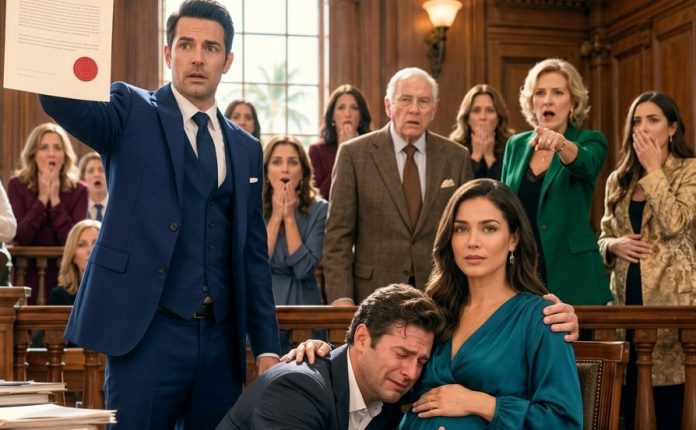
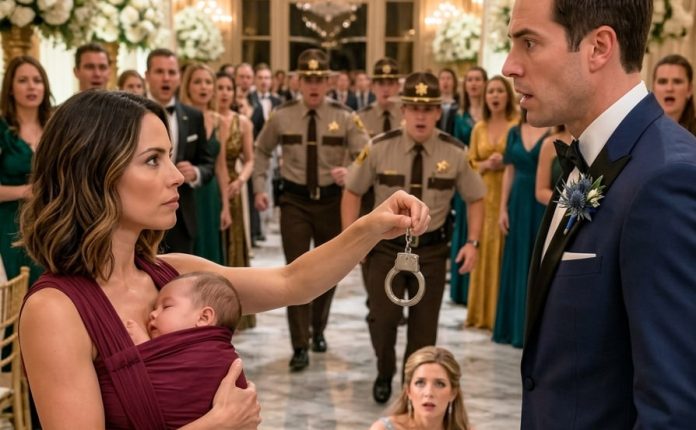
Downstairs, guests watched as the country club staff cleared tables that had never served dinner. The white roses disappeared one arrangement at a time. The room did not become ugly. That would have been easier. It remained beautiful in patches, which somehow made the emptiness worse. A half-decorated dream is more painful than a ruined one because you can still see what it was supposed to be.
By seven that evening, the Grand View ballroom was nearly empty.
The guests had gone home confused, hungry, and full of a story they would repeat for years. Derek had left in his car after a final argument in the parking lot. Scarlet had locked herself in the bridal suite wearing a wedding dress she would never walk down the aisle in.
And I was across town at a quiet restaurant with my phone face-down beside my plate.
The waiter brought me a steak cooked exactly the way I liked it. For the first time all day, someone asked me what I wanted and waited for the answer.
That nearly undid me.
I had thirty-seven missed calls and sixty-two text messages by the time dessert arrived.
I did not open them.
Three weeks later, I was loading the last box into a moving truck when Mrs. Henderson from next door came across the lawn with a concerned expression and a casserole dish covered in foil.
Mrs. Henderson was seventy-eight and had known Scarlet since she was little. She had brought us dinners after Sarah died. She had seen me walking the driveway at midnight with a crying child on my shoulder. She had watched Scarlet grow from a girl who slept with her mother’s sweater into a woman who thought elegance could hide shame.
“Charles,” she said, “that girl has been by here every day since Tuesday.”
I lifted a box of kitchen supplies into the truck.
“I know.”
“She looks just like Sarah around the eyes when she cries.”
That sentence landed gently and still hurt.
“If she comes again,” I said, “tell her I’ve moved.”
Mrs. Henderson’s face tightened. “Should I tell her where?”
“No.”
“Charles.”
I turned to her. “Helen, I love my daughter. But love is not the same as access.”
She looked at me for a long moment, then nodded slowly.
“Sometimes,” she said, “children don’t understand what a parent has given until they have to live without it.”
“I’m afraid Scarlet is learning that now.”
I moved to Cedar Falls, two hours away, into a smaller house near a lake. The house had less space, fewer memories, and no room where Sarah’s jewelry box had once sat waiting to accuse me. I retired from full-time work and started repairing old furniture in the garage because wood, unlike people, tells you exactly where it is damaged if you know how to look.
For months, Scarlet wrote.
At first, the letters came weekly. I did not read the first three. I placed them in a drawer. The envelopes sat there, her handwriting slanted across my name.
Dad.
Not Charles.
Not Mr. Whitmore.
Dad.
Eventually, I opened one.
I’m sorry was the first line.
The rest was messy. Too many explanations. Too much grief. Too many sentences beginning with “I didn’t know.” I set it aside.
“I didn’t know” can be true and still not enough.
She wrote again.
I should have known.
That letter I finished.
She wrote about finding the tag. About Marcus showing her the contracts. About Derek. About realizing that every time I offered help, she had let Derek make me feel small because it was easier than confronting the fact that she was embarrassed by the life we came from. She wrote that she had spent years trying to look like she belonged in Derek’s world and had failed to notice that I had been the only person who never made her earn her place in mine.
I cried after that one.
Not because I forgave her.
Because I heard my daughter in it.
Six months later, she found me.
It was not dramatic. She did not appear in the rain or collapse on my porch. She called Mrs. Henderson repeatedly until the old woman finally took pity and mailed her a return address from a Christmas card I had sent. Scarlet drove to Cedar Falls and waited outside the small coffee shop near the lake because, according to the barista, I came in every Thursday at ten.
When I walked in, she stood from a corner table.
I almost turned around.
She looked thinner. Older. Not in years, but in certainty. Her hair was shorter. She wore jeans and a plain gray sweater, no expensive coat, no polished performance. On the table in front of her sat a manila envelope.
“Dad,” she said.
The word nearly broke me.
I sat across from her because I had imagined this moment too many times not to meet it when it came.
For a while, neither of us spoke.
The coffee shop smelled like cinnamon and roasted beans. Outside, the lake was gray under a winter sky. A waitress moved between tables, refilling mugs, unaware that one small corner held the remains of a family trying to decide whether anything living still grew under the ash.
Scarlet pushed the envelope toward me.
“I’m not asking you to forgive me today,” she said.
That was the first thing she had said in months that did not feel like a plea.
I looked at the envelope but did not touch it.
“What is it?”
“Part of what I owe you.”
I opened it.
Inside was a cashier’s check.
Forty-seven thousand dollars.
Plus interest.
I looked up.
Scarlet’s eyes filled, but she did not cry. Not yet.
“I got a job,” she said. “Two, actually. I sold the condo Derek convinced me to rent. I moved into a studio. I’ve been paying off debts. I know money doesn’t fix it.”
“No,” I said. “It doesn’t.”
She nodded. “But I took it. Even without knowing all of it, I took it. I let myself live inside a lie because it was comfortable.”
I looked at the check.
For months, I had imagined anger carrying me through this conversation. Instead, what I felt was tired sorrow, and under it, something fragile I did not trust yet.
“Why now?” I asked.
She reached into her purse.
This time, she placed a small blue velvet box on the table.
My breath caught before she opened it.
Sarah’s pearls lay inside, softly luminous against the fabric.
For several seconds, I could not move.
The coffee shop blurred.
“I found the broker you sold them to,” Scarlet said. Her voice shook now. “It took time. He had sold them to a private collector. I wrote letters. I offered more than they were worth. I told them they belonged to my mother, and that my father had sold them because of me.”
I touched the edge of the box.
The pearls were warm from her hand.
“I’m sorry,” she whispered. “Not because the wedding ended. Because you had to sell her for me, and I let someone make you feel unwanted in the room she should have been standing in.”
That was when I cried.
Quietly. Embarrassingly. Like an old man in a coffee shop who had run out of ways to hold grief politely.
Scarlet did not reach for me. She seemed to understand that comfort, like forgiveness, was not something she could take just because she wanted it.
After a while, I closed the box.
“Your mother loved those pearls.”
“I know.”
“She wanted you to have them someday.”
Scarlet looked down. “I don’t deserve them.”
“No,” I said.
She flinched.
“Not yet.”
Her eyes lifted.
I held the box between us. “But someday, maybe. If we get there honestly.”
A tear slipped down her cheek. “I’ll wait.”
I believed her then.
Not completely. Trust is not a switch. It is a road built slowly, plank by plank, and some boards need replacing more than once. But I believed that she was no longer trying to escape the consequences of what she had done. That mattered.
We did not hug that day.
We talked for an hour. About her work. About Derek leaving town after his business story finally collapsed under questions he could not answer. About Jessica, who had remained her friend. About Mrs. Henderson, who apparently had been reporting to Scarlet that I looked “too thin” and needed to eat more.
At the end, Scarlet stood.
“Can I write you again?” she asked.
“Yes.”
“Can I call?”
I thought about it.
“Once a week,” I said. “Sunday afternoons. If I don’t answer, you wait.”
She nodded. “Okay.”
“And Scarlet?”
She looked at me.
“No more secrets dressed up as surprises.”
Her mouth trembled. “No more.”
A year passed.
Then another.
We built something new, though not the thing we had lost. That was important. People love the idea that a family can return to what it was before the injury. I do not believe that anymore. Some doors close. Some rooms burn. You do not move back into ashes and call it healing.
You build somewhere else.
Scarlet kept working. She paid the check. She never asked me to give back the trust changes. She visited Cedar Falls twice a month, at first for coffee, then for dinner, then to help me sand old chairs in the garage. She learned to listen without defending herself. I learned to speak without storing every sentence as proof for a future goodbye.
One Sunday, she came with a small box of photographs she had found while cleaning out her storage unit.
We sat at my kitchen table, sorting through them. Scarlet as a child in a red coat. Sarah holding a birthday cake. Me, younger and darker-haired, standing behind them with one hand on each of their shoulders.
Scarlet stopped at one photo.
It was Sarah wearing the pearls.
My wife was laughing at something outside the frame. Not posing. Not perfect. Just alive.
Scarlet touched the edge of the picture.
“I wish she could have been there,” she said.
“At the wedding?”
She nodded.
I looked at the photo for a long time.
“Part of her was,” I said.
Scarlet’s eyes filled.
I stood, went to the small safe in the hallway closet, and returned with the blue velvet box.
Her breath caught.
“Dad—”
I placed it on the table between us.
“I’m not giving these back because everything is fixed,” I said. “It isn’t. I’m giving them to you because your mother wanted them to belong to her daughter. And because you returned them before asking for them.”
Scarlet covered her mouth.
“But,” I said gently, “you do not wear them as proof that the past is erased. You wear them as a reminder that love can be wasted if it is not respected.”
She nodded, crying openly now.
“I understand.”
“I hope you do.”
She opened the box with both hands.
The pearls caught the kitchen light.
For a moment, Sarah felt very near.
Not because a necklace can bring back the dead. It cannot. But memory lives in objects sometimes, and in that small quiet room, between a father and daughter who had both paid dearly for the truth, the pearls no longer felt like something sold. They felt like something returned.
Months later, Scarlet invited me to dinner.
Not a celebration. Not a performance. Just dinner at her apartment. She cooked pasta from a recipe Sarah used to make, though she burned the garlic and apologized three times. I told her burned garlic was practically a family tradition if she counted my early years as a widower.
She laughed.
It sounded like the old Scarlet for one second, and then like the new one.
After dinner, she walked me to my car. The night was cool. Her building sat on a quiet street with maple trees and porch lights. She hugged herself against the wind.
“I used to think you embarrassed me,” she said suddenly.
I turned toward her.
She looked ashamed, but she did not look away.
“I hate admitting that. But I did. Not because of you, really. Because Derek made everything feel like a test. The right clothes. The right venue. The right family. The right story. And I started measuring you with someone else’s ruler.”
I said nothing.
She swallowed.
“But you were the only person who never made me audition for love.”
The words entered me slowly.
“I wish you had known that before the wedding.”
“Me too.”
Another silence.
Then she said, “I’m sorry I didn’t save you a seat.”
I looked at her.
That apology was different from all the others. It did not explain. It did not excuse. It named the wound.
I nodded.
“So am I.”
We stood there a little longer, father and daughter under the porch light, neither of us pretending the past had become beautiful just because we had survived it.
The next spring, Jessica got married.
Scarlet was invited. So was I, oddly enough, because Jessica had become something like a bridge between the life before and the life after. The ceremony was small, held in a garden behind a historic inn. White chairs stood in rows on the grass. No chandeliers. No country club. No performance pretending to be love.
When I arrived, Scarlet met me near the entrance.
She wore a blue dress and Sarah’s pearls.
For one second, my chest tightened.
Then she smiled, nervous but steady.
“I saved you a seat,” she said.
She led me to the front row.
Not beside her because she was not the bride. Not in a place of honor for show. Just a real seat, chosen deliberately, with my name printed on a small card.
Charles Whitmore.
No joke.
No cruelty.
No hidden meaning.
Just my name.
I sat down.
Scarlet sat beside me.
During the ceremony, she reached for my hand. I let her take it.
Her fingers trembled once, then settled.
I thought about Grand View Country Club. The hallway. The label. The look on the planner’s face. The phone calls. The contracts. The empty ballroom. The velvet box. The check. The long road back.
I did not feel triumph.
That surprised me.
Revenge sounds satisfying when you imagine it from the wound. But real healing is quieter. It does not roar. It sits beside you in a garden, holding your hand without assuming it has the right.
After the ceremony, Scarlet and I stood near the edge of the reception lawn while guests laughed under string lights. She looked toward the dance floor, then back at me.
“Do you ever wish you hadn’t canceled everything?” she asked.
I thought about it.
“No.”
She nodded.
“I don’t either,” she said.
That made me look at her.
Her eyes were wet, but her voice was clear.
“If that wedding had happened, I would have married Derek. I would have learned the truth later, maybe after more damage. You stopping it hurt. But it stopped me too.”
The band began playing softly behind us.
A real band this time. Paid by people who wanted them there.
“I didn’t do it to save you,” I said.
“I know.”
“I did it because I finally decided not to pay for my own humiliation.”
“I know that too.”
She took a breath.
“But it saved me anyway.”
I looked across the lawn at the lights moving in the evening breeze. Somewhere, Sarah would have understood the strange shape of it all. Pain, consequence, mercy arriving late and dressed nothing like we expected.
“Then maybe something good came from it,” I said.
Scarlet leaned her head briefly against my shoulder.
“Maybe.”
We stayed that way for a moment, not fixed, not finished, but present.
That was enough.
People sometimes ask whether I forgave Scarlet.
I never know how to answer that simply.
Forgiveness, to me, was not a single generous moment where I opened my arms and declared the debt erased. It was a hundred smaller choices. Answering the Sunday call. Letting her come for dinner. Telling her the truth when it would have been easier to remain noble and silent. Accepting the check. Touching the pearls again. Sitting beside her at someone else’s wedding without flinching.
It was also boundaries.
It was the trust remaining changed.
It was my house staying mine.
It was knowing I could love my daughter and still never again allow my love to become someone else’s invoice.
Derek faded from our lives the way men like him often do when attention no longer feeds them. I heard once that he had moved to Denver and started calling himself a consultant. I hoped, for the sake of anyone who listened, that they checked his references.
Grand View Country Club sent a formal apology months later after Jessica, bless her fierce heart, wrote a letter to their management about what happened with the prop. The planner, whose name was Amelia, had already left for another job. She sent me a handwritten note.
Mr. Whitmore,
I have never forgotten your dignity that day. I am sorry I could not protect you from what someone else arranged. I hope you know at least one person in that room saw you clearly.
I kept that note.
Sometimes the smallest witness matters.
I still live in Cedar Falls. I still repair furniture in the garage. Scarlet still comes on Sundays when she can. Sometimes we talk about Sarah. Sometimes we talk about nothing important. Sometimes we sit in silence, and unlike the old silence, this one does not punish.
The pearls are in Scarlet’s possession now. She does not wear them often. When she does, she touches them lightly, as if checking not whether they are there, but whether she is worthy of what they mean.
Last month, she brought over a chair she had found at a flea market. The wood was scratched, one leg wobbled, and the seat needed replacing.
“I thought maybe we could fix it,” she said.
We carried it into the garage together.
I turned it over on the workbench and tested the frame.
“It has good bones,” I said.
Scarlet smiled a little. “Can it be saved?”
I looked at my daughter across the old chair, at the woman she had been, the woman she was trying to become, and the father I had become because I finally walked out of a room that had no seat for me.
“Yes,” I said. “But not by pretending it was never broken.”
She nodded.
Then she picked up the sandpaper and started working beside me.
That is where we are now.
Not at the wedding that collapsed.
Not beside the hallway.
Not under the tag.
Here.
In a garage full of sawdust and late afternoon light, repairing something damaged with patient hands, both of us old enough at last to understand that love is not proven by what you endure.
Sometimes love begins again the moment you stop paying for the places that refuse to make room for you.