The Wedding Seat Nobody Wanted
The moment the wedding planner stopped beside the back hallway instead of the front row, I knew someone had decided exactly where I belonged.
Grand View Country Club had never looked more beautiful. White roses spilled from the ends of polished wooden rows. Crystal chandeliers caught the afternoon light and threw it across the ceiling in soft gold. A string quartet played near the arched windows, the music elegant and careful, the kind of music people choose when they want a room to feel more expensive than it already is.
I had arrived thirty minutes early.
That was what fathers did on their daughters’ wedding days. They arrived early. They checked their tie in the rearview mirror. They carried tissues in their jacket pocket even if they told themselves they would not cry. They smiled at old relatives, nodded at vendors, and waited for the moment when their little girl appeared in white.
I had pressed my navy suit twice that morning. I had polished my shoes until the kitchen light reflected in them. I had stood alone in the hallway of my house with my hand resting on the framed photo of my late wife, Sarah, and whispered, “I’ll stand there for both of us.”
Now I was standing beside a silver utility bin near the restrooms while a wedding planner stared at her clipboard, her face losing color.
“I’m sorry,” she said. Her voice dropped until it was barely above the music. “There must be a mistake.”
I looked where she was looking.
A cheap folding prop chair had been placed beside the utility bin, half hidden behind a potted plant as if someone wanted the cruelty visible only after it was too late to pretend. A small handwritten tag had been taped to the chair back. The letters were slanted and dark, written by someone who had taken their time.
The guest nobody wanted.
For a few seconds, I heard nothing. Not the quartet. Not the guests murmuring behind us. Not the faint clink of glasses from the reception room. Just those four words, repeating themselves in a silence so complete it felt as if the room had stepped away from me.
The planner looked mortified. She was young, maybe early thirties, sharp suit, neat hair, headset tucked against her cheek. She had greeted me at the entrance with a professional smile and said, “You must be the father of the bride. Let me show you to your seat.”
The father of the bride.
There was supposed to be a seat for that.
Not because I cared about tradition for its own sake. Not because I needed attention. But because a father who raised his daughter alone from the age of eight does not expect to be hidden beside a hallway on the day she begins a new life.
Behind us, a few guests noticed. I felt the shift before I saw it. A pause in conversation. A turn of heads. Someone from Derek’s side of the family whispered something, and another person covered a laugh with a cough. Derek’s aunt Patricia lowered her champagne glass and smiled as if she had been waiting for me to find the punchline.
The planner reached toward her headset. “Sir, I can fix this. I’ll get you a proper seat. This is completely unacceptable.”
I should have been angry. I should have asked for Derek. I should have demanded to see Scarlet.
But the strange thing about deep hurt is that sometimes it arrives so cleanly it leaves no room for noise.
I looked at the front row, where the groom’s family sat in beautiful suits and pale dresses. I looked at the empty chair near the aisle where a father should have sat. I looked at the roses, the chandeliers, the stage, the guests who had begun pretending not to watch.
Then I looked back at the tag.
The guest nobody wanted.
Derek might have written it. Derek might have laughed when he thought of it. Derek’s relatives might have helped place it. But Scarlet had walked through this venue. Scarlet had approved seating. Scarlet had known where I would be.
That was the part that broke through everything else.
Not the prop. Not the cheap little label. Not the people smirking.
My daughter had let it stay.
I adjusted my tie with hands I was proud were steady.
“It’s all right,” I told the planner.
Her eyes lifted to mine, full of apology.
“No,” she said softly. “It isn’t.”
I gave her a small smile. Not a happy one, but a real one. “I understand perfectly.”
Then I turned and walked out.
No one stopped me.
The string quartet kept playing as if nothing had happened, as if music could make cruelty tasteful.
Outside, the country club driveway curved under the late afternoon sun. Valets moved quickly around black sedans and polished SUVs. Guests hurried toward the entrance with satin wraps over their arms and gift bags swinging from their wrists. The white columns of the club stood behind me, bright and proud, holding up a celebration I had paid for in ways my daughter did not even know.
I walked to my old Lincoln parked near the far edge of the lot.
Not because I had been assigned the far edge. Because I had arrived early and left the nearer spaces for guests.
That thought almost made me laugh.
Even in humiliation, I had been considerate.
I got into the car, closed the door, and sat with both hands on the steering wheel. For three full minutes, I did not move.
The heat inside the car was gentle, trapped from the afternoon sun. My reflection in the rearview mirror looked older than it had that morning. Silver hair neatly combed. Navy suit. Burgundy tie Sarah would have liked. A man trying very hard not to become small in a moment designed to make him exactly that.
My name is Charles Whitmore. I was sixty-one years old the day my daughter’s wedding taught me the difference between sacrifice and surrender.
I had raised Scarlet alone after Sarah died from a long illness when Scarlet was eight. For months after the funeral, my daughter slept with Sarah’s blue cardigan under her cheek. She would wake in the middle of the night and call for her mother, then cry harder when she remembered the answer before I reached her bedroom.
I learned to braid hair from a neighbor. I learned which socks did not itch. I learned the difference between a school permission slip and a medical form, between a real fever and a child trying to avoid a math quiz, between teenage silence and teenage heartbreak. I worked two jobs for a while. I packed lunches at dawn. I sat through dance recitals with my shirt still smelling faintly of the hardware store where I worked weekends.
Scarlet was my whole world.
Not in a poetic way. In the daily way. In the way a child becomes the center of your schedule, your money, your fear, your hope, and every prayer you whisper while driving home from late shifts.
When Derek came into her life, I tried to like him.
That is the honest truth.
He was handsome, polished, and careful with his manners when he wanted something. He wore fitted suits and expensive watches. He shook my hand with just enough firmness to suggest confidence and just enough distance to suggest he did not consider me his equal. Scarlet adored him in the way people adore someone they think will elevate them. Around Derek, she stood straighter, laughed differently, and watched my reactions too closely.
The first time she brought him to dinner, I made pot roast because it had always been her favorite.
Derek looked around my modest dining room and said, “This is cozy.”
Not warm. Not lovely.
Cozy.
Scarlet shot him a look. He corrected himself quickly. “I mean that in the best way.”
I pretended not to notice.
That became the pattern.
I pretended not to notice when Derek called my neighborhood “quiet” with the same tone he used for old carpeting. I pretended not to notice when his parents asked what I had done for a living and changed the subject after I said I had managed a warehouse and later a maintenance supply company. I pretended not to notice when Scarlet stopped asking me for advice and started saying, “Derek thinks…” before every decision.
When they got engaged, she called me in tears.
“Dad,” she said, breathless. “He proposed.”
I sat down at the kitchen table because my knees went weak, not from sadness, but from the sudden rush of years. Scarlet with missing front teeth. Scarlet in a yellow raincoat. Scarlet crossing a graduation stage. Scarlet asking if her mother would know she was in love.
“That’s wonderful, sweetheart,” I said. “I’m so happy for you.”
“We’re thinking spring,” she said. “Something elegant. Something really beautiful.”
“Whatever you need,” I told her. “I’ve been saving for this day since you were little.”
At the time, I meant money.
I did not realize I had also been saving trust.
Over the next few months, every attempt I made to be involved was brushed aside. When I suggested a photographer who had done beautiful work at my neighbor’s daughter’s wedding, Derek smiled and said, “We’re going with someone more elevated.” When I asked about flowers, Scarlet said, “Don’t worry, Dad, it’s handled.” When I offered to help with seating, Derek chuckled.
“We’ll find somewhere for you, Charles.”
Somewhere.
I remembered that word now, sitting in the country club parking lot with the steering wheel beneath my palms.
Six months before the wedding, Derek had come to my house alone.
It was raining that evening. I remember because his coat was dry when he arrived, meaning he had parked close to the porch or sat in his car until the rain slowed. He stood in my kitchen with his hands wrapped around a mug of coffee he never drank and gave me his most sincere expression.
“Charles,” he said, “I need to be honest about something.”
I leaned back in my chair. “All right.”
“The wedding Scarlet wants is beyond my current means.”
That did not surprise me. Grand View Country Club, white roses, live music, premium catering — it was more than a young couple should reasonably spend, even with two families helping.
“I don’t want to disappoint her,” Derek continued. “She’s dreamed about this for years.”
“She has.”
He lowered his voice. “My family can contribute some, but not enough. I have a business deal coming through later this year, and once that closes, I’ll be in a much stronger position. But right now…”
He let the sentence hang. He was good at that. Good at making silence feel like opportunity.
“What are you asking me?” I said.
“If you could cover some of the major expenses temporarily, I would be grateful. Venue. Catering. Maybe the band. I’ll pay you back once the deal closes.”
I did not answer immediately.
Derek leaned forward. “Scarlet doesn’t need to know. She’s proud. You know how she is. She’d feel guilty.”
He said that last part as if he knew my daughter better than I did.
Looking back, I can see every thread of the manipulation. But at the time, all I heard was a young man admitting he needed help to give my daughter the day she wanted. I had spent half my life stepping between Scarlet and disappointment. This felt like one more thing a father quietly did.
So I agreed.
The first payment was the venue deposit. Then catering. Then flowers. Then photography. Then the band.
Derek always had an explanation. The business deal was delayed. His family had a short-term liquidity issue. Scarlet had her heart set on the string quartet, and wouldn’t it be a shame to cut it now?
I liquidated part of my retirement account. I took a second mortgage on my house. And then, when the florist invoice came higher than expected, I opened the small safe in my bedroom and took out Sarah’s jewelry.
Her pearl necklace sat in a blue velvet box, the one she wore in our tenth anniversary picture. I had planned to give it to Scarlet the morning of her wedding. I pictured placing it in her hands and saying, “Your mother should be here. Since she can’t, wear this.”
Instead, I sold it.
I told myself Sarah would understand.
I told myself love sometimes looks like loss you never mention.
I told myself a father sacrifices quietly.
Sitting in the car outside Grand View, I finally said the truth aloud.
“I sold the last piece of Sarah for a room where they placed me beside a utility bin.”
My voice did not break.
That made it worse.
My phone was in my hand before I remembered picking it up. I scrolled until I found Marcus, the wedding coordinator Derek’s family had recommended. Marcus answered on the second ring, upbeat and rushed.
“Charles, how’s the father of the bride feeling today?”
I looked through the windshield at the white columns.
“Marcus,” I said, “I’m withdrawing authorization for every final payment in my name.”
Silence.
Then papers rustled. “I’m sorry?”
“The band. Catering. Flowers. Photography. Anything awaiting final release from my account is no longer authorized.”
“Sir, the ceremony is about to begin.”
“I know.”
“The vendors are set up. The food is prepared. The quartet is playing.”
“Then they should be paid for time already rendered and instructed to pack.”
Another pause, longer this time.
“Charles, there must be some misunderstanding.”
“There was,” I said. “I misunderstood my place in my daughter’s wedding.”
His voice lowered. “Sir, whatever happened, I’m sure we can fix it.”
“No. My daughter and her fiancé made it very clear that I am not welcome at this celebration. If I’m not welcome, my money is not either.”
“Mr. Whitmore—”
“Check the contracts, Marcus. Every major payment came from Charles Whitmore. Not Derek. Not Derek’s family. Me. I’ve reviewed the terms. Final authorization remains mine. I am not authorizing final service.”
I could hear him breathing now. Not panicking, not yet, but close.
“This will create chaos.”
“Yes,” I said. “It will.”
The calm in my own voice surprised me. Not because I was heartless. Because I had reached the place beyond pleading.
Marcus tried twice more to talk me out of it. I thanked him for his professionalism and ended the call.
Then I called the catering manager directly. Melody had been kind during planning, even though she probably knew more than she said.
“Mrs. Lane,” I told her, “this is Charles Whitmore. I need you to stop service for the Whitmore wedding. Your staff should be compensated for preparation and time on site, but no dinner is to be served under my authorization.”
She went quiet.
“I’m very sorry,” she said at last.
“So am I.”
Next was Harmony Strings. The quartet Scarlet had always wanted. I told them to finish the current piece and pack their instruments. They would be paid for the hour. Their services were no longer required.
Then Petals and Pearls, the florist.
I could hear the woman on the other end take a breath when I explained.
“Mr. Whitmore, are you sure?”
I looked at the country club entrance as two more guests walked in laughing.
“I have never been more sure.”
By the time I made the last call, my phone had begun lighting up.
Derek.
Scarlet.
Unknown number.
Marcus again.
I watched the names appear and disappear.
For most of my life, I answered when Scarlet called. Fever at school. Flat tire. Bad date. College panic. Lease questions. Tax forms. Engagement excitement. I answered because fathers do.
This time, I placed the phone face-down on the passenger seat and started the car.
I did not drive home.
If I went home, I would see Sarah’s empty jewelry box. I would see Scarlet’s childhood photos. I would sit in the kitchen and let grief talk me into forgiveness before truth had finished speaking.
So I drove to Thompson and Avery, the law office that had handled my estate documents for years.
Robert Thompson was still at his desk when I arrived. He was older than me by a decade, gentle in the way men become when they have seen too many families mistake paperwork for love.
“Charles,” he said, standing. “I thought you were at the wedding.”
“I was.”
He looked at my suit, my face, the phone vibrating silently in my hand.
Then he closed his office door.
“What happened?”
I told him enough.
Not every detail. Not the tag yet. I could not say those words in that room. But I told him I needed to revise my estate plan. Immediately.
“Are you certain?” he asked.
“No,” I said honestly. “But I am certain I need to stop leaving my life in the hands of people who think I exist to be used.”
Robert nodded slowly.
We did not remove Scarlet entirely. That was the thing people later misunderstood. I was wounded, not cruel. Robert helped me shift the estate into a trust with conditions. Education funds for any future grandchildren. A donation to the hospice foundation Sarah had loved. A smaller protected share for Scarlet, inaccessible to Derek or any spouse. The house would no longer pass automatically into her control. The retirement account that remained would not be available for someone else’s dream.
It was not punishment.
It was protection.
My phone buzzed across the desk.
Again.
Again.
Derek’s name appeared seven times before Scarlet’s came back.
Robert watched me sign the first page.
“You don’t have to decide everything today,” he said.
“I know.”
I signed the second page.
My hand was steady.
At that exact time, as I later pieced together from voicemails, vendor calls, and Scarlet herself, the wedding began unraveling upstairs in the bridal suite.
Scarlet had been seated at a vanity in front of a mirror framed by soft bulbs. Her hair was pinned in loose waves. Her makeup artist had just uncapped a lipstick. Bridesmaids were taking pictures near the window, their dresses pale champagne. Everyone was laughing.
Then Marcus entered without knocking.
He was pale, sweating through his collar, a leather contract folder under one arm.
“Miss Whitmore,” he said. “We have a serious issue.”
Scarlet did not look up at first. “If this is about the guest count, talk to Derek.”
“It’s about your father.”
That made her turn.
According to Jessica, her maid of honor, Scarlet’s expression changed from irritation to confusion in half a second.
“What did he do?”
Marcus did not answer that directly. He placed the folder on the vanity.
The soft thud of leather against glass stopped the room.
“Your father has withdrawn payment authorization for several major services.”
Scarlet laughed.
I know because Jessica told me, voice trembling with disbelief, that Scarlet actually laughed. Not because she found it funny, but because the sentence did not fit the story she had been told.
“My dad doesn’t control any of this,” Scarlet said. “Derek’s family is paying for the wedding.”
Marcus opened the folder.
“Ma’am,” he said carefully, “every major contract lists Charles Whitmore as payer.”
The makeup artist lowered the lipstick.
One bridesmaid stopped recording.
Jessica stepped closer.
Scarlet stared at the pages, then shook her head. “No. That’s not right.”
Marcus turned the first contract toward her.
Venue deposit. Charles Whitmore.
Catering. Charles Whitmore.
Floral design. Charles Whitmore.
Photography. Charles Whitmore.
Harmony Strings. Charles Whitmore.
Scarlet’s hand moved to the edge of the vanity as if the floor had shifted.
“What do you mean my father paid for this?”
Derek arrived minutes later, breathless and irritated, tuxedo jacket open, phone in hand. He looked first at Scarlet, then at Marcus, then at the folder.
That was when, Jessica said, Derek went white.
Not pale. White.
Scarlet turned toward him slowly. “You told me your family handled it.”
Derek lifted both hands. “I can explain.”
“What did you tell him?”
“It was temporary.”
“What did you tell my father?”
“Scarlet, this is not the time.”
She stood in her wedding dress, lipstick still uncapped in one hand.
“It is exactly the time.”
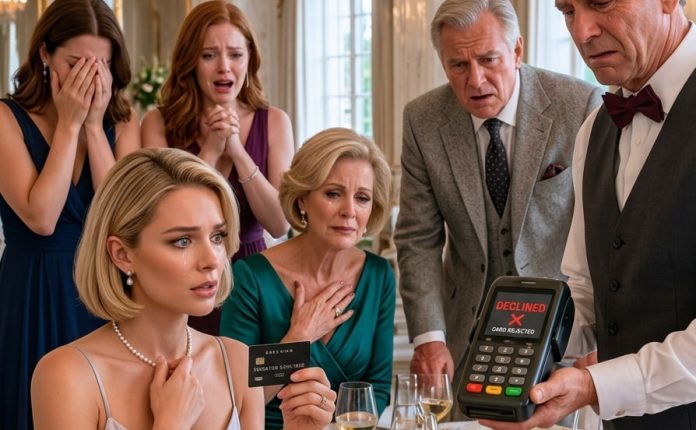
Downstairs, the quartet finished the piece they had been playing and began putting their instruments away. Guests looked around, confused. A florist removed white roses from a side table, then another from the aisle arrangement. Catering staff rolled covered trays back toward the service entrance. At first, people thought it was a delay. A supply issue. A timing problem.
Then the whispers began.
Where’s the music going?
Why are they moving the flowers?
Has anyone seen the bride’s father?
Patricia, Derek’s aunt, marched toward Marcus near the ballroom entrance. “What is happening?”
Marcus kept his face professional. “There has been a change in service authorization.”
“A what?”
“The contract holder has withdrawn final authorization.”
“Who is the contract holder?”
Marcus hesitated.
He should not have. But I understand why he did.
“Mr. Charles Whitmore.”
The name moved across the room faster than any announcement could have.
Charles Whitmore.
The old man.
The guest nobody wanted.
The man they had seated beside a hallway.
The man paying for every chair in the room.
Upstairs, Derek’s mask had begun to crack.
“I was going to pay him back,” he said.
“With what?” Scarlet asked.
“My deal was supposed to close.”
“What deal?”
He looked away.
“What deal, Derek?”
No answer.
That silence became its own confession.
Jessica told me Scarlet looked at him then as if seeing a stranger in a familiar suit.
“How much?” she asked.
Derek rubbed his forehead. “I don’t know exactly.”
“How much did my father pay?”
Marcus answered quietly from the doorway.
“Approximately forty-seven thousand dollars in major vendor payments and deposits.”
Scarlet sat back down.
For a moment, no one spoke.
Forty-seven thousand dollars.
That number did not include the second mortgage. It did not include retirement losses. It did not include Sarah’s necklace, because some costs do not appear in contracts.
Derek tried to recover. Men like him often do. They mistake exposure for negotiation.
“Okay,” he said. “We call him. We apologize. We tell him it was a misunderstanding. He’ll calm down. He loves you. He’ll pay. He always does.”
Scarlet looked up.
“What did you say?”
Derek did not hear the danger in her voice.
“Your father is emotional. You know that. You should have managed him better. I told you he was going to be a problem.”
Jessica said the bridal suite went quiet enough to hear the air system humming.
“Managed him?”
“Scarlet, don’t twist this.”
“My father?”
Derek exhaled sharply, losing patience. “The prop was a joke. A stupid joke, fine. But he’s ruining everything because he can’t take it.”
Scarlet’s eyes changed.
I wish I had seen that moment. Not because I wanted her pain. Because that was the moment she began returning to herself.
“The prop?” she whispered.
Derek froze.
“What prop?” Jessica asked.
No one answered.
Scarlet stood again, slower this time.
“What prop, Derek?”
He looked at Marcus, then at the floor.
Jessica left the suite before anyone stopped her. She went down the back staircase, through the hallway near the restrooms, and found it.
The folding chair. The silver utility bin. The tag still taped to the back.
The guest nobody wanted.
She brought the tag upstairs.
She did not bring the chair. Only the tag.
She placed it on the vanity in front of Scarlet.
Scarlet stared at it for a long time.
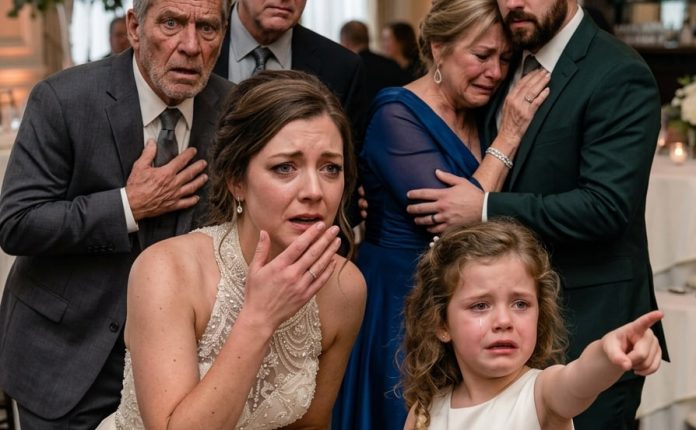
Then she covered her mouth with both hands.
There are many kinds of grief. There is the grief of losing someone suddenly. There is the grief of realizing someone you love has changed. And then there is the grief of seeing your own cruelty written in someone else’s handwriting and realizing you did not stop it when you could have.
Scarlet cried then.
Not beautifully. Not like a bride in a movie. She cried with her shoulders shaking, makeup smearing at the corners of her eyes, one hand still clutching the edge of the vanity.
Derek said, “Scarlet, come on.”
She turned toward him.
“Get out.”
His face hardened. “You cannot be serious.”
“Get out.”
“Our guests are downstairs.”
“Then go explain to them why the man you humiliated was the man who paid for the room.”
He looked around, searching for support. None came. Even his own mother, who had arrived in the doorway, stood frozen, one hand at her throat.
“This is insane,” Derek said. “You’re throwing away our relationship because your father overreacted.”
“No,” Scarlet said. Her voice was quiet now. “I’m ending it because you lied to me, used my father, and thought humiliating him was funny.”
“Scarlet—”
“And because when everything collapsed, your first instinct was to get him to pay again.”
That shut him up.