From the very first day I stepped into the Whitmore family circle, I understood I was being evaluated in a way that had nothing to do with who I was as a person. It wasn’t a warm introduction or a slow attempt at bonding. It was an assessment, like someone examining a purchase they weren’t sure they approved of. I remember standing in their vast living room, surrounded by polished marble floors and paintings that looked older than the country itself, while Ethan gently held my hand as if he was trying to anchor me to something steady. His mother, Victoria Whitmore, didn’t bother to hide her opinion. She smiled in a way that never reached her eyes and asked me what my “intentions” were with her son. The word alone told me everything I needed to know about her mindset. I wasn’t dating Ethan in her world. I was applying for a position I would probably be rejected from. Over the years, that same energy never left. It simply evolved into something sharper, more familiar, and more public.
By the time Ethan and I married, I had already been labeled. Gold digger. Opportunist. Outsider. It didn’t matter that I had a stable career in healthcare administration or that I had been financially independent since my early twenties. In their narrative, none of that mattered because narratives in wealthy families are rarely built on facts alone. They are built on perception, fear, and the need to protect legacy. Every dinner became a reminder that I didn’t belong. Every holiday gathering came with subtle comments about “people like me.” If I wore something nice, it was assumed I was trying to look the part. If I wore something simple, it was taken as proof that I was pretending to be humble. It became impossible to win because the game was never designed to be fair. Even Ethan, who loved me deeply, often struggled to push back against his family’s collective belief system. Love in that environment wasn’t enough to rewrite years of inherited suspicion.
The only exception, strangely enough, was Charles Whitmore, my father-in-law. Unlike the others, he never reduced people to categories. He observed quietly, spoke sparingly, and seemed more interested in understanding people than judging them. When I first met him, I expected the worst. Instead, he asked me about my work, listened carefully to my answers, and nodded as if my life had value independent of his wealth. Over time, our interactions remained steady but respectful. He never defended me openly against the family, but there were moments when his silence felt more protective than any argument could have been. I once overheard him telling Victoria that assumptions were “a luxury of those who don’t bother to learn the truth.” She didn’t respond, but the tension in the room afterward was unmistakable. It was clear that even within his own household, Charles operated on a different moral frequency.
As the years passed, the accusations never stopped. At first, they were subtle enough to ignore. A comment about how “lucky” I was to marry into wealth. A joke about how some people “know how to secure their future.” Then they became more direct. Victoria once told a group of relatives that I had “perfect timing” when it came to Ethan’s inheritance. I remember feeling something shift inside me that day, not anger exactly, but a quiet realization that no amount of explanation would ever change how she saw me. The narrative was already locked in place, reinforced by repetition and comfort. It was easier for them to believe I was a threat than to accept I might simply be a woman who loved their son without hidden motives. Ethan would get angry when these comments were made, but anger without consequence has a way of dissolving into exhaustion. Over time, even his resistance softened under the weight of constant repetition.
What I didn’t fully understand at the time was that Charles was watching all of this much more closely than anyone realized. He rarely intervened, but his attention was always present in subtle ways. He noticed who spoke kindly when nothing was to be gained, and who became attentive only when wealth was mentioned. He noticed who visited him when he was healthy, and who appeared more frequently when his health began declining. And he noticed something that apparently mattered more to him than anything else: I never once asked him for money, favors, or access to anything he owned. In fact, I actively avoided any situation where it might even appear that I was seeking advantage. At the time, I assumed that was simply basic respect. I didn’t realize it was being recorded internally as evidence of character.
When Charles’s health began deteriorating, everything around the family subtly changed. At first it was concern, at least on the surface. Hospital visits increased, conversations became more frequent, and everyone suddenly had opinions about treatment plans. But underneath that concern was something harder to ignore. There was calculation. I saw it in the way certain relatives began discussing “future planning” more openly. I saw it in the way Victoria started organizing documents and asking questions about ownership structures that had never interested her before. Even Ethan noticed it and became increasingly uncomfortable during family gatherings. Meanwhile, I simply tried to help where I could. I drove Charles to appointments when needed, helped organize his medication schedules, and spent time talking with him when he was too tired to entertain visitors. Those were not grand gestures. They were simple acts of presence. But in that household, presence itself was rare enough to stand out.
One afternoon, about two months before Charles passed away, he asked me to join him in his study. The room smelled faintly of old leather and paper, filled with books that looked untouched for years. He didn’t begin with anything dramatic. Instead, he asked me how I was coping with everything. Not just his illness, but the family dynamics as well. I remember hesitating before answering honestly. I told him it was exhausting being misjudged for something I had never done, but that I had stopped expecting fairness a long time ago. He studied me for a long moment after that, as if weighing something internally. Then he said something I didn’t fully understand at the time. He told me that families don’t fall apart because of money. They reveal themselves because of it. Then he changed the subject, smiled faintly, and asked if I would bring him tea. I didn’t know it then, but that conversation would later become one of the most important moments of my life.
When Charles died, the entire Whitmore family collapsed into a strange mixture of grief and anticipation. The funeral was large, dignified, and emotionally overwhelming in the way such events often are. People spoke about his achievements, his generosity, and his influence in the business world. But in the corners of the reception hall, quieter conversations were happening. Conversations about estates, assets, shares, and trusts. I remember standing beside Ethan and feeling like I was watching two versions of the same event unfold. One was about loss. The other was about distribution. Victoria was composed but tense, constantly surrounded by relatives discussing what they believed was coming next. Ethan stayed close to me, visibly uneasy with the undercurrent of expectation that seemed to dominate every interaction. I wasn’t thinking about money. I was thinking about how quickly grief had been replaced by speculation.
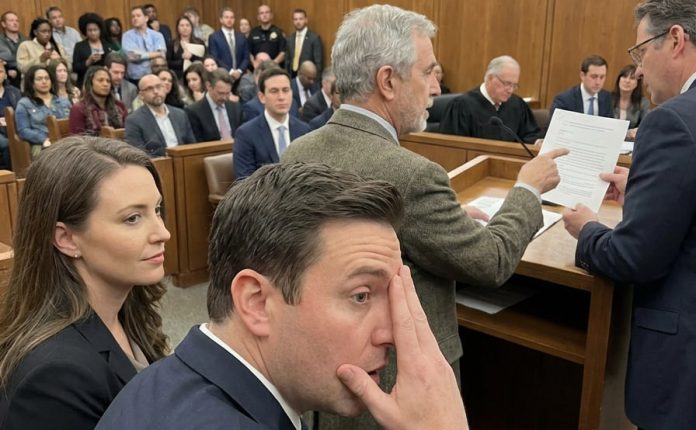
A week later, we all gathered at the law office of Harold Bennett, Charles’s longtime attorney. The atmosphere was heavy, but not with sadness. It was heavy with assumption. Everyone believed they already knew how the will would unfold. Certain percentages for family members, distribution of assets, continuation of the business structure. Victoria even brought a notebook, as if she were attending a financial briefing rather than a reading of her husband’s final wishes. Ethan held my hand under the table, and I remember thinking how strange it was that something so intimate could feel so tense. When Harold began speaking, the early sections were predictable. Personal items. Charitable donations. Small bequests to staff and friends. Then the tone shifted. There was a pause, a longer one than usual, before he moved into the section that dealt with ownership.
That was when everything stopped making sense.
According to the legal documents, the majority of Charles’s assets were no longer directly owned by him at the time of his death. Instead, they were placed in a private trust structure established years earlier, one that had been quietly reinforced and expanded over time. At first, people were confused but still calm. Trusts were not unusual in wealthy families. But then Harold continued reading, and the confusion turned into disbelief. Because the named controlling trustee, the person legally responsible for managing, protecting, and overseeing the entire structure, was not Ethan, not Victoria, not any family member at all.
It was me.
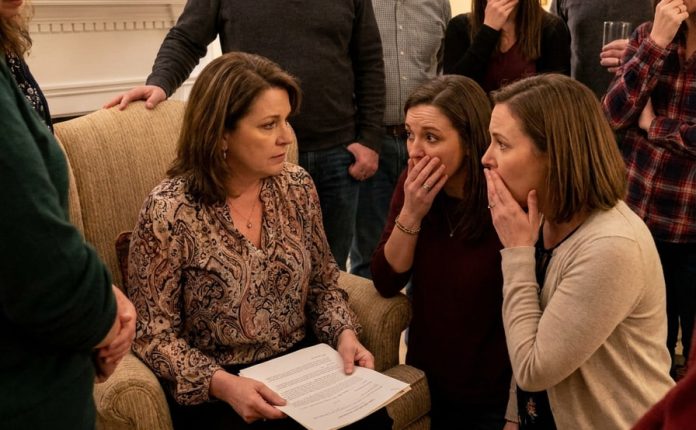
The silence that followed was not immediate outrage. It was disbelief so deep that it temporarily suspended reaction. Victoria actually laughed once, as if it were a misunderstanding that would resolve itself in the next sentence. But when Harold calmly repeated the wording, the atmosphere changed completely. Questions erupted from every direction. Accusations. Demands for clarification. Suggestions that there had been an error. Through it all, I sat completely still, trying to understand how something like this could be possible. I had never been informed. I had never been involved in any legal discussions. I had no idea this structure even existed. Harold eventually raised his hand to restore order and explained that everything had been executed legally, documented thoroughly, and reviewed multiple times over several years.
Then he opened a sealed envelope.
Inside was a letter from Charles.
As Harold began reading, the room slowly shifted from chaos to silence again, but this time it was different. This silence was heavier. In the letter, Charles explained that he had spent years observing his family, not with suspicion, but with clarity. He described how wealth had changed conversations, priorities, and relationships. He wrote about how people he once trusted began treating him differently as his health declined. But most importantly, he wrote about why he made his decision. He said he was not looking for bloodline loyalty. He was looking for integrity under pressure. And in his view, almost everyone had failed that test except one person.
Me.
He wrote that I had never treated him as a financial institution. I had never asked for advantage. I had never participated in conversations about inheritance or entitlement. I had simply treated him like a person. He also wrote something that caused the room to go completely still. He said the family had spent years accusing the wrong person of chasing wealth, while ignoring the fact that the only person who consistently behaved as though money was irrelevant was the one he chose to trust with it.
The letter continued, explaining the structure of the trust, the responsibilities attached to it, and the safeguards he had put in place to ensure it could not be easily dismantled by emotion or greed. Ethan was named co-trustee in case anything ever happened to me, but the authority was clear and legally binding. As Harold finished reading, I looked around the room and saw expressions I had seen for ten years suddenly collapse into something unrecognizable. Victoria looked like she had been physically struck by the realization that her assumptions had been completely wrong. But I wasn’t celebrating. I wasn’t smiling. I wasn’t even sure how to feel. Because the truth was simple and heavy at the same time. For a decade, I had been judged for something I never did. And the person who had known the truth all along was the one they were now grieving.
In the months that followed, nothing became easier immediately. Trust like that does not repair relationships overnight. Some family members apologized. Some did not. Some accepted the reality but never fully adjusted to it. But over time, something shifted. The narrative that had defined me for years slowly began to dissolve, not because I defended myself, but because it was never accurate to begin with. And what remained was not wealth, or status, or control. What remained was a question that Charles had answered in his own way long before anyone else understood it.
Who do you trust when everything is at stake?
And in the end, his answer had never been about money at all.
It had been about character.
The End.