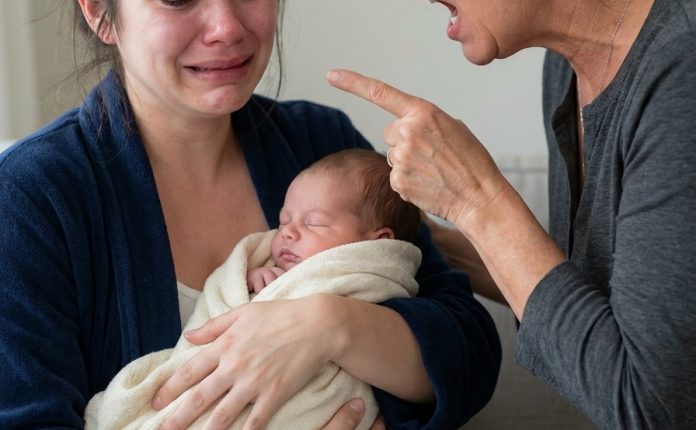
My husband asked for a DNA test on a Sunday morning while the sunlight was still warm on our kitchen floor, and by the time he finished explaining why he needed “peace of mind,” I already knew the marriage was not cracking because of something I had done. It was cracking because of something he was hiding.
Derek sat across from me with his hands folded beside his coffee cup, looking almost formal in the house where we had once eaten pizza from cardboard boxes on the floor because we were too happy and too broke to care about plates. His hair was still damp from the shower. He wore the navy sweater I had bought him in Asheville years ago, the one he claimed made him look like a professor even though he managed construction projects for a living and had never once willingly entered a library unless there was free parking nearby. Everything about him looked familiar, which made the words feel even more unreal.
“I need a paternity test,” he said.
Not “I’m scared.” Not “I’m struggling.” Not “This pregnancy is bringing up grief from the miscarriages, and I don’t know how to handle it.” No. He chose the cleanest blade and slid it across the table between us.
I kept my right hand around my mug because I was afraid if I let go, he would see my fingers tremble.
“A DNA test,” I said.
He nodded. Just once. Careful, measured. “I think it would be better for both of us.”
“For both of us,” I repeated.
Outside, our golden retriever Cooper was in the yard pawing at a pile of leaves as if they had personally offended him. The kitchen window looked out over the small patch of grass Derek and I had argued about when we bought the house six years earlier. He wanted low-maintenance landscaping. I wanted a yard big enough for a dog and, eventually, a child. Someday kids, we had said so casually then, as if children arrived because two people loved each other and bought a house with enough bedrooms.
I was nine weeks pregnant that morning.
Nine weeks after two miscarriages, three years of trying, one long season of silence, and a routine blood draw that turned my entire life upside down in a clinic parking lot. I had cried in my car for twenty minutes when the nurse called. Not elegant tears. Not pretty tears. The kind that bend you forward over the steering wheel and leave your throat raw. I had been happy, terrified, grateful, and already mourning the possibility before it had time to become real.
Now my husband was asking me to prove that the child I had prayed for belonged to him.
I looked at him carefully.
Derek Collins had always been handsome in a way that felt sturdy rather than polished. Tall, broad-shouldered, with hazel eyes and a face that made people trust him before he earned it. When we met at a barbecue in Charlotte eleven years earlier, he had been laughing at something near the grill, head tipped back, one hand around a beer bottle, and I remember thinking, That laugh is real. At twenty-three, I still believed real laughter revealed real character. Sometimes it does. Sometimes it only reveals one honest moment before time and weakness do their work.
Back then, I was starting my first year at an architecture firm, running on ambition, coffee, and the anxious hope that nobody would notice how young I felt in conference rooms full of men who had been calling women “kiddo” since before I was born. Derek was twenty-six, working his way up at a midsize construction company, and he asked me more questions about my work than anyone had in months.
“So you design buildings?” he said that first night.
“I help design them,” I corrected. “Junior architect. Mostly I wrestle with code requirements and pretend I’m not offended when senior partners call my ideas ‘interesting.’”
He grinned. “In construction, ‘interesting’ means expensive.”
“In architecture, it means maybe good, maybe stupid, definitely not approved yet.”
He laughed again. The real laugh.
That laugh was what I built memories around.
We made sense together. At least it seemed that way. Architecture and construction. Plans and execution. Dreaming and building. I designed spaces; he understood how they stood. We spent early dates walking through neighborhoods in Charlotte, pointing at houses and arguing over rooflines, window placement, bad porch proportions, beautiful brickwork. He kissed me for the first time outside a coffee shop in Dilworth after I finished complaining for ten minutes about fake shutters that did not even fit the windows.
“You are passionate about shutters,” he said.
“I am passionate about honesty,” I said. “If a shutter can’t close, it’s decoration pretending to be function.”
He smiled like he loved that about me.
Maybe he did then.
We married four years later in a garden behind a small inn outside Asheville. Wildflowers, string lights, eighty guests, my best friend Cynthia crying before the ceremony even started. Derek’s mother, Barbara Collins, wore dove gray and inspected every centerpiece with the faint expression of a woman trying not to look disappointed by someone else’s budget. She had raised Derek alone after his father died when he was twelve, and from the beginning I understood there were three people in our marriage: me, Derek, and Barbara’s belief that no woman would ever love her son correctly.
Still, we were happy. Or happy enough that the imperfections looked ordinary. We bought a house in a quiet suburb south of Charlotte, a two-story Craftsman with a modest yard, a creaky back deck, a mortgage that made me sweat the first year, and a spare room we called the future nursery before we learned how dangerous hope could be.
Cooper came first. A golden retriever puppy with giant paws and no respect for shoes. He ate one of Derek’s work boots, two throw pillows, and the corner of my drafting notebook. Derek said, “He’s lucky he’s cute,” while holding the dog like a newborn, and I took a picture because I thought someday our child would laugh at it.
Then we tried for the child.
Trying was sweet at first. Calendar jokes. Pharmacy runs. Secret smiles. Then months passed, and trying became tracking. Temperature charts, ovulation kits, appointments, vitamins, lab work, quiet disappointment folded into bathroom trash cans. The first miscarriage happened at ten weeks. I had already started looking at nursery paint colors online. People told me it was common. People say common like it makes grief smaller. It does not. It only means many women are walking around with invisible rooms inside them where a baby almost lived.
The second miscarriage came fourteen months later.
After that, Derek and I became careful around each other. We did not break dramatically. We became quiet. He worked longer hours. I took on larger projects. He stopped touching my stomach in that hopeful, absent way. I stopped saying baby names aloud. We both became skilled at not making the other person cry.
Grief did not destroy us all at once.
It put walls inside the house.
So when I found out I was pregnant again last October, I was afraid to tell him. Not because I thought he would be unhappy, but because I feared reopening a room we had locked together. I brought the test home anyway, placed it on the kitchen counter, and waited.
Derek came home late that evening.
That mattered later.
At the time, I let it pass. He had been late often. Work was busy, he said. Projects were behind, subcontractors unreliable, clients demanding. That night, he entered through the garage, loosening his tie, checking his phone. I stood by the island, both hands pressed against the counter.
“Derek,” I said.
He looked up, distracted.
I pointed to the test.
For a moment, his face did nothing.
Then he smiled.
He hugged me. He said the right words. “Oh my God.” “Di, that’s amazing.” “We’re going to be okay.” He kissed my hair and held me, but his arms released me too quickly. His eyes moved back to his phone before I had finished searching his face.
I told myself shock looks strange after loss.
I told myself men process fear privately.
I told myself anything except the truth, because the truth was still too large to carry.
The first real warning came three weeks later. A client meeting canceled early, and I came home at 2:30 in the afternoon, nauseated, tired, and desperate for sweatpants. Derek’s car was in the driveway. He worked across town; he should not have been home. I entered through the garage door and heard his voice in the kitchen.
“It’s complicated right now,” he said softly. “I know. I know. Just give me time.”
It was not his work voice. I knew Derek’s work voice. Practical, confident, slightly impatient. This was lower. Tenderer. Secretive.
He turned too quickly when I stepped into the kitchen.
“Work call,” he said before I asked.
I nodded. I put down my bag. I went upstairs.
In the bathroom mirror, I looked at my reflection: seven weeks pregnant, pale from nausea, hair coming loose from its clip, eyes suddenly alert in a way they had not been five minutes earlier. Suspicion did not arrive like lightning. It arrived like cold air under a door.
After that, I noticed everything.
Late nights three or four times a week. The phone angled away when texts came in. A password added where before there had only been a swipe. His call history cleared. A new habit of taking calls in the garage. The faint smell of unfamiliar perfume on his jacket one Friday night, something expensive and floral, not mine. The way his attention seemed to leave the room before his body did.
Still, I said nothing.
Partly because I was pregnant and terrified. Partly because I had loved him for eleven years. Partly because a woman does not want to discover betrayal while carrying a child she begged heaven for after losing two.
Then came the Sunday morning at the breakfast table.
“I need a paternity test,” he said.
And something in me, some structural calculation I had been avoiding, finally resolved.
He was not asking because he doubted me.
He was asking because guilt had made him paranoid.
He had done something, and now he needed to make me unstable before I discovered it. He needed to turn suspicion outward. He needed me defensive, emotional, frightened, proving myself, while he kept control of the narrative.
I lifted my mug.
“Of course, darling,” I said.
His eyes narrowed slightly, not with suspicion, but confusion. He had expected me to cry. He had expected anger. He had expected pleading questions. He had not expected agreement.
“If that’s what you need,” I added, “we’ll do it.”
“You’re not upset?”
“I’m pregnant and tired,” I said. “I don’t have extra energy to perform the reaction you expected.”
He looked away first.
That was the first time I saw him afraid.
The days after that conversation were the loneliest I had ever spent inside my own marriage.
On the surface, our life continued. We still ate dinner. We still slept in the same bed. We still discussed Cooper’s vet appointment, the broken guest bathroom faucet, the grocery list, the prenatal vitamins that made me gag if I took them before food. Derek found a licensed paternity testing service and forwarded me the information as if scheduling a dental cleaning. I replied with one word.
Fine.
Inside, I began measuring.
I am an architect. When I am afraid, I look for load-bearing walls. I ask what can fail, what must be supported, what should be removed before collapse spreads. That week, I turned my marriage into a structure on paper.
The house. Mortgage balance. Current equity. My income. His income. Brokerage account. Retirement accounts. Joint credit card. Insurance. Tax returns. Cars. Savings. The baby.
The baby became the center of every line.
At nine weeks pregnant, I could not yet feel the life inside me move. The baby was a fact on paper, a heartbeat at the clinic, a wave of nausea before dawn. Still, the child became the fixed point around which everything else had to orbit.
I took a personal day from work on Wednesday.
I drove across Charlotte to a coffee shop I had never visited, far enough from our neighborhood that I would not run into clients or colleagues. I ordered ginger tea and sat by the window for three hours with a notebook open.
What do I know?
Behavior changes. Late nights. Cleared call logs. Overheard phone call. Paternity accusation.
What do I need?
Legal advice. Documentation. Financial records. Proof.
What do I avoid?
Confrontation. Emotional outbursts. Warning him.
I searched for family law attorneys in Mecklenburg County and made a list of three names. The first had good reviews but too much emphasis on “amicable solutions,” which sounded lovely for people not being strategically humiliated while pregnant. The second did not call back. The third was Laura Hayes.
Former assistant district attorney. Twelve years in family law. Known for high-conflict divorce, financial misconduct, and custody disputes. Her website was plain, almost severe. No smiling stock photos of relieved families. No promises about fresh starts. Just experience, process, and outcomes.
Her assistant called within an hour.
“Ms. Hayes can see you Friday at two.”
“I’ll be there,” I said.
That evening, I sat across from Derek at dinner while he scrolled his phone under the table badly enough that he almost wanted me to notice.
“Work?” I asked.
He looked up. “Yeah. Sorry.”
I nodded and ate my soup.
He thinks I’m waiting, I thought. He thinks I’m confused and hurt and waiting for him to tell me what this means.
That thought did not make me hate him.
It made me still.
After he fell asleep that night, I went downstairs with my laptop and began copying records. Mortgage documents. Deed. Three years of tax returns. Pay stubs. Bank statements. Brokerage account summaries. Credit card statements. Insurance policies. Retirement account statements. I photographed documents and uploaded them to a private cloud account linked to an old email address I had created years ago for a freelance design project. Derek did not know it existed.
I started a log in my phone under a folder labeled “Anderson Mixed-Use Reference Notes,” buried among actual work files. Date. Time. Derek’s whereabouts. Calls. Behavior. Anything odd.
It felt paranoid until it felt necessary.
By Thursday night, I had a file.
By Friday afternoon, I had a lawyer.
Laura Hayes’s office was on the fourteenth floor of a glass building downtown. Normally, I would have noticed the view. The skyline. Reflections. The way light moved through the conference room glass. That day, I barely saw anything except the woman sitting across from me.
Laura was in her late forties, compact, dark-haired, with reading glasses pushed up on her head and a manner that made comfort seem inefficient. She shook my hand, offered water, opened a legal pad, and said, “Tell me everything. Don’t edit.”
So I did.
I told her about meeting Derek, the marriage, the house, the miscarriages, the pregnancy, his reaction, the phone call, the late nights, the cleared history, the DNA test request. I told her what I suspected and what I could prove. I told her I was afraid he was trying to destabilize me before I could act.
Laura listened without interrupting. When I finished, she wrote something down and looked up.
“You haven’t confronted him.”
“No.”
“Good. Don’t.”
That single word steadied me more than sympathy would have.
She explained North Carolina divorce law with clean precision. Equitable distribution. Marital property. Separate property. Custody considerations. Post-separation support. Child support. Marital misconduct. Dissipation of marital assets.
“If he is having an affair and spending marital money on it,” she said, “that matters. It gives us leverage.”
Leverage.
I held onto that word.
“Should I still take the paternity test?” I asked.
“Yes,” Laura said. “He asked for it. Let him have it. If the child is his, and you seem certain, then the test becomes useful. He accused you of possible infidelity while hiding his own. Courts notice patterns like that when they are documented properly.”
Before I left, she gave me rules.
Do not move large sums of money.
Do not threaten him.
Do not post online.
Do not contact any suspected affair partner.
Do not leave the marital home unless safety requires it.
Document everything.
Act like the person with nothing to hide.
At the door, she said, “Diana, quiet is fine. Quiet and unprepared are different things. You are going to be quiet and prepared.”
I drove home feeling something I had not felt since the breakfast table.
Ground.
The evidence found me the following Tuesday.
Or I found it because I had finally stopped refusing to look.
I was working from home at the dining room table while my work computer installed updates. I opened the shared household laptop to check a supplier website. Derek used his phone for almost everything, but occasionally he used the laptop for travel or restaurant searches. Maybe he forgot. Maybe he got careless. Guilt often makes people both vigilant and sloppy in turns.
The browser autofill suggested a restaurant in NoDa.
I did not recognize it.
I almost ignored it, then noticed the date in the browsing history.
Last Thursday.
Derek had told me he was working late last Thursday.
I followed the thread carefully. OpenTable reservation. Two people. 8:00 p.m. A restaurant with low lighting and a wine list. Then a search from six weeks earlier: romantic hotels Charlotte NC. Then an autofilled email address I had never seen.
tiffross07.
My body went cold.
Not because I knew everything yet.
Because I knew enough.
I did not click recklessly. I did not send myself anything from the laptop. I used my personal phone to photograph the browser history, the reservation page, the hotel search, the autofill field. I noted the time. I closed the browser exactly as I found it. Then I made tea and sat at the kitchen table until the shaking passed.
My hands were steady when I emailed Laura.
I have documentation. Can we meet this week?
Her response came within the hour.
Thursday at 2. Bring everything.
Derek started noticing my quiet around then.
Not enough to understand it, but enough to feel the change. I was polite. Functional. Even pleasant. I asked if he wanted chicken or salmon for dinner. I scheduled the paternity test. I mentioned the baby app said the baby was the size of a grape. I did not ask where he had been. I did not touch his phone. I did not cry.
That unsettled him.
So he called his mother.
Barbara Collins called me Wednesday evening while I was folding laundry in the guest room, which we had not yet dared call a nursery.
“Diana, sweetheart,” she said. “I just wanted to check on you.”
Barbara had a voice like expensive wrapping paper: smooth, controlled, designed to make whatever was inside seem more thoughtful than it was.
“I’m well, Barb. Thank you.”
“Derek mentioned you’ve seemed distant.”
Of course he did.
“Pregnancy fatigue.”
“Yes, hormones can make everything feel bigger than it is.”
There it was.
The first brick in their new wall.
Diana is hormonal. Diana is emotional. Diana is pregnant and overreacting. Derek is worried. Barbara is concerned.
“I appreciate your concern,” I said.
After we hung up, I added the call to my log.
Date. Time. Content. Tone.
I felt ridiculous writing tone. Laura later told me it mattered.
Patterns often wear perfume instead of fingerprints.
At my second meeting, Laura reviewed the photos I had taken.
“This email,” she said. “Do you know Tiffany Ross?”
I had searched her carefully. Not obsessively. Carefully.
“Tiffany Ross. Thirty-one. Project development. Construction industry. She works with firms that partner with Derek’s company.”
Laura nodded. “I’d like to bring in a private investigator.”
The phrase made my stomach twist.
“Is that necessary?”
“It is useful. Browser history is good. Admissible documentation is better. I use someone discreet and licensed.”
“How much?”
She gave me a number.
I thought of the hotel search. The DNA test. The way Derek had asked me to prove my child’s paternity while funding whatever he was doing with marital money.
“Do it,” I said.
Paul Garrett was the investigator: retired law enforcement, gray-haired, ordinary-looking, the kind of man who could sit in a parking lot for three hours and blend into the asphalt. He worked through Laura, not directly through me, which I preferred. I did not want drama. I wanted evidence.
Within ten days, Paul had photographs.
Derek and Tiffany at the NoDa restaurant.
Derek and Tiffany entering a hotel in South End.
Derek and Tiffany touring an apartment building together, one with rooftop amenities and monthly rents that required planning.
That last set hurt most.
An affair could be framed as weakness by people desperate enough to excuse it.
An apartment showing was architecture.
He was building another life.
When Laura placed the photographs across the conference table, I stared at them until the faces blurred. Derek’s hand at Tiffany’s lower back. Tiffany smiling up at him. Derek leaning in at dinner with the same attentive posture he used to give me when I explained design concepts too enthusiastically.
Laura watched me.
“Do you need a minute?”
“No.”
It was not bravery. It was momentum.
She tapped the apartment photograph. “This is important.”
“I know.”
“He’s planning something permanent while creating doubt about you.”
I looked up. “He was building an exit while making me defend the doorway.”
Laura’s expression shifted.
“That,” she said, “is exactly the kind of sentence that helps me understand a case.”
We filed on a Thursday.
Quietly. Procedurally. No dramatic music. No courtroom doors flying open. Just documents submitted in Mecklenburg County, a case number assigned, and a legal process set into motion before Derek understood the ground beneath him had moved.
He was served the following Monday at his office.
He called four times in the first hour.
I let each call go to voicemail.
The fifth time, I answered.
“What is this?” he demanded.
His voice was controlled, but barely. I could hear office noise behind him, a door closing, someone laughing distantly. He was trying to remain composed in a place where people knew him as competent.
“I think the paperwork explains it.”
“You filed for divorce without talking to me?”
“You asked me for a DNA test while I was pregnant with your child,” I said. “I think we are past the stage where you get to complain about process.”
“Diana, this is insane.”
“No,” I said. “It’s legal.”
That stopped him.
“You don’t know what you’re doing.”
“I do.”
I ended the call.
He came home that evening with Barbara.
Of course he did.
I saw his car pull into the driveway from the upstairs window. Barbara sat in the passenger seat, wearing a camel coat and the expression of a woman arriving to correct someone below her. They remained in the car for several minutes, heads angled toward each other, rehearsing. Cooper barked once downstairs. I let them knock twice before opening the door.
Derek held a paper bag from the bakery we used to visit on Sunday mornings early in our marriage. It was a calculated prop. Memory wrapped in wax paper.
“We just want to talk,” he said. “No lawyers. No documents. Just us.”
I looked at Barbara.
She had arranged her face into concern.
I opened the door.
Not because I wanted reconciliation. Because sometimes people reveal more when they think they are winning.
We sat in the living room. I took the armchair and left them the couch. Derek placed the bakery bag on the coffee table. No one opened it.
“Diana,” he said, leaning forward. “I know I hurt you. I know the test request was wrong. I panicked. The pregnancy brought up fear after everything we’ve been through. I handled it badly.”
He paused.
He was good. I had to give him that. Soft voice. Pained eyes. No mention of Tiffany. No mention of hotels, apartment tours, or marital funds.
“We have eleven years,” he continued. “We have a baby coming. I don’t want to throw that away over fear.”
Over fear.
Not over betrayal.
Over fear.
Barbara took her cue.
“You’re carrying my grandchild,” she said. “And I want to support you. We all do. But a legal process like this is hard on a pregnant woman. The stress. The uncertainty. Is this really what you want for the baby’s beginning?”
There it was. My child turned into a lever before she was even born.
“The baby and I are doing very well,” I said. “Thank you.”
Derek’s jaw tightened.
“If this is about Tiffany—”
“You don’t have to explain Tiffany to me,” I said. “That’s what attorneys are for.”
The warmth left his face in small, visible pieces.
“You’re being unreasonable.”
“No,” I said. “I’m being documented.”
Barbara stood.
That was the moment the mask fell.
“You listen to me,” she said, low and precise. “My son has resources and connections that will make this very unpleasant for you. Judges in this county know our family. Your attorney may be competent, but she does not have the relationships we have. You are a pregnant woman, salaried, emotional, and alone. You can fight this, or you can walk away with something reasonable and your health intact. But do not mistake politeness for weakness.”
The room went very still.
Derek did not stop her.
That mattered.
I let three seconds pass.
▶️ Continue to Part 2
The story continues — don’t miss what happens next