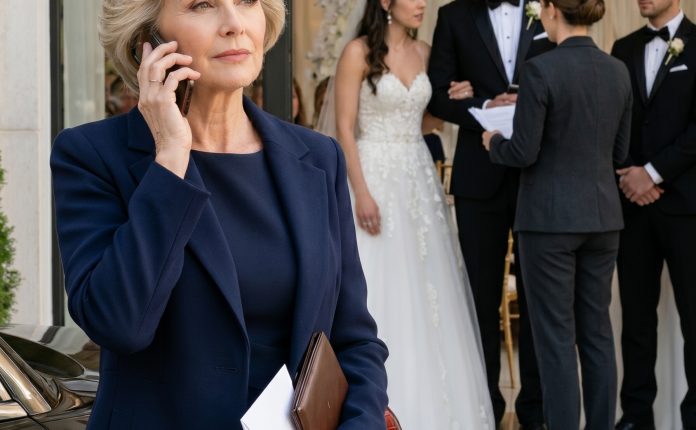
Then I Walked Out, Called My Lawyer, And Somewhere Between The Vows And The Champagne Toast, Julian’s Phone Started Vibrating Inside His Tux—Because The Woman He Had Just Thrown Away Was The Only Reason He Had A House, A Job, And A Life Worth Showing Off.
I arrived at my son’s wedding wearing the blue dress I had saved for months to buy, the one I imagined he would see and say, “Mom, you look beautiful.”
Instead, the girl at the reception table checked the list three times and whispered, “I’m sorry, ma’am. Your name isn’t here.”
I thought it had to be a mistake. Mothers are not forgotten from their sons’ weddings.
Then Julian walked over in his tuxedo, looked me up and down, and rolled his eyes like I was embarrassing him by existing.
“Did you really think you’d be invited?” he asked.
That was when I finally understood the boy I raised was gone.
My name is Eleanor. I am seventy-one years old, and I adopted Julian when he was three.
He had been abandoned before he was old enough to understand what abandonment meant.
I still remember the first time I saw him at the orphanage, sitting in the corner with his knees pulled to his chest, staring at the floor while the other children played.
He did not cry loudly. He cried the way children do when they have already learned nobody is coming.
I came.
I gave him my last name. My home. My bed when he had nightmares. My paychecks. My youth. My whole life.
I was not rich then, at least not in any way he could see.
I worked as a secretary, then took extra jobs when school fees arrived, then more when he needed braces, tutoring, sports uniforms, a computer, college applications, clothes that would help him fit in with children whose parents did not count every dollar at the grocery store.
When Julian graduated with his engineering degree, I cried so hard my hands shook around the program. I thought every sacrifice had been worth it.
Then Vanessa came.
She was beautiful in a polished, sharp-edged way, with perfect hair, perfect nails, and a smile that never reached the part of her eyes that judged people.
At first, I tried to love her because Julian loved her. I cooked her favorite meals. I bought thoughtful gifts. I asked about her work, her family, her dreams.
She treated me like a stain she was trying to scrub out of Julian’s life.
“Eleanor, don’t you think that blouse is a little young for you?” she once said at dinner, smiling across my own table.
Another time, when I brought Julian homemade soup because he had the flu, she said, “You know, normal couples handle illness without their mothers hovering.”
Julian heard her. He said nothing.
The first time she insulted my cooking, calling it “salty old-lady food,” I waited for him to defend me. He kept eating. The silence hurt more than her words.
Little by little, my son changed. The calls became shorter. The visits became rarer.
When I asked if I could come over, Vanessa was tired. Vanessa needed space. Vanessa thought boundaries were healthy. Vanessa felt I was “too attached.”
Then came the engagement dinner. I was the last to know.
I arrived thinking we were having a normal family meal. Instead, Vanessa sat at the table with her parents, her siblings, and a diamond ring so large it looked almost theatrical under the chandelier.
“Surprise!” they all shouted.
I smiled. I congratulated them. I hugged Julian while Vanessa watched as if measuring how long my hands stayed on his back.
Later that night, Julian said, “Mom, Vanessa and I want a small wedding. Just close family.”
I nodded, thinking I was close family. I had never been more wrong.
For weeks, every time I asked about the venue, the time, the rehearsal, Vanessa gave vague answers. “We’ll let you know.” “Still finalizing.” “It’s complicated.”
Then, three days before the wedding, I called Julian.
“What time should I arrive?” I asked.
There was a pause long enough for my heart to start hurting before he spoke.
“Mom,” he said, “Vanessa and I decided the wedding is only for the closest family.”
“But Julian,” I whispered, “I am your mother.”
“I know. But Vanessa feels you don’t fit the image we want to project.”
The image. I thought about that sentence for three days.
Then I went anyway.
Not to make a scene. Not to ruin anything.
I went because some foolish, faithful part of me believed that if Julian saw me standing there in the dress I bought for his wedding, maybe he would remember the woman who had chosen him when the world had not.
At the reception table, the staff looked embarrassed when my name did not appear. Then Julian came over.
“Mom, what are you doing here?”
“I came to your wedding,” I said. “There must be a mistake.”
“It’s not a mistake.” His voice was cold. “I told you. Close family only.”
“But I am your family.”
He sighed, as if I were exhausting him. “Did you really think you were going to be invited after everything you’ve done?”
Everything I had done.
Feeding him. Clothing him. Raising him. Working until my feet swelled.
Paying his bills when he was grown and still pretending to be independent. Calling in favors to get him hired. Quietly paying what he could not afford so he could look like the man Vanessa wanted to marry.
Then Vanessa appeared in her wedding gown.
“What is she doing here?” she asked, like I was a stranger who had wandered in from the street.
“She’s leaving,” Julian said. “Right, Mom?”
I could have cried. I could have begged.
Instead, I smiled.
“I understand perfectly,” I said. “Have a beautiful wedding.”
Then I walked out.
In the taxi, I called Arthur, my lawyer of more than twenty years.
“Arthur,” I said, “it’s time.”
He was quiet for a moment. “Are you sure, Eleanor? Once we begin, there’s no going back.”
I looked down at the blue dress folded across my knees, the dress no one had wanted to see.
“I’m sure,” I said. “My son just showed me what I am worth to him. Now he can learn what he has really been standing on.”
Because Julian never knew the truth about me.
He knew the struggling secretary who adopted him. He knew the mother who lived modestly, saved coupons, drove an old car, and wore the same coat for years.
He knew I helped him, but he never asked how I always had money when he needed it.
He did not know about my father’s inheritance.
He did not know about the properties in Geneva, the stocks, the investment accounts, the quiet fortune I kept hidden because I wanted my son to love me for myself and not my bank balance.
He also did not know that the house he bragged about owning had been held up by my payments.
That his job existed because I had asked an old family connection to give him a chance.
That Vanessa’s shopping card, his utilities, his emergencies, his reputation, and half the life he was displaying at that wedding were all standing on invisible wires connected to me.
And as the ceremony began, Arthur started cutting those wires one by one.
Somewhere between the vows and the champagne, Julian’s phone began vibrating inside his tux.
First the utility company.
Then the bank.
Then his boss.
Then Vanessa’s card issuer.
And while he stood at the altar pretending to be a man who had outgrown his mother, the life I had built for him began quietly disappearing from under his feet…
I arrived at my own son’s wedding, and when I gave my name, the staff looked at me with confusion. I wasn’t on the list.
I searched for Julian among the guests, and when I asked him about it, he rolled his eyes and told me with contempt, “Did you really think you would be invited?”
I smiled calmly, told him I understood perfectly, and left. But in the middle of the ceremony, his phone began to ring non-stop.
My name is Eleanor. I am 71 years old. And that day, I understood that I had raised a monster.
For decades, I dedicated myself completely to that boy. I adopted him when he was just three years old, an abandoned child I found crying in an orphanage. I gave him my last name, my home, my entire life.
I worked double shifts to send him to the best private schools. I gave up my own dreams so that he could achieve his.
When he graduated with his engineering degree, I cried with happiness, thinking it had all been worth it.
But I never imagined that the same son I loved so dearly would cast me out like a stray dog on the most important day of his life.
Vanessa, his fiancée, had been the architect of it all. From the moment she appeared in our lives, she began to poison his mind against me.
“Your mother is too clingy,” she would tell him. “A woman her age should have her own life and not always be hovering over us.”
Julian would listen to her and nod like a puppet. Little by little, the visits became less frequent, the calls colder, the excuses more elaborate.
The first time Vanessa disrespected me, Julian said nothing. We were having dinner at my house when she commented that my food was too salty and that she didn’t understand how Julian could have grown up eating such garbage.
I froze, waiting for my son to defend me, but he just kept eating as if nothing had happened. Then came the more subtle humiliations.
“Eleanor, don’t you think that blouse is a bit too young for you?” Vanessa would say with a fake smile.
Or when I would arrive to visit him without calling first: “Oh, Eleanor, I wish you had called ahead. We’re busy planning our future.”
And Julian always nodded, always supported her.
But what hurt the most was when they announced their engagement. They organized a family dinner, and I was the last to find out.
I arrived at Julian’s house expecting a normal dinner and found Vanessa showing off a huge ring, surrounded by her parents and siblings.
“Surprise!” they all shouted.
I forced a smile and congratulated them. But inside, something broke.
“Mom,” Julian told me that night, his tone different, colder, more distant, “Vanessa and I have been talking about the wedding. We want something intimate, just close family.”
I nodded, thinking I was included in that category. How naive I was.
The following weeks were an ordeal. Vanessa was in charge of the preparations, and every time I asked something about the ceremony, she gave me vague answers.
“We’re still deciding,” she’d say. “We’ll let you know.”
But they never let me know anything.
Three days before the wedding, I called Julian to ask what time I should arrive at the venue. There was a long silence on the other end of the line.
“Mom,” he finally said, “Vanessa and I have decided that the wedding will be for only the closest family.”
I felt as if I had been stabbed.
“But Julian,” I said with a trembling voice, “I am your mother.”
“I know,” he replied. “But Vanessa feels that, well, that you don’t fit the image we want to project.”
I didn’t fit their image. Those words echoed in my head for days.
The woman who had sacrificed everything for him, who had worked to the point of exhaustion to give him a decent life, who had given up love and my own dreams, did not fit their image.
But I decided to go anyway. I put on my best dress, the one I had bought thinking of his wedding. I did my hair and took a taxi to the venue.
I thought that maybe, upon seeing me there, Julian would have a change of heart, that he would remember everything we had been through together. All the nights I stayed awake when he was sick. All the sacrifices I made.
I couldn’t have been more wrong.
When I arrived at the venue and gave my name at the reception, the staff checked the list once, twice, three times.
“I’m sorry, ma’am, but your name isn’t on here,” the receptionist told me with an uncomfortable smile.
“There must be a mistake,” I insisted. “I’m Julian’s mother.”
It was then that I saw him approaching, elegant in his tuxedo, with that smile I knew so well.
“Mom, what are you doing here?” he asked me. But his tone wasn’t one of surprise. It was one of annoyance.
“Julian, son, I came to your wedding,” I told him. “My name isn’t on the list, but it must be a mistake.”
He looked at me with a coldness I had never seen before.
“It’s not a mistake, Mom. I told you it was for close family only.”
“But I am your family,” I pleaded. “I am your mother.”
Julian sighed and rolled his eyes. “Did you really think you were going to be invited after everything you’ve done?”
Those words hit me like a punch.
“Everything I’ve done? Julian, I gave you everything.”
“Exactly,” he said with contempt. “Always giving, always smothering, always meddling in my life. Vanessa is right. You never knew your place.”
At that moment, Vanessa arrived radiant in her wedding dress. And when she saw me, her smile froze.
“What is she doing here?” she asked Julian as if I were invisible.
“She’s just leaving,” he replied without looking at me. “Right, Mom?”
I could have started crying. I could have pleaded. I could have made a scene.
But instead, I smiled. A calm, serene smile that unsettled them both.
“I understand perfectly,” I told them. “Have a beautiful wedding.”
And I left.
But as I walked towards the exit, I took out my phone and dialed a number.
“Arthur,” I said when he answered, “I think it’s time to execute the plan we discussed.”
Arthur had been my lawyer for over 20 years, the only one who knew all my secrets.
“Are you sure, Eleanor?” he asked me with a worried voice. “Once we do this, there’s no going back.”
“Completely sure,” I replied as I got into the taxi. “Julian just showed me that I am worthless to him. It’s time for him to learn what he’s really going to lose.”
As the taxi drove away from the venue, my phone began to vibrate with messages. They were from Vanessa, furious that I had shown up at her wedding.
“How dare you show up without an invitation. You have no dignity,” one of her messages read.
“Julian is upset with you. I hope you’re happy for ruining our special day.”
Ruining their special day. That woman truly believed that my five-minute presence had ruined anything. She had no idea what it really meant to ruin something, but she was about to learn very soon.
I arrived home, and for the first time in months, I felt strangely calm. For years, I had been walking on eggshells, trying not to bother Julian, not to inconvenience Vanessa, to be the perfect mother-in-law who doesn’t meddle, but is always there when needed.
But that night, as I took off the dress I had bought for a wedding I wasn’t invited to, I made the most important decision of my life.
I was retiring—not from work. I was retiring from being a mother.
Julian never knew the truth about my financial situation. When I adopted him, I was a young woman working as a secretary and living in a small apartment. He grew up seeing my sacrifices, my part-time jobs, my constant struggle to make ends meet.
What I never told him was that during all those years, my father, who had moved to Europe in the 50s, had been wisely investing the money he earned from his import-export business. When my father died 10 years ago, he left me a considerable inheritance.
Properties in Geneva, stocks in prosperous companies, bank accounts that Julian could never have imagined existed.
But I decided to keep living as I always had—working, saving, keeping the same modest house. I wanted Julian to value me for who I was, not for what I had.
What a huge mistake I had made.
That very night, while Julian and Vanessa were celebrating their wedding, I was on my computer transferring money, making calls, setting in motion a plan I had been considering for months.
The next day, when they woke up from their express honeymoon, their world had begun to change.
At first, it was subtle. Julian called me three days after the wedding, not to apologize, but to ask me to look after his apartment while he and Vanessa were in Cancun.
“Mom, I need you to go water the plants and pick up the mail,” he said as if nothing had happened. “Oh, and Vanessa wants you to clean up a bit because we’re having visitors when we get back.”
“I can’t,” I replied simply.
“What do you mean you can’t?” he asked, surprised.
“I’m busy,” I told him. “Find someone else.”
And I hung up.
An hour later, Vanessa was screaming at me over the phone.
“What’s wrong with you, Eleanor? Are you crazy? It’s the least you can do after the scene you made at our wedding.”
“I didn’t make a scene,” I responded calmly. “I just went to congratulate my son.”
“Your son doesn’t want you there,” she yelled. “Get it through your head. You are a burden to him.”
A burden. After everything I had been done, after all the sacrifices, I was a burden.
“You’re right, Vanessa,” I told her. “I am a burden. That’s why I’ve decided to free him from that burden forever.”
“What do you mean by that?” she asked, her voice changing tone.
“I mean, I’m retiring. Julian no longer has a mother.”
I hung up the phone and turned it off. It was time to start my new life.
The next day, I hired a moving company and packed my most important things. The rest I donated to charity. I sold my modest house in the neighborhood where I had raised Julian and moved into a five-star hotel in the city center.
Not because I couldn’t buy another house, but because I wanted time to decide exactly what I was going to do with the rest of my life.
Arthur visited me at the hotel that first week.
“Eleanor, are you sure you want to do this?” he asked as he reviewed the papers I had given him.
“I’ve been sure since the moment Julian looked at me with contempt at the door of that venue,” I replied. “That boy thinks I’m a poor, pathetic old woman who depends on him. It’s time for him to know the truth.”
The papers Arthur held in his hands were property transfer documents, bank statements, and something Julian had never seen: the deed to the house he lived in.
The house he thought he had bought with his mortgage was actually purchased by me. I had paid the down payment. I had co-signed the loan. I had been silently paying the mortgage for years so he could maintain his standard of living.
But that wasn’t all. The company where Julian worked as an engineer also had a secret.
The owner, Mr. Harrison, was a business partner of my father’s from Europe. When Julian graduated, I had spoken to Mr. Harrison to give my son a chance. Not only did he get him the job, but for years, he had been receiving reports on his performance.
Julian was a mediocre employee who had kept his job more because of my influence than his talent.
Vanessa also had no idea who she had really married. Her brand-new husband, the successful engineer she bragged so much about, was actually the adopted son of a woman who could buy and sell his entire family without blinking.
While they were enjoying their honeymoon, spending the wedding gift money from Vanessa’s family, I was at the hotel spa, relaxing for the first time in decades.
It had been years since I had allowed myself this kind of luxury. I had always been so busy working for Julian, worrying about Julian, living for Julian, that I had forgotten to live for myself.
It was during a relaxing massage that I made my next decision. Not only was I going to retire from being a mother, but I was also going to make sure that Julian and Vanessa understood exactly what they had lost.
When Julian and Vanessa returned from their honeymoon, the problems began.
First, it was the utility company that cut off their electricity because they hadn’t paid the bill.
Julian called me furious. “Mom, why didn’t you pay the electricity bill for my house?”
“Because it’s not my house,” I replied calmly. “And because I am no longer your mom.”
“What are you talking about? Of course, you’re my mom.”
“No,” I said. “Mothers are invited to their sons’ weddings. I was not invited. Therefore, I am not your mother.”
Julian was silent for a moment. “Mom, don’t be ridiculous. It was just a wedding.”
“Exactly,” I replied. “Just a wedding. The most important wedding of your life, and you decided I had no place in it. Now you live with the consequences of that decision.”
“But you’ve always paid my utilities,” he shouted. “It’s your obligation.”
“My obligation?” I repeated, feeling the anger rise in my chest. “Julian, for 28 years, I fulfilled obligations that were not mine. That’s over.”
I hung up and dialed Mr. Harrison’s number.
“Good morning, Mr. Harrison,” I said. “It’s Eleanor. I think it’s time we talked about Julian.”
“Ah, Eleanor,” Mr. Harrison sighed. “I figured you’d be calling soon. I heard about what happened at the wedding. That boy has no idea what you’ve done for him all these years.”
“That’s exactly why I’m calling,” I said. “I want you to see who Julian really is as an employee without my influence.”
Mr. Harrison was quiet for a moment. “Eleanor, if I withdraw my protection, Julian is going to have serious problems in the company. His work is mediocre. He’s constantly late, and several clients have complained about his attitude.”
“Then handle the situation as it should be handled,” I replied. “I will no longer intercede for him.”
Meanwhile, Vanessa had begun to notice other changes. The credit card she used for her shopping sprees for clothes and beauty products had been canceled.
It was a card I had taken out years ago and had been paying silently so that Julian could keep his girlfriend, and later wife, happy.
When Vanessa tried to use it at her favorite boutique, the saleswoman told her the card had been reported as canceled for non-payment.
“Julian!” Vanessa screamed that night. “Your mother canceled my credit card. Call her right now and tell her to reactivate it.”
Julian called me in a rage. “Mom, how can you be so petty? Vanessa needs that card.”
“Vanessa can get her own card,” I replied. “Or you can get one for her with your credit. Oh, wait. You don’t have any credit because you’ve never paid for anything yourself.”
“You’re a bitter old woman,” he yelled at me. “That’s why nobody loves you.”
His words hurt. But this time, I didn’t stay silent.
“Julian,” I said in a firm voice, “for 28 years, I swallowed my pride so you could have everything you wanted. I humbled myself, worked to exhaustion, and gave up my own happiness. And when the most important moment of your life came, you treated me like trash. Now you’re going to learn what it means to stand on your own two feet.”
I hung up and turned off my phone. It was time for the next step.
The next day, I visited Julian at his work. I arrived in a luxury car service, dressed in an elegant suit I had bought that morning.
When I entered the office, everyone stared at me. Julian came out of his cubicle with a surprised look on his face.
“Mom, what are you doing here?”
“I came to talk to you,” I said. “Can we speak in private?”
We went to the conference room, and I closed the door.
“Julian,” I said, “I want you to know something. For all these years, Mr. Harrison has been very patient with you because he respects me. But that patience has run out.”
“What are you talking about?” he asked nervously.
“I’m talking about the fact that Mr. Harrison knows you’re late, that your work is mediocre, that several clients have complained about you. The only thing that has kept you in this job has been my influence.”
Julian turned pale. “That’s not true.”
“Isn’t it?”
I took out my phone and dialed Mr. Harrison’s number.
“Mr. Harrison, could you please come to the conference room? My son has some questions about his job performance.”
Five minutes later, Mr. Harrison entered the room with a folder in his hands.
“Good morning, Julian,” he said in a serious voice. “Your mother asked me to show you this.”
He opened the folder and took out several documents.
“These are the reports from your supervisors for the last three years. It says here you’ve been late 43 times. You’ve submitted projects with significant errors, and three major clients specifically requested that you not work on their accounts again.”
Julian looked at the papers, unable to believe what he was seeing. “But they never said anything to me.”
“Because your mother asked me to be patient with you,” Mr. Harrison continued. “She has been quietly paying for your mistakes, apologizing to clients, even financially compensating the company for the losses you’ve caused.”
“That’s a lie,” Julian whispered.
“It’s not a lie,” I told him. “For years, I’ve been cleaning up your messes because I thought one day you would become the man I wanted you to be. But I was wrong. You are already the man you were going to be—one who treats his mother like trash.”
Mr. Harrison closed the folder.
“Julian, as a personal favor to your mother, I’m going to give you two weeks to find another job. After that, your employment here is terminated.”
He stood up and left, leaving us alone.
Julian looked at me with pleading eyes. “Mom, please, you can’t do this. Vanessa is going to kill me if I lose my job.”
“You should have thought of that before you kicked me out of your wedding,” I replied. “Now you’re going to learn what it means to lose what you value most.”
I stood up to leave, but Julian grabbed my arm. “Wait, you can’t do this. I’m your son.”
“No,” I said, pulling my arm away. “My son would have defended his mother when his wife insulted her. My son would have invited me to his wedding. My son would have treated me with respect. You are not my son, Julian. You are a stranger living in a house I paid for, with a job I got for him, married to a woman who despises him as much as he despises me.”
I walked out of the office, and for the first time in years, I felt completely free.
That night, Julian arrived home completely shattered. Vanessa was waiting for him with a glass of wine in her hand, ready to hear about his day. But when she saw his face, she knew something was wrong.
“What’s wrong with you?” she asked. “You look like you’ve seen a ghost.”
“Worse,” Julian replied, slumping onto the couch. “I saw my mother turn into my worst nightmare.”
He told her everything that had happened at the office. The performance reports, the threat of being fired, the revelation that Eleanor had been paying for his mistakes for years.
Vanessa listened with growing horror. “Are you telling me your mother has been controlling your job this whole time?”
“It wasn’t control,” Julian mumbled. “It was protection.”
“It was manipulation,” Vanessa shouted. “That woman is a psychopath. First, she ruins our wedding, and now she wants to ruin your career.”
But for the first time, Julian wasn’t so sure his mother was the villain of the story. His entire life, Eleanor had been there, solving his problems, paying his bills, opening doors he thought he had opened himself, and he had kicked her out of his wedding as if she were an intruder.
“Vanessa,” he said slowly, “maybe we should apologize to her.”
“Apologize?” Vanessa jumped to her feet. “Julian, that woman is blackmailing you. She’s manipulating you to make you feel guilty.”
“It’s not blackmail,” Julian replied. “It’s a consequence. I told her she didn’t fit our image, and now she’s showing us that we’re the ones who don’t fit in hers.”
Vanessa couldn’t believe what she was hearing. “I can’t believe you’re defending her after what she did to you today.”
“What she did to me?” Julian looked at her with tired eyes. “Vanessa, what she did was open my eyes. For years, I’ve been living a lie, believing I was successful on my own merit, when in reality, I was successful because of her sacrifice.”
That conversation was the beginning of the end for many things. Vanessa could not accept that her successful husband was actually a mediocre man supported by his mother-in-law. She had bragged for months about Julian’s job, his abilities, his bright future. What was she going to tell her friends now? That she had married a failure.
Meanwhile, I was in my hotel suite having room service for dinner and watching the news. My phone had been ringing all afternoon, but I kept it on silent. I knew it was Julian and Vanessa—probably desperate, probably furious, probably pleading—but I had learned something important.
When someone shows you who they really are, you should believe them.
The next morning, Arthur came to visit me with more papers.
“Eleanor,” he said, “I have the transfers ready. Are you sure you want to do this?”
In my hands, I held the documents to transfer the ownership of Julian’s house to my name, cancel all the automatic payments I had been making for him, and withdraw my co-signature from all his loans.
“Completely sure,” I replied. “That boy wants independence. Well, he’s going to get complete independence.”
I signed all the papers, and Arthur left to process the transfers.
In 24 hours, Julian was going to discover that the house he lived in was no longer his, that his credit cards had been canceled, and that he had to start paying a rent he couldn’t afford with the job he was about to lose.
But I had a bigger plan. It wasn’t enough for Julian to learn his lesson. I also wanted Vanessa to understand who she had messed with.
That woman had spent months insulting me, looking down on me, treating me as if I were a bothersome and worthless old woman. It was time for her to learn what my real value was.
That afternoon, I dressed in my best suit and took a taxi to the boutique where Vanessa worked as a sales associate. It was an expensive store in the most exclusive mall in the city, the kind of place where she felt important because she attended to wealthy women.
What Vanessa didn’t know was that I was wealthier than most of her clients.
I entered the store like any other customer and started looking at the clothes. Vanessa was helping another woman, but when she saw me, her face changed completely.
“What are you doing here?” she asked in a hostile voice.
“I came to buy clothes,” I answered calmly. “Isn’t this your job, to help customers?”
The other client looked at us, confused by Vanessa’s aggressive tone. “Do you know this lady?” she asked.
“She’s my mother-in-law,” Vanessa replied with contempt. “One who doesn’t know her place.”
“Oh,” I said, smiling. “Then I do know my place. My place is that of a woman with money who wants to spend it. Are you going to help me, or do I need to speak with your manager?”
Vanessa turned red with rage, but she couldn’t make a scene in front of other customers.
“What do you want?” she asked through gritted teeth.
“I want to see that dress in the window,” I said, pointing to the most expensive one in the store. “The $6,000 one.”
Vanessa’s eyes widened. “$6,000?”
“Are you deaf? Yes, $6,000. Do you think I can’t afford it?”
Vanessa went to get the dress, muttering insults under her breath. When she returned, she showed it to me with a look of annoyance.
“Here it is,” she said. “But I doubt you can afford it.”
I took out my platinum credit card and handed it to her. “Charge it,” I said. “And while you process the payment, I want you to know something.”
Vanessa took the card and walked to the cash register. When she swiped the card, the system not only approved the purchase, but also showed a credit limit that left her speechless.
“How?” she started to say.
“How can a poor old woman like me have a card like this?” I finished her sentence. “Very easily, Vanessa. It turns out I’m not poor. I never was.”
I took out my phone and showed her the screen of my banking app. Vanessa looked at the numbers and turned pale.
“This can’t be real,” she whispered.
“Do you see that number?” I asked, pointing to my bank balance. “That’s just one of my accounts. I have properties in Geneva, stocks in several companies, and more money than you’ll ever earn in your entire life working in this store.”
Vanessa handed me back the card with trembling hands. “Why did you never say anything?”
“Because I wanted Julian to value me for who I am, not for what I have,” I replied. “But you both showed me that, to you, I am worth nothing. So, I decided to show you what you’re really going to lose.”
I took my bag with the dress and headed for the exit. But before I left, I turned back to Vanessa.
“Oh, and one more thing. Julian is going to lose his job next week, and the house you live in is no longer yours. So, I hope you have some savings because you’re going to need them.”
I left the store, leaving Vanessa paralyzed behind the counter.
That night, Vanessa came home trembling with rage and confusion. Julian was in the living room drinking a beer and watching television, trying to forget the horrible day he’d had at work.
“Julian,” Vanessa shouted from the doorway, “your mother was at my work today.”
Julian turned off the television and turned to face her. “What? What for?”
“To humiliate me,” Vanessa replied, throwing her purse on the floor. “She bought a $6,000 dress just to prove to me that she has money.”
Julian frowned. “$6,000? Vanessa, my mom is a retired secretary. She doesn’t have $6,000 to spend on a dress.”
“That’s what we thought,” Vanessa shouted. “But she showed me her bank account, Julian. She has millions. Millions.”
Julian fell silent, processing what he had just heard. “That’s impossible,” he murmured. “I know my mother’s financial situation. She’s always been a middle-class woman.”
“She lied to you.” Vanessa started pacing back and forth. “For years, she made you believe she was poor to manipulate you. She’s a sociopath.”
But Julian was remembering things he had never questioned before. His mother had always had the exact amount of money for his emergencies. When he had appendicitis in college, she appeared with the money for the private surgery. When he wanted to buy his car, she had the money for the down payment. When he needed a suit for his graduation, she gifted it to him without any trouble.
“Vanessa,” he said slowly, “I don’t think my mother ever lied to us about her money. We simply never asked.”
“What do you mean, we never asked?” Vanessa looked at him as if he were crazy. “Julian, you lived with that woman your whole life.”
“Exactly,” Julian replied. “I lived with her my whole life, and I was never really interested in getting to know her. I never asked her about her family, about her past, about her finances. I just assumed she existed to serve me.”
That revelation hit them both like a bucket of cold water. Vanessa realized she had married a man who didn’t really know his own mother, and Julian realized he had despised a woman who had kept important secrets for decades.
The next day, Julian decided to go look for his mother at the hotel.
When he arrived at the reception and asked for Eleanor, the concierge looked him up and down with contempt.
“Are you a relative of the lady?” he asked.
“I’m her son,” Julian replied.
“Ah,” the concierge said with a cold smile. “The son who didn’t invite her to his wedding, the lady told us.”
Julian turned red with embarrassment. “Can I speak with her?”
“The lady left specific instructions that she does not want to receive visits from her family,” the concierge informed him. “But I can deliver a message if you like.”
Julian wrote a quick note, apologizing and begging for a chance to talk. The concierge took it and disappeared into the elevator.
Five minutes later, he returned with the same note.
“The lady says, ‘You already had your chance to talk to her, and you wasted it at the door of the wedding venue. There will not be a second chance.’”
Julian left the hotel feeling more lost than ever.
Meanwhile, I was in my suite talking on the phone with Mr. Harrison.
“How has Julian been at work?” I asked him.
“Eleanor,” Mr. Harrison sighed, “the boy is a wreck. He’s late, makes constant mistakes, and yesterday a client complained because Julian broke down crying during a presentation.”
“Crying?” I asked, surprised.
“Yes,” Mr. Harrison confirmed. “They asked him something about the project costs, and he started crying, saying he didn’t know anything anymore, that his whole life had been a lie.”
For a moment, I felt a small pang in my chest. Despite everything, Julian was still the boy I had raised, the one who cried when he got hurt and came running into my arms.
But then I remembered his face of contempt when he kicked me out of his wedding, and the pain turned into determination.
“Mr. Harrison,” I said, “stick to your decision. Julian needs to learn that actions have consequences.”
That same week, Julian and Vanessa received the legal notice about the house. A lawyer arrived at their door with papers proving that the property had been fully transferred to my name and that they had 30 days to vacate or start paying a monthly rent of $3,000.
Vanessa read the documents and became hysterical. “This is impossible. The house is ours. We have the deed.”
“Apparently not,” Julian told her in a dull voice. “Apparently, my mother has been paying for this house for years, and I never knew.”
Vanessa started screaming at him that he was useless. How could he not know his own mother owned his house, that she had married a failure?
Her screams became so intense that the neighbors called the police for a domestic disturbance. When the officers arrived, they found Vanessa breaking plates and furniture while Julian was huddled in a corner crying.
“Ma’am,” one of the police officers said to Vanessa, “you need to calm down or we’re going to have to arrest you for disturbing the peace.”
“You can’t arrest me,” Vanessa screamed. “This is my house.”
“According to these documents,” the officer said, reviewing the legal papers, “this house belongs to a lady named Eleanor. Are you Eleanor?”
“She’s my mother-in-law.”
“Then this is not your house,” the officer concluded. “I suggest you resolve this matter in a civilized way, or we will be forced to intervene.”
After the police left, Julian and Vanessa sat among the broken plates and overturned furniture.
“What are we going to do?” Vanessa whispered.
“I don’t know,” Julian replied. “I don’t have a job. I don’t have a house. I don’t have any savings because I always thought my mother would be there to bail me out.”
“I hate that woman,” Vanessa screamed. “I hate her. She ruined our lives.”
“No,” Julian said in a broken voice. “We ruined our lives when we decided she didn’t deserve our respect.”
It was the first time Julian had admitted they were wrong. But Vanessa wasn’t ready to accept responsibility. In her mind, I was the villain who had destroyed her perfect marriage.
What she didn’t know was that her marriage had never been perfect. It had been an illusion built on my silent sacrifices.
That night, Vanessa made a decision that would change everything. If she couldn’t get Julian to win back his mother, then she would make his mother pay publicly for what she had done to them.
She opened her social media account and began to write a post that would go viral for all the wrong reasons.
Vanessa wrote a post full of lies and manipulation.
“My psycho mother-in-law kicked us out of our house after ruining our wedding,” the post began. “For years, she pretended to be poor to manipulate my husband, but in reality, she’s a millionaire. Now that we’re married, she decided to destroy our lives out of jealousy. My husband lost his job because of her, and now we have nowhere to live. This sick woman can’t accept that her son doesn’t need her anymore.”
The post was accompanied by photos of Vanessa crying and of their trashed house after the tantrum she had thrown.
Within hours, the post had thousands of shares and comments. People were outraged by the evil mother-in-law who had abandoned her son after his wedding.
Vanessa had presented herself as the perfect victim, a beautiful young bride destroyed by a jealous and vengeful older woman.
The comments were filled with insults toward me and words of support for Vanessa.
“What a horrible mother-in-law,” one person wrote. “She should be ashamed for treating her own son like that.”