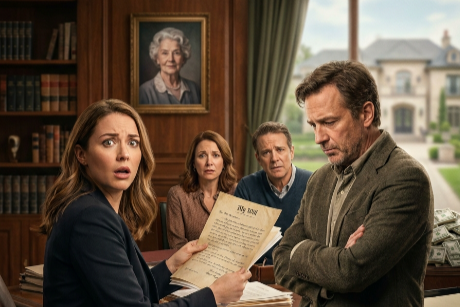
“I told you it was a mistake,” my husband’s lawyer whispered, his face turning completely pale as he stared at the documents the judge was holding.
I need you to understand how we got to that courtroom. I am not a writer or a legal genius. I am a dental receptionist from Toledo, Ohio. For 15 years, I sorted paper charts, argued with insurance companies, and collected copays. I know what it means to work hard for every single dollar. My husband, Richard, sold commercial building materials. To the world, we were a happy, stable Midwestern couple. We drove our old Chevy Malibu until the rust ate through the passenger doors. We clipped coupons, grew beefsteak tomatoes in our backyard, and rarely went out to eat.
We saved everything. We had a joint savings account with exactly $180,000 in it. That was our life savings. It was meant for our retirement, our safety net, our future.
Our house sat on three acres of quiet, wooded land that had belonged to my family for three generations. When we got married, we built a modest ranch home there. It was my dream house. But my father, Thomas, never fully trusted Richard. My father was a retired county surveyor and land title clerk. He spent 40 years studying property lines, deeds, and local tax records. He had a quiet, sharp mind, and he could see right through people.
When my father got sick and was staying in the hospital, he called me to his bedside. He was weak, but his mind was still completely clear. He reached under his pillow and pulled out an old blue plastic binder with a cracked spine, held together by a yellow rubber band.
“Clara,” he whispered, his voice raspy. “Keep this safe. Do not put it in the filing cabinet. Do not tell Richard. Just keep it in your closet under the old winter blankets.”
I thought he was just being paranoid. He died two weeks later, and I put the blue binder in the closet, exactly where he told me to, and completely forgot about it. I was too busy grieving to think about property paperwork.
Two months after the funeral, Richard came home on a Tuesday evening. He had a stack of papers in his hand and a very casual smile on his face. He tossed a cheap blue pen onto our kitchen counter.
“Hey, babe, just sign this real quick,” he said, pouring himself a glass of iced tea. “It is just some standard tax reassessment paperwork for the county. Just a tax thing. Don’t even worry about reading it, it is mostly legal jargon.”
I trusted him. He was my husband of 12 years. I signed the paper on the laminate kitchen table while I was heating up some leftover spaghetti. I did not even look at the title of the document. I just wanted to finish dinner and go to sleep.
That was my biggest mistake.
Three weeks later, Richard did not come home. Instead, I got a text message saying he needed space. When I tried to log into our bank account to pay the electric bill, my screen showed a balance of zero. My stomach dropped. I felt a cold weight settle in my chest. I drove straight to the bank. The teller looked at me with pity. Richard had walked in with a cashier’s check request and emptied all $180,000.
Then the sheriff showed up at my front door with divorce papers.
It got worse. I found out that the document I signed on the kitchen table was not a tax form. It was a quitclaim deed. I had legally signed over our entire house and the three acres of land to his mother, Susan.
Susan showed up at my house the very next morning. She did not even knock. She walked right through the front door, wearing her expensive Sunday coat, carrying a tape measure.
“You need to start packing, Clara,” she said, looking around my living room with a cold smirk. “Richard and I are putting this place on the market. It is my house now. You have thirty days.”
My chest went completely numb. I could hear my own pulse drumming in my ears. I did not scream. I did not cry. I just stood there in the kitchen, holding a dirty coffee mug, watching her measure the windows.
Not when I worked fifty hours a week.
Not when we skipped our tenth anniversary because he said we could not afford it.
Not when I wore the same faded winter coat for six years to save money.
He had planned this for months, and his mother was in on it the entire time.
I spent three weeks in a state of absolute panic. I could not afford a high-priced divorce lawyer. Richard’s lawyer was one of the most expensive attorneys in the county. I felt completely defeated. On the night before our first court hearing, I was looking through my closet for a decent blouse to wear. That was when my hand brushed against the old blue plastic binder hidden under my winter blankets.
I pulled it out and sat on the floor. I opened the cracked spine and started reading my father’s neat, handwritten notes.
Inside were decades of county land records, certified deeds, and a legal trust agreement. My father had bought our three acres of land fifty years ago, but he had never actually deeded it to me directly. Instead, he had placed the land into a strict, generation-spanning family trust. The trust agreement was ironclad. It stated that the land, and any structures built upon it, were the sole property of the trust. It could never be sold, transferred, or encumbered without the written, notarized consent of the appointed trust administrator.
And the sole trust administrator was me.
Richard had used a crooked notary public, his cousin Todd, to sign off on the quitclaim deed. But my father’s trust documents proved that the quitclaim deed was completely illegal because the property was never in my name to begin with. It belonged to the trust, which had strict rules against spousal transfers.
On the morning of the court hearing, the room felt sterile and cold. Richard sat at the defense table, wearing a new suit. His mother, Susan, sat in the front row of the gallery, looking incredibly smug.
Richard’s lawyer stood up first. He smiled warmly at the judge.
“Your Honor, this is a very straightforward asset division case,” the lawyer said. “The wife has no assets. She owns no home, and she has no savings. She signed a voluntary quitclaim deed transferring the marital residence to my client’s mother. We have the certified deed right here. My client is simply asking for a clean break.”
The judge, a stern older man named Judge Miller, looked over his glasses at me. “Mrs. Reynolds, you do not have legal representation present today. Do you have anything to present to this court before we proceed?”
I stood up. My knees felt weak, but I kept my voice steady.
“Yes, Your Honor,” I said, walking to the bailiff. “I have this binder. It contains the original land deeds and the trust documents for the property. My father was a county title examiner, and he prepared these before he died.”
The bailiff handed the blue plastic binder to the judge.
Richard let out a soft, mocking laugh from his table. His lawyer leaned back in his chair, looking bored.
But as Judge Miller started flipping through the pages of the binder, the silence in the room became incredibly heavy. The judge’s eyebrows knitted together. He stopped on a page with a gold county seal and read it twice. He flipped to the notary signature on Richard’s quitclaim deed, then back to the trust rules.
Judge Miller’s face went completely serious. He slowly took off his reading glasses and leaned forward, looking directly at Richard and his lawyer.
“Mr. Reynolds,” the judge said, his voice dropping to a deadly quiet tone. “You have a very serious problem.”
Richard’s smirk instantly vanished. His lawyer sat up straight, his face suddenly losing all its color.
“Your Honor?” the lawyer stammered.
“This quitclaim deed is not only completely void,” Judge Miller said, tapping his finger on my father’s documents. “It appears to be a fraudulent transfer of trust-protected property. The land and this house belong to a family trust. The husband had no legal right to transfer it, and this notary signature by a Mr. Todd Reynolds is a major violation of state notary laws. I am referring this matter to the county prosecutor’s office immediately.”
Susan gasped loudly from the gallery. Richard looked like he was about to throw up.
“Furthermore,” Judge Miller continued, looking down at his notepad. “I am issuing an immediate emergency order to freeze all bank accounts associated with Richard Reynolds and Susan Reynolds. The $180,000 removed from the joint savings account will be returned to the court’s registry within forty-eight hours, or Mr. Reynolds will be held in contempt and jailed immediately.”
Richard’s lawyer looked like he wanted to crawl under the table. He leaned over and started whispering frantically to Richard, whose head was buried in his hands.
Outside the courtroom, Susan tried to corner me near the elevators. Her face was bright red, and she was clutching her designer purse like a shield.
“You planned this!” she screamed, her voice echoing down the marble hallway. “You knew about that trust the whole time!”
I did not say a word. I just watched her through the elevator doors as they slowly closed.
It took six months of legal battles, but the hammer fell hard. Richard’s cousin, Todd, had his notary license permanently revoked and faced a heavy fine for document fraud. Richard had to return every single penny of the $180,000. Because he had spent a portion of it on a down payment for a new truck, he had to sell the truck at a massive loss and borrow money from his mother to cover the court order.
Our divorce was finalized three months later. I kept the house, the three acres of land, and the full $180,000 in savings as part of the final settlement.
Yesterday, my coworkers at the dental clinic threw me a small party to celebrate my new chapter. We had sheet cake and drank cheap sparkling cider in the breakroom. It was loud and messy, and for the first time in years, I did not have to worry about saving every single penny.
When I got home, the house was completely quiet. I walked out to the backyard garden. The tomato plants were starting to sprout, and the grass was thick and green. I sat on the back porch with a cup of chamomile tea, looking out at the woods my father loved.
The blue plastic binder is back in my closet, resting on the top shelf where I can see it every day. I still miss my father terribly, but every time I look at that blue spine, I know he is still watching over me.
THE END.