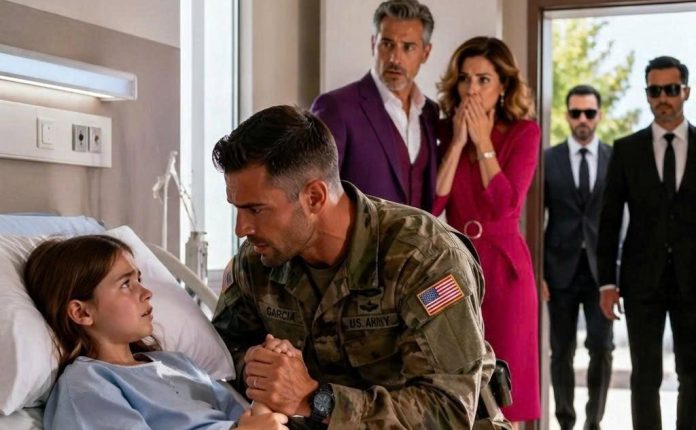
“My mom pushed me,” Maya says, and the quiet weight of the truth fills the room until it is almost impossible to breathe.
Dr. Sterling does not react with shock or judgment, but she immediately turns to the nurse and asks that I step out into the hallway for a moment so she can conduct the exam in private.
I want to argue, to stay by Maya’s side so she does not feel abandoned, but I understand the importance of the protocol. I spend the next twelve minutes standing by a wall covered in medical posters, staring at my phone as it vibrates with messages from Selene asking why I am not home yet.
I realize now that every message, every conversation, and every laugh we shared over the last few years has been colored by the reality I am only just discovering.
When the door finally opens, Dr. Sterling calls me back in, and her expression has hardened into a professional, resolute mask.
“The bruising is consistent with the report, and while there is no fracture, I am concerned about the severity of the soft tissue trauma,” she says.
“She also shared that this is not an isolated incident,” she adds, and the room seems to tilt beneath my feet as my blood turns to ice.
I look at Maya, who is sitting on the edge of the examination table, and I feel a profound, devastating guilt for all the times I thought I was just being a busy provider. I believed I was working for our future, but I was actually leaving my daughter alone in a house where the air was thick with tension and the threat of violence.
“Because this involves a parent, I am required to file a report with the child protection authorities immediately,” Dr. Sterling says, and she looks at me to gauge my reaction.
I nod my head, and the motion feels like the most significant thing I have ever done in my life.
“Do it,” I say, and my voice is firmer than I ever thought possible.
The doctor looks at me with a momentary flicker of relief, and she asks if I have any hesitation about the process.
“Not a single one,” I reply, and I reach out to take Maya’s hand, feeling the small, fragile strength in her fingers.
The rest of the night is a blur of social workers, pediatric specialists, and questions that tear open the wounds we are trying to heal. Maya tells them about the laundry room, the darkness, the way she was made to sit and wait for hours, and the way she was forbidden from mentioning any of it to me.
Every word is a physical ache in my chest, and I realize that the distance between us was the exact space where this abuse was allowed to flourish.
By the time we reach the temporary housing the authorities helped me locate, it is nearly one in the morning, and the world has been permanently altered by the events of the last few hours.
“Dad, are you going to stay?” Maya asks as I tuck her into the bed.
“I am right here, and I am not going anywhere,” I say, and I pull a chair next to the bed to watch over her until the sun comes up.
My phone rings again, and I see Selene’s name on the screen, but I let it go to voicemail twice before I finally decide to pick it up.
“Where are you? I came home and the house was dark, and I don’t know what you think you are doing,” Selene says, her voice starting with a tone of sharp authority that she usually uses to win arguments.
“We are at a hotel, and we are not coming home tonight,” I say, keeping my voice low and devoid of the typical patience I used to show her.
“What are you talking about? Are you trying to kidnap our own daughter?” she asks, and I can hear the shift in her voice as she realizes the situation is escaping her control.
“Maya told me what happened with the push, and I have the medical reports to prove that she has been injured,” I say, and I wait for her to deny it or make an excuse.
“She is a child and she is confused, and you are just looking for a reason to make me look like a bad mother,” she snaps back.
“I saw the marks on her body, Selene, and I am not having this conversation with you right now,” I say, and I terminate the call before she can escalate the argument further.
The next few weeks are a legal and emotional battlefield, and I realize that the process of reclaiming our lives will be far more difficult than the initial discovery.
My sister, Sarah, arrives from out of state to provide a buffer for Maya, and her presence is a gift of stability that we desperately need. Maya begins regular therapy sessions with Dr. Aris, a woman who understands the language of trauma and helps Maya navigate the complex emotions she is feeling about her mother.
Selene attempts to portray herself as a victim of my sudden instability, but the consistency of Maya’s testimony and the medical documentation makes her narrative impossible to maintain in front of the judge.
Returning to our old house to pack our things is an experience that feels like visiting the scene of a crime, and every corner of the place reminds me of the secrets I was living alongside.
I find Maya’s list in the nightstand drawer, and the sight of her small, pencil-written reminders about not spilling and not crying makes me realize that she had essentially been living as a soldier in a war I refused to see.
I sit on the floor of her room and hold the paper against my heart, promising that I will never again be the person who wasn’t there to hear her whisper.
The court hearings are long and exhausting, and I watch as Selene tries to frame her actions as a consequence of her own stress, as if my work schedule or our domestic pressures could ever justify the pain she inflicted on a child.
The judge does not buy it, and the final ruling grants me primary custody while allowing for only highly supervised visits for Selene, provided she undergoes extensive therapy. It is not a moment of cinematic triumph, but it is a step toward justice, and for the first time in years, I can see a horizon that does not involve walking on eggshells.
Life in the new apartment is simple, and we spend our time building a routine that is based on safety, predictability, and the freedom to be imperfect without fear of reprisal.
One afternoon, Maya is drawing at the kitchen table, and she accidentally knocks over a glass of water, causing it to pool across the table and drip onto the floor.
She freezes in her seat, her eyes wide and fixed on the floor, and I can see her bracing herself for the anger that she has been conditioned to expect. I walk over to the counter, grab a handful of paper towels, and wipe it up while talking about nothing important, making sure to keep my voice light and relaxed.
“It’s okay, Maya, it’s just water, and it’s very easy to clean up,” I say, and I see her relax as she realizes that the world has not ended.
“You’re not mad?” she asks, her voice small.
“I am not mad, and I would never be mad at you for having an accident,” I tell her, and I smile as she goes back to her drawing.
That night, she stands in the doorway of her room and asks me if I will read to her, and I realize that the most important work I will ever do is the work of being present.
We have a long way to go before the trauma is completely in the past, but we are moving forward, one day at a time, with the kind of honesty that is finally capable of keeping us both safe.
The house, the furniture, and the life I once thought were the most important things have been replaced by the quiet, sacred reality of my daughter’s laughter. I sit by her bed as she drifts off to sleep, and I know that I have finally become the father she needed all along.
THE END.