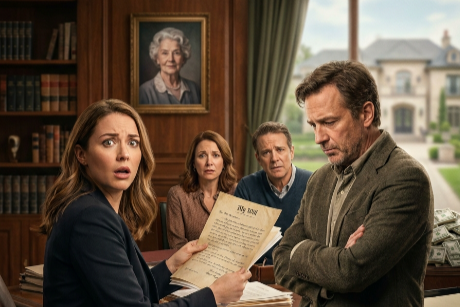
“When we leave this building, that lake house won’t be yours anymore, Felicia. You will finally understand that you are not the one calling the shots in this family.”
Isabelle whispered those words directly into my ear, her voice dripping with a chilling, artificial sweetness, just moments before the bailiff called our case. She said it with a calm, predatory smile, as if she could already see herself lounging on the porch of my private getaway in Aspen, sipping expensive wine from a glass she never worked a single hour to afford.
My mother, Beatrice, sat right behind her with her designer handbag resting stiffly on her lap, wearing that look of haughty pride she reserved exclusively for when Isabelle managed to bully someone. My father, Marcus, kept his lips pressed into a thin, white line, projecting an aura of cold disapproval as if he were the self appointed moral authority of our entire bloodline.
To them, I was always the black sheep, the daughter who moved out without asking for permission and never looked back. I was the one who refused to get married by twenty five and the one who prioritized building a successful logistics empire over organizing tedious Sunday brunches just to stroke my aunts’ egos.
Isabelle, on the other hand, was always their golden child, the sweet daughter and the exemplary wife who perpetually needed financial bailouts that everyone simply ignored. Whenever Isabelle pretended to cry, they would rush to comfort her with open arms and checkbooks, but when I faced my own struggles, they simply told me that I was tough enough to handle it alone.
The cabin in Aspen was my sanctuary, a place with stone walls, cedar beams, and a private dock I bought after years of working through holidays, weekends, and even when I was bedridden with fever. It was my only respite, my hard earned reward, and my quiet corner of the world.
Now, my sister and her spineless husband, Patrick, were trying to steal it from me using a pathetic, fraudulent deed.
We walked into the courtroom, and Patrick marched forward as if he were the one who owned the entire judicial system. He wore a stiff, dark suit and polished shoes, carrying the smug arrogance of a man who believes every single person has a price tag.
As he brushed past me in the aisle, he leaned in and murmured, “It would be better for everyone if you just stopped making a scene, because your parents are already incredibly disappointed in your behavior.”
I didn’t bother responding to his nonsense, choosing instead to sit down next to my attorney, Gregory Vance, a composed man who had spent the last few weeks telling me to let them talk themselves into a corner.
Judge Katherine Sterling walked into the room, and the entire gallery stood in silence as she took her seat. Isabelle’s lawyer stood up immediately, adopting a tone of rehearsed solemnity.
“Your Honor, my client formally requests that the private agreement signed by her sister, Felicia, be honored, in which she voluntarily cedes the family property located in Aspen to my client. We believe this is fair, given that the defendant has no children or family legacy that justifies her holding onto such a significant estate.”
I felt my mother nodding in agreement right behind me, her expression one of complete vindication.
The true source of their bitterness was laid bare in that moment, as they firmly believed that a woman without a husband or children simply did not deserve a large house. They especially hated that I owned a beautiful home that my favorite sister had been green with envy over for nearly a decade.
The lawyer handed over the forged document, and my alleged signature appeared at the bottom, shaky and poorly slanted, as if a child had tried to copy my handwriting in the dark.
Isabelle dabbed at her eyes with a silk handkerchief, letting out a single, calculated, fake sob.
“I truly just want the promise she made to be kept, because that house is a family legacy,” she lied through her teeth.
The judge scanned the document with a bored expression, but then she paused, her brow furrowing as she flipped to the next page. She squinted at the text for a long moment before finally looking up at me.
“Ms. Felicia, this property is listed as being registered under the name of a corporate entity rather than an individual,” the judge noted.
“That is correct, Your Honor,” I replied, feeling my pulse steady.
Isabelle stopped her fake crying instantly, her eyes darting between her lawyer and the judge.
The judge looked back down at the paperwork and asked, “Is this cabin in Aspen one of your holdings?”
The silence in the room became heavy and suffocating as I looked at my sister, then at my parents, and finally back at the bench.
“Yes, Your Honor,” I replied clearly, “it is one of twelve different properties.”
Isabelle’s composed, victorious smile vanished as if someone had physically ripped a mask off her face. I honestly could not believe what was about to unfold, but the look of pure terror on her face told me everything I needed to know.
“Twelve different properties?” my mother blurted out, completely losing her composure and forgetting she was in a formal courtroom.
The judge glared at her, forcing my mother to shrink back into her seat while her face turned a bright, humiliated shade of red.
Isabelle looked at me as if I had committed some grand act of treason by not disclosing my net worth to her. Patrick, meanwhile, stopped puffing out his chest, his eyes darting frantically around the room as he tried to calculate his exit strategy.
“To clarify for the record,” the judge said, “exactly what other properties are part of this corporate portfolio?”
My lawyer stood up and addressed the court with a firm, confident voice.
“Your Honor, my client currently owns various commercial retail buildings in Austin, luxury condominiums in Miami, a massive logistics warehouse in Boise, and three other residential estates. The property in Aspen was never a family inheritance, as she purchased it entirely with her own capital long before her sister ever decided to make a fraudulent claim.”
My father clenched his jaw so tightly I thought he might crack a tooth.
For years, they had called me selfish for refusing to lend them money, and they had called me cold for refusing to subsidize Isabelle’s reckless spending. They constantly mocked my business trips and my late nights at the office, never once asking what I was actually building.
They had simply assumed that because I didn’t brag about my success, it didn’t exist.
Isabelle’s lawyer stood up, clearly rattled and sweating under his collar.
“That revelation does not change the fact that there is a legally binding document signed by the defendant,” he argued weakly.
Attorney Vance opened his black leather folder with a calm smile.
“Actually, that is precisely why we need to discuss the validity of that signature,” he said.
Isabelle blinked rapidly, her voice trembling as she asked, “What exactly do you mean by that?”
My lawyer handed a thick file to the judge, who began reviewing the contents with a sharp eye.
“We have submitted a formal forensic report which confirms that the signature on this supposed agreement does not belong to my client, as it is a clear forgery,” he explained.
“That is a total lie!” Isabelle screamed, forgetting her manners. “She absolutely signed it, I saw her do it!”
The judge slammed her gavel down once, demanding silence in the courtroom.
Patrick sat there in complete shock, not saying a single word to defend his wife.
That silence was the final piece of the puzzle I needed.
My lawyer walked toward the large display screen at the front of the room.
“We also have irrefutable evidence regarding how this entire document was fabricated,” he announced.
The screen lit up, showing a clear, high definition video feed of my private office in Aspen. The timestamp on the footage was from October fourth, which was nearly two months after the supposed signing date on the document.
The office door swung open on the screen, and Patrick walked in, looking around nervously.
My mother let out a sharp gasp, Isabelle covered her mouth in shock, and my father just stared blankly at the screen.
In the video, Patrick walked directly to my desk, opened several drawers, rummaged through my private files, and pulled out my company letterhead. He then snatched a pen from my desk, checked the hallway one more time, and exited the room with the stolen materials.
Mr. Vance paused the footage just as Patrick turned his face toward the security camera, confirming his identity beyond a shadow of a doubt.
“The defendant entered private property without any authorization and stole my client’s corporate stationery,” Mr. Vance told the court. “Later, that exact stolen stationery was used to draft the document presented by the plaintiff.”
Patrick stood up, his face flushed with a mixture of rage and panic.
“That proves absolutely nothing, and besides, those cameras were not supposed to be there!” he shouted.
For the very first time that day, I looked him directly in the eyes.
“I was inside my own home, Patrick, which means you were the one who had no business being there in the first place.”
Isabelle turned toward him, her body shaking with a mixture of fear and betrayal.
“You told me she had signed it, and you told me we only needed to put a little bit of pressure on her!” she wailed.
Patrick laughed, but it was a jagged, hollow sound.
“Do not try to play the saint now, Isabelle, because you were the one who said you couldn’t stand seeing your single sister living a better life than you,” he spat back.
My mother started sobbing loudly, and my father finally closed his eyes, looking as though he had aged ten years in the span of five minutes.
The judge demanded silence, but the chaos was already too far gone to contain.
Then, my lawyer pulled one final, thick envelope from his briefcase.
“Your Honor, there is one last piece of evidence that the court needs to see,” he said.
When Isabelle saw the envelope, I knew she realized that there was no way out of this nightmare.
Mr. Vance opened the envelope with methodical care.
“Your Honor, we are presenting verified, certified screenshots of private text conversations between Ms. Isabelle and Mr. Patrick,” he declared.
Isabelle shook her head, her face turning pale.
“No, you cannot use those, they are private,” she cried.
Patrick looked at her with pure hatred, snarling, “Did you actually save those messages?”
She began to weep, but this time her tears were useless.
My lawyer began reading the messages aloud for the court record.
“Isabelle writes to her husband, ‘If Felicia says she didn’t sign it, my parents are going to pressure her, because she always caves in when we make her feel guilty.’ Patrick replies, ‘With the paper and the forged signature, the judge isn’t going to look too closely, and she doesn’t have a family, so she won’t fight back.’”
My chest tightened, but I kept my head high.
Then he read another exchange.
“Isabelle texts, ‘That cabin should have been mine, because I have a husband and I can fill it with a real family, while she just uses it to feel superior to us.’”
My mother was weeping silently into her hands now.
My father no longer looked angry, but simply withered and defeated, as if he had finally realized that he had not raised a beloved daughter, but rather a daughter who was only interested in what she could take from others.
The judge looked over the documents one last time before turning her gaze to the couple.
“Did you knowingly present a fraudulent document to this court with the express intention of dispossessing Ms. Felicia of her rightful property?” she asked coldly.
No one dared to answer.
Isabelle tried to crawl toward me, reaching for my hand.
“Felicia, please, I was just so desperate, and Patrick kept filling my head with these ideas, and you have so much while I have nothing,” she pleaded.
I pulled away, my voice icy.
“You did not want my help, Isabelle, you just wanted to punish me for achieving a life of my own without asking for your permission.”
My father stood up, his voice cracking.
“Felicia, please think about this very carefully, because she is your sister and you cannot just destroy the family like this.”
That sentence cut through me, bringing back a lifetime of suppressed pain.
I had heard those words every time Isabelle broke my toys, every time she stole my money and refused to pay it back, and every time she humiliated me at family dinners. My parents had always demanded I stay quiet because family was supposed to come first.
But in that moment, I finally understood the truth.
A family that only contacts you when they want to take from you is not a refuge, it is a liability.
The judge issued her ruling without hesitation.
“This lawsuit is dismissed with prejudice. The District Attorney’s office is ordered to be notified immediately to open an investigation into potential forgery, criminal trespass, theft, and attempted fraud upon this court.”
Patrick slumped back into his chair, looking like a man who had finally realized his life was over.
“No, no, there has to be a mistake here,” he stammered.
Two police officers walked into the courtroom, and Isabelle started screaming his name.
My mother begged the officers not to take him away, and my father tried to appeal to the judge as if he could still fix the situation with his hollow, paternal authority.
Nobody listened to them for a second.
As Patrick was led away in handcuffs, Isabelle turned to me with desperation in her eyes.
“Please, just drop the charges, you cannot do this to me,” she shrieked.
I stepped close enough that only she could hear my voice.
“I didn’t do anything to you, Isabelle, I simply stopped saving you from your own terrible decisions.”
A few months later, Patrick lost his career and eventually accepted a plea deal in exchange for a lighter sentence.
Isabelle sold her house in a suburb to pay for her mounting legal fees and was forced to move back into my parents’ home, living in a cramped attic room they used to store old, broken boxes.
I returned to my cabin in Aspen on a clear, crisp afternoon.
I sat in front of the stone fireplace with a cup of coffee and, for the first time in my adult life, I felt true peace without a single drop of guilt.
That evening, my mother sent me a long, manipulative audio message.
“Felicia, your sister is struggling and needs money, so do not be so harsh, you have plenty to spare,” she complained.
I deleted the audio before the first sentence even finished playing.
I finally learned that forgiveness does not always mean opening your door to those who hurt you.
Sometimes, forgiving means locking the door, staying silent, and letting those who tried to destroy your peace learn exactly how to live without it.
THE END.