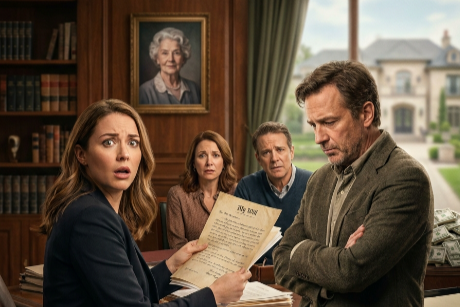
My father let out a theatrical, impatient sigh, tapping his fingers on the wood as if I were wasting his valuable time.
“Yes, yes, we read the news, it’s an absolute tragedy, but now, regarding the liquidity of the funds,” he prompted, clearly irritated.
“But when you dig into the internal maintenance logs of Zenith Logistics, the trucking company involved, they tell a vastly different story,” I interrupted, my voice slicing through his bluster.
My mother’s painted-on smile twitched, and I saw a hairline fracture form in her composure.
“What internal records, and what on earth are you blabbering about?” she asked, her voice tight with sudden anxiety.
Out of the corner of my eye, I saw Marcus’s thumb abruptly halt its endless scrolling, and his phone slowly lowered to his side.
There it was, the first genuine crack in their united, greedy front.
My family had always viewed my profession with thinly veiled disdain, as they only cared for numbers when they could be inherited, manipulated, or stolen.
They never understood that ledgers are just diaries written in mathematics, and that they hold secrets that never lie.
“Zenith Logistics has been hemorrhaging cash for two years,” I explained, my tone clinical, as if presenting a quarterly review to a board of directors.
“To survive, they began funneling money through an intricate network of phantom shell vendors, billing for fictitious repairs and logistics fees,” I continued.
“And one of those primary consulting firms belonged to you, Marcus,” I added, turning my head to lock eyes with my brother.
My brother, the undisputed golden child, the flawless son my parents worshipped while I was perpetually dismissed as the ordinary afterthought.
“Two weeks prior to the intersection collision, your supposed consulting company, Horizon Partners, received a wire transfer of exactly sixty-two thousand dollars,” I stated clearly.
“Three days before the crash, the senior mechanic at the Zenith depot flagged the brakes on truck number four hundred and nine as critically unsafe,” I said, my voice steady.
“The replacement parts were ordered, and an invoice for the mechanic’s overtime was generated and marked as paid in full,” I explained, watching them grow pale.
I finally lifted the cover of the black folder, exposing the truth to the fluorescent kitchen lights.
“The physical repairs were never executed, and the funds for the brake overhaul vanished through a digital labyrinth directly into your offshore holding account,” I said.
“The driver of that truck couldn’t stop at the red light because his brakes were completely compromised,” I whispered, leaning over the table.
“My daughter’s chest was crushed because greedy men signed fraudulent invoices and cashed blood money,” I said, my voice trembling with controlled rage.
“I have absolutely no idea what you are suggesting,” Marcus stammered, abruptly standing up straight, his phone slipping from his grip and clattering onto the floor.
I flipped the folder open and rotated it so the first page faced him, revealing a bank statement with his name highlighted in neon yellow.
His arrogant expression vaporized, replaced by the pale, terrified visage of a cornered animal realizing his life was over.
My mother gasped, grabbing his forearm as if she could physically shield him from the consequences of his actions.
“Marcus, what is she talking about?” she demanded, her voice rising in panic.
My father stood up, his chair scraping violently against the floorboards, and his voice dropped to a low, menacing baritone.
“Jane, I suggest you tread very, very carefully right now,” he threatened, staring at me with cold eyes.
A quiet, broken laugh escaped my throat, sounding foreign and almost demonic in my dead kitchen.
“Careful, because you possess the sheer audacity to waltz into my home, after skipping the burial of your own granddaughter, purely to extort me for money, and you tell me to be careful?” I challenged him.
My mother, ever the master of psychological warfare, attempted a rapid recovery, forcing a smile that didn’t reach her eyes.
“Jane, darling, please, this is simply the grief talking, and the trauma is making you paranoid and confused,” she pleaded.
“No,” I replied softly, shaking my head. “For the absolute first time in my entire pathetic existence as your daughter, my vision is crystal clear.”
Marcus thrust a trembling finger toward me, his face red with a mixture of anger and absolute terror.
“You have no solid proof, you just hacked some emails, that is inadmissible and you are bluffing!” he shouted, desperate to maintain control.
I calmly turned another page in the binder, revealing encrypted wire transfer receipts and highly confidential emails demanding kickbacks.
There were also subpoenaed text messages from a burner phone, acquired through a sympathetic former colleague who still owed me his career.
And the final piece was a crisp, high-resolution photograph of Marcus clinking whiskey glasses with Zenith Logistics’ corrupt CFO at a gala.
Marcus swallowed audibly, the sound loud in the tense air as he stared at the evidence of his own destruction.
My father slowly leaned across the table, his eyes darting frantically between the documents and my face, his menacing posture melting into desperate negotiation.
“Alright, let’s talk like adults, so how much liquid cash would it take to make this entire folder find its way into the fireplace?” he asked.
And there it was, the ultimate validation, the ugly, undeniable confession hiding beneath decades of inherited arrogance.
I reached into my blazer pocket, retrieved my smartphone, and placed it gently on the table next to the folder.
The screen was illuminated, and a red timer was counting upwards, showing fifteen minutes and forty-two seconds of recorded audio.
But they had no idea who was listening on the other end of that phone.
Chapter 3: The Blueprint of Ruin
“No,” my mother breathed, the single syllable a fragile, terrified exhalation as the color drained from her face.
“Yes,” I replied, my voice a steel trap snapping shut on their futures.
With a sudden, explosive roar, my father lunged across the table, his heavy hands scrambling wildly for the phone to stop the recording.
He knocked over the black folder, scattering the meticulously organized evidence across the floor in a flurry of white paper.
“Police! Nobody move!”
The command tore through the kitchen like a gunshot, freezing everyone in place.
From the darkened hallway leading to the guest bedrooms, Fiona stepped into the light, flanked by two broad-shouldered detectives in plainclothes.
Their badges were prominently displayed, and their hands rested cautiously near their holstered weapons as they stepped into the room.
My parents froze in grotesque tableaus of panic, my father splayed half across the oak table and my mother with her hands clamped over her mouth.
Marcus, operating on sheer adrenaline, stumbled backward until his hip slammed violently into the kitchen counter.
His elbow caught Samuel’s favorite chipped ceramic coffee mug, which teetered on the edge for a heart-stopping second before plummeting to the tiled floor.
CRASH.
The ceramic shattered into a hundred jagged pieces, echoing in the sudden silence of the room.
For one brief, terrifying second, the icy composure that had sustained me for weeks completely fractured, and a wave of white-hot rage surged through my veins.
I wanted to leap over the table and wrap my hands around my brother’s throat, but I inhaled sharply and dug my fingernails into my palms until they drew blood.
Detective Henderson, a stoic man with a gaze that had seen decades of human depravity, calmly stepped forward and picked up my phone with a gloved hand.
He stopped the recording, nodding to me as he said, “Thank you for your cooperation, Mrs. Miller, we have everything we need.”
My mother’s jaw worked soundlessly for a moment before she managed to find her voice to protest.
“This is an outrage, this is an illegal ambush, and you are trespassing on private property!” she shouted at the officers.
“So was your granddaughter’s funeral,” Fiona spat back, her eyes blazing with protective fury as she stared down my mother.
“But you didn’t seem to care much about those boundaries either,” she added, her voice dripping with pure, unadulterated contempt.
Marcus pointed at me, his finger shaking so violently it looked as though he were vibrating with pure, unadulterated fear.
“She set us up, she lured us here, she trapped us!” he screamed at the detectives, desperate to shift the blame.
I walked around the table, the soles of my shoes crunching deliberately over the shattered pieces of Samuel’s favorite mug.
I stopped inches from my brother’s face, my voice barely louder than a sigh as I spoke.
“No, Marcus, you meticulously built this trap all by yourself, wire transfer by wire transfer,” I whispered.
“I just finally stopped pretending I couldn’t read the blueprints,” I added, meeting his frantic, bloodshot eyes with a steady gaze.
Detective Henderson gestured to his partner as they approached, and the room seemed to shrink.
“Marcus, you are under arrest for wire fraud, grand theft, and conspiracy to commit insurance fraud,” he announced.
The words hit the kitchen like thunderclaps, and I knew that the pending investigation for accessory to negligent homicide would follow soon after.
As the cold steel cuffs ratcheted around Marcus’s wrists, my mother completely lost her mind and threw herself at the second detective.
“Stop it, let him go, my son is a good man, he’s an entrepreneur!” she shrieked, clawing at his jacket.
“Jane, tell them, tell them this is a horrific misunderstanding because you are his sister!” she begged, turning her wild eyes toward me.
I stood perfectly still, offering her nothing but the hollow, dead stare she had created through her years of neglect and manipulation.
My father, realizing aggression had failed, pivoted to his final strategy of manipulation, smoothing his wrinkled linen shirt as he tried to look pathetic.
“Jane, honey, please, try to understand, we are grieving too, we’re in shock, and we aren’t thinking straight,” he said, his voice trembling.
A dry, bitter chuckle escaped my lips as I looked at the man who had abandoned his own family in their darkest hour.
“Grieving, because you literally texted me that Penelope’s funeral was trivial,” I reminded him, my tone devoid of any pity.
My mother burst into massive, theatrical sobs, tears streaming through her expensive foundation as she clutched her husband’s arm.
“I was upset, I was emotional about the flights, I didn’t mean it, I swear on my life I didn’t mean it!” she cried out.
“You meant every single syllable,” I corrected her, my tone cold and clinical as I watched the scene unfold.
Detective Henderson cleared his throat and pulled a secondary warrant from his interior jacket pocket, looking directly at my parents.
“Mr. and Mrs. Smith, we also have corroborated evidence indicating that both of you received substantial, undocumented cash transfers from Vanguard Consulting,” he said.
My father’s face went completely blank, the mask of the patriarch utterly destroyed by the reality of the situation.
My mother gripped the edge of the granite counter to keep from collapsing, her breath coming in short, panicked gasps.
“That, those were gifts, he was just taking care of his parents,” she stammered, looking around for a way out.
“It was systematic money laundering,” I clarified, speaking to them as if they were slow, confused children.
“And you were staggeringly foolish enough to spend those illicit funds on international beach resorts while your granddaughter was being lowered into the ground,” I said.
As the officers began dragging Marcus toward the front door, he dug his heels into the rug, twisting his head back to look at me.
“You think you’ve won, Jane, you think putting me in a cage brings them back!” he shrieked, spit flying from his lips.
“You have nothing, you’re completely alone now, Samuel is dead, Penelope is dead, you’re going to rot in this empty house all by yourself!” he yelled.
The screaming stopped, and the kitchen fell so silent I could hear the rain beginning to lightly patter against the windows again.
I stepped slowly toward the doorway, moving until I was bathed in the porch light, forcing him to look directly into my face.
“No, Marcus,” I said, my voice resonating with an absolute, terrifying certainty.
“I lost the two people I loved more than the universe, but you just lost the only person who spent her entire life protecting you from the consequences of your own mediocrity,” I told him.
For the very first time in his thirty-four years of existence, my golden-boy brother had absolutely nothing to say.
And as the cruiser doors slammed shut, the real work began.
Chapter 4: Yellow Slides and Sunrise
The arrests dominated the evening news cycle for weeks, and the ensuing domino effect was swift and merciless for those involved.
Upon seeing the writing on the wall, the CFO of Zenith Logistics attempted to board a private charter jet to a country lacking a US extradition treaty.
He was intercepted by federal marshals on the tarmac and flipped on Marcus in exchange for a plea deal before the ink on his confession was even dry.
Marcus’s domestic and offshore accounts were instantly frozen, and the sprawling suburban estate my parents owned was seized by the federal government.
The wrongful death civil suit I filed against Zenith Logistics never even made it to the courtroom because they settled for a staggering, eight-figure sum.
I didn’t keep the money, as the very thought of it sitting in my bank account felt like carrying a rotting corpse.
Instead, I purchased a massive, neglected two-acre lot directly behind the elementary school where Penelope was supposed to start kindergarten.
I hired the best landscape architects and playground designers in the state, determined to build something that would last.
Six months later, the Penelope Memorial Playground officially opened to the public as a masterpiece of pure, unadulterated joy.
The ground was covered in a soft, bouncy rubber material, and the climbing structures were both elaborate and incredibly safe for the children.
Soaring above it all were three massive, twisting enclosed slides, all painted a brilliant, blinding canary yellow because Penelope believed yellow was the color of happiness.
At the far edge of the park, set away from the chaos of the swings, I had them plant a mature, sweeping Japanese Maple tree.
Beneath its crimson canopy sat a heavy, wrought-iron and cedar reading bench where parents could watch their children play.
I put it there because Samuel always believed that every child, regardless of their background, deserved a quiet place to get lost in a good story.
On a crisp Tuesday morning in October, just as the sun began to peek over the horizon, I stood at the wrought-iron entrance gates.
Fiona walked up beside me, her breath pluming in the chilly autumn air, and held out a steaming paper cup of black coffee.
“You doing okay, Jane?” she asked softly, her eyes tracking a group of early-bird children racing toward the yellow slides.
I wrapped my hands around the warm cup, feeling the heat seep into my cold fingers as I watched the scene.
I looked past the playing children, my eyes resting on the polished granite dedication stone embedded near the reading bench.
“In Loving Memory of Penelope and Samuel. The Light Remains,” I read, feeling a bittersweet smile touch my lips.
The grief was still there, curled tightly in my chest, but it was no longer the only thing inside me anymore.
It was a chronic condition, an ache that would flare up on rainy Sundays or whenever I smelled pancakes, but it didn’t occupy every room of my soul.
Last week, my mother had sent a letter from the minimum-security federal correctional facility where she was serving her sentence.
The envelope had been thin and cheap, and the letter contained only two sentences, written in her familiar, looping cursive.
“We are family, Jane, please, find it in your heart to help us,” she had written, expecting me to save her again.
I had read it once, and then I simply folded it with meticulous care and slipped it into the very back of the black leather folder.
Then, I closed the binder and placed it on the highest shelf of my bookshelf, letting it gather dust where it belonged.
“Yeah,” I finally answered Fiona, watching a little girl with backward pigtails shriek in delight on the swings.
“I’m going to be okay,” I promised, taking a sip of the coffee and turning away from the shadows of the past.
I walked forward into the bright, morning sunlight, feeling lighter than I had in years, and finally, undeniably free.
THE END.