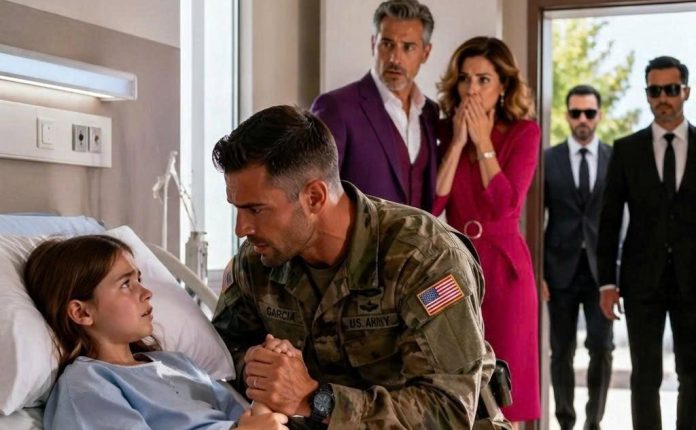
The hidden zippers had spilled their contents onto the sterile floor. My military ID, a handwritten note on cream stationery, the sealed bank envelope, and the urgent medical packet were all visible.
Dr. Peterson scooped up the medical report, his eyes scanning the first page. His expression darkened instantly, a storm gathering in his gaze.
“Get radiology on standby,” he barked, his voice booming with authority. “Page vascular surgery right now.”
Joanne blinked, her annoyance faltering for the first time, replaced by a flicker of confusion. “What is that?”
Dr. Peterson ignored her for a highly satisfying second, focusing on the urgent tasks at hand. Then, he turned his gaze on my mother, his eyes cold and unforgiving.
“It is a report from an imaging center,” he stated. “Your daughter was instructed to come to the ER three hours ago for an active internal bleed and a suspected splenic artery aneurysm.”
The room went dead silent. The only sound was the frantic, erratic beeping of my heart monitor, a stark reminder of my precarious state.
“The bloodwork confirms it,” Dr. Peterson continued, his voice dripping with barely concealed rage, a righteous anger directed entirely at my family. “This was not a panic attack, it was not dehydration, and it certainly was not dramatics.”
Nurse Jenkins picked up the cream stationery and the bank envelope. She handed them to Sophie, who was staring at the floor, her hands trembling uncontrollably.
I knew exactly what the note said. I had written it in my car as a desperate attempt to buy their love and to prove my worth.
“Sophie,” the note read, “For the venue, the flowers, the band, or whatever makes the day perfect. I know Mom says I never show up for you, but I hope this proves I do. Love, Harper.”
Inside the envelope were cashier’s checks totaling twenty three thousand dollars. I had sold my beloved motorcycle, the only thing I truly owned that brought me joy.
I had worked grueling double shifts, exhausted myself beyond measure, and lived on ramen for eight months to afford it. Sophie read the note. Her face morphed from confusion, to shock, to a deeply ugly and devastating shade of shame.
The realization of her own callousness, mirrored in the handwritten words, seemed to finally penetrate her self absorbed bubble. Joanne took a hesitant step toward the envelope, her eyes wide as she asked, “That is for the wedding?”
I looked at the woman who had raised me, the woman who had consistently prioritized a party over her daughter’s life. Not, “Harper, I am so sorry.” Not, “Are you going to live?” Just, “That is for the wedding?”
“It was,” I rasped, my voice weak and a fragile thread connecting me to the living, but laced with a potent and undeniable venom.
Dr. Peterson stepped between us, a protective shield blocking my family’s toxic presence. “This conversation is over,” he said. “She is going to surgery, and unless you are medical personnel, get out of my trauma bay.”
“I am her mother,” Joanne snapped, her pride finally wounded and her sense of entitlement flaring up. Dr. Peterson did not blink, his resolve unwavering as he said, “Then start acting like one.”
The next few minutes were a blur of chaotic motion, a frantic dance of medical professionals fighting to save my life. A CT scan quickly confirmed the worst: the aneurysm was actively leaking, a ticking time bomb threatening to detonate at any moment.
“We have to operate now,” Dr. Peterson told me, his face grave and the weight of the situation etched into his features. “It is highly unstable.”
I looked through the glass doors, the barrier separating me from the family that had nearly cost me my life. Sophie and Joanne were standing in the hallway, looking lost and disoriented. Sophie was still clutching the bank envelope, her knuckles white.
A sudden and sharp clarity broke loose inside my chest, piercing through the fog of pain and fear. It was a moment of profound realization, a severing of ties that had long been toxic and debilitating.
“Doctor,” I said, grabbing his wrist with the last ounce of my fading strength. I looked at my sister through the glass, my gaze steady and unflinching. “Tell her not to touch that money, not one single dollar.”
The OR doors swung shut with a heavy thud, sealing me inside the cold and bright room. The anesthesia hit my veins, a warm wave of darkness washing over me, and I closed my eyes, entirely unsure if I would ever open them again.
Surgery felt like a stolen chapter of my life, a void where time ceased to exist. One moment I was staring at the blinding surgical lamps, and the next, I was clawing my way through a heavy, drug induced fog.
A heart monitor beeped in a slow and steady rhythm, a reassuring sound that tethered me to reality. I opened my eyes, the world slowly coming into focus.
My throat felt like sandpaper, raw and dry, and my abdomen was packed with what felt like wet concrete, a heavy, dull ache that radiated through my entire body. “Welcome back,” a gentle voice said.
Nurse Jenkins was adjusting my IV, her touch deft and reassuring. “Did I make it?” I croaked, the words barely a whisper.
She offered a warm and tired smile, a glimmer of genuine care in her eyes. “You did. It was close, but you are a fighter.”
Later that evening, Dr. Peterson came in to explain the procedure, his demeanor calm and professional, yet tinged with a palpable sense of relief. They had repaired the artery just before a catastrophic rupture, a testament to his skill and the swift action of the medical team.
I had lost a massive amount of blood, a testament to the severity of the internal bleeding, but I was stable and the immediate danger had passed. “Your family is in the waiting room,” Dr. Peterson said carefully, studying my chart with a guarded expression.
“Your sister cried, but your mother had questions,” he added. “What kind of questions?” I asked, bracing myself for the inevitable onslaught of demands and complaints.
His expression turned meticulously neutral, a practiced mask that betrayed nothing. “Billing, visitor access policies, and the protocol for releasing a patient’s personal property to next of kin.”
I let out a broken and wheezing laugh that made my stitches burn, a harsh, humorless sound that echoed the absurdity of the situation. “Of course she did. Did you let them in?”
“Not without your permission. Do you want to see them?”
I looked out the window at the dark Columbus skyline, the city lights twinkling like distant stars, indifferent to the drama unfolding within the hospital walls. A sense of profound peace settled over me, a quiet acceptance of the truth I had finally acknowledged.
“No, ban them from the floor,” I said. He nodded, a silent look of approval passing between us, a shared understanding of the necessity of boundaries.
Over the next three days, the universe decided to test whether surviving a near death experience had truly taught me how to set those boundaries. Eleanor tried to bypass security by calling the nurses’ station under fake names, a desperate attempt to assert control and gather information.
Sophie sent white lilies, which she knew I was allergic to, followed by a massive, generic fruit basket and a long, rambling text message claiming that wedding stress makes people say things they do not mean. It was a pathetic attempt at an apology, devoid of genuine remorse or understanding.
Only Mark, Sophie’s fiancé, sent a message that felt real and resonated with genuine concern and shock. “I just found out about the money and what happened in the ER,” the text read. “I am sick to my stomach because I had absolutely no idea. Please focus on your healing, Harper.”
On the fourth day, the hospital social worker came in with my estimated medical bills, her expression sympathetic but professional. The number printed on the bottom of the page was staggering, a stark reminder of the financial burden of my near death experience.
I looked at my belongings bag on the chair, a simple plastic bag holding the remnants of my life before the hospital. The bank envelope was inside, securely guarded by the nursing staff, a tangible symbol of my misplaced devotion.
“Can I use my own cashier’s checks to pay my hospital balance?” I asked the social worker, my voice steady and my resolve firm.
She smiled kindly, an understanding glint in her eyes. “If they are in your name and unendorsed? Absolutely.”
There was no grand cinematic swelling of music, no dramatic monologue, and no sweeping declarations of independence. Just simple, life saving arithmetic.
The money I had saved to buy my family’s love would now pay for the care that had saved my life. That night, Sophie sent the text that finally severed the last frayed thread between us, the final nail in the coffin of our relationship.
“Harper, I know you are hurting,” the text read. “But if you cannot give the full twenty three thousand, can you at least just cover the venue balance? They are threatening to cancel, but we will pay you back after the honeymoon.”
I read it three times, letting the sheer audacity and the staggering selfishness of her request sink in. Then, I typed my reply, the words flowing with a newfound clarity and conviction.
“You watched me bleed out on a gurney, and you still think I owe you centerpieces?” I sent. I blocked her number immediately, a decisive action that felt like shedding a heavy burden.
I blocked my mother’s number, severing the connection to the woman who had consistently failed to be a mother. I called the bank, canceled the checks, and redirected every single cent to my medical and recovery accounts, reclaiming my hard earned money and prioritizing my own well being.
For years, I had believed that being the family workhorse was a sign of moral strength, a testament to my resilience and dedication. I thought my silence, my sacrifices, and my endless accommodating bought their love and their approval.
But lying in that hospital bed, surrounded by the sterile hum of medical equipment, I realized a brutal truth. Love that only accepts your labor is not love; it is access and exploitation masquerading as affection.
The next morning, I needed a ride home, a simple logistical hurdle that would have previously involved a fraught negotiation with my family. But this time, I refused to call them.
Instead, I texted Riley, a tough and no nonsense former army medic I worked logistics contracts with, a woman whose friendship was based on mutual respect and genuine care. Riley showed up two hours later in an oversized hoodie, her demeanor practical and unfazed, carrying a massive duffel bag that seemed to hold everything but the kitchen sink.
“What is in the bag?” I asked as she helped me into a wheelchair, her movements swift and efficient.
“Tupperware full of homemade soup, extra gauze, electrolyte drinks, and a mechanical grabber tool so you do not pop a stitch picking up your TV remote,” Riley said deadpan. “Don’t make it weird.”
I almost burst into tears, the genuine care and concern overwhelming me. It was the first time in my life someone had simply cared for me without requiring a transaction, without demanding a sacrifice, and without expecting anything in return.
Riley drove me to my apartment, a quiet sanctuary away from the chaos of my family, and stayed while I settled in, her presence acting as a comforting anchor. We were just opening the soup, the warm and savory aroma filling the small kitchen, when a sharp and aggressive knock hammered against my front door.
I knew that knock, as it was the sound of entitlement and demands from the family I had just excised from my life. Riley looked through the peephole, her eyes narrowing and her jaw clenching.
“It is an older woman carrying a Prada bag, and she looks incredibly pissed off,” Riley said. “Want me to tell her to kick rocks?”
I took a deep breath, clutching my scarred abdomen and feeling the throb of healing tissue. This was a confrontation I could not avoid, a final boundary I had to establish.
“No,” I said, my voice steady and my resolve firm. “Let her in, because it is time to end this.”
Joanne marched into my apartment as if she owned the air inside it, her presence domineering and suffocating. She did not look at Riley, dismissing her as a minor obstacle.
She looked at me, her eyes sweeping over my pale face and the thick blanket draped over my legs, her expression devoid of any genuine maternal concern. “Harper,” my mother said, her tone dripping with rehearsed disappointment, a manipulative tactic she had honed over decades. “You look terrible.”
“I had an organ repaired, Mom,” I replied flatly, refusing to engage with her melodramatics. She sat on my sofa uninvited, crossing her legs like a picture of haughty indignation.
“Your sister is completely devastated,” she said. “She has been crying for two days.”
“Because her sister almost died?” I asked, my voice laced with a bitter irony. Joanne’s jaw tightened, her true priorities revealing themselves as she said, “Because you canceled the cashier’s checks. The venue is threatening to pull our reservation, and you are creating a massive family division right before the most important day of Sophie’s life.”
I looked at her, and the last, desperate, childlike hope inside me, the fragile hope that she might finally act like a mother, withered and died. It was a final, necessary death.
“I canceled the checks to pay the surgeon who saved my life, Joanne,” I said, the words ringing with a finality that brooked no argument. She flinched at the use of her first name, a subtle shift in the power dynamic that she clearly detested.
“Harper, do not be cruel,” she said. “I know emotions were high in the ER.”
“You told a trauma doctor that Sophie needed my money more than I needed a CT scan,” I stated, my voice echoing coldly in the small living room, the words a stark condemnation of her actions.
“I was panicking!” she defended, her voice rising in a frantic attempt to justify the unjustifiable.
“No, you were prioritizing,” I corrected her, my tone unwavering. “I worked double shifts for almost a year and I sold my motorcycle, all because some pathetic part of my brain believed that if I bought Sophie’s dream wedding, you two would finally love me.”
“But in that ER, you proved exactly what my life is worth to you,” I continued. The room went deathly silent, the weight of the truth hanging heavy in the air.
Joanne stood up, her face flushing dark red as the mask of the refined matriarch crumbled to reveal the petty, vindictive woman beneath. “You have always been jealous of her, and you make everything difficult, but we are your family!”
“Not anymore,” I said, pointing a trembling finger at the front door, a decisive gesture that finalized the severance. “Get out and do not ever come back.”
She stared at me, realizing with a growing sense of panic that I was not backing down, that the old Harper, the compliant and self sacrificing Harper, was gone. She grabbed her designer bag, her movements sharp and jerky.
“You will deeply regret this, Harper,” she hissed. “Maybe,” I said, looking her dead in the eye, my gaze steady and unflinching. “But I would regret it more if I let you keep treating me like a walking ATM.”
Riley opened the door, a silent sentinel enforcing my boundaries. Joanne walked out, her heels clicking furiously down the hallway, the sound fading into the distance in a final, satisfying retreat.
When the door clicked shut, the silence in the apartment was deafening, a profound and expansive silence that held the promise of a new beginning. I did not cry. I did not feel the familiar pangs of guilt or obligation.
I just felt incredibly and wonderfully light, as if a massive, suffocating weight had been lifted from my shoulders. Saturday arrived, the day of the royal wedding and the culmination of a year of stress, planning, and misplaced priorities.
The weather in the city was completely perfect, seventy degrees and sunny, a beautiful day that stood in stark contrast to the ugliness that had unfolded over the past week. I sat on my couch in loose sweatpants, eating a bowl of Riley’s soup and feeling the dull ache of my healing incision, a physical reminder of the trauma I had survived.
There was a time when missing a family event, especially one of this magnitude, would have destroyed me with guilt, a gnawing sense of failure and inadequacy. But today, my absence felt like absolute justice, a necessary assertion of my self worth.
At two in the afternoon, my phone buzzed on the coffee table. It was a text from Mark. “I thought you should know,” the text read. “I canceled the wedding.”
I set my spoon down, staring at the glowing screen as the words slowly sank in. A second text popped up. “What Sophie did in the hospital was not wedding stress, it was a revelation of her character,” Mark wrote. “I refuse to marry someone who would watch her own sister die over a catering bill, so I hope you heal well, Harper.”
I did not feel gleeful. I did not laugh. I did not feel a sense of vindictive triumph.
I just felt a profound and quiet sadness. Sadness for the man who had to learn the truth about his fiancé through such cruelty, a painful revelation that shattered his illusions.
And sadness for the family I had spent my whole life trying to fix, a family that was fundamentally broken, beyond my capacity to repair. Thirty minutes later, my phone began ringing frantically.
It was an unknown number, but I knew exactly who it was. The frantic and persistent ringing was a testament to the chaos unfolding in the wake of Mark’s decision.
I let it go to voicemail, refusing to be drawn back into their toxicity. When I listened to it later, Sophie’s voice was hysterical, a raw and unfiltered scream of rage and despair.
She screamed that I had ruined her life, that Mark had walked out, and that the embarrassment was entirely my fault, a frantic attempt to assign blame and evade accountability. I deleted the voicemail and permanently blocked the number, severing the final tie and closing the door on a chapter of my life that I would never revisit.
Six months later, my scar had faded from a violent, angry red to a pale, silver line cutting across my stomach, a permanent mark and a daily reminder of the day I stopped dying and finally started living. It was a testament to my resilience, a physical manifestation of the boundaries I had drawn and the life I had reclaimed.
I had moved into a brighter apartment on the other side of the city, a fresh start and a clean slate. I was back to working logistics contracts, my bank account was recovering, and the funds I had saved for a wedding were now investing in my future.
And my medical proxies were legally updated so Joanne could never, ever make a decision for me again, ensuring that my autonomy was protected and my choices respected. I was standing in my new bedroom, getting ready to go out, the evening sun casting long, golden shadows across the room.
My phone buzzed on the nightstand. “Dinner at my place tonight,” Riley texted. “Bring that cornbread you make, and do not be late.”
I smiled, a genuine and unburdened smile. I walked over to my closet and pulled out the olive green tactical jacket, the garment that had been a silent witness to the most pivotal moment of my life.
I had almost thrown it in the trash after the hospital. It felt too heavy, too soaked in the trauma of that day, a painful reminder of the near fatal consequences of my misplaced loyalty.
But holding it now, feeling the familiar and durable fabric, I realized the jacket was not the problem. The jacket had held the truth, the tangible evidence that had finally shattered the illusions and forced a reckoning.
I unzipped the hidden pockets. They were completely empty, the secrets they once held now exposed, the burdens they once carried now lifted.
I slipped my arms into the sleeves. It fit perfectly, a comfortable and familiar embrace. I grabbed my keys, locked my apartment door, and walked out into the cool evening air, the city lights twinkling in the twilight.
I did not wear the jacket as armor anymore. I did not need armor. The walls I had built and the defenses I had erected were no longer necessary.
Now, it was just a jacket. And I was just a woman who had survived the fire, spoken the truth, and finally walked away, stepping into a future defined by my own choices, my own worth, and my own enduring strength.
THE END.