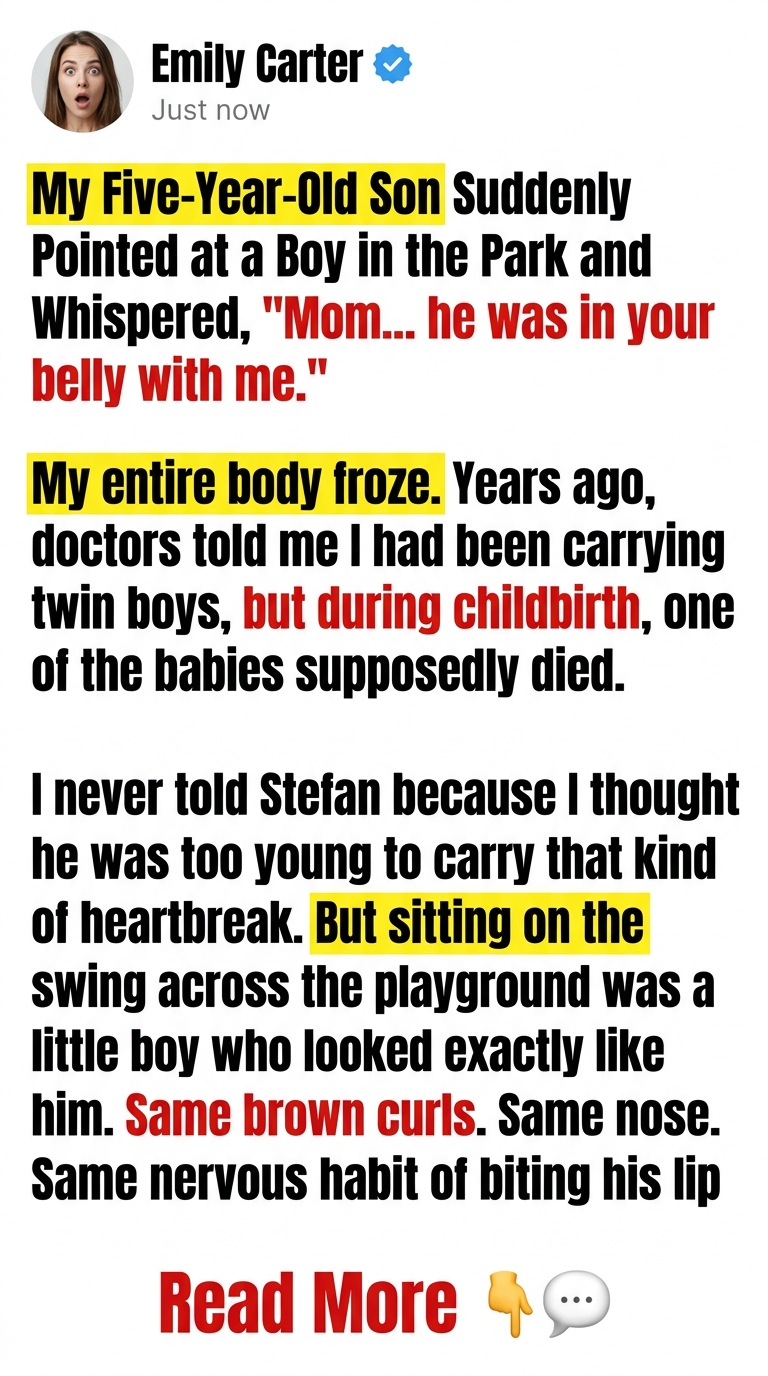
My Five-Year-Old Son Suddenly Pointed at a Boy in the Park and Whispered, ‘Mom… he was in your belly with me.’
My entire body froze.
Years ago, doctors told me I had been carrying twin boys, but during childbirth, one of the babies supposedly died. I never told Stefan because I thought he was too young to carry that kind of heartbreak. But sitting on the swing across the playground was a little boy who looked exactly like him. Same brown curls. Same nose. Same nervous habit of biting his lip. Then my heart nearly stopped when I saw the tiny birthmark under his chin—the exact same one Stefan had.
Panic rushed through me instantly. I grabbed my son’s hand and whispered, ‘We’re leaving right now.’ But Stefan pulled away and ran straight toward the boy. The two children stood face-to-face in total silence… then smiled the exact same smile at the exact same moment. My legs nearly gave out beneath me. I hurried toward the woman sitting beside the swings, desperate for answers. Then she turned around… and I recognized her instantly from the hospital the day I gave birth.
She was older now, her hair threaded with silver instead of the stark, dyed blonde I remembered from that agonizing afternoon half a decade ago, but the shape of her eyes—wide, pale blue, and perpetually darting with a deeply buried anxiety—was unmistakable. She was the attending neonatal nurse. The exact same woman who had placed a heavy, sympathetic hand on my trembling shoulder while the exhausted surgeon delivered the devastating news that my second son had suffered a fatal umbilical cord prolapse during the emergency cesarean section.
The playground around us seemed to instantly dissolve. The joyous shrieks of playing children, the distant hum of city traffic, the rustling of the autumn leaves in the wind—all of it faded into a terrifying, vacuum-sealed silence. My blood ran completely cold, rushing out of my extremities and pounding furiously in my ears.
“You,” I breathed, the single word scraping against my throat like shattered glass.
The woman’s pale blue eyes locked onto my face, and the recognition was utterly instantaneous. The warm, maternal smile she had been wearing just a fraction of a second prior violently collapsed. The color drained from her cheeks with such alarming speed that she looked as though she might physically faint onto the rubber playground mat. Her hands began to visibly tremble, the coffee cup she was holding slipping from her grip and splattering dark liquid across the concrete path.
“I… I don’t know who you are,” she stammered, her voice thin and reedy, a terrible, transparent lie that only confirmed the horrifying truth exploding in my mind. She frantically lunged forward, reaching past me to grab the little boy’s shoulder. “Julian, come here right now. We have to go. We are leaving immediately.”
“Do not touch him!” I screamed, the sound tearing out of my chest with a primal, feral intensity that startled several nearby parents. I threw my body between her and the child, my arms outspread, shielding the boy who possessed my son’s exact face.
The little boy—Julian—looked up at me with wide, confused brown eyes. He didn’t pull away. He didn’t cry. He simply looked at Stefan, who was standing right beside him, and reached out to grasp his brother’s hand. Their small fingers intertwined completely naturally, two halves of a fractured whole instinctively finding their way back together despite five years of stolen time.
“Let me pass,” the former nurse hissed, her panic morphing into a cornered, desperate aggression. She tried to shove her way past my shoulder, her eyes darting wildly toward the park exit. “He is my son! You are scaring him!”
“He is my son!” I roared back, shoving her forcefully away. The physical contact seemed to break whatever final thread of composure she possessed. She stumbled backward against the chain-link fence of the swing set, gasping for air. “You were there. You were in the operating room. You told me he was gone. You stood there and watched me shatter into a million pieces, and you took him!”
By now, the commotion had drawn a crowd. Another mother at the park, sensing the absolute gravity and danger of the situation, had already pulled out her cell phone and was urgently speaking to a 911 dispatcher. I didn’t care about the audience. I didn’t care about the public spectacle. Every single maternal instinct I possessed had completely taken over, transforming me from a terrified mother into an absolute, unyielding fortress protecting the two boys standing behind me.
“You don’t understand,” the woman wept, sliding down the chain-link fence until she collapsed onto her knees in the woodchips. Her hands covered her face, muffled sobs racking her frail body. “You don’t understand what it’s like. You don’t know what the silence does to a house.”
I stood over her, my chest heaving, the adrenaline coursing through my veins making my hands shake violently. “Explain it to me,” I demanded, my voice dropping into a deadly, terrifying calm. “Before the police arrive, you are going to look me in the eyes and tell me exactly how you stole my baby.”
She looked up, her face streaked with tears and dirt, the ultimate facade of her life entirely broken. The confession tumbled out of her in frantic, fragmented sentences, a horrifying window into the mind of a woman driven to absolute madness by her own grief.
She had suffered five consecutive miscarriages. Her husband had left her. Her entire life had dissolved into a bitter, suffocating emptiness. She had returned to her job in the neonatal intensive care unit completely hollowed out, surrounded every single day by the one thing she could never possess. Then came the afternoon of my emergency delivery. The hospital was severely understaffed due to a massive winter storm that had paralyzed the city. The chaotic nature of the twin delivery, the sudden drop in my blood pressure, the alarms blaring—it created a perfect, terrifying blind spot.
“The second baby… he wasn’t breathing at first,” she whispered, looking down at the ground, unable to meet my eyes. “The doctor handed him to me to resuscitate while he fought to stabilize you. I took him to the adjacent warming room. I cleared his airway. He took a breath. He was perfectly healthy.”
She choked on a sob, her hands gripping the fabric of her coat. “But the doctor didn’t know. He was screaming for more blood, completely focused on keeping you from bleeding out. In the chaos, I looked at this perfect, beautiful boy. I knew you already had one healthy son. You had a family. You had a husband. I had absolutely nothing. So… I swapped his identification tags with a stillborn infant from a different ward who had passed away an hour prior. The paperwork was a mess because of the storm. I forged the transfer logs. I forged the death certificate. By the time the doctor came looking for the second twin, I showed him the other infant. He was too exhausted and traumatized by your near-fatal hemorrhage to question the neonatal supervisor.”
I listened to her words, nausea twisting my stomach into brutal, agonizing knots. The sheer, unfathomable cruelty of her actions was almost impossible to process. She hadn’t just stolen a child; she had systematically engineered the darkest, most agonizing trauma of my entire life. She had forced me to pick out a tiny casket. She had forced me to stand in a freezing cemetery and bury an empty, tragic lie, while she walked out of the hospital doors and played house with my living, breathing flesh and blood.
“You buried a piece of my soul,” I whispered, the tears finally breaking free and spilling hot down my cheeks. “You watched me grieve for five years.”
“I loved him!” she cried out defensively, reaching a trembling hand toward the boys. “I gave him a beautiful life! He has everything he could ever want! I am his mother!”
“You are his kidnapper,” I stated, the finality of the word hanging heavily in the crisp autumn air just as the wail of police sirens began to echo in the distance, rapidly approaching the park.
The next forty-eight hours dissolved into a surreal, exhausting nightmare of flashing red and blue lights, sterile police precinct interrogation rooms, and the overwhelming, terrifying machinery of the criminal justice system. The park was immediately locked down. The woman, whose real name was confirmed to be Beatrice Alden, was taken into federal custody without bail, charged with kidnapping, severe medical fraud, and a litany of other federal offenses that would ensure she never saw the outside of a prison wall for the rest of her natural life.
The most agonizing part of the immediate aftermath was the physical separation. Because Julian was technically considered a ward of the state and the victim of a complex federal crime, child protective services had to intervene. For two excruciatingly long days, while emergency expedited DNA tests were processed by the state crime lab, Julian was placed in a highly specialized, trauma-informed emergency foster facility. Stefan, my sweet, perceptive boy who had unwittingly cracked a massive criminal conspiracy wide open, sat in his bedroom window window, refusing to eat, simply asking over and over again when his brother was coming back.
I spent those two days sitting in the offices of high-powered family attorneys, untangling the horrific legal mess Beatrice had created. I learned how she had utilized forged birth certificates and exploited loopholes in the foster-to-adopt system in a neighboring county to legitimize his existence on paper. I learned that she had lived less than ten miles away from us this entire time, hiding in plain sight, entirely convinced that the sheer audacity of her crime was her greatest protection.
When the DNA results finally cleared—a staggering 99.9% maternal match—the judge signed the emergency reunification order with tears in his own eyes.
The morning I drove to the child protective services building to bring Julian home, the sky was a brilliant, cloudless blue. The social worker led me into a quiet, sunlit playroom. Julian was sitting on a colorful rug, quietly building a tower out of wooden blocks. He looked up when the door opened. He looked terrified, confused, and profoundly lost. The only mother he had ever known had been violently torn away from him in a public park, and his five-year-old brain was struggling to process the seismic collapse of his entire universe.
I didn’t rush him. I didn’t overwhelm him with hysterical tears or smother him with demands for affection. I knew that earning his trust, and carefully unraveling the psychological damage Beatrice had inflicted, would be the greatest, most delicate challenge of my life.
I slowly sank to my knees on the edge of the rug, giving him plenty of space. I reached into my bag and pulled out a small, worn plush bear—the exact replica of the one Stefan slept with every single night. I gently slid it across the carpet toward him.
Julian looked at the bear, then looked up at me. His little nose twitched, and his teeth nervously bit down on his bottom lip—the exact same nervous habit I had watched Stefan perform a thousand times.
“Hi, Julian,” I said softly, keeping my voice as gentle and steady as humanly possible. “My name is Mom. And Stefan is waiting in the car to show you your new room.”
He hesitated for a long, quiet moment. The silence stretched between us, thick with the weight of five stolen years. But then, slowly, tentatively, he reached out and picked up the bear. He hugged it tightly to his chest, and for the first time since that horrifying confrontation at the park, he offered a tiny, hesitant smile.
The road ahead was going to be incredibly difficult. There would be years of intense childhood therapy, countless confusing questions, and the monumental task of merging two entirely different lives into a single, cohesive family. But as I finally took my son’s hand and walked him out into the bright sunlight, watching Stefan press his face excitedly against the glass of the car window, I knew that the darkest part of the nightmare was permanently over. The house would never be silent again, and the broken pieces of my soul had finally, miraculously, found their way back home.