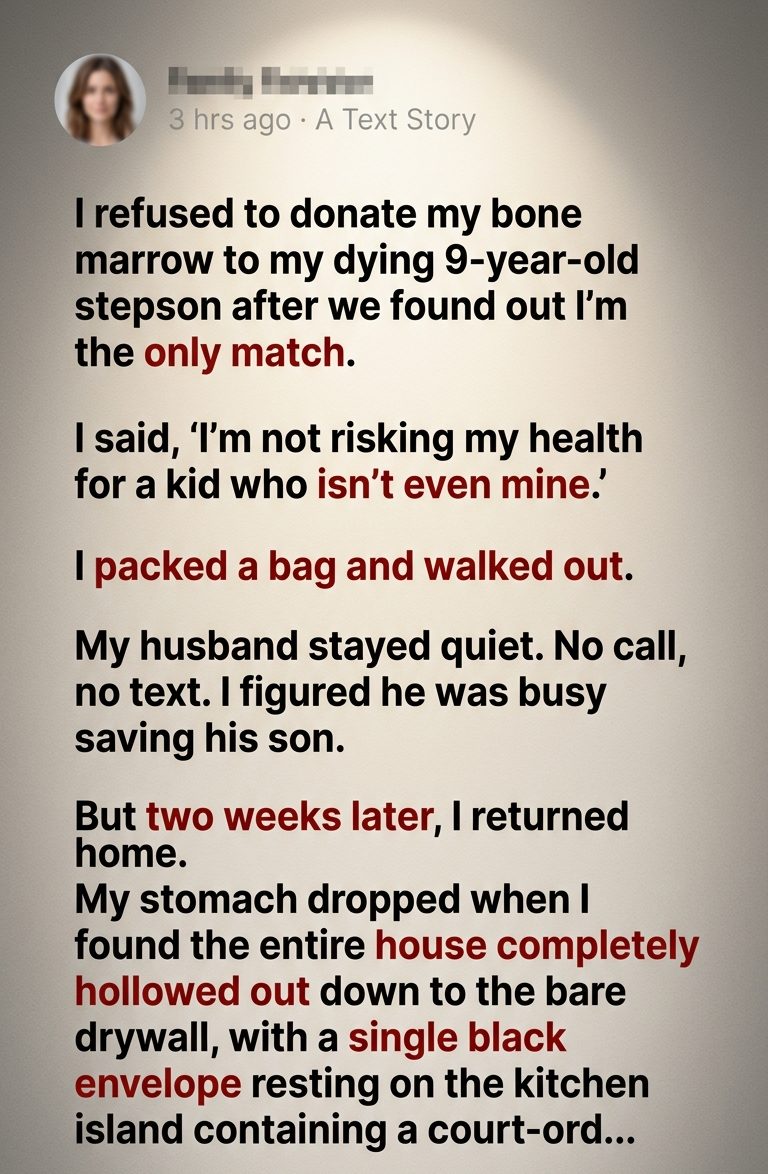
I refused to donate my bone marrow to my dying 9-year-old stepson after we found out I’m the only match. I said, ‘I’m not risking my health for a kid who isn’t even mine.’ I packed a bag and walked out. My husband stayed quiet. No call, no text. I figured he was busy saving his son. But 2 weeks later, I returned home. My stomach dropped when I found the entire house completely hollowed out down to the bare drywall, with a single black envelope resting on the kitchen island containing a court-ordered eviction notice, an asset seizure decree, and a letter that permanently ended my life as I knew it.
The Cold Calculation of Departure
When the medical team at the oncology center first delivered the news, I genuinely thought it was some sort of statistical anomaly or a cruel cosmic joke. Out of the hundreds of thousands of registered donors and the entire extended family, I—the stepmother who had deliberately kept her distance for three years—was the only perfect genetic match for nine-year-old Toby.
My husband, Julian, had looked at me with a desperate, shining hope in his eyes that instantly made me feel claustrophobic. He had reached across the sterile hospital table to grab my hand, his voice trembling as he whispered about miracles. But all I could see were the potential complications of a medical procedure I wanted no part of. I thought of the pain, the recovery time, and the microscopic risks of chronic infection or long-term fatigue. I looked at Toby, pale and fragile in his oversized hospital gown, and I felt nothing but a cold, defensive resentment. He wasn’t my biological child. He was the living, breathing anchor tying Julian to his late ex-wife’s memory.
I didn’t hesitate. I pulled my hand away from Julian’s grasp, stood up in front of the stunned primary physician, and delivered the ultimatum that would set this entire tragedy into motion.
“I am not risking my permanent health or putting my body through a grueling surgical procedure for a kid who isn’t even mine.”
The words had cut through the quiet room like a jagged shard of glass. I didn’t wait to see the devastation on Julian’s face, nor did I stay to hear the doctor’s medical counterarguments. I marched straight out of the oncology wing, drove back to our upscale suburban home, and packed three large designer suitcases with my finest clothes, jewelry, and personal documents.
Julian didn’t follow me home. He didn’t flood my phone with frantic phone calls, and he didn’t send a single text message begging me to reconsider. For the next fourteen days, my phone remained completely, chillingly silent. I checked into a luxury wellness resort in Miami, lounge-sitting by the pool, sipping expensive cocktails, and actively convincing myself that I had made the pragmatic, self-protective choice. I assumed Julian was simply trapped in a state of helpless grief, spending his final days beside his son’s hospital bed, entirely too overwhelmed to argue with a wife who had made her boundaries clear. I fully expected that when the boy inevitably succumbed to his illness, Julian would eventually crawl back to me, broken and desperate for comfort, allowing me to dictate the terms of our marriage moving forward.
My smug satisfaction lasted exactly thirteen days. On the final morning of my stay, when I handed my black titanium credit card to the resort receptionist to settle the massive room service bill, the machine let out a sharp, mocking rejection beep.
“I’m terribly sorry, Mrs. Vance,” the receptionist said, her polite smile tightening with professional awkwardness. “The transaction was heavily declined by the issuing bank. It appears the account associated with this card has been completely closed and flagged by a corporate entity.”
A sudden, sharp spike of anxiety hit my chest. I quickly pulled out my backup cards, but one by one, they were all rejected with the exact same systematic finality. I was forced to drain my meager personal savings account just to clear the hotel bill. Panicked and furious, I threw my luggage into my rental car and began the long drive back home, entirely convinced that Julian had thrown a petty, emotional tantrum by freezing our joint credit lines. I was fully prepared to walk through the front door, unleash my fury, and remind him of the strict legal protections of our marital assets.
But nothing could have ever prepared me for the terrifying reality that was waiting for me at the end of that driveway.
The Hollowed Sanctuary
The first sign of trouble was the absolute stillness of the property. The long, circular driveway, which was usually immaculate, was completely deserted. The custom wrought-iron security gates stood wide open, their electronic mechanisms completely powered down.
I parked the rental car, hauled my suitcases up the limestone steps, and reached for the heavy oak front door. To my surprise, it was entirely unlocked. I pushed it open, stepping into the grand foyer, fully prepared to confront Julian about the frozen bank accounts.
Instead, the words caught in my throat as my voice echoed loudly through a completely vacant cavern.
The house wasn’t just empty; it had been surgically dismantled. The massive crystal chandelier that usually flooded the entrance with warm light had been entirely uninstalled, leaving nothing but a cluster of exposed copper wires hanging from the ceiling. The hand-woven Persian rugs were gone. The expensive Italian leather furniture, the custom oil paintings, the flat-screen televisions, and even the brass light switches had been systematically stripped away. The walls had been roughly patched where frames once hung, leaving the entire house looking like an abandoned, gray concrete skeleton.
I ran frantically from room to room, my high heels clicking loudly against the bare, uncarpeted subflooring. The kitchen was completely gutted—the industrial stainless steel appliances, the marble-topped island stools, and even the high-end espresso machine had vanished. Toby’s bedroom, which had once been filled with bright toys, model airplanes, and books, was nothing but four bare walls and a layer of dust.
My breath came in ragged, hyperventilating gasps as the terrifying magnitude of the situation began to settle into my stomach. This wasn’t a petty act of domestic revenge. This was a massive, highly organized corporate clearing.
That was when I noticed the kitchen island. Though the custom marble countertop had been unbolted and removed, the rough wooden support structure remained in the center of the room. Resting directly on top of the unfinished wood was a single, pristine matte-black envelope. My name was written across the front in a cold, elegant calligraphy that I recognized instantly as the handwriting of Julian’s family attorney.
With trembling, shaking fingers, I tore the envelope open. Three separate documents slid out onto the wood.
The first was a certified, court-ordered eviction notice, giving me exactly zero days to vacate the premises, stating that the property had been transferred to a corporate real estate trust. The second was an asset seizure decree from a federal court, detailing the immediate freezing and liquidation of every single bank account, investment fund, and line of credit I had accessed during our three years of marriage.
But it was the third document—a hand-written letter from Julian himself—that permanently destroyed the comfortable, privileged illusion I had built around my life.
The Letter and the Legacy
The letter began without a greeting, its opening lines carrying a chilling, absolute detachment that made my knees buckle.
To the woman I once thought was my partner,
When you walked out of that hospital room fourteen days ago, you did so under the profound miscalculation that you were leaving a normal, middle-class husband who was entirely dependent on your presence and your mercy. You believed that this house, our lifestyle, and the funds you so eagerly spent at your luxury resort were the products of a standard marital partnership. You believed that by withholding your match, you could punish me for my past and force me into submission.
You never truly bothered to ask where my family’s wealth originated, because you were far too preoccupied with enjoying its benefits. You assumed the Vance name was just an ordinary surname. You had no idea that my late father was the founder of the Vanguard International Shipping Syndicate, or that this house—and every single asset you touched—belonged entirely to a multi-billion dollar generational trust governed by a strict, non-negotiable character and morality clause.
I stopped reading for a second, my eyes wide with horror as the room seemed to spin. My mind raced back through the three years of our marriage. Julian had always been so quiet, so modest about his career as an independent maritime consultant. He wore simple clothes, drove a reliable but unpretentious truck, and preferred quiet family dinners over high-society galas. I had assumed his comfortable income was just the result of a good salary. I had never once suspected that he was sitting on top of an international maritime empire.
The letter continued, the ink biting sharply into the heavy paper.
The morality clause of the Vanguard Trust is explicitly clear: any spouse who exhibits egregious moral turpitude, abandonment, or intentional endangerment of an immediate family heir is immediately and permanently disqualified from any financial claim, marital property, or future support. The moment your refusal to save Toby’s life was officially logged into the hospital’s medical registry, your legal standing as my wife was entirely dissolved under federal trust law.
I spent the last two weeks staying quiet not because I was weeping or helpless, but because I was actively coordinating with our global legal teams to execute a total, scorched-earth extraction. Every single piece of furniture, every luxury item, and every asset in that house was purchased with trust capital. As of 9:00 AM this morning, you own absolutely nothing. The clothes in your suitcases are the final pieces of property you will ever hold from this life.
A loud, sobbing gasp escaped my lips. I dropped to my knees on the cold, bare subfloor, my hands shaking so violently I could barely hold the paper. I was bankrupt. I had no personal savings, no career to fall back on, and my credit reputation had just been utterly annihilated by a global corporate syndicate.
But it was the final paragraph of the letter that delivered the ultimate, devastating blow—a revelation that turned my cold selfishness into an eternity of bitter, unmitigated regret.
You believed Toby was going to die without you. You believed you held the ultimate card of life and death over a nine-year-old boy. But while you were busy pampering yourself in Miami with frozen credit cards, my family’s international medical foundation mobilized.
Six days ago, we located a perfect, alternative bone marrow match through an elite, private European registry that we fund entirely. Toby underwent a completely successful transplant at a private medical facility in Zurich, Switzerland. He is currently recovering beautifully, surrounded by a family that actually loves him. His biological mother’s estate has officially stepped in to formalize his inheritance, and his future is brighter than it has ever been.
When you finish reading this, the private security units stationed at the end of the driveway will enter the house to remove you from the property. Do not attempt to contact me, do not attempt to contact my son, and do not bother hiring a lawyer. You traded a family and a life of unimaginable security for a moment of pure, unadulterated cruelty. Enjoy your health, Maggie. It is the only thing you have left.
The Empty Echoes
The heavy paper slipped from my numb fingers, fluttering face-down onto the dusty wooden floorboards.
Before I could even gather the strength to stand up, the heavy crunch of boots echoed from the front limestone steps. Two tall, stone-faced security guards dressed in dark corporate uniforms stepped through the empty doorframe, their eyes completely devoid of warmth or sympathy. They didn’t say a single word. They simply pointed toward my three designer suitcases sitting in the foyer, and then gestured firmly toward the open exit.
I picked up my bags, my body trembling with a profound, freezing shock that no winter storm could ever replicate. As I walked down the limestone steps of the grand estate for the very last time, looking out at the empty driveway and the rental car I could no longer afford to keep, the absolute weight of my choices crashed down upon me.
I had thought I was being clever. I had thought I was protecting my own health, my own boundaries, and my own future from a child who “wasn’t mine.” But in my desperate attempt to remain entirely untouched by sacrifice, I had systematically dismantled my own existence. Toby was alive, healthy, and moving forward into a world of immense wealth and unconditional love. And I was standing on the side of a deserted suburban road, completely alone, permanently branded a pariah, with absolutely nothing to my name but the clothes on my back and the bitter, suffocating echoes of my own cruelty.