My grandfather passed away alone in a small Indiana hospital

My grandfather, Abner Pickett, was the quietest man I ever knew, and for most of my life people mistook that for emptiness. They saw a man who lived alone in a weather beaten house at the edge of a tired Indiana town and assumed there could not possibly be much behind him.
They saw old jackets, cheap coffee, fixed rather than replaced tools, and a porch that tilted just enough to warn careless visitors. They decided he had lived a small life because the evidence of largeness was not displayed where they preferred to look for it.
“Abner, why don’t you ever put up those old photos from your younger days?” Mrs. Dooley from next door once asked while handing him a peach cobbler. My grandfather just took the dish and said, “The memories stay where they belong, Agnes.”
He did not perform himself for the benefit of others. He did not decorate silence to make other people comfortable inside it.
“Your grandfather is a difficult man to talk to,” my mother, Rhonda, often complained after our Sunday visits. She liked things named and displayed and emotionally legible for everyone to see.
My grandfather never seemed to believe he owed anyone a dramatic explanation for why he had become who he was. That unsettled people because silence with no visible insecurity in it makes most people nervous.
“He just sits there like a statue while I try to tell him about the neighborhood association,” my father, Patrick, would say with a shrug. To my father, Abner was just an aging man who had never turned his past into anything profitable or prestigious.
The town itself was the kind of place travelers crossed without remembering, a small spot in Indiana with a diner that still sold pie for less than bottled water. It had a church on every corner and a downtown area that seemed to have stopped negotiating with modernity sometime in the late 1980s.
“You have to lift the metal door before you pull the handle, or the mailbox will jam on you,” Grandpa told me when I was six. He watched me struggle with the mail and waited for me to figure out the rhythm of the old metal.
To me, it was the safest house in the world. It was not cozy in the way people write about in sentimental essays, but nothing in that house ever lied to me.
“The kitchen clock is three minutes fast because three minutes can save you from looking foolish at a meeting,” he explained when I asked why the time was wrong. There was always soup in the pantry and a sense that if something in your world cracked, this was the place where you could bring the broken piece.
My parents hated visiting because they thought he was being stubborn on purpose. “He could make an effort to be warmer,” my mother would say after one of his long pauses at the dinner table.
My brother, Shane, simply absorbed the family weather and called it his own. “Grandpa has a special skill for making a room uncomfortable without moving a single muscle,” Shane joked during a holiday dinner.
I never found him difficult because I found him exact. He never promised what he did not mean and he never flattered anyone for the sake of politeness.
“If you are going to climb that oak tree, you had better learn where your weight belongs,” he said when I was ten years old. My mother had already told me I would tear my dress, but Grandpa just walked me out to the yard.
He stood beneath the lowest branch and spent an hour teaching me how bark feels when it is healthy. “Don’t trust something just because it looks strong,” he whispered while I reached for a limb.
“Trust it because you tested it,” he added while his hand hovered near my ankle without grabbing it. That was how he taught everything through a sentence, a demonstration, and the expectation that you were capable of learning.
When I was twelve, I asked him if he had ever seen a real battle during his time in the service. He gave me a look that barely moved his mouth but changed his whole face if you knew how to read it.
“I saw enough to know that peace is worth the silence, Cassidy,” he replied quietly. He then took me to the kitchen and showed me how to sharpen a knife properly on a whetstone.
“Focus on the angle of the blade instead of the speed of your hand,” he instructed as the metal sparked. He redirected my curiosity by replacing it with a skill that was sturdy enough to carry me until the next question arrived.
My mother used to complain that he had never learned how to be affectionate. She did not see that he kept the orange popsicles I liked in the back of the freezer even in the middle of January.
“I kept these in case you got a fever, but you can have one now,” he said when I visited during a snowstorm. He was affectionate in ways that were invisible to anyone waiting for the wrong kind of proof.
I joined the Army at nineteen. I wanted to leave the life my parents had drafted for me and find out if the restlessness in me was direction or just rebellion.
“The military is what people do when they do not have better options,” my father said when I told him the news. He leaned back in his chair and looked at me as if I had made a terrible mistake.
“Is this because you are upset about your grades?” my mother asked while looking at me over her wine glass. She seemed to think my choice was an emotional outburst rather than a calculated decision.
I went to see Grandpa the next day to tell him the truth. He was at the kitchen table with the newspaper open and the afternoon light coming through the lace curtains.
“Why the Army, Cassidy?” he asked after folding his paper carefully. He did not ask if I was sure or if my parents approved because approval was never a serious compass for him.
“Because if I am going to do something hard, I want it to mean something,” I told him while holding a mug of his bitter coffee. He looked at me for a long time before nodding his head once.
“That is a good reason,” he said softly. “Just make sure you are running toward something instead of just running away.”
I carried that sentence through basic training and through every difficult moment that followed. My parents drove me to the bus station when I shipped out because it would have looked bad if they had stayed home.
“Call me when you can, and try to stay safe,” my mother said in the same tone she used for a grocery list. My father warned me not to sign anything stupid and Shane told me not to come back brainwashed.
Grandpa did not come to the station. I understood later that he knew exactly what leaving feels like and did not want my last image of him to be a performance for strangers.
He was waiting on his porch when I came home on leave for the first time. He looked at me in my uniform and took in the way basic training had rearranged my body into sharper lines.
“How are your feet, Sergeant?” he asked while holding the screen door open for me. I laughed because no one else in my family had asked me anything so practical or correct.
“They are terrible, Grandpa,” I admitted as I stepped into the kitchen. “That is good,” he replied, “it means you actually used them for something.”
Every time I came home after that, he asked the real things that mattered. “Are you sleeping enough, and is there anybody worth trusting in your unit?” he would ask while we sat on the porch.
My parents never seemed to understand that I had a real career and not just an extended costume. If I mentioned a promotion, my father asked if that meant more paperwork or better pay.
“It must be so stressful to be away from home so much,” my mother would sigh during our phone calls. They listened just enough to describe themselves as interested to their friends at the country club.
I stopped translating my life for them. I did not have to do that for Grandpa because he listened like information mattered even when he did not intend to comment on it.
“I had a leader who made a bad call today, and I am still thinking about it,” I told him once. He just nodded and said, “A leader who does not second guess himself is a dangerous man to follow.”
Then he got sick. The call did not come from my mother or my father.
It came from Mrs. Dooley. “He collapsed in the kitchen, honey, and the ambulance took him to Hopewell County General,” she said with a voice full of fear.
I put in for emergency leave within the hour and began the long drive back to Indiana. My mother sounded distracted when I called her from the road to check on his status.
“The doctors are still running tests, so call me when you know something final,” she said. It was as if she was waiting for a completed report before she decided how to feel.
By the time I reached the hospital, it was just after dawn. The parking lot was wet from old snow and the building smelled like bleach and overheated air.
He was on the third floor. Illness had made him look smaller, and the sight of him lying in that bed broke something inside of me.
“Guess you are the one who did not forget me,” he whispered when he opened his eyes. I sat down and took his hand, promising him that I was there to stay.
“I called Mom and Dad, and they said they would be here soon,” I lied to him. He gave a slight shake of his head because he already recognized the truth of our family.
“They won’t come,” he said simply. I stayed with him for two days while the machines blinked with indifferent competence around us.
My mother said hospitals made her anxious, and my father said work was too busy for him to leave. Shane texted me a thumbs up emoji after I told him the situation was serious.
A nurse named Loretta brought me crackers from the vending machine when she saw I had not eaten. “You can love someone without making yourself collapse too,” she said with a firm but kind voice.
On the second morning, Grandpa squeezed my hand and looked at me with focus. “In the bedroom drawer, top right, keep the handkerchief,” he whispered with great effort.
“What is inside it, Grandpa?” I asked as I leaned closer to his face. “The ring knows better than the papers do,” he replied before slipping back into a deep sleep.
He died that afternoon just after four o’clock. There was no dramatic last speech, just one breath that went out farther than the others and did not come back.
I called my mother from the family alcove down the hall. “At least he is not suffering anymore,” she said, using the clean sentence people use to perform maturity.
My father said he knew it was coming eventually. I arranged the funeral myself because no one else even bothered to ask if there were arrangements to be made.
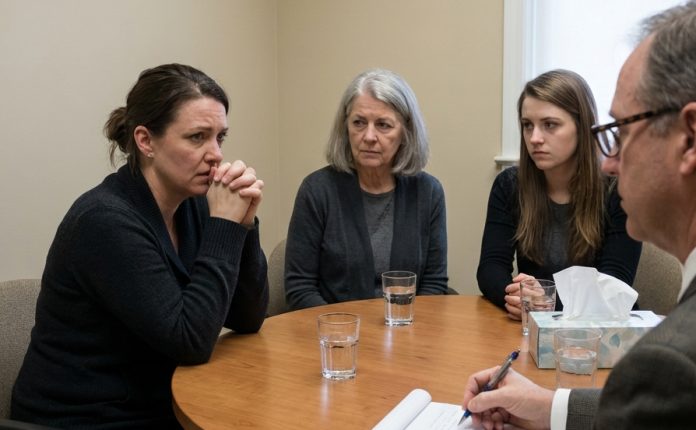
The funeral was on a Thursday, and the church boiler rattled through the hymns. Mrs. Dooley sat in the front pew, and Loretta the nurse came during her lunch break to stand against the back wall.
My parents and my brother did not come. I stood alone beside the casket and listened to the priest speak about peace and service.
It felt obscene that such a strong man was leaving the world with less attention than a broken furnace. After the burial, I went back to his house alone to pack his things.
The house felt like an accusation against time now that he was gone. His jacket still hung on the hook, and his coffee mug sat by the sink with a dried ring at the bottom.
In the bedroom, I opened the top right drawer. Beneath the folded shirts, I found the white handkerchief tied into a small bundle.
I knew what it was because I had seen it on his hand almost my entire life. It was a heavy silver ring, thick and plain, with edges worn smooth by decades of work.
On the inside, a compass rose had been engraved deep into the metal. One point of the compass was blackened, and there were three letters I could finally read.
“It reminds me who I am,” he had told me when I was a child. I put it on my finger immediately, and the weight of it felt grounding in the empty house.
Three weeks later, my parents sold the house. They moved with the efficiency of people handling a nuisance rather than a life.
“It is just an old house, Cassidy,” my mother said when I called her in a rage. I realized then that some arguments are too heavy to carry into a conversation with shallow people.
I went back to my base and tried to focus on my duties. A few months later, I was invited to a formal veterans recognition ceremony in a large hall filled with officers and flags.
I wore my dress uniform and polished my boots until they reflected the dim light. I had the ring on my finger as I talked to a lieutenant colonel about base housing repairs.
“Where did you get that ring, Sergeant?” a voice asked from behind me. I turned to see a general with four stars on his shoulders standing there with a shocked expression.
“It belonged to my grandfather, Abner Pickett,” I answered. The general, whose name tag read Riggs, looked like the color had drained completely from his face.
“We need to talk in private right now,” General Riggs said. He led me into a small side room and shut the door behind us.
“Did your grandfather ever tell you why he refused the Medal of Honor?” he asked. I felt the world lurch under my feet and I had to sit down in a folding chair.
“My grandfather never mentioned any medal to me or anyone else,” I said breathlessly. General Riggs sat down across from me and his eyes were suddenly wet with tears.
“My name is Orson Riggs, and your grandfather saved my life in the jungle forty years ago,” he explained. He told me about a mission that official paperwork had preferred to keep secret for a long time.
There had been bad intelligence and a compromised extraction plan. My grandfather had gone back into the line of fire three times to rescue his team and the local scouts.
“He got hit while doing it, but he refused to leave anyone behind,” Riggs said. The government wanted to give him the medal, but they wanted to change the story first.
“They wanted a clean citation that left out the scouts and the mistakes made by command,” the general continued. They were willing to honor him only if he was willing to accept a lie.
“He told them he would not stand under lights for a medal built on missing names,” Riggs whispered. My grandfather had told them that if the country needed a hero more than the truth, it could look elsewhere.
“I saw that ring and I knew it had to be his,” Riggs said as he looked at my hand. He told me that letters had been sent to my grandfather’s next of kin recently because the files were declassified.
I felt sick as I realized my parents must have seen those letters. “There is more information at the archives if you want to see it,” Riggs offered.
Two days later, I was at a facility outside the city. An archivist wheeled out a metal footlocker with my grandfather’s name stenciled on the side.
Inside were grainy photographs of young men in mud streaked uniforms. There were maps marked in pencil and a field notebook wrapped in waxed cloth.
General Riggs opened another handkerchief bundle that was inside the locker. It contained six silver rings that matched the one I was wearing.
“The team had these made after the war, one for each man who made it home,” Riggs explained. On the inside of each ring was a name like Cooper, Diaz, or Sutton.
“The blackened point on the compass meant that north no longer guaranteed a home,” he said softly. I picked up the field notebook and saw my grandfather’s tight handwriting.
“Do not let them vanish because someone needs clean paperwork,” one entry read. I sat there staring at the words until they blurred together.
The documents showed that my grandfather had spent forty years refusing to let his story be polished. He had never been two different men; he was just a man the world was not patient enough to see.
I called my mother that evening. “I know who Grandpa really was, and I know about the letters from the military,” I told her firmly.
“We didn’t know what those were, Cassidy,” she lied immediately. She tried to claim they hadn’t opened them, but her voice was full of a guilt she could not hide.
“You turned his moral refusal into simple shyness because it was easier for you to live with,” I said. My father took the phone and asked what I wanted from them now.
“I want the truth,” I replied, “and I don’t need your help to find it anymore.” The military began the process of officially correcting the record of that mission.
It was a long process involving boards and legal reviews. My mother was the legal next of kin, so she had to sign papers to delegate the authority to me.
She only did it because the local newspapers started calling for comments. “You got what you wanted,” she snapped at me after she signed the documents.
“No, Mother, Grandpa finally got what he deserved,” I told her before hanging up. The review took nine months of interviews and re examining old maps.
I discovered that my grandfather had sent money to the families of the fallen scouts for years. He had chosen that quiet town to become ordinary on purpose because he did not want to be a monument.
The ceremony to correct the record was held the following spring at a military museum. It was not for the Medal of Honor, but for a Navy Cross under a citation that finally told the whole truth.
My parents showed up in their best clothes to perform for the cameras. My mother cried into a silk handkerchief, and my father tried to act like he had always been proud.
General Riggs stood at the podium and told the real story of the ridge and the men who were saved. “He refused a version of honor that required a lie,” the general told the crowd.
“His granddaughter is the reason this correction became possible,” he added while looking directly at me. I stood up as the citation was read, and I did not look at my parents once.
When Riggs handed me the presentation case, he whispered that my grandfather would have been proud. I felt a sense of presence in the room that was stronger than any ghost.
Outside on the terrace, my father approached me with a look I had never seen before. “I really didn’t know it mattered that much,” he admitted quietly.
“It mattered,” I said, looking at him as an equal for the first time. He nodded and walked away, looking smaller than I had ever remembered him.
My mother never apologized for the hospital, but she apologized for how complicated things became. I stopped waiting for more because waiting for an apology from her was a waste of time.
Shane visited me a few months later and sat at my kitchen table. “I realized I was just borrowing Mom and Dad’s laziness and calling it my own opinion,” he confessed.
The last piece of my grandfather arrived in a box found in the crawl space of his old house. It contained spare buttons, an old pocketknife, and one final envelope.
“For my granddaughter, if she ever asks the right question,” the front of the envelope said. Inside was a letter that told me he was proud of me for learning to ask why before learning to obey.
“I did what I could, then I came home and tried to be decent,” the letter concluded. He had seen the shape of me before I even knew who I was.
I still wear the silver ring every day. Some people notice it, but most do not, and that feels right.
He was the quietest man I ever knew, but he was also the bravest. He taught me that silence is not surrender if you know who you are inside of it.
I miss the ordinary version of him the most. I miss the sound of his screen door and the smell of his strong coffee.
I miss the man who dried his hands on a perfectly folded towel. I keep his memory true by asking why instead of just following the crowd.
I no longer let anyone make me smaller for their convenience. That is his final inheritance to me, and it is worth more than any medal.
THE END.