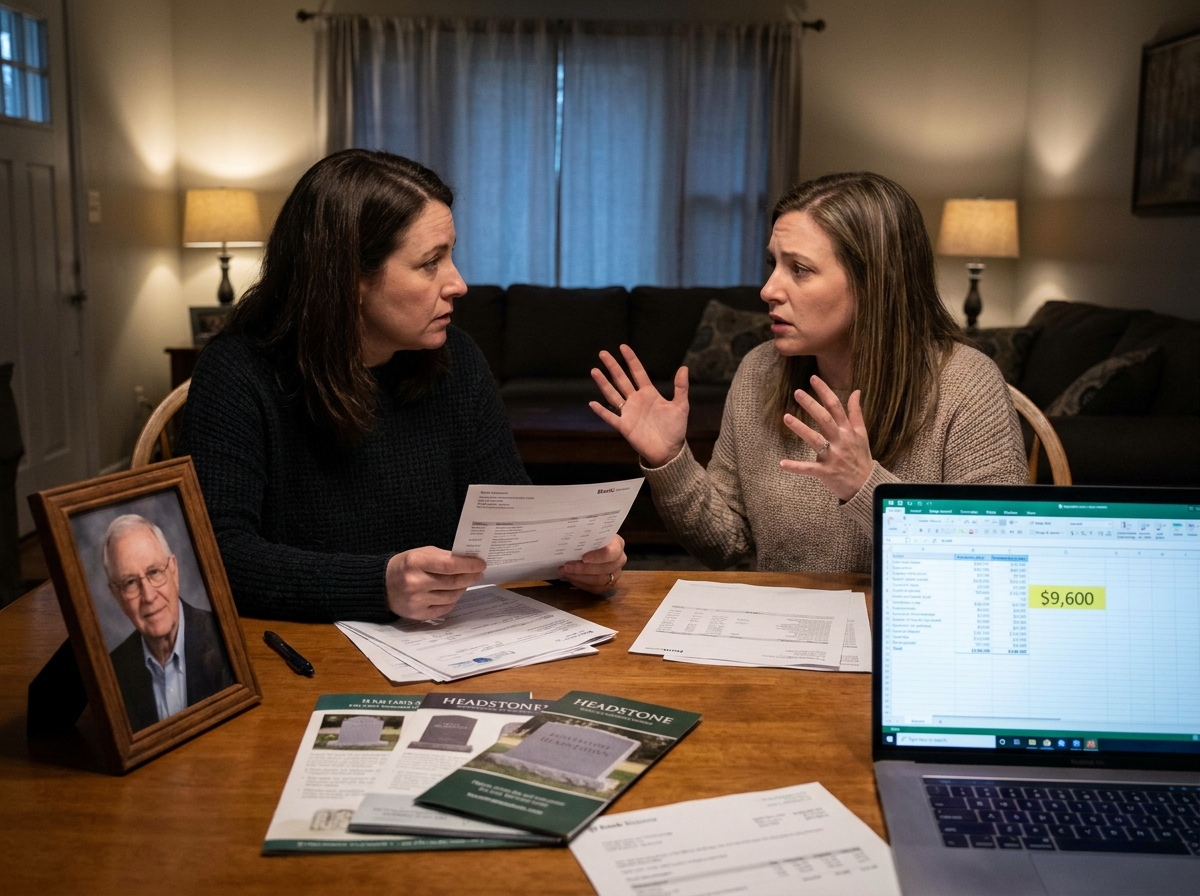
The morning after my father’s funeral, my sister stood in his kitchen holding a legal pad and speaking in that calm, practical tone people use when they want authority to sound like grief. She said the donations from the memorial service would be “handled centrally,” that she would pay the cemetery, the stone engraver, and the church lunch bill once everything settled. By then, friends, old coworkers, neighbors, and men from Dad’s union hall had given more than $9,600 in cash and checks to help cover burial costs and the final months of home hospice. Ten days later, the headstone deposit had not been paid, the church secretary was calling twice a day, and my sister had quietly used the money to catch up her mortgage, settle two maxed-out credit cards, and book herself what she later called “a necessary reset weekend” at a coastal hotel.
It is easy to think betrayal only becomes real when lawyers enter the room or six-figure estates are involved. That was not true in our family. What my sister took was smaller on paper and somehow uglier in spirit. The money had not come from a windfall, a sale, or an inheritance dispute. It came from hands shaking after prayer, from envelopes slid across folding tables, from men who hugged me with their work jackets still smelling like diesel and rain. It came from people who loved my father or respected him enough to want his last expenses handled with dignity. When she spent it, she did not steal from a fund. She stole from the tenderness people offered us when we were too broken to ask for help twice.
My father, Thomas, was the kind of man people trusted with keys, ladders, and bad news. He fixed boilers, patched roofs, stayed late at church fish fries, and answered his phone at hours that should have belonged to sleep. If someone’s car died in January, Dad showed up with jumper cables and coffee. If a neighbor’s son got arrested, Dad stood at the station with folded arms and a look that made foolish boys cry harder than any lecture. He was not wealthy, not polished, and not sentimental in public, but the shape of his life was service. That became obvious only after he died and people started telling us stories we had never heard—utility bills he paid for others, groceries he dropped off without signing the card, two months’ rent he covered for a widow down the block and never mentioned again.
My sister Andrea knew all of that because she had benefited from it more than anyone. Dad co-signed her first apartment when her credit was already damaged. He paid $4,800 to keep her from losing her townhouse during a brutal divorce. He covered three months of daycare for her son when she said child support was delayed. He even cashed out a small certificate of deposit meant for his own dental work to help her avoid a lawsuit over unpaid tuition. She always described those rescues as temporary bridges. Dad, who preferred peace to confrontation, rarely corrected her. But bridges imply movement. Andrea had a talent for building houses on emergency help and calling it bad luck when the structure collapsed.
When Dad got sick, all of us slipped into roles without formally assigning them. I handled insurance calls because I could stay patient on hold. My younger brother took care of yard work and pharmacy runs. Our aunt organized meals. Andrea took over anything involving paperwork, or at least she said she did. She liked clipboards, folders, bank envelopes, itemized lists. She wore competence like jewelry. In a crisis, that kind of performance can be persuasive, especially to exhausted people. During the final six weeks of Dad’s hospice, she was constantly saying things like “I’ll manage the billing side” and “let me streamline this.” What none of us were paying attention to was the difference between managing something and controlling access to it.
By the time Dad died, the numbers were larger than any of us had expected. Hospice equipment not fully covered by insurance. Private night aides for the last twelve days because Dad was afraid to die alone and none of us could safely lift him anymore. A cemetery plot next to my mother. A burial vault he had once said he did not care about but that the cemetery rules required anyway. Flowers, clergy honorarium, obituary costs, printed programs, luncheon trays, thank-you cards. We were staring at nearly $13,000 in immediate expenses, not including older medical balances still trickling in from scans and transport services. The memorial donations mattered. They were not decorative comfort. They stood between us and debt we would carry into the year after losing him.
At the wake, people pressed envelopes into our hands so steadily that my aunt finally placed a brass-trimmed memorial box at the end of the guest book table to keep them from getting misplaced. Andrea immediately positioned herself near it like a volunteer treasurer appointed by God. She thanked people in a low solemn voice and wrote names on a pad, though later we realized she had not written down amounts, only enough details to create the appearance of order. I was moving between the receiving line, the coffee station, and the chapel, too stunned and tired to question her. My brother assumed someone else was verifying things. My aunt assumed the same. That is how these thefts happen in families—not because everyone is foolish, but because grief scatters responsibility into soft corners where the most self-assured person can gather it up.
The service itself was one of those cold bright mornings that make cemeteries look almost painfully honest. Dad’s union sent four men in dark coats. The church choir sang too beautifully for my nerves to hold. My brother cried openly for the first time when they lowered the casket straps into place. Andrea wept too, but even then I noticed how quickly she recovered between public moments. She had always been able to switch expressions faster than the rest of us, like someone changing rooms. At the luncheon afterward, she moved among tables collecting extra envelopes and telling everyone she would “settle the memorial account first thing Monday.” She sounded so capable that I felt guilty for being relieved. Grief makes competence seductive. You want to lean on the person who seems upright, even when their balance is partly theater.
Three days later, the cemetery office called asking where the $3,200 headstone deposit was. I said Andrea had told us it was already sent. The receptionist checked again and politely explained that nothing had been received. When I called my sister, she answered on the second ring and said the bank had placed a temporary hold on “some of the memorial funds” because of check-clearing timelines. That sounded plausible to me for almost thirty seconds. Then she added too many extra details about routing numbers and branch delays. Liars often think complexity creates credibility. It usually just leaves fingerprints. I asked which bank. She named one Dad had never used. When I told her the memorial account had been opened at the credit union across town, the silence on the line went so tight I could hear her breathing.
That evening, she came to Dad’s house carrying a tote bag full of folders and indignation. She spread receipts on the dining room table with the flair of someone unveiling evidence in a courtroom drama. A gas bill. Her HOA statement. A grocery receipt. An insurance notice. None of it had anything to do with burial costs. When my brother asked where the actual memorial money was, she snapped that everything was “intermingled temporarily” because she had been fronting family expenses from her own accounts for weeks. That was not true. We knew it because my aunt had paid for most of the groceries, I had paid the obituary fee, and our cousin had covered the printed programs. Andrea began using the language of burden almost immediately. Nobody appreciates what I’ve been carrying. I have done everything. I have been drowning. I have had no help. She was trying to turn bookkeeping into martyrdom before we had even finished asking questions.
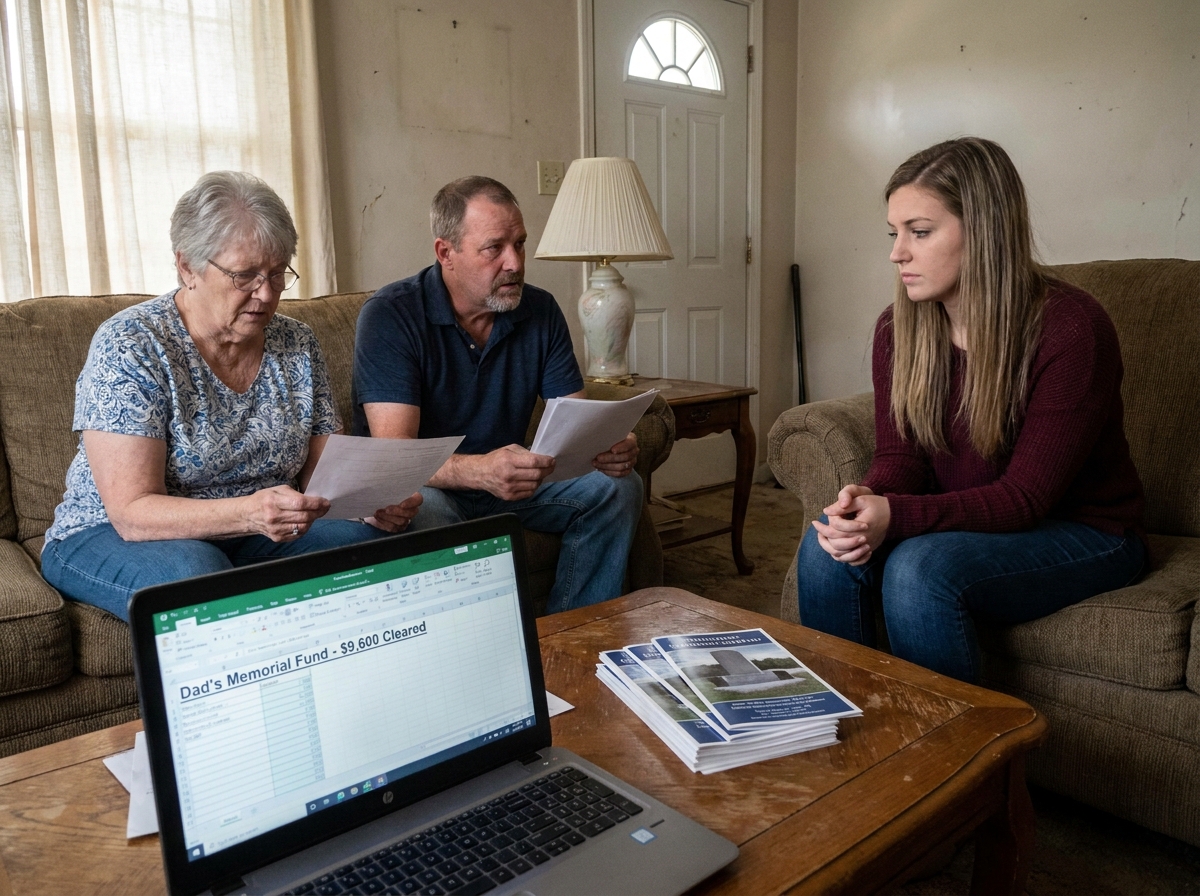
The first hard proof came from a check written by one of Dad’s former supervisors for $2,000. He called to confirm the charity notation because he wanted to make sure it had gone where intended. Andrea had deposited it into her personal checking account with the mobile app. After that, the rest came apart quickly. Another envelope from a neighbor containing $600 in cash had never been logged anywhere. Two checks totaling $1,350 from union members were deposited in separate increments across four days. Cash donations estimated at over $4,000 were almost impossible to track exactly, but witnesses remembered specific amounts because grief makes memory cling to what seems useful. An elderly couple had given $200 in a card with a saint on the front. Dad’s bowling friend gave $500 cash, folded twice. Our cousin Mara had counted at least $9,600 with Andrea on the night after the service, and Andrea had joked, “Well, at least death is expensive enough to bring in revenue.” At the time Mara thought it was dark humor. Later she cried while repeating it to us.
When confronted with the deposit evidence, Andrea changed tactics so fast it was dizzying. First she denied wrongdoing. Then she said she had only borrowed against money that would have come to the family anyway. Then she argued that as Dad’s eldest child, she had every right to decide how the memorial funds were used. According to her, paying her own mortgage was indirectly helping the family because if she lost her townhouse, her son would suffer, and Dad would never have wanted that. She said this while standing beneath the clock Dad repaired three separate times instead of replacing because he hated waste. The gall of it left me almost detached. It was as if she had swallowed every selfish thought a person can have during grief and taught them all to speak in the vocabulary of duty.
The hotel booking was what finished any remaining sympathy I might have had. At first she insisted she had used only enough money to “stabilize” her household. Then my brother found an emailed reservation confirmation on the old family laptop she had borrowed to print documents. Two nights at a coastal inn, $612 after taxes, spa add-ons included. When I asked her about it, she did not deny it. She said she had needed rest because “nobody is considering what this has done to me emotionally.” I remember staring at her and thinking that some people experience grief as sorrow, while others experience it as a stage on which they finally believe all appetite is excusable. Dad was not even in the ground a full week before she used donations made in his name to fund a view of the ocean and an exfoliating body wrap.
Still, even then, the ugliest thing she said was not about the hotel. It was what she said when my aunt asked how she could touch that money knowing where it came from. Andrea put both hands flat on the table and said, “Dad always helped me first because he knew I had the most on my plate.” There it was. Not shame. Not even panic. Hierarchy. She truly believed his love had ranked us. That every quiet bailout over the years had been proof not of his softness or her instability, but of her special claim on family resources. The memorial fund, in her mind, was simply the final extension of an old arrangement. She was not stealing. She was inheriting early from the stream of forgiveness he had spent a lifetime directing toward her.
After that, all the old memories began rearranging themselves. The time Dad sold his fishing boat and never explained where the money went. The month he skipped his blood pressure medication because “things are a little tight.” The Christmas Andrea’s son had a brand-new gaming console while Dad wore the same frayed coat for another winter. The dentist appointment he canceled because Andrea needed help with legal fees. We had always known he protected her, but we told ourselves it was temporary, occasional, manageable. What we had really been watching was a system: Andrea in crisis, Dad stepping in, everyone else adapting, and her learning that if she sounded overwhelmed enough, the family budget bent toward her automatically. She took the memorial money because she had spent years being taught, intentionally or not, that desperation plus confidence could open any locked drawer.
The consequences landed fast and without drama. The church luncheon invoice remained unpaid long enough for the secretary, embarrassed but firm, to call my aunt during dinner. The stone engraver canceled our preferred date because the deposit never arrived. The cemetery started applying late penalties. I borrowed $2,000 from my emergency savings, my brother used a tax refund, and my aunt covered the luncheon just to stop the calls. Every dollar we scrambled to replace felt heavier because we knew the original money had existed. This is part of what theft inside a family does: it forces the innocent to pay twice, once in cash and again in humiliation. We were not grieving in private anymore. Vendors, secretaries, bank clerks, and neighbors were all brushed by the outlines of what she had done.
Some relatives demanded police. Others begged us not to “destroy the family” over money. That phrase always reveals whose comfort is being prioritized. The family had already been damaged. The question was whether we were going to name the damage honestly. Dad’s younger sister wanted charges filed immediately, especially after we discovered Andrea had also redirected condolence checks mailed to Dad’s house by intercepting them before anyone else opened the mailbox. My mother’s brother argued that public scandal would stain Dad’s memory. I understood both positions. In the end, we chose something in between: no criminal complaint, but no private forgiveness either. Andrea had to sign a notarized acknowledgment of the amount taken, surrender access to any estate papers, and agree to a formal repayment schedule. If she defaulted, we would file.
She hated the paperwork more than the accusation. Said it made her feel like a stranger. Said you do not notarize things between siblings. But trust, once broken, often has to be replaced by documents because documents do not cry, manipulate, or revise history in the middle of a sentence. She signed with a hand that shook just enough to imply victimhood. Then she looked at me and said, “I hope you’re happy.” The sentence almost made me laugh from sheer absurdity. Happiness had nothing to do with it. The problem with people like Andrea is that they understand confrontation only as hostility, never as the natural end point of their own conduct. To her, the notarized paper was the aggression. The cleared memorial fund was merely context.
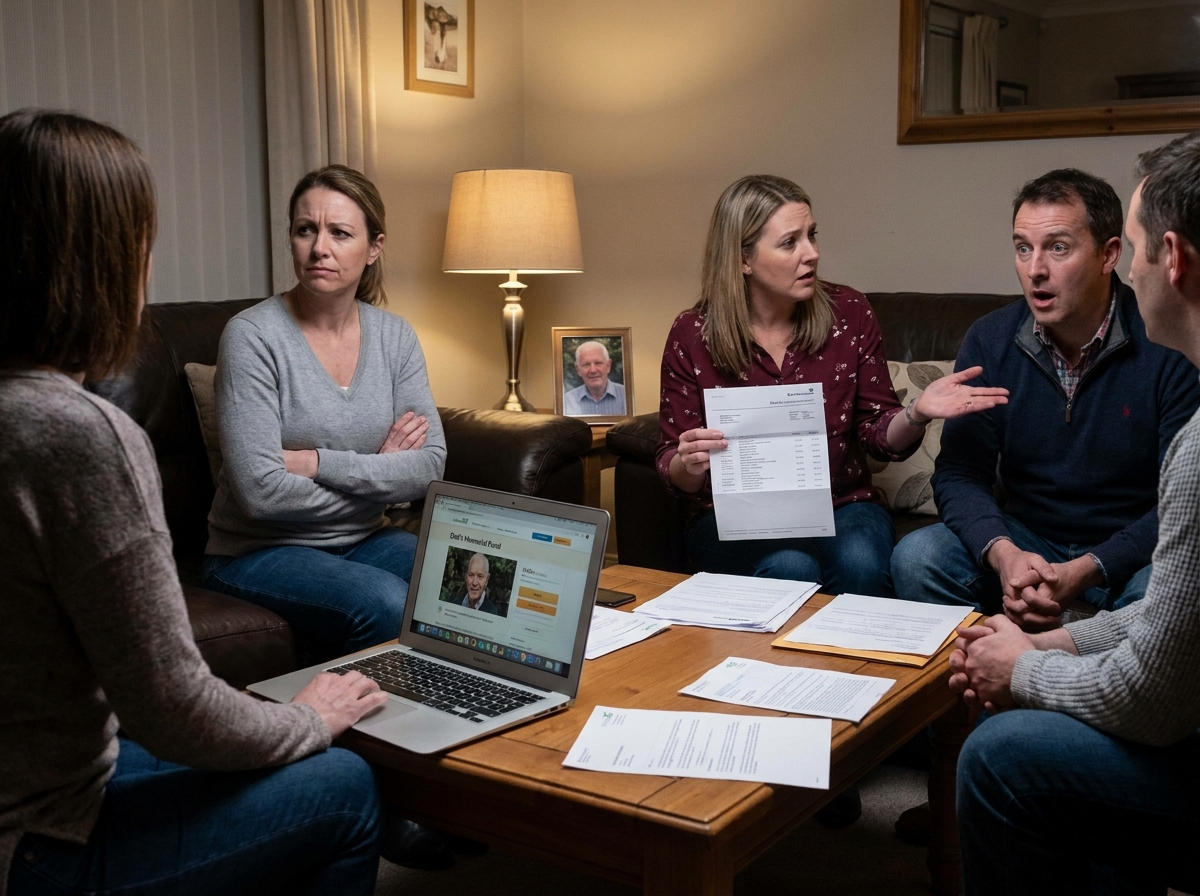
Repayment dragged over fourteen months. She missed deadlines, pleaded hardship, sent partial amounts, and attached explanations so long they felt like invoices for attention. One month she wrote that therapy was expensive because of “the trauma of family rejection.” Another month she said her son needed braces and implied that asking for the scheduled payment showed we cared more about money than a child’s health. She was always trying to move the camera, to redirect the scene from what she had done to how cruel it was that we remembered it. But this time the family had grown less willing to blur. My aunt kept spreadsheets. My brother saved every text. I stopped answering emotional monologues and replied only with dates and balances. It was not warmth. It was not even peace. It was simply structure, and structure was the one thing her charisma could not dissolve.
The strangest part of all this is that Andrea still expected normal closeness afterward. She still invited us to birthday dinners, still posted filtered family photos online with captions about love and resilience, still acted wounded when people did not comment. At Thanksgiving that year, she arrived carrying a pecan pie and kissed everyone on the cheek as if we had merely survived a misunderstanding about seating arrangements. But trust leaves a room long before a person does. Nobody asked her to collect money for the meal. Nobody let her “organize” anything. When cards were passed for a cousin’s retirement gift, they went from hand to hand around her rather than through her. She noticed, of course. Her face tightened each time. But that was the shape of the new reality: she would always be present, and she would never again be central.
What I mourned most, once the anger cooled enough to make room for subtler pain, was not the money. It was the collapse of a story I had been telling myself about what grief could do to people. I had believed that death, especially a parent’s death, might temporarily strip away selfishness and make everyone reach toward their better selves. I thought a funeral could shame pettiness into silence for at least a week. Instead, I learned that grief does not improve character. It magnifies what is already there. Generous people become more generous. Reliable people become the beams everyone leans on. And opportunists become alert to loose cash, unattended paperwork, and moral confusion. Sorrow is not always cleansing. Sometimes it is just low light, and low light makes theft easier.
Dad would have hated all of it, not only because of the money but because of the spectacle of siblings turning one another into ledger entries after he died. Yet I also know something harder now: his silence over the years helped build the conditions for this final betrayal. Love made him excuse too much. Protection became precedent. Every time he softened a boundary to keep peace, Andrea learned that the boundary had not really existed. I do not blame him cruelly for that. Parents in complicated families make triage decisions all the time and call them compassion because the alternative feels unbearable. But after he was gone, we had to live in the architecture those choices left behind. And one room in that architecture was a memorial fund my sister treated like a personal overdraft shield.
There was one moment, months later, that fixed the whole story in me permanently. The headstone had finally been installed after delays, pale gray granite with Dad’s name, dates, and a line from Micah he used to quote when people made morality sound more sophisticated than it was: Do justly, love mercy, walk humbly. I stood there after rain, brushing damp leaves from the base, when an older man from the union approached and asked quietly whether the donation checks had helped. He was not accusing us. He was simply asking with the gentle directness of someone who had cared. I told him yes, eventually, and felt the lie scratch my throat. Not because the money had not been replaced, but because help given in innocence should not have to travel through deceit before reaching its purpose.
People still say, from time to time, that Andrea was under terrible pressure and that grief makes people act out of character. I disagree. Grief revealed her character with brutal efficiency. She saw memorial money and categorized it as accessible. She saw burial invoices and ranked them below her mortgage. She saw concern and used it as camouflage. Even the language she chose afterward—family money, temporary borrowing, emotional collapse—showed the same instinct she had always had: turn obligation into oppression, turn selfishness into strain, turn accountability into cruelty. Once you see that pattern in full daylight, you cannot unsee it.
We did get the headstone. We did pay the church. We did settle the cemetery balance and the remaining hospice fees. On paper, the ending looks respectable. Expenses covered. Partial repayment completed. No police report. Family technically intact. But paperwork is not the same as restoration. Something foundational broke in that season, something that changed how I understand both loyalty and pity. I can still love my sister in the thin, sad way people sometimes love those who cannot be trusted. I can hope she becomes more honest, more ashamed, more aware. But I do not confuse those hopes with reconciliation. Some doors do not slam. They simply stop being offered.
And when people ask why I never again let her handle a collection, a bill, a family account, or even the cash envelope for a niece’s graduation gift, I tell them the truth. Because I watched her stand in our father’s house, among sympathy flowers and casserole dishes and unopened condolence cards, and explain with a straight face that memorial donations belonged wherever her crisis happened to be. Because while we were still choosing the wording on his headstone, she was clearing her own balances and calling it responsibility. Because she looked at money given in his honor and saw not his dignity, not our burden, not other people’s love—but her own overdue life waiting to be financed.
That is not a misunderstanding. That is not stress. That is not one bad week.
That is character, exposed at the graveside.