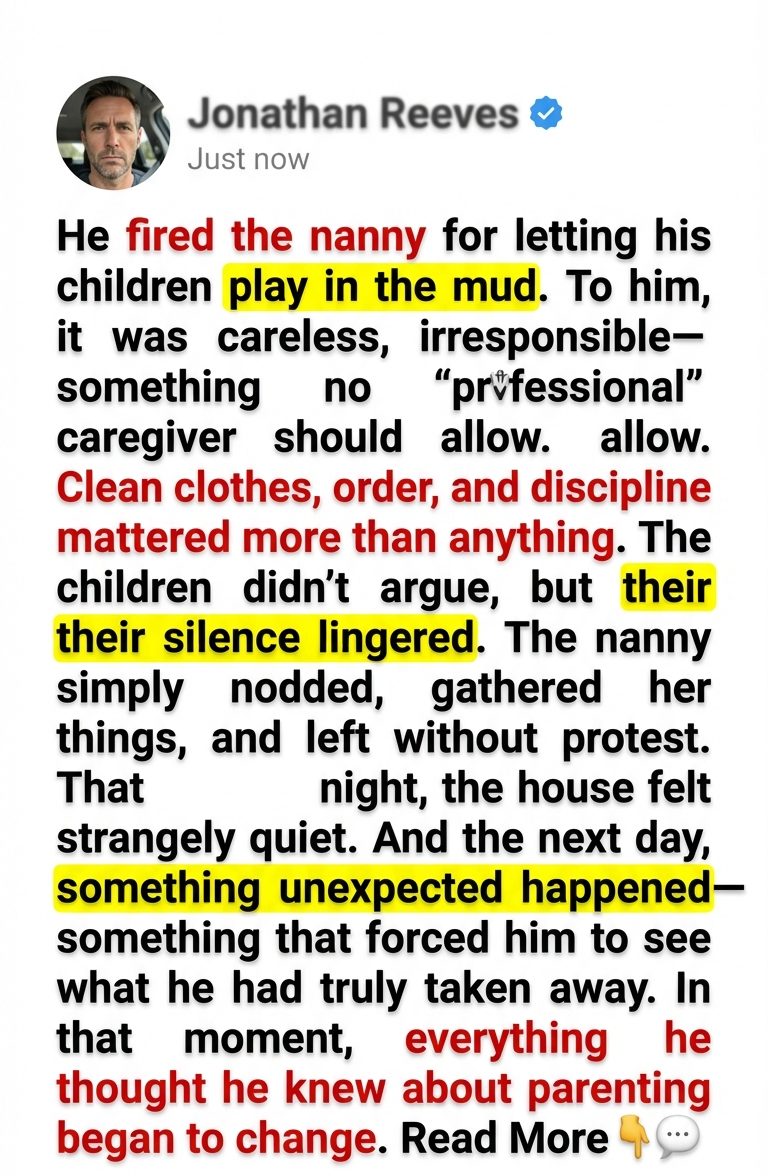
Arthur Pendelton firmly terminated the nanny’s employment on a terribly humid Tuesday afternoon after discovering his seven-year-old twins covered in thick garden mud. To his rigidly structured, deeply corporate mind, this messy, chaotic display was the ultimate sign of careless, highly irresponsible behavior from a professional caregiver. He firmly believed that pristine clothes, strict environmental order, and unwavering discipline mattered far more than anything else in a child’s developmental journey. The twins did not argue or cry when he loudly yelled, but their lingering, terrified silence echoed heavily through the immaculate, perfectly manicured courtyard.
Maria, the deeply experienced nanny, simply nodded her head in understanding, quietly gathered her modest belongings, and left the grand estate without protesting. She recognized the blinding, completely irrational fury blazing within Arthur’s eyes and knew that logical, educational explanations would entirely fail to penetrate his anger. That night, the massive, luxuriously appointed suburban house felt strangely quiet, completely stripped of the warm, vibrant, and chaotic energy she had effortlessly brought. Arthur paced the spotless hardwood floors until midnight, aggressively convincing his own doubting mind that he had made the absolute correct parental decision.
Arthur’s intense obsession with maintaining perfect, unwavering order was not born out of natural malice, but rather out of a profound, unresolved grief. Following the sudden, tragic passing of his beloved wife Eleanor five years prior, he had desperately sought to systematically control every possible variable. He incorrectly assumed that if his physical environment was perfectly maintained, the unpredictable, devastating pain of unexpected loss could never somehow hurt them again. His children’s young lives were subsequently managed like highly sensitive corporate mergers, heavily scheduled with demanding tutors, rigid routines, and entirely sterile, controlled environments.
Before Maria officially arrived at the estate, Leo and Maya were quiet, highly anxious children who navigated their own home like frightened, unwelcome guests. They spoke exclusively in hushed, polite whispers, carefully ensuring their expensive, heavily starched designer clothing never caught a single wrinkle during their scheduled playtime. Their youthful imaginations were strictly confined to approved educational workbooks, classical piano practice, and highly structured, adult-supervised activities that fundamentally lacked any genuine, spontaneous joy. Arthur viewed their robotic, quiet compliance as a massive parenting success, completely blind to their slowly suffocating, entirely muted, and broken spirits.
Maria was initially hired precisely because her glowing, top-tier agency references highlighted her remarkable educational background and her proven ability to manage complex households. However, Arthur completely failed to properly evaluate her underlying personal philosophy, which heavily prioritized hands-on, messy experiential learning over quiet, sterile, repetitive memorization tasks. From her very first week on the job, she subtly introduced vibrant colors, spontaneous outdoor excursions, and loud, joyful laughter into the depressingly quiet, cavernous mansion. Arthur tolerated her unconventional methods initially, but his underlying, protective anxiety steadily grew as the house began feeling unpredictably alive again.
The underlying tension finally reached its absolute, catastrophic breaking point on that fateful, terribly humid afternoon when Arthur returned home early from a meeting. He confidently walked through the pristine, vacuumed living room, fully expecting to find the twins quietly sitting at the dining table completing their reading worksheets. Instead, he heard loud, completely unrestrained shouting coming from the far corner of the expansive, meticulously landscaped backyard, prompting him to investigate the noise immediately. Stepping quickly onto the stone patio, his heart hammered with sudden panic as he witnessed a scene of absolute, horrifying, muddy chaos.
Maya and Leo were sitting directly in the center of a massive, flooded flowerbed, their normally pristine clothing completely saturated with thick, dark mud. Maria was kneeling right beside them in the dirt, her own clothing ruined, laughing loudly while helping them violently dig a massive, ugly trench. Arthur did not see the focused determination on his children’s faces, nor did he recognize the complex, cooperative nature of the messy game they played. He saw only a terrifying breakdown of absolute order, a dangerous loss of control that instantly triggered his deepest, most profound, unhealed psychological traumas.
He stormed across the perfectly manicured lawn, his face flushed with unadulterated fury, and screamed Maria’s name with a terrifying, booming, uncharacteristic volume. The joyful laughter instantly died in the humid air, completely replaced by the heartbreaking sound of his children gasping in sudden, paralyzing, overwhelming fear. Leo desperately held up his small, mud-caked hands, frantically trying to explain the complex water displacement experiment they were conducting before Arthur violently silenced him. He roughly grabbed both children by their fragile wrists, furiously dragging them toward the house while delivering his brutal, instantaneous termination speech to Maria.
The subsequent scrubbing in the pristine, marble-tiled bathrooms was a miserable, silent affair, filled with the harsh, stinging scent of strong, chemical antibacterial soap. Arthur scrubbed the stubborn dirt from their soft skin with an unnecessary, frantic vigor, aggressively trying to wash away the unpredictable chaos of the afternoon. When they were finally dressed in fresh, heavily starched pajamas, he strictly banished them to their respective bedrooms without their customary, comforting bedtime stories. He sat alone in his dark, quiet study, drinking a glass of expensive scotch, desperately waiting for the familiar comfort of absolute order.
The morning following Maria’s abrupt departure dawned with a heavy, oppressive gray overcast, casting long, depressing shadows across the immaculate, silent, gleaming hardwood floors. The house was undeniably pristine, smelling faintly of lemon polish and bleach, looking exactly like the sterile, perfect museum Arthur had always desperately desired. As he sat at the head of the massive oak dining table sipping his black coffee, the complete lack of normal, chaotic morning noise felt suffocating. He tried to convince himself that this heavy, unbroken silence was the ultimate sound of proper discipline, safety, and excellent, responsible parenting.
His seven-year-old twins descended the grand staircase for breakfast at exactly eight o’clock, moving with a synchronized, terrifyingly robotic precision that chilled the room. They were dressed in perfectly crisp, spotless clothes—Maya in a stiff pinafore dress, Leo in a sharply pressed, uncomfortable, collared button-down shirt. They silently took their designated seats, neatly unfolded their linen napkins, and began slowly eating their plain oatmeal without making a single, solitary sound. There was no joyful bickering over the fruit bowl, no spontaneous stories about their dreams, just a blank, deeply unsettling, and profoundly empty obedience.
Attempting to fill the massive, uncomfortable void separating them, Arthur cleared his throat loudly and announced that they would complete reading comprehension exercises immediately. He strictly dictated that their academic tasks would be followed directly by an hour of classical piano practice, expecting them to nod in polite agreement. “Yes, Father,” they replied in perfect, terrifying unison, their young voices sounding completely hollow, defeated, and devoid of any recognizable, vibrant, or childish enthusiasm. They never once lifted their eyes from their ceramic bowls, acting precisely like the highly efficient, miniature corporate executives he had trained.
Arthur frowned deeply, a sudden, uncomfortable realization slowly creeping into the edges of his highly analytical, usually unshakeable, and supremely confident executive mindset. The heavy silence filling the dining room was not the sound of proper discipline; it was the tragic, devastating sound of a fading, dying spark. When Maria had managed their mornings, the kitchen was a chaotic, beautiful symphony of dropped spoons, spilled juice, giggles, and her warm, booming laughter. She had occasionally allowed them to eat breakfast seated on the rug, a minor infraction that had made the entire house feel wonderfully alive.
Now, the massive estate felt like an empty, echoing tomb, perfectly preserved but completely devoid of the messy, unpredictable joy that actually defined life. After the miserable, silent breakfast concluded, a gentle, steady summer rain began to fall from the gray clouds, tapping softly against the large glass windows. Arthur walked slowly to the expansive glass doors at the rear of the house to ensure the heavy deadbolts were securely, safely, and properly locked. He looked out toward the far corner of the lush garden—the exact, muddy site of yesterday’s infuriating, chaotic, and heavily punished infraction.
He fully expected to look out and see nothing but a carelessly ruined flowerbed and a disgusting, disorganized pit of pointless, filthy garden mud. However, the steady, gentle rain was slowly washing away the loose, uncompacted topsoil, revealing something incredibly surprising hidden beneath the messy, muddy surface. Without his blinding, overwhelming anger clouding his usually sharp vision, Arthur was finally able to truly look at what his children and the nanny built. It was absolutely not a random, chaotic, thoughtless mess of dirt; it was a highly intentional, meticulously planned, and carefully constructed miniature topography.
Deeply carved into the damp earth was an incredibly complex network of small, intersecting trenches specifically designed to funnel the pooling rainwater perfectly. These carefully planned, muddy canals seamlessly directed the heavy downpour toward a central, excavated depression that served as a beautifully functioning, miniature artificial lake. Small, sturdy twigs had been ingeniously lashed together using thick blades of wild grass to form stable, functional bridges over the rushing, muddy streams. Smooth, heavy river stones were perfectly arranged along the edges to create a highly effective, structurally sound, and impressive protective retaining wall.
Standing proudly at the absolute highest point of the excavated mud area was a lumpy, carefully sculpted, and highly resilient protective clay castle structure. It had been constructed using the thickest, most durable clay found deep beneath the topsoil, allowing it to withstand the current, heavy summer downpour entirely. Next to the impressive castle, carefully arranged under a massive, green oak leaf that acted as a protective, makeshift waterproof tent, were three figures. These small, muddy avatars had been shaped with obvious, loving care, representing the brilliant architects who had spent the afternoon building this masterpiece.
Arthur squinted through the rain-streaked glass, his heart suddenly aching as he closely examined the three distinct clay figures sheltering beneath the oak leaf. There were two smaller, identical figures huddled closely together, representing Leo and Maya, seeking shelter from the imaginary storms ravaging their miniature, muddy kingdom. Standing directly behind them, slightly taller and positioned in a fiercely protective, embracing stance, was the undeniable, muddy representation of their beloved nanny, Maria. The figures were not careless lumps of dirt; they were a profound, heartbreaking monument to safety, creativity, love, and genuine, uninterrupted childhood connection.
Arthur’s breath caught sharply in his tight throat as the devastating, crushing weight of his terrible, reactionary mistake finally collapsed heavily upon his shoulders. He vividly remembered walking out onto the patio yesterday in a blinding, irrational rage, completely refusing to observe the brilliant scene unfolding before him. He remembered his son Leo desperately holding up his tiny, muddy hands, excitedly trying to explain the advanced concepts of water displacement and dam engineering. He had violently silenced that brilliant, blossoming curiosity, choosing instead to enforce a sterile, meaningless standard of perfect, absolute, and highly destructive cleanliness.
Maria had absolutely not been acting carelessly or irresponsibly when she allowed his precious children to become completely covered in the thick, brown garden mud. She had been down on her hands and knees in the wet dirt with them, actively teaching them fundamental physics, structural architecture, and wild imagination. More importantly, she had been giving them the incredible, necessary freedom to simply be joyful, unburdened, happy children exploring their fascinating, complex natural world. Arthur, in his relentless, grief-driven pursuit of a spotless, disciplined life, was actively turning them into tiny, anxious, deeply miserable corporate executives.
He slowly turned away from the rain-streaked glass doors, carrying the heavy, unbearable weight of his massive revelation back toward the pristine living room. Leo and Maya were currently sitting rigidly on the absolute edge of the expensive, white leather sofa, holding their academic flashcards in trembling hands. They were staring blankly at the sterile, white walls, mechanically flipping through vocabulary words without processing a single, solitary piece of actual, meaningful information. They looked perfectly, immaculately clean in their heavily starched clothing, but they also looked entirely, undeniably miserable, completely crushed by his overwhelming expectations.
Arthur looked down at his own pristine, incredibly expensive, highly polished Italian leather loafers, suddenly disgusted by what they represented in this sterile house. He looked at his perfectly pressed, custom-tailored suit trousers, recognizing them as the physical uniform of a man terrified of living a genuine life. With a sudden, decisive exhalation, he aggressively reached down, unbuttoned his crisp, white shirt cuffs, and tightly rolled his sleeves past his muscular elbows. He was making a conscious, terrifying, and absolutely necessary choice to permanently abandon the rigid, suffocating control that was actively destroying his children’s happiness.
He walked purposefully into the silent living room, his heavy footsteps echoing loudly, and gently plucked the thick stack of flashcards from his son’s hands. The twins blinked rapidly, looking up at his face in profound, terrified confusion, entirely unsure how to process this sudden, highly irregular disruption of routine. “Get your yellow rain boots,” Arthur commanded, his voice remarkably soft, gentle, and completely devoid of the harsh, demanding authority he usually heavily employed. Maya visibly trembled, glancing nervously toward the large windows. “But Father,” she whispered hesitantly, “It is raining outside. We will get dirty.”
Arthur looked at his terrified daughter, his heart completely breaking as he realized he had actively taught her to fear the simple joy of nature. He smiled warmly, and for the very first time in five incredibly long, agonizing years, it was a real, genuine, entirely unpracticed display of emotion. “I know it is raining, sweetheart,” he said softly, kneeling down on the pristine hardwood floor and holding both of his large hands out toward them. “But the retaining wall on the south riverbed looks like it is breaching, and our brave castle desperately needs immediate defending.”
The sheer, absolute shock on their young, innocent faces was incredibly profound, rapidly shifting from deep, ingrained terror to a blossoming, hesitant, and beautiful hope. Ten minutes later, the historically immaculate, gleaming hardwood floors of the grand foyer were completely covered in wet, messy, muddy footprints leading out the door. Arthur sat squarely in the damp, freezing earth, his incredibly expensive, custom-tailored suit trousers entirely, irreparably ruined by the thick, brown, wonderful garden sludge. His hands were completely coated in wet mud as he enthusiastically helped his brilliant, laughing children rebuild the intricate, failing stone dam.
The humid, summer air was filled with the steady, rhythmic sound of the falling rain, completely washing away the sterile, suffocating anxiety of the estate. More importantly, the atmosphere was finally saturated with the returning, brilliant, absolutely beautiful sound of his children’s loud, unrestrained, and deeply genuine, joyous laughter. Arthur scooped up a massive handful of wet clay, completely ignoring the dark, messy stains spreading rapidly across his crisp, white, expensive designer dress shirt. He carefully packed the thick mud around the base of their miniature castle, actively reinforcing the structure while simultaneously repairing his own broken family.
He knew with absolute certainty that he had a very humbling, incredibly difficult phone call to make to Maria later that afternoon to beg forgiveness. He owed her a profound, sincere apology for his blinding arrogance, and he desperately needed to offer her position back with a substantial, well-deserved raise. But in that specific, perfect moment, gently wiping a streak of brown mud from his daughter’s beaming, radiant face, Arthur finally understood the ultimate truth. The most beautiful, meaningful, and deeply connected parts of a family’s life rarely ever happen perfectly within the clean, predictable, and sterile, rigid lines.
As the summer rain continued to fall, transforming the backyard into a wonderful, sloppy playground, Arthur realized the true, hidden cost of his perfect order. He had built an impenetrable, sterile fortress to protect his fragile heart from grief, entirely failing to see that he had locked his children outside. By rigidly controlling their every waking movement, he had systematically denied them the essential, messy human experiences required to build true, lasting, and powerful resilience. The mud covering his hands was not a symbol of irresponsibility; it was the ultimate, beautiful badge of active, engaged, and loving fatherhood.
Leo excitedly demonstrated how the newly reinforced river stone wall was successfully holding back the rising tide of the miniature, muddy, newly formed central lake. Arthur listened with genuine, undivided attention, asking thoughtful, engaging questions about the structural integrity of the twigs and the fluid dynamics of the rushing water. He wasn’t testing his son’s vocabulary or correcting his grammar; he was simply sharing a moment of pure, unadulterated discovery, completely free from academic expectations. The brilliant, proud smile that erupted across Leo’s dirty face was worth vastly more than a thousand perfectly completed, sterile, reading comprehension flashcards.
Maya, completely emboldened by her father’s shocking, wonderful transformation, playfully scooped up a small handful of wet mud and lightly tossed it at his shoulder. The dark, wet dirt splattered loudly against his ruined, soaked dress shirt, causing a brief, terrifying second of absolute, completely stunned, and heavy, breathless silence. Arthur looked slowly down at the messy, ruined fabric, then looked up into Maya’s suddenly terrified, wide eyes, knowing this was a pivotal, defining test. He threw his head back and let out a massive, booming, joyous laugh, immediately scooping up his own handful of mud to gently retaliate.
The ensuing, chaotic mud battle completely destroyed the last remaining barriers of cold, corporate formality that had tragically defined their father-child relationship for years. They slipped, slid, and fell into the soft, wet earth, their expensive clothing serving as the absolute perfect canvas for their joyful, messy, loud rebellion. Arthur felt a massive, profound weight physically lifting from his tired, grieving chest, realizing that letting go of absolute control was actually incredibly, deeply liberating. He had finally stepped out of the sterile, emotional museum he had built, actively choosing to live a messy, vibrant, and incredibly beautiful life.
Eventually, thoroughly exhausted and completely covered from head to toe in thick, brown garden mud, the three of them collapsed laughing onto the wet grass. Arthur wrapped his large, dirty arms tightly around his two shivering, giggling children, pulling them close against his chest in a fiercely protective, warm embrace. He kissed the tops of their muddy heads, silently promising the memory of his late wife that he would never let their joyful spirits suffocate again. The perfect, pristine order of the house had been permanently broken, proudly replaced by the wonderful, unpredictable, and loving chaos of true family.
When they finally trudged back inside, leaving a massive, unapologetic trail of thick mud across the gleaming hardwood floors, the entire estate felt fundamentally different. It no longer felt like a depressing, silent tomb waiting for an inevitable tragedy; it felt incredibly warm, deeply alive, and wonderfully, perfectly, beautifully lived-in. Arthur marched them directly into the grand master bathroom, completely bypassing the sterile, separate children’s quarters, and filled the massive, luxurious soaking tub with warm water. He washed the mud from their hair with gentle, loving hands, listening happily as they excitedly recounted every detail of their backyard engineering triumphs.
Later that evening, dressed in comfortable, soft pajamas, Arthur sat on the floor of their playroom, actively engaging in a massive, sprawling, chaotic board game. He had already called Maria, offering his deepest, most sincere apologies, and to his immense relief, the brilliant, compassionate nanny had agreed to return tomorrow. The strict, suffocating schedules had been permanently shredded, replaced by a flexible, loving environment that prioritized emotional connection, spontaneous creativity, and genuine, uninterrupted childhood joy. Arthur finally understood that being a truly successful parent meant actively participating in the beautiful, messy, and wonderfully unpredictable journey of growing up.
As he finally tucked the exhausted, incredibly happy twins into their beds, kissing their foreheads with a profound, overwhelming sense of deep, protective, unconditional love, he smiled. He looked out the bedroom window at the dark, rain-soaked garden, knowing the brilliant mud castle they had built together would likely wash away entirely overnight. But the incredible, vital lesson he had learned sitting in the freezing dirt with his children would remain permanently cemented within his completely transformed heart forever. He had fired the nanny to protect his perfect order, but in doing so, he accidentally saved his entire family.
The following morning dawned with bright, brilliant, and incredibly warm sunshine streaming perfectly through the massive, spotless glass windows of the grand, sprawling suburban estate. Arthur descended the long, winding staircase wearing a comfortable, relaxed sweater, completely abandoning the stiff, highly restrictive corporate suits that had previously defined his weekend uniform. Maria walked through the front doors at exactly eight o’clock, greeted not by oppressive, terrifying silence, but by the loud, joyous sounds of children playing happily inside. Arthur smiled warmly, handed the brilliant nanny a fresh cup of coffee, and peacefully welcomed the beautiful, chaotic, messy life back into his finally healed home.