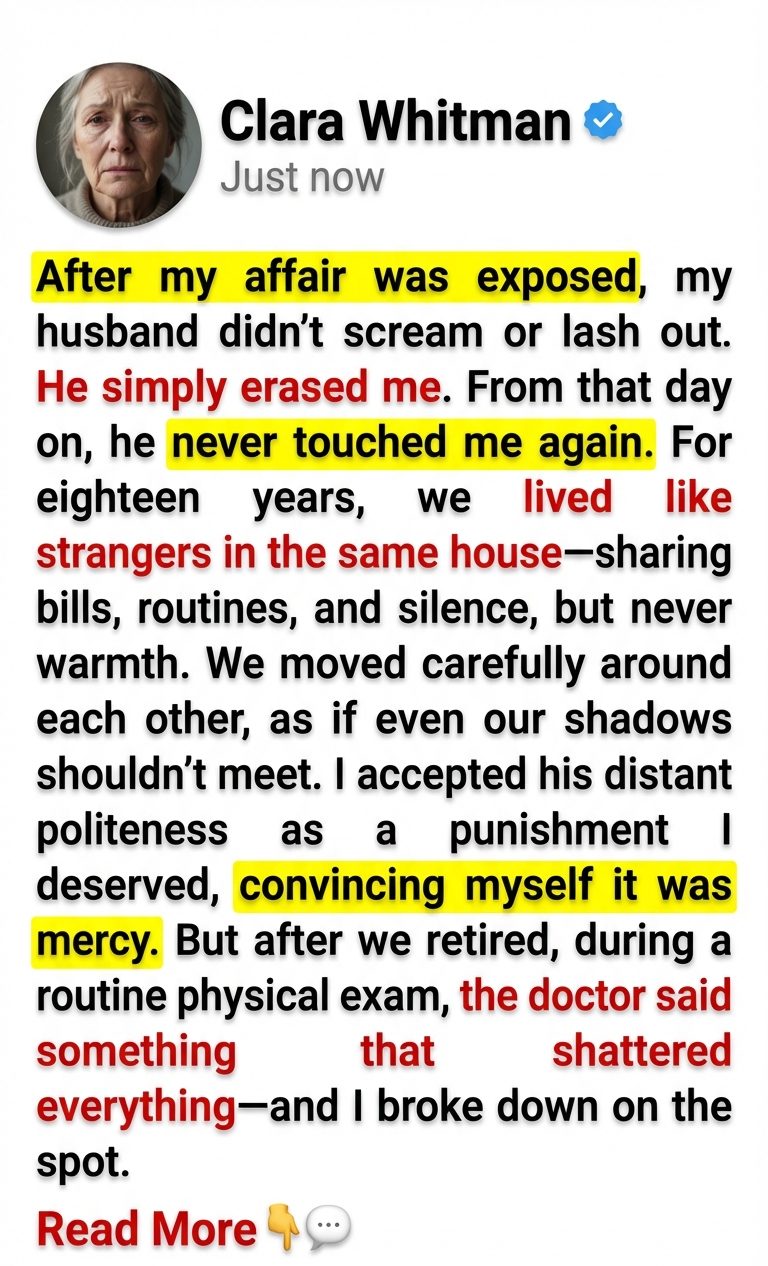
After my affair was exposed, my husband didn’t scream or lash out. He simply erased me. From that day on, he never touched me again. For eighteen years, we lived like strangers in the same house—sharing bills, routines, and silence, but never warmth. We moved carefully around each other, as if even our shadows shouldn’t meet. I accepted his distant politeness as a punishment I deserved, convincing myself it was mercy. But after we retired, during a routine physical exam, the doctor said something that shattered everything—and I broke down on the spot.
The betrayal had happened during a particularly dark chapter of our marriage. I was feeling neglected, completely consumed by my own selfish insecurities, and I sought validation in the arms of a colleague. It meant absolutely nothing, a fleeting mistake that I regretted the moment it began. But when my husband, Thomas, discovered the truth through a stray text message, the damage was permanently done. I braced myself for the explosive anger, the shouting, and the inevitable divorce papers. Instead, I received something far worse.
Thomas walked into our shared bedroom, quietly packed his clothes into a leather duffel bag, and moved into the guest room down the hall. He didn’t ask for a painful divorce, nor did he demand any chaotic public separation. He simply stopped looking at me. The warm, loving man I had married vanished overnight, replaced by a polite, hollow shell. Our home, once filled with laughter and the comforting hum of a shared life, instantly transformed into a sterile, suffocating tomb of unspoken resentments.
In those early months, I desperately tried to fix it. I cried, I begged, and I offered to go to intensive couples counseling. I wrote him long, agonizing letters pouring out my deepest apologies and slid them under his bedroom door. Thomas would read them, fold them neatly, and leave them on the kitchen counter without a single word of response. His absolute refusal to engage with my apologies was a cold, impenetrable fortress. Eventually, my desperate pleading faded into a defeated, heavy silence.
We slowly developed a bizarre, perfectly synchronized choreography to avoid crossing paths. If he was brewing coffee in the kitchen, I would wait upstairs until I heard his heavy footsteps retreat to his home office. If we accidentally found ourselves in the same room, he would offer a tight, polite nod and immediately exit. We were two ghosts haunting the exact same house, acutely aware of each other’s presence but permanently forbidden from making any meaningful contact.
People often ask why I didn’t just leave, why I subjected myself to nearly two decades of profound emotional isolation. The painful truth was that my immense guilt chained me to that house. I genuinely believed I had destroyed a good man, and staying to endure his silent punishment was the only penance I could offer. I convinced myself that his willingness to keep me under his roof, to continue paying our shared mortgage, was a bizarre form of mercy I had absolutely no right to abandon.
I spent eighteen years watching my husband age from a painful distance. I watched from the living room window as the dark hair at his temples slowly turned a distinguished silver. I noticed how his broad shoulders began to stoop slightly under the weight of passing time. My heart ached every single day, mourning the loss of a man who was sitting just one room away. I missed his deep laugh, the comforting smell of his cologne, and the gentle, reassuring weight of his hand resting on my shoulder.
The complete lack of physical touch was a slow, agonizing starvation. For eighteen years, my skin literally ached for the simplest human connection. No hugs, no accidental brushes in the hallway, no comforting embraces after a terribly long day. Whenever I suffered a loss or felt overwhelmed, I had to weep alone in my locked bathroom. Thomas would hear me crying, but he would never cross the threshold to comfort me. The icy boundary he had drawn between us was absolute and entirely unbreakable.
To the outside world, we maintained a flawless, polished facade. We attended neighborhood barbecues and holiday parties together, standing side by side and smiling for the cameras. Thomas was a master at performing the role of the devoted, happy husband in public. He would politely pull out my chair, pour my wine, and make casual small talk with our mutual friends. But the absolute second we stepped back into our car, the heavy, suffocating silence would instantly drop like a dark, heavy curtain.
Over the years, the sharp, stinging pain of his rejection dulled into a chronic, numb ache. I eventually stopped hoping for a miraculous reconciliation. I accepted that we would live out the rest of our days as polite roommates, tied together by a piece of paper and a shared history we were both too exhausted to legally dismantle. I foolishly thought I had finally found a twisted sort of peace in our permanent estrangement, resigning myself to a quiet, desperately lonely twilight.
When retirement finally approached, a new wave of intense anxiety washed over me. For years, our demanding careers had provided a necessary escape, giving us a valid excuse to spend eight hours a day apart. Without the comforting distraction of the office, we would be trapped together in the house twenty-four hours a day. I dreaded the thought of navigating our silent, complex choreography without the breaks that our separate professional lives had naturally afforded us.
Retirement proved to be exactly as suffocating as I had feared. The house felt incredibly small, the oppressive silence echoing off the walls with deafening volume. Thomas spent most of his days sitting in his leather armchair by the window, reading thick historical biographies and staring blankly out at the garden. I spent my time baking bread we didn’t need and tending to houseplants, desperately trying to look busy to avoid acknowledging the massive, terrifying void separating us.
It was during these long, quiet days at home that I began to notice subtle, alarming changes in Thomas’s physical health. He was losing weight at a rapid pace, his clothes hanging loosely off his shrinking frame. His skin had taken on a pale, grayish pallor, and he was sleeping far more than usual. When he walked down the hallway, he would lean heavily against the walls for support. Despite our estrangement, my deep maternal instinct to care for the man I still loved fiercely kicked in.
I finally broke our unspoken rule of silence and confronted him in the kitchen one morning. “You look terrible, Thomas. You are going to the doctor, and I am driving you,” I stated firmly, leaving absolutely no room for debate. He looked at me with a startlingly vulnerable expression, opening his mouth to protest, but the sheer exhaustion in his eyes betrayed him. He simply nodded, surrendering to my demand with a quiet sigh that completely broke my heart.
The waiting room at the specialist’s clinic was freezing and brightly lit. We sat side by side on the uncomfortable plastic chairs, maintaining our customary six inches of impenetrable distance. Thomas stared blankly at a faded medical poster on the opposite wall, his hands trembling slightly in his lap. I desperately wanted to reach out and interlock my fingers with his, to offer him some small shred of comfort, but the invisible eighteen-year wall kept my hands frozen firmly at my sides.
A young nurse finally called his name, and we followed her back to a sterile examination room. Dr. Evans, a kind-faced physician with silver hair, walked in a few moments later holding a thick, incredibly heavy medical file. He greeted Thomas warmly, performing a brief, routine physical examination before sitting down on his rolling stool. The doctor’s face was completely unreadable as he flipped through the dense pages of Thomas’s extensive chart, letting out a long, heavy sigh.
“Well, Thomas,” Dr. Evans said gently, taking off his reading glasses and looking directly into my husband’s tired eyes. “The latest scans confirm what we’ve been monitoring. The deterioration has accelerated significantly over the past six months.” My heart plummeted into my stomach. Monitored? Accelerated? I looked frantically between the two men, completely utterly lost. They were speaking a secret, terrifying medical language about a long-standing condition I knew absolutely nothing about.
“You have managed this incredibly bravely for eighteen years, my friend,” the doctor continued, his voice thick with genuine admiration and deep sorrow. “To survive this long with this specific neurological progression is nothing short of a medical miracle. But we are officially entering the final stages now.” The walls of the small examination room began to spin violently around me. Eighteen years. That specific, devastating number echoed loudly in my ears like a deafening warning bell.
I couldn’t contain my sudden panic. “Wait, managed what for eighteen years? What is going on?” I demanded, my voice cracking wildly. Dr. Evans turned to look at me, his brow furrowing in profound confusion. “Mrs. Vance, your husband’s Huntington’s diagnosis. The incredibly rare, slow-progressing variant we identified nearly two decades ago.” He looked back at Thomas, realizing with horror that I had been kept completely entirely in the dark about my husband’s fatal, agonizing illness.
Thomas closed his eyes tightly, a single tear slipping down his pale, gaunt cheek. The doctor gently explained that exactly eighteen years ago, Thomas had undergone genetic testing after experiencing early neurological tremors. The devastating results confirmed an untreatable, fatal condition that would slowly strip away his motor functions and ultimately his mind. He was given a terrible death sentence during the exact same week he discovered the heartbreaking evidence of my foolish infidelity.
“Why didn’t you tell me?” I gasped, the crushing weight of the revelation driving the air completely from my lungs. Thomas slowly turned his head to look at me, truly looking directly into my eyes for the very first time in almost two decades. “Because you were already pulling away,” he whispered, his voice incredibly frail and broken. “You had found someone else. I was dying. I couldn’t bear to trap you in a loveless marriage acting as a permanent nurse to a crumbling, dying old man.”
The horrifying truth finally clicked into place, completely shattering the narrative I had believed for nearly twenty years. His silence had never been a cruel, vindictive punishment for my affair. It had been a desperate, misguided act of profound, unconditional love. He had completely erased himself from my emotional life so that I wouldn’t be destroyed by the agony of watching him slowly waste away. He pushed me away hoping I would eventually leave and find happiness without his heavy burden.
“But I didn’t leave,” I sobbed openly, the dam finally breaking as eighteen years of unshed tears violently spilled down my face. “I stayed, Thomas. I stayed because I loved you, because I hated myself for hurting you. I would have gladly cared for you every single day.” Thomas let out a devastating, ragged sob, realizing that his ultimate sacrifice had only resulted in two decades of mutual, unnecessary torture. We had completely wasted the best years of our lives trapped in silent misunderstandings.
I collapsed to my knees right there on the cold, sterile linoleum floor of the doctor’s office, weeping with a profound, agonizing grief that threatened to tear my soul apart. Then, I felt it. For the first time in eighteen long, agonizing years, Thomas reached out his trembling hand and gently rested it on the top of my head. His fingers stroked my hair with a desperate, familiar tenderness that instantly transported me back to the beautiful, loving days before our lives were completely broken.
We drove home that afternoon holding hands across the center console, the suffocating silence finally broken by shared tears and desperate, whispered apologies. We cannot get back the eighteen years we lost to my foolish mistake and his tragic, misguided nobility. But in the harrowing shadow of his final diagnosis, the heavy ice between us has finally completely melted. I am no longer his silent roommate; I am his devoted wife again, determined to fill his remaining days with all the warmth we missed.