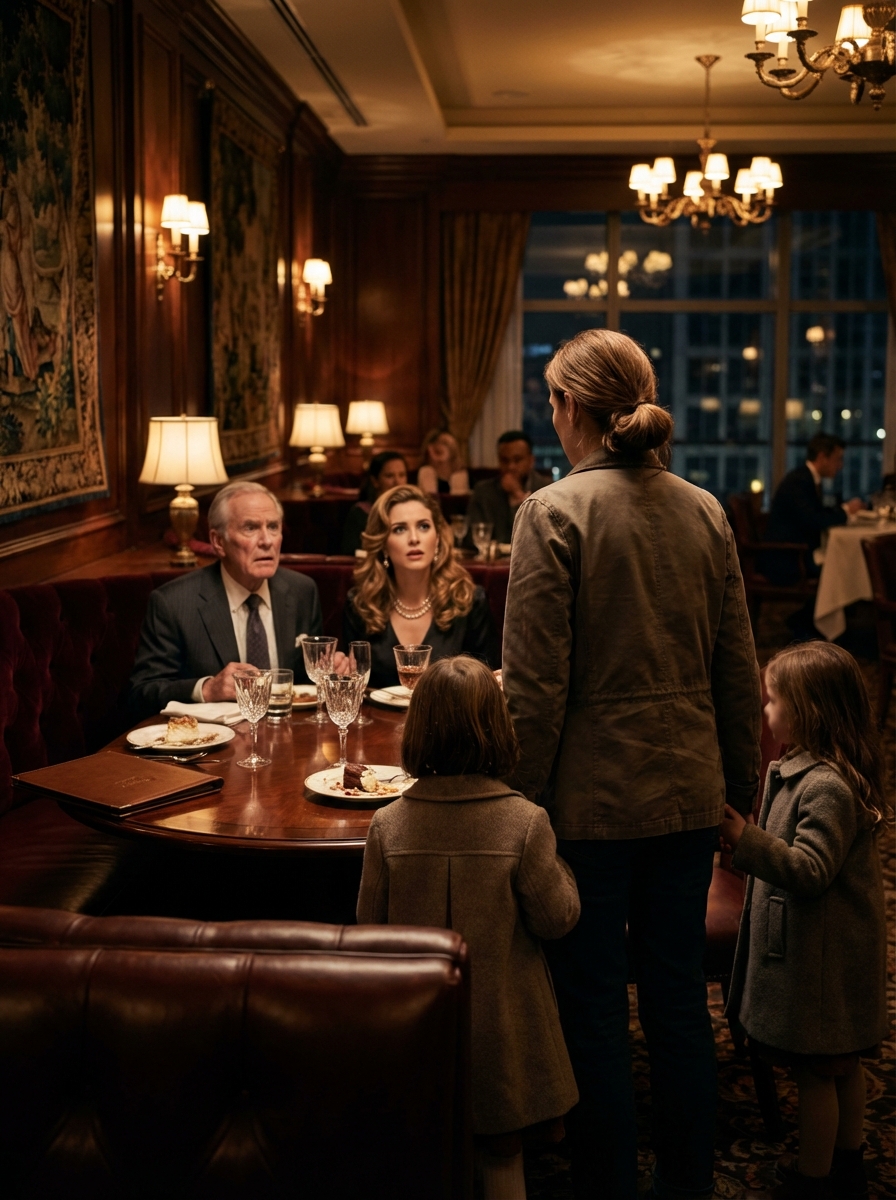
“My dad told my kids they could eat when we got home while my sister boxed up a $72 meal for hers. Everyone laughed like I was supposed to accept it. Then the waiter came back—and I stood up. I set my glass down slowly, the quiet clink cutting through their laughter. My girls hadn’t said a word, but I could feel their shame like it was my own. I looked at the waiter, then at the check, then finally at my father. For the first time that night, I didn’t stay quiet. My voice was calm—steady—but it carried across the table. And in that moment, everything shifted.” The air in the restaurant suddenly felt incredibly heavy, almost suffocating, as if every ounce of oxygen had been instantly vacuumed out of the opulent, chandelier-lit dining room. My father’s smug, self-satisfied smile faltered for a fraction of a second, quickly replaced by a look of sheer, unadulterated confusion, while my sister’s boisterous laughter died a sudden, awkward death in the back of her throat. They were so deeply accustomed to my endless silence, to my passive, defeated acceptance of their casual, everyday cruelty, that my sudden, uncharacteristic defiance was entirely incomprehensible to their privileged, out-of-touch minds.
For my entire life, Richard, the man sitting across from me nursing a three-hundred-dollar glass of scotch, had operated under the absolute assumption that his financial success granted him an unquestionable authority over the emotional well-being of everyone in his orbit. He was a man who measured love in monetary value and doled out affection with the strict, unforgiving ledger of a ruthless corporate accountant, ensuring that the balance always remained heavily and undeniably in his favor. Whenever I had dared to express a differing opinion or point out the glaring inequities in how he treated his children, I was swiftly and brutally dismissed as being overly sensitive, hopelessly ungrateful, or completely out of touch with the realities of the real world. Sitting there in that absurdly expensive velvet chair, watching the dawning realization of my rebellion wash over his aged, privileged face, I finally understood that his power over me was entirely reliant on my continued, desperate willingness to play the role of the compliant, eternally inferior daughter who just wanted to be loved.
My sister, Elena, the undisputed golden child of our fractured family dynamic, sat next to him, her perfectly manicured fingers nervously playing with the stem of her artisanal cocktail glass as she processed the sudden shift in the atmosphere. From the moment we were born, she had been groomed for a life of effortless luxury, her every minor achievement celebrated with lavish gifts and extravagant parties, while my own milestones were met with polite nods and immediate pivoting back to her latest triumph. She had never known the gnawing anxiety of checking a bank account balance before buying groceries, nor had she ever experienced the profound humiliation of having her children treated as second-class citizens by their own flesh and blood. In that suspended moment of silence, as her eyes darted nervously between me and our father, I realized with absolute clarity that she was not my ally, nor had she ever been; she was merely a grateful beneficiary of a toxic system that kept me perpetually ground down beneath her designer heels.
My two young daughters, eight-year-old Lily and ten-year-old Mia, were pressed tightly against my sides, their small bodies rigid with a palpable tension that broke my heart into a million irreparable pieces. They had spent the entire evening trying to make themselves as small and invisible as possible, their wide, expressive eyes absorbing every slight, every dismissive comment, and every cruel laugh with a silent, devastating comprehension that no child should ever have to possess. I could feel the heat radiating from their flushed cheeks, the physical manifestation of the deep, burning shame they had internalized on my behalf, a toxic inheritance that I was suddenly, violently determined to prevent them from carrying into their own futures. My protective instinct, long suppressed by a lifetime of conditioned obedience, roared to life within my chest, a fierce, blazing inferno of maternal rage that demanded immediate and absolute justice for the two innocent souls who relied on me to be their shield against the world.
The waiter, a flawlessly groomed young man whose crisp white apron was completely unstained by the messy realities of the human condition, stood frozen beside our table, the leather-bound checkbook trembling ever so slightly in his extended hand as he desperately tried to become invisible. He was an unwilling spectator to a deeply intimate family implosion, his professional facade cracking under the immense, crushing weight of the sudden, aggressive hostility that had descended upon his previously cheerful section of the dining room. I met his panicked gaze with a look of calm, unwavering determination, silently communicating that his role in this nightmare was over, and that the ensuing wreckage was entirely mine to navigate, to manage, and to ultimately clean up. He quickly placed the small black booklet onto the pristine white tablecloth, practically sprinting away toward the safety of the bustling kitchen, leaving us completely isolated in our little bubble of escalating, inescapable confrontation.
To truly understand the profound weight of this singular moment, one has to look back at the agonizing days leading up to this fateful, disastrous dinner invitation, a summons that had arrived like a dreaded court subpoena demanding my immediate compliance. My father had called exactly a week prior, his booming, authoritative voice leaving no room for negotiation or decline, announcing that we were to celebrate his recent, highly lucrative real estate acquisition at the most exclusive, ridiculously overpriced bistro in the entire downtown district. I had initially attempted to politely decline, citing my overwhelming grading schedule as a middle school teacher and the girls’ upcoming school projects, knowing full well that my meager budget could not withstand even a fraction of the bill that would inevitably be racked up. But the guilt trip had been swift and merciless, a masterful, deeply manipulative tactic honed over decades, leaving me feeling like an ungrateful, terrible daughter for even considering missing such a momentous family milestone, ultimately forcing my reluctant hand.
The sheer financial disparity between my daily reality and the world my father and sister inhabited was a constant, throbbing ache that colored every single interaction we ever had, a chasm that seemed to grow wider and more insurmountable with every passing year. While Elena spent her afternoons browsing high-end boutiques and discussing upcoming ski trips to Aspen with her country club friends, I spent mine meticulously clipping coupons, calculating the exact cost of generic brand cereal, and praying that my ten-year-old car wouldn’t need another expensive repair. The anxiety of simply existing in their presence was a physical weight on my shoulders, a constant, nagging reminder of my perceived failures and my inability to provide my daughters with the kind of effortless, carefree lifestyle their cousins enjoyed without a second thought. Agreeing to attend this dinner felt less like a familial obligation and more like a deliberate act of self-flagellation, a forced march into a hostile environment where my inadequacies would be placed on full, public display for everyone to casually critique.
Preparing for the evening had been an exercise in extreme emotional endurance, an agonizing attempt to disguise our economic reality beneath a thin, unconvincing veneer of middle-class respectability. I had spent hours meticulously ironing the girls’ best dresses, garments purchased on clearance racks at the very end of the previous season, desperately trying to smooth out the imaginary wrinkles that I felt telegraphed our poverty to the entire world. I gave them a very gentle, but firm lecture on the drive over, reminding them to use their absolute best manners, to speak only when spoken to, and, most importantly, to strictly order from the small list of affordable appetizers we had memorized from the restaurant’s online menu earlier that afternoon. They had nodded with a solemn, heartbreaking understanding, their young faces devoid of the innocent excitement that should accompany a fancy dinner out, replacing it instead with a weary, cautious vigilance that mirrored my own deep-seated anxieties.
We had deliberately parked three blocks away from the grand entrance of the restaurant, shivering slightly in the brisk, unforgiving autumn air, completely unable to justify spending twenty desperately needed dollars on the luxury of valet service. The walk had felt like a long, arduous march to an inevitable execution, every step bringing us closer to the suffocating atmosphere of judgment and exclusion that always characterized these mandatory family gatherings. As we finally approached the heavy, glass doors of Le Petit Bijou, the overwhelming scent of roasted garlic, expensive truffles, and heavy designer perfumes hit me like a physical blow, a sensory reminder that we were essentially trespassing in a world where we fundamentally did not belong. I plastered a bright, entirely artificial smile onto my face, squeezing my daughters’ cold hands in a silent promise of solidarity, and pushed open the door, stepping off the precipice and into the lions’ den.
The immediate feeling of exclusion washed over me the second we were led to our table, a prominent, highly visible circular booth located in the absolute, unavoidable dead center of the bustling dining room. My father and Elena were already seated, holding court with the easy, unbothered arrogance of people who inherently believed the universe was designed specifically to cater to their every whim and desire. Their greetings were perfunctory and painfully dismissive, a quick, barely-there nod from my father and a tight, glossy smile from Elena that didn’t even attempt to reach the cold, calculating depths of her eyes before she immediately returned her attention to her phone. I wedged myself into the remaining chairs at the far edge of the table, physically shielding my daughters from the brunt of their indifference, acutely aware of the invisible, impenetrable wall that instantly materialized between our side of the table and theirs.
When the impeccably dressed waiter arrived to take our initial drink orders, the stark, humiliating contrast in our financial realities was immediately broadcast to anyone who happened to be paying attention. My father casually ordered a deeply complex, rare vintage red wine without even glancing at the exorbitant price tag, while Elena enthusiastically requested a specialty crafted cocktail that involved imported elderflower and a theatrical presentation involving dry ice. When the waiter’s polite gaze finally shifted to me, I felt the familiar, burning heat of shame creeping up my neck as I quietly, almost apologetically, requested standard tap water with a slice of lemon for myself and simple, inexpensive sodas for the girls. I could feel Elena’s heavily mascaraed eyes rolling in my peripheral vision, a silent, damning judgment of my perpetual frugality, but I aggressively swallowed my pride, silently reminding myself that those three sodas were a luxury I could barely afford to begin with.
The conversation that flowed throughout the initial portion of the evening was entirely dominated by Elena and our father, a rapid-fire, entirely exclusionary exchange of high-society gossip, boasting about investment portfolios, and complaining about the agonizing difficulty of finding reliable, trustworthy domestic help. I sat in stoic, agonizing silence, occasionally offering a noncommittal hum or a polite nod when I felt their eyes briefly graze past me, knowing from decades of bitter experience that any contribution I attempted to make would be swiftly ignored or subtly mocked. The girls remained perfectly still beside me, their little hands politely folded in their laps, completely ignored by their grandfather and aunt, treated as if they were entirely invisible, insignificant props rather than living, breathing human beings who desperately craved familial connection.
When it came time to finally order our actual meals, the tension in my chest tightened into a hard, painful knot, a physical manifestation of the immense anxiety I felt about navigating the treacherous minefield of the incredibly overpriced menu. Elena encouraged her two boys, who had been loud and utterly disruptive the entire time, to order whatever their hearts desired, loudly proclaiming that her father was paying and that they should treat themselves to the absolute best items available. Meanwhile, I leaned down and gently whispered to Lily and Mia, pointing them toward the cheapest chicken dish on the menu, a subtle, heartbreaking negotiation that reinforced their understanding that our worth was strictly limited to what we could scrape together from the very bottom of the barrel.
The arrival of the food only served to further highlight the grotesque, unavoidable disparity in our family dynamic, presenting a visual feast of inequality that was impossible to ignore or brush under the rug. Elena’s side of the table was completely covered in massive, steaming plates of prime rib, buttery lobster tails, and towering, decadent desserts that the boys immediately began picking at and subsequently ignoring. In stark, depressing contrast, my daughters were presented with small, sad-looking portions of basic grilled chicken, which they ate with a quiet, devastating politeness, never once complaining or asking for a single bite of the extravagant feast laid out mere inches away from them. I watched my father casually saw into his expensive steak, completely oblivious to the glaring, heartbreaking inequity unfolding right in front of his eyes, his absolute lack of awareness a testament to his profound emotional blindness.
The dinner conversation continued to orbit exclusively around their wealth and their privilege, completely ignoring the struggles and the realities of my life as a single, hardworking mother trying to keep her head above water. They discussed extravagant, multi-week vacations to Europe as if they were casually running to the corner store for milk, utterly dismissive of the fact that my idea of a family vacation was a weekend trip to a local, free public park. Every time I attempted to shift the conversation to something more universal, perhaps a book I had read or a funny story about the girls’ school, I was met with blank, disinterested stares before the topic was swiftly and aggressively steered back to their own exorbitant lives.
As the grueling, agonizing meal finally began to mercifully wind down, Elena’s boys had barely touched their massive, incredibly expensive meals, leaving behind mountains of prime rib and untouched, buttery lobster that could have fed my family for an entire week. Elena casually waved the waiter over, demanding numerous takeout boxes for the leftover food, loudly declaring that her dogs would absolutely love the expensive steak scraps when they got home to their sprawling suburban mansion. I watched this gross, careless display of immense wastefulness with a sick, churning feeling in the pit of my stomach, tightly gripping my water glass to keep my hands from shaking with a mixture of suppressed rage and deep, overwhelming sadness.
And then, in a moment of stunning, unprovoked cruelty that would forever alter the trajectory of our entire family, my father looked directly at my beautiful, well-behaved daughters, who had finished every single bite of their meager chicken dinners, and delivered the final, fatal blow. He let out a loud, booming chuckle, a sound devoid of any real warmth or affection, and casually remarked that it was a good thing I couldn’t afford to buy them dessert, because they could just go home and fill up on cheap cereal, while his precious grandsons took home the real, expensive food. The entire table erupted into laughter—Elena, her husband, and my father all sharing a cruel, exclusionary joke at the direct expense of two innocent children who had done absolutely nothing but exist in a lower tax bracket.
It was in that precise, agonizing moment that the invisible, heavy chains of familial obligation and conditioned subservience finally and violently snapped, releasing a flood of righteous, burning anger that I had spent my entire life frantically trying to suppress. The laughter echoed loudly in my ears, a grotesque, distorted soundtrack to the profound, unforgivable humiliation of my children, a humiliation that I had unwittingly facilitated by continuing to subject them to these toxic, deeply damaging gatherings. I looked at Lily and Mia, seeing the bright, unshed tears welling up in their eyes, the deep, visceral sting of rejection painted clearly across their innocent faces, and I knew with absolute, unshakable certainty that I could never, ever allow this to happen to them again.
The physical sensation of standing up was entirely detached from my conscious thought process; it was a pure, instinctual, animalistic reaction, a sudden, powerful surging of protective energy that physically propelled me out of the plush velvet booth and onto my feet. I didn’t slam my hands on the table, I didn’t scream, I didn’t throw a dramatic, theatrical tantrum; I simply stood up, my posture straighter and taller than it had ever been in my entire thirty-five years of existence. The sudden, unexpected movement completely shattered the jovial, cruel atmosphere, instantly silencing the laughter and drawing the shocked, bewildered attention of every single person seated at our table, as well as a few curious onlookers from nearby booths.
The silence that followed was absolute and incredibly profound, a heavy, expectant void that seemed to stretch out for an eternity, pregnant with the terrifying, exhilarating realization that the established, unquestioned power dynamic had just been irrevocably ruptured. My father stared at me, his fork suspended halfway to his mouth, a look of genuine, baffled shock replacing his usual expression of smug, confident superiority, entirely unsure of how to process this sudden, unprecedented rebellion from his normally quiet, deeply compliant daughter. I met his gaze squarely, refusing to shrink back, refusing to look away, channeling every ounce of the fierce, protective love I had for my daughters into a solid, unyielding wall of absolute defiance.
“We are not your punchline,” I said, my voice completely devoid of the usual tremor of anxiety that accompanied my interactions with him, echoing clearly and steadily across the silent table, carrying a profound, undeniable weight that demanded absolute attention. “And my daughters are not second-class citizens who exist solely for you to mock and belittle in order to make yourself feel more powerful and important than you actually are.” The words tasted like cold, hard steel in my mouth, a stark, shocking departure from the carefully constructed, polite platitudes I had spent decades regurgitating to keep the fragile, toxic peace within our deeply broken family.
My father’s face instantly darkened, a deep, angry red flush creeping up from his collar as he instinctively reached for his usual, highly effective weapons of gaslighting, manipulation, and aggressive intimidation, attempting to regain control of the narrative. “Don’t be so ridiculously dramatic, Sarah,” he hissed, his voice dropping into a menacing, authoritative register that had historically sent me scurrying back into submission. “It was just a simple joke. You’ve always been entirely too sensitive for your own good, looking for insults where none were intended.”
Before he could continue his predictable tirade, Elena practically lunged across the table, her perfectly painted face twisted into an ugly, condescending sneer, completely eager to defend the deeply flawed system that benefited her so immensely. “Honestly, Sarah, you’re ruining dad’s entire retirement celebration with your pathetic, misplaced victim complex,” she snapped, her voice dripping with venomous disdain. “If you can’t handle a little harmless family banter, maybe you shouldn’t have bothered showing up and bringing down the mood for the rest of us.”
I didn’t even bother looking at her, completely dismissing her input as the irrelevant noise of a deeply insecure, morally bankrupt person, keeping my unwavering, furious gaze locked entirely on my father, ensuring he understood the absolute finality of this moment. “It’s not a joke when the only people laughing are the ones holding all the power,” I stated firmly, the absolute clarity of my own truth ringing loudly in my ears, completely drowning out their pathetic, desperate attempts to invalidate my entirely justified anger. “We are leaving, and we will not be subjected to your casual, everyday cruelty ever again.”
Without waiting for a response, I reached down and firmly grasped the small, trembling hands of my daughters, pulling them gently but decisively out of the deep booth and away from the toxic, suffocating gravitational pull of their grandfather. They clung to me tightly, their little fingers gripping mine with a desperate, frantic strength, drawing immense comfort and reassurance from the solid, unyielding certainty of my protective actions, finally seeing their mother not as a passive victim, but as a fierce, capable defender.
With my free hand, I calmly reached into my worn, sensible purse, pulled out a crisp, folded fifty-dollar bill—money I desperately needed for the electric bill—and tossed it carelessly onto the center of the table, directly onto the leather checkbook. “That covers the kids’ chicken and my tap water,” I said, my voice dripping with an icy, detached finality that completely severed the last remaining, frayed thread of our familial connection. “Enjoy the rest of your incredibly expensive, morally bankrupt lives.”
Turning my back on them was the single most liberating, terrifying, and profoundly transformative physical action I had ever taken, a literal and metaphorical walking away from a lifetime of emotional abuse, deeply ingrained inadequacy, and forced subservience. We marched away from the table, my head held incredibly high, completely ignoring the shocked, gaping stares of the other wealthy patrons and the frantically apologizing waiter, moving toward the exit with the unstoppable, purposeful momentum of a freight train.
The heavy, glass doors of the restaurant swung shut behind us with a definitive, satisfying thud, instantly cutting off the suffocating noise and the oppressive, overwhelming smell of the dining room, plunging us into the cool, crisp, refreshing reality of the autumn night. The immediate, sudden rush of fresh air hitting my face felt like a physical baptism, a glorious, desperately needed cleansing that began to wash away the sticky, lingering residue of their toxic judgment and my own deep-seated, deeply ingrained shame.
We walked the three long blocks back to our parked car in absolute, profound silence, the only sound the rhythmic, comforting click of our shoes against the hard concrete pavement, a unified march toward a completely new, terrifyingly unknown, but ultimately better future. The adrenaline that had aggressively fueled my confrontation was slowly beginning to recede, leaving behind a deep, aching physical exhaustion that settled deep into my bones, completely draining me of everything except the absolute, unshakable certainty that I had done exactly what needed to be done.
Reaching the familiar, comforting confines of our slightly battered, ten-year-old sedan felt like crossing the heavily fortified border into a completely safe, protected sanctuary, a place where their cruel judgments and financial superiority could never, ever reach us. I unlocked the doors with trembling fingers, helping the girls buckle into the back seat with a tenderness that brought hot, prickling tears to my own eyes, before finally collapsing into the driver’s seat and letting out a long, shuddering, incredibly cathartic breath.
The drive back to our small, cramped apartment was quiet, the glow of the passing streetlights casting long, sweeping shadows across the interior of the car, offering a peaceful, deeply meditative environment to fully process the massive, earth-shattering magnitude of what had just occurred. I kept glancing back in the rearview mirror, checking on Lily and Mia, incredibly relieved to see that the tense, anxious expressions they had worn all evening had been completely replaced by a look of quiet, thoughtful contemplation, a visible shedding of the heavy, toxic burden they had been carrying.
About halfway home, the heavy silence was finally broken by a small, quiet voice from the back seat, cutting through the hum of the engine and the soft rhythm of the tires on the asphalt. “Mom?” Mia asked, her voice entirely devoid of the fear and anxiety that had plagued her earlier in the evening, replaced by a newly discovered, cautious curiosity. “Are we ever going to see Grandpa Richard or Aunt Elena again?”
I gripped the steering wheel a little tighter, carefully considering my answer, knowing that the words I chose in this precise moment would forever shape their understanding of boundaries, self-respect, and the true, complicated nature of family. “No, sweetheart,” I said, my voice incredibly soft but completely resolute, filled with an absolute, unwavering certainty. “We are not. Because family is supposed to love you, support you, and make you feel incredibly safe, and if they can’t do that, then we simply don’t need them in our lives.”
We finally pulled into the cramped, poorly lit parking lot of our apartment complex, the familiar, slightly rundown surroundings feeling incredibly warm, welcoming, and safe compared to the cold, sterile opulence of the restaurant we had just fled. As we walked up the concrete stairs to our front door, the heavy, invisible weight of their judgment and my own perceived inadequacies completely fell away, leaving behind a profound, overwhelming sense of lightness and absolute, undeniable freedom.
Once inside the safe, comforting walls of our home, I immediately went to the kitchen, opening the simple, slightly outdated refrigerator, and pulled out the ingredients to make a massive, comforting batch of our favorite, inexpensive homemade macaroni and cheese. It was an incredibly simple, totally unpretentious meal, utterly devoid of truffles or prime rib, but as I watched the girls devour it with genuine, uninhibited smiles and loud, happy chatter, I knew it was worth infinitely more than any seventy-two-dollar takeout box.
Sitting there at our small, scratched wooden kitchen table, eating dinner with the two most important people in my entire world, the profound, unalterable finality of my actions finally settled deeply into my heart, bringing with it a complex, swirling mixture of grief and absolute relief. I grieved for the loving, supportive father and sister I had always desperately wanted but never actually had, mourning the total, undeniable death of the fantasy I had clung to for so long, but the immense relief of never having to pretend ever again was a beautifully intoxicating, entirely overwhelming sensation.
In the long, quiet days and weeks that followed that disastrous dinner, the deafening silence from my father and sister was incredibly loud, a clear, undeniable confirmation that their love was, and always had been, entirely conditional upon my absolute subservience. They never called to apologize, never reached out to check on the girls, perfectly content to completely write us off rather than face the uncomfortable, undeniable reality of their own deeply flawed, incredibly toxic behavior.
But the most profound, beautiful, and deeply rewarding change happened right inside our own little home, as I watched my daughters completely blossom, finally freed from the oppressive, crushing weight of their family’s constant, silent judgment. They walked incredibly taller, spoke much louder, and completely stopped shrinking themselves to fit into the tiny, insignificant boxes their grandfather and aunt had so callously constructed for them, realizing their own inherent, undeniable worth.
That completely disastrous, ridiculously expensive dinner ultimately cost me my entire extended family, but the incredible, undeniable price I paid bought back my own shattered dignity and secured a deeply safe, emotionally healthy future for my children. I learned that sometimes, the most profound, powerful, and truly life-altering act of love you can ever perform is simply recognizing your own inherent worth, standing up in the middle of a crowded, expensive room, and bravely walking away from the people who refuse to see it.