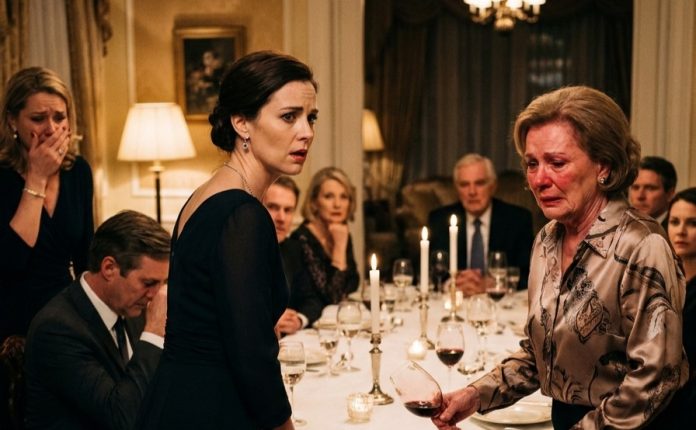
After my husband passed away, I quietly kept his $28 million inheritance a secret. I didn’t need anyone to know—not yet. To my daughter-in-law, I was just an aging burden, someone easy to dismiss. One afternoon, she looked me straight in the eye and told me to leave—that I could “go live on the streets” for all she cared. I didn’t argue. I simply walked away and let her believe she had won. But three months later, everything shifted. When an eviction notice arrived at her door, she finally realized just how wrong she had been—and how much she had underestimated me.
The day she told me to leave, I remember noticing how calm her voice sounded, as if she had rehearsed the moment long before saying it out loud. There was no hesitation, no trace of discomfort, only a quiet certainty that she held all the power in that room. My son stood just behind her, not meeting my eyes, his silence heavier than her words. I could have argued, could have reminded them of everything I had done, everything I had contributed, but something in me had already shifted beyond that need.
Grief has a way of stripping life down to its most essential truths. When my husband passed, I didn’t just lose him—I lost the version of my life that had felt stable, predictable, and shared. The inheritance he left behind wasn’t just money. It was security, independence, and, more importantly, a quiet promise that I would never have to rely on anyone who didn’t value me. That promise mattered more than anything I could have said in that moment.
So I didn’t respond. I didn’t raise my voice or try to defend my place in a house where I was no longer welcome. Instead, I nodded once, turned, and walked to the bedroom I had occupied since his passing. I packed slowly, carefully, folding each item as if the act itself carried meaning beyond necessity. There was no urgency, no panic—just a quiet understanding that this moment was not an ending, but a transition.
As I left the house, I paused briefly at the doorway, not to look back, but to acknowledge something within myself. I wasn’t being pushed out. I was choosing to leave a place where I no longer belonged. That distinction mattered. It reframed everything—not as loss, but as clarity.
The first few days alone were quieter than I expected. I had already arranged temporary accommodations, something simple but comfortable, a space that belonged entirely to me. There was a stillness there that felt unfamiliar at first, but not uncomfortable. For the first time in a long while, I didn’t feel like I was navigating around someone else’s expectations or adjusting myself to avoid conflict.
I didn’t contact my son. Not out of anger, but out of understanding. Whatever had led him to remain silent that day wasn’t something I could fix with a conversation. It was something he would have to confront on his own, if he ever chose to. And I had already decided that I would not be the one to guide him there.
The inheritance remained untouched in those early weeks. I didn’t rush to make decisions or take immediate action. Instead, I reviewed everything carefully, meeting with advisors, understanding the structure my husband had left behind. He had been meticulous, thoughtful in ways I had always admired but never fully appreciated until that moment.
What I discovered confirmed something important: nothing about what I now controlled was accidental. Every detail had been arranged with foresight, ensuring that I would have both security and autonomy. It wasn’t just wealth—it was leverage. And leverage, when used correctly, doesn’t require force. It requires patience.
Three months passed quietly. No contact. No confrontation. From the outside, it likely appeared as though I had simply disappeared, as though the situation had resolved itself without consequence. That was the assumption my daughter-in-law relied on—the belief that silence meant weakness, that absence meant defeat.
But silence can also mean preparation.
During that time, I made decisions—not impulsive ones, but deliberate, informed choices that aligned with both my values and my long-term intentions. One of those decisions involved the property itself, the house they still occupied, the one my husband had ensured remained within structures I now fully understood.
Ownership is not always as simple as people assume. What appears to belong to one person may, in reality, be governed by agreements, protections, and conditions that only reveal themselves when necessary. My daughter-in-law had never asked those questions. She had simply assumed.
And assumptions, when left unexamined, can be costly.
The notice was delivered on a quiet morning. Official, clear, and impossible to ignore. It wasn’t aggressive or dramatic—it didn’t need to be. The language was precise, outlining timelines, responsibilities, and the reality of their situation without room for interpretation.
When she opened the door and received it, I imagine her initial reaction was confusion. Then disbelief. Then something closer to realization. Because the document didn’t just inform—it revealed.
For the first time, she was confronted with something she hadn’t anticipated: the fact that the position she believed was secure had never truly belonged to her.
I wasn’t there to witness it. I didn’t need to be. The impact of that moment didn’t require my presence. In fact, it was more powerful without it. Because it forced her to face the situation without the ability to deflect, argue, or diminish it in real time.
My phone rang later that day. My son’s name appeared on the screen. I let it ring once, twice, three times before answering—not out of hesitation, but out of intention.
“What is this?” he asked, his voice strained, unfamiliar in its urgency.
“It’s a notice,” I replied calmly.
“You know what I mean,” he said. “Why is this happening?”
I paused, allowing the question to settle.
“Because ownership matters,” I said.
There was silence on the other end, the kind that signals understanding beginning to form, even if it isn’t fully accepted yet.
“You’re… you’re doing this?” he asked.
“I’m enforcing what already exists,” I replied.
The distinction was important. This wasn’t retaliation. It wasn’t revenge. It was structure being acknowledged, authority being exercised within the boundaries that had always been there.
“She didn’t know,” he said, his voice quieter now.
“I know,” I replied.
“And you didn’t tell us,” he added.
“No,” I said. “I didn’t.”
Because I had never needed to. Respect doesn’t come from information—it comes from character. And what had been shown to me that day, standing in that house, had already made everything clear.
The conversation didn’t last much longer. There was nothing left to explain, nothing left to negotiate. The situation was no longer emotional. It was defined, structured, and already in motion.
In the days that followed, I continued with my life without disruption. Meetings, decisions, small routines that felt grounded and stable. The difference now was that everything I did was rooted in choice, not obligation.
I didn’t feel vindicated.
I didn’t feel satisfied.
I felt certain.
Certain that walking away that day had been the right decision. Certain that silence had been more powerful than argument. Certain that understanding my position had allowed me to respond in a way that aligned with who I had become.
Some people believe power comes from confrontation, from asserting control in visible ways. But real power is quieter. It’s knowing when not to react. It’s understanding that timing matters more than intensity.
Three months earlier, I had walked out of that house with nothing but a suitcase and a decision.
Now, without raising my voice, without returning to that doorstep, everything had shifted.
Not because I forced it.
But because I understood it.
And that understanding changed everything.