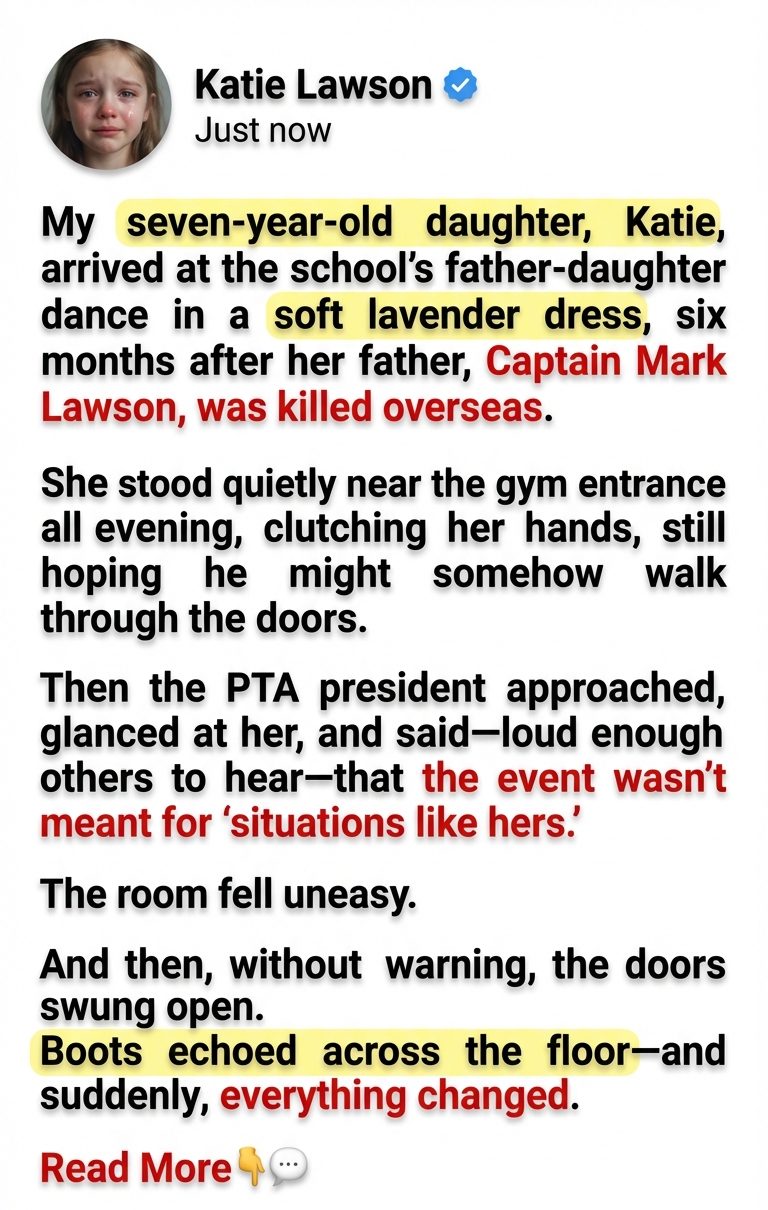
My seven-year-old daughter, Katie, arrived at the school’s father-daughter dance in a soft lavender dress, six months after her father, Captain Mark Lawson, was killed overseas. She stood quietly near the gym entrance all evening, clutching her hands, still hoping he might somehow walk through the doors. Then the PTA president approached, glanced at her, and said—loud enough for others to hear—that the event wasn’t meant for “situations like hers.” The room fell uneasy. And then, without warning, the doors swung open. Boots echoed across the floor—and suddenly, everything changed.
Katie had insisted on coming, even though I hadn’t been sure it was the right decision. When the flyer first came home, she had stared at it for a long time, tracing the words “Father-Daughter Dance” with her finger as if they might rearrange themselves into something else. I had gently suggested we skip it this year, maybe do something special just the two of us instead. But she shook her head, her voice quiet but firm, and said she still wanted to go.
That quiet determination was something she had inherited from her father. Mark had always believed in showing up, no matter how difficult it was, no matter how uncertain the outcome. Katie didn’t fully understand what she was asking for that night, but she understood enough to know she didn’t want to stay home. She wanted to be where she felt he should have been.
So I helped her get ready. I smoothed her dress, fixed the ribbon in her hair, and told her she looked beautiful in a way that felt both true and painfully incomplete. As we drove to the school, she sat quietly in the back seat, her hands folded neatly in her lap, staring out the window. I could tell she was imagining something—something hopeful, something impossible.
When we arrived, the gym was already filled with music and laughter. Fathers spun their daughters across the floor, cameras flashed, and the kind of joy that comes from shared moments filled the space. Katie paused at the entrance, taking it all in, her eyes searching, scanning every face.
I stayed close, unsure how to guide her through something I didn’t fully understand myself. She didn’t ask to leave. She didn’t cry. She simply stood there, watching, waiting, holding onto something I couldn’t reach.
Time passed slowly. Songs changed, conversations shifted, and still she remained near the edge of the room. A few people noticed, their expressions softening with quiet sympathy, but no one approached. It was as if everyone understood the situation—but no one knew what to do with it.
Then the PTA president walked over. Her heels clicked sharply against the gym floor, drawing attention even before she spoke. She looked at Katie, then at me, her expression polite but distant, as if she were addressing a logistical issue rather than a child.
“I’m sorry,” she said, her voice carrying further than it needed to, “but this event is really intended for traditional father-daughter participation. It’s not designed for… situations like this.”
The words landed harder than anything I had expected. Not because they were loud, but because they were deliberate. Carefully chosen. Public enough to be heard, controlled enough to seem reasonable.
Katie’s hand tightened in mine.
I felt it immediately—the shift, the moment her quiet hope began to fracture under the weight of something she didn’t fully understand but could still feel. I opened my mouth to respond, to say something that would protect her from the impact of those words, but before I could—
The doors opened.
The sound echoed through the gym, sharp and unexpected. Conversations paused, music continued but felt distant, and every head turned toward the entrance.
Boots stepped onto the polished floor.
Measured. Steady.
Unmistakable.
A group of uniformed service members entered, their presence filling the space in a way that didn’t demand attention—but commanded it anyway. The room fell silent, the earlier discomfort replaced by something else entirely.
At the front of the group was a man in full dress uniform, his posture straight, his expression composed but warm. He paused just inside the doorway, scanning the room briefly before his gaze settled on Katie.
And then he walked toward her.
Each step was deliberate, respectful, carrying a weight that everyone in the room could feel, even if they didn’t fully understand it yet. When he reached us, he stopped, lowering himself slightly to meet Katie at eye level.
“Are you Katie?” he asked gently.
She nodded, her grip on my hand loosening just slightly as she looked up at him.
“My name is Colonel Harris,” he said. “I served with your father.”
The room seemed to hold its breath.
Katie blinked, her eyes widening just enough to show recognition—not of him, but of what he represented.
“He told us about you,” the colonel continued softly. “He said you were the bravest girl he knew.”
Her lips parted slightly, as if she wanted to respond but didn’t know how.
The colonel stood, then extended his hand toward her—not as a command, not as an expectation, but as an invitation.
“Would you do me the honor of this dance?” he asked.
The music shifted then, almost as if the moment had been waiting for it. A slower song began, filling the space with something softer, something more intentional.
Katie looked at me briefly, her eyes searching for reassurance.
I nodded.
She placed her hand in his.
And just like that, everything changed.
He guided her gently onto the dance floor, his movements careful, measured, making space for her in a way that felt both protective and empowering. She stepped lightly, uncertain at first, then more confidently as the moment settled around her.
The room watched in silence—not out of curiosity, but out of respect. What had started as discomfort had transformed into something else entirely. Something meaningful. Something undeniable.
Other service members followed, approaching girls who stood alone, offering the same quiet invitation. One by one, the empty spaces on the dance floor began to fill—not with obligation, but with intention.
The PTA president stood off to the side, her earlier certainty gone, replaced by something she couldn’t easily define. She didn’t speak again. She didn’t need to.
Because the room had already responded.
Katie smiled then—small at first, then brighter, more certain. It wasn’t the kind of happiness that erased loss, but it was something just as important. It was connection. Recognition. The understanding that she hadn’t been forgotten.
When the song ended, the colonel knelt again, meeting her eyes once more.
“Your father would be very proud of you,” he said.
This time, she didn’t hesitate.
“I know,” she replied softly.
And for the first time that evening—
She wasn’t waiting for him to walk through the door anymore.
Because somehow, in a way none of us expected—
He already had.