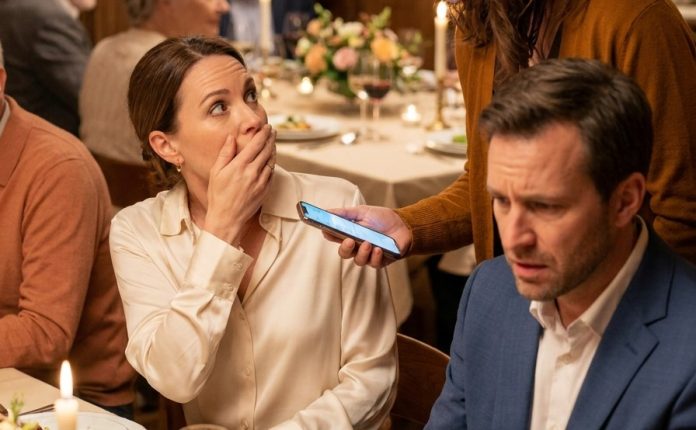
At Easter dinner, my sister shoved my daughter out of “her” seat. “You filthy parasite—you’re dirtying my chair!” she snapped, loud enough for everyone to hear. My parents didn’t react. They simply urged everyone to “eat while the food’s hot,” pretending nothing had happened. I felt my daughter’s hand tighten in mine, her silence saying everything. They thought they could ignore it, dismiss it, erase it. Instead, I stood up calmly, took my daughter’s hand, and walked out without a word. Once outside, I made a single call. My voice was steady: “Fire Elena.”
The moment the door closed behind us, the noise from inside the house dulled into a distant hum, as if the world we had just left belonged to someone else entirely. The evening air felt colder than expected, brushing against my skin in a way that made everything sharper, clearer. My daughter’s hand was still gripping mine tightly, her small fingers wrapped around me with quiet urgency. I looked down at her, searching her face for tears or confusion, but what I saw instead was something far heavier—understanding.
That quiet understanding unsettled me more than anything my sister had said. Children shouldn’t have to interpret cruelty so quickly, shouldn’t have to learn how to endure humiliation in silence just to keep the peace. Yet there she was, standing beside me, holding herself together in a way that felt far too practiced for her age. I knelt slightly to meet her eyes, brushing her hair back gently, as if that small act could undo what had just happened inside those walls.
“I’m okay,” she whispered before I could speak, her voice soft but certain.
Those words broke something in me more deeply than anger ever could. She shouldn’t have been okay—not like that, not so quickly. She should have been confused, upset, even crying. Instead, she had adapted. And that realization made something painfully clear: this wasn’t the first time she had learned to shrink herself to survive someone else’s behavior. It was just the first time I had refused to ignore it.
For years, I had told myself that my family’s behavior was manageable. That their sharp words, their dismissive tone, their constant need to assert control were simply part of who they were. I convinced myself that enduring it quietly was the easier path, that confrontation would only create more problems than it solved. But standing there, holding my daughter’s hand, I realized that my silence hadn’t protected her—it had exposed her.
The call I made wasn’t born out of anger, even though anger would have been justified. It came from something far more grounded, something that had been forming quietly for years beneath every moment I had chosen to tolerate. I lifted my phone, dialed the number without hesitation, and spoke with a clarity that surprised even me. “Elena is no longer to have access,” I said. “Effective immediately.”
There was no pause on the other end, no confusion, no need for explanation. The response came quickly, professionally, confirming what I already knew—that this decision was not only possible, but already prepared for. I ended the call and lowered my phone slowly, the weight of that moment settling into something solid, something irreversible. This wasn’t just a reaction. It was a boundary finally enforced.
Inside the house, life would continue as if nothing had happened, at least for a while. Plates would be passed, conversations resumed, laughter forced into the spaces where discomfort should have lived. That was how they operated—minimize, dismiss, move forward without acknowledgment. But what they didn’t understand was that this time, something had shifted beyond their control.
“Do you want to go home?” I asked gently, my voice softer now.
She nodded without hesitation, her grip on my hand loosening just slightly, as if she felt safe enough to release some of the tension she had been holding. That small change was enough for me to understand that leaving had already mattered more than staying ever could have. We walked to the car in silence, not the heavy silence of avoidance, but the quiet kind that allows something to settle.
The drive home was calm, almost unusually so. I glanced at her occasionally, watching the way she looked out the window, her expression thoughtful rather than distressed. I wondered what she was thinking, what she was processing, what she had already decided about the people we had just left behind. Children understand more than we realize—they just don’t always have the words to express it.
“I’m sorry,” I said finally, breaking the silence.
She turned to me, her brows pulling together slightly in confusion. “Why?” she asked.
“For not stopping it sooner,” I replied, my voice steady but honest.
She didn’t answer immediately. Instead, she reached over and placed her hand on mine again, this time gently, without the earlier tension. “You did stop it,” she said quietly.
I nodded, but I knew the truth was more complicated than that. I had stopped it now, yes—but only after allowing it to continue for far too long. That realization stayed with me as we pulled into the driveway, settling into a place that wasn’t painful, but wasn’t easy either. It was simply real.
By the time we stepped inside the house, my phone had already begun to buzz with notifications. Messages stacked one after another, calls I had missed, voicemails waiting to be heard. I didn’t need to read them to understand their progression—confusion first, then irritation, and eventually something closer to panic. Because what I had done wasn’t contained within the walls of that dining room. It had extended into something much larger.
I set my phone down on the counter and didn’t touch it again right away. There was no urgency to respond, no need to explain. This wasn’t a misunderstanding that required clarification. It was a consequence that required acknowledgment. And for the first time, I wasn’t interested in making it easier for them to accept.
An hour later, the phone rang again. My mother’s name appeared on the screen, and this time, I answered. Not because I felt obligated, but because I wanted to hear what she would say when pretending was no longer an option.
“What did you do?” she asked immediately, skipping any pretense of concern.
“I left,” I said calmly.
“That’s not what I mean,” she replied sharply. “Elena just called—something about her position, about being removed. What is going on?”
I leaned against the counter slightly, letting a small pause stretch between us. “You didn’t seem concerned about what happened at dinner,” I said.
“That’s different,” she insisted. “That was just tension. You know how your sister is.”
Yes, I did know. And that was exactly why this moment mattered.
“No,” I said quietly. “I know how all of you are.”
The silence that followed was immediate and heavy, the kind that signals a shift neither side can ignore.
“You’re overreacting,” she said finally.
I almost smiled, not out of amusement, but recognition. That word had followed me my entire life, used to minimize, to dismiss, to reshape reality into something more comfortable for them.
“Am I?” I asked calmly.
She didn’t answer. Because this time, the situation had moved beyond something she could explain away.
“Elena humiliated my daughter,” I continued. “And you said nothing.”
“She didn’t mean it like that,” my mother said quickly.
“She said exactly what she meant,” I replied.
Another silence followed, heavier than the last.
“You’re going to ruin her over this?” she asked, her voice shifting, softer but more urgent.
I considered that question carefully before answering.
“No,” I said. “She did that herself.”
I ended the call before she could respond, not out of anger, but because there was nothing left to say.
That evening, I sat with my daughter in the living room, the quiet around us no longer heavy, but steady. She leaned against me, her breathing even, her body relaxed in a way that told me everything I needed to know. She felt safe. And for the first time in a long time, I knew I had chosen correctly.
“Will we still go back?” she asked after a while.
I paused, then shook my head gently. “No,” I said.
And this time, that answer didn’t feel like loss.
It felt like protection.
Because family isn’t defined by who shares your table.
It’s defined by who deserves a place at it.
And that night, I finally understood the difference.