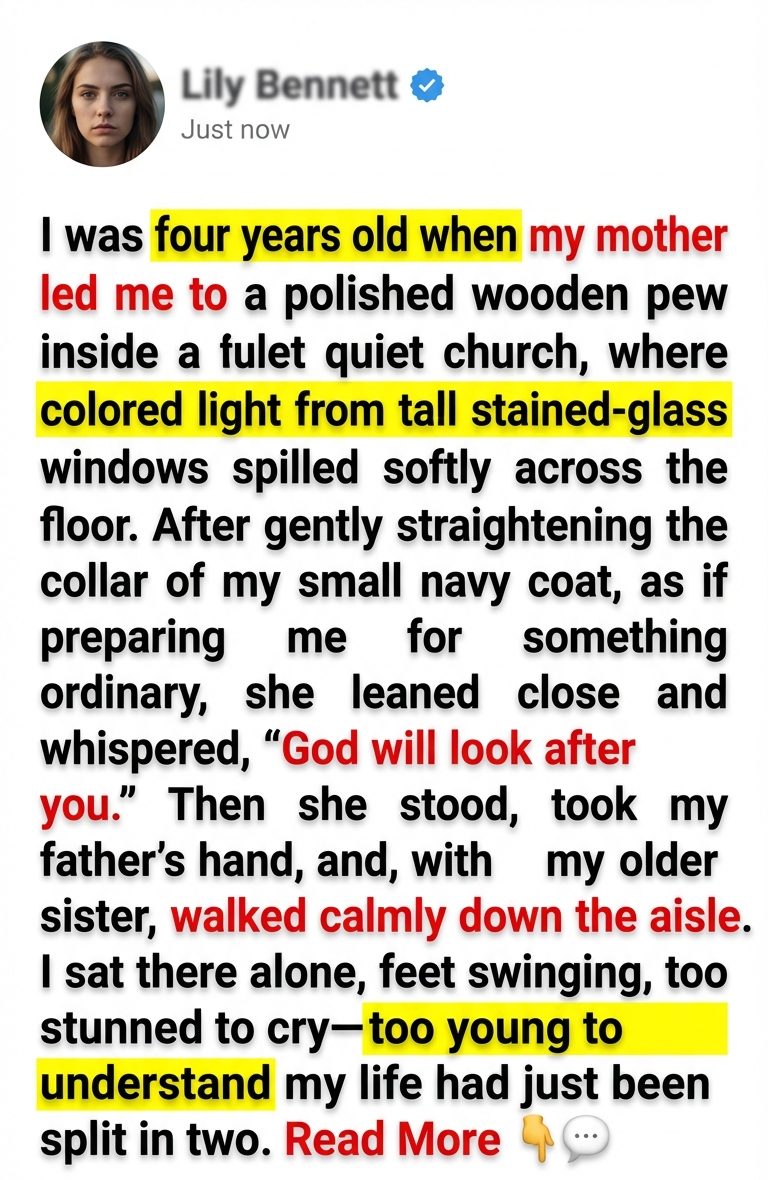
I was four years old when my mother led me to a polished wooden pew inside a quiet church, where colored light from tall stained-glass windows spilled softly across the floor. After gently straightening the collar of my small navy coat, as if preparing me for something ordinary, she leaned close and whispered, “Stay right here, sweetheart. God will look after you.” Then she stood, took my father’s hand, and, with my older sister, walked calmly down the aisle. I sat there alone, feet swinging, too stunned to cry—too young to understand my life had just been split in two.
At first, I thought they would come back. That’s what parents do, right? They step away for a moment and return with a smile, maybe a treat, maybe a reassuring touch. I watched the door carefully, expecting it to open again at any second.
Minutes passed. Or maybe longer—I didn’t understand time then. The silence inside the church grew heavier. The soft echo of distant footsteps faded, and all that remained was the quiet hum of a space that suddenly felt too big.
I remember sliding off the pew and walking slowly down the aisle, my small shoes tapping against the floor. Each step felt uncertain. I didn’t know where I was going. I only knew I needed to find them.
When I reached the doors, I pushed them open with both hands. The light outside was brighter, harsher than the soft glow inside. But they weren’t there. No familiar faces. No waiting arms. Just strangers passing by.
That was the moment confusion began to turn into something else. Not quite fear—not yet. But a deep, uncomfortable awareness that something wasn’t right.
A woman noticed me standing alone near the entrance. She approached gently, crouching to my level, her voice soft and careful. “Where are your parents, sweetheart?” she asked.
I pointed behind me, back into the church. “They said to stay,” I replied, repeating the only instruction I had been given.
Her expression changed—subtle, but I could feel it. Concern replaced curiosity. She stood and called for someone, her voice now carrying urgency I didn’t understand.
Soon, more adults gathered. A priest. Another woman. They spoke in hushed tones, glancing at me, then toward the doors, as if expecting someone to return.
But no one did.
I was led into a small office, offered water, and asked questions I didn’t have answers to. “What are your parents’ names?” “Where do you live?” I tried, but my words were scattered, incomplete, like pieces of a puzzle too big for me.
Hours passed. I remember sitting in a chair that felt too large, holding a cup I didn’t drink from, staring at a door that never opened the way I wanted it to.
Eventually, someone arrived—not my parents, but a uniformed officer. His presence felt serious, final. He spoke gently, but his questions were different. More direct.
That was the first time I sensed something irreversible had happened.
I didn’t go home that night.
Instead, I was taken somewhere unfamiliar—a place with bright lights, quiet hallways, and people who spoke kindly but weren’t family. They gave me a blanket, a small toy, and a bed that didn’t feel like mine.
I remember asking, “When are they coming back?”
No one answered directly.
Days turned into weeks. Weeks into months. The question stayed the same, but the answers grew quieter, more careful, until eventually, no one asked it anymore.
I learned new routines. New faces. New rules. But underneath it all was a constant feeling I couldn’t name at the time—a sense of being misplaced, like I had been set down somewhere by accident and forgotten.
As I grew older, pieces of the truth began to surface. Not all at once, but slowly, through conversations I wasn’t meant to fully understand. Words like “abandonment” and “case” and “placement” became part of my world.
I learned that my parents hadn’t gotten lost. They hadn’t been delayed. They had made a choice.
A choice to leave me behind.
Understanding that didn’t come with one big moment. It came in waves. Each one hitting a little harder as I grew old enough to grasp what it meant.
At six, I felt confusion.
At ten, I felt anger.
By my teenage years, it had settled into something deeper—questions that had no easy answers.
Why me?
Why not my sister?
What had I done—or not done—that made me the one they left sitting in that church pew?
Those questions followed me everywhere. Into school. Into friendships. Into every attempt I made to feel normal.
Trust didn’t come easily. How could it? The people who were supposed to protect me had quietly walked away without looking back.
But life, in its strange way, continued.
I moved through foster homes. Some kind. Some not. Each one leaving its own mark, its own lesson about what family could be—and what it sometimes wasn’t.
There were moments of warmth. People who tried. People who cared. But there was always a part of me that stayed guarded, waiting for the moment things might change again.
Because once you’ve been left like that, you learn something early: nothing feels permanent.
Years later, as an adult, I found myself standing outside a church—not the same one, but close enough in feeling to bring everything rushing back.
The smell of polished wood. The quiet echo of footsteps. The colored light filtering through glass.
I hadn’t planned to go in. But I did.
I sat in a pew, just like before. Older now. Aware. And for the first time, I allowed myself to fully feel what that four-year-old version of me couldn’t.
The loss.
The confusion.
The quiet moment where everything changed without warning.
But something else was there too.
Perspective.
I realized that while my story began with abandonment, it didn’t end there.
I had grown. Survived. Built something from nothing.
And while I may never fully understand why they made that choice, I no longer needed that answer to move forward.
Because the truth is, being left behind didn’t define me.
It shaped me—but it didn’t end me.
And that small child sitting alone in a church pew?
They didn’t know it yet.
But they were stronger than anyone could have imagined.