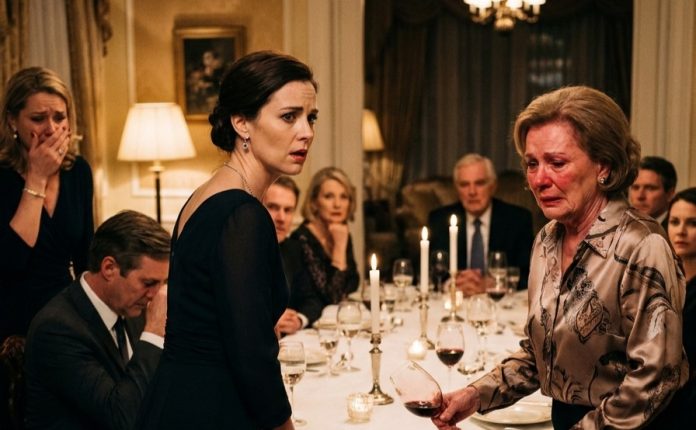
My Mother Looked Around My $960,000 Housewarming, Smiled At My Sister, And Said, “You need to pack your bags and find somewhere smaller”—fourteen years after they took my college fund, left me sleeping in my car, and swore I owed the family one more sacrifice, I picked up my phone, faced a room full of guests, and decided this time they would finally hear the truth.
Part 1
My mom stole my $45,000 college fund for my sister’s house, so I was sleeping in my car at eighteen. Years later, after becoming a millionaire, I saw them again and finally turned the tables.
For me, one of those moments came when I watched my sister Veronica and our mother, Margaret, walk into the welcome reception for my new $960,000 home. It was a house that reflected every sacrifice, every late night, every ounce of hustle I had poured into building my IT company.
Even so, a knot tightened in my stomach and my skin began to crawl, because I recognized the look in their eyes. It was the exact same look I had seen when I was eighteen, on the night my whole world collapsed.
Growing up in Boston, we looked like a pretty normal family from the outside. Dad worked in finance, Mom ran a boutique, we were two daughters under one roof, and we had a golden retriever named Rusty padding around the house.
But appearances can lie beautifully. When I was twelve, the cracks started showing. Dad walked out, and while the divorce itself was not explosive, what happened after that laid the foundation for years of pure family dysfunction.
Veronica, who was three years older than me, later married Daniel, an investment banker from a wealthy family. Their wedding was spectacular, and Mom spent more than $50,000 she did not have, insisting that a daughter only gets married once.
I was nineteen then, working two jobs, attending community college, and barely scraping together enough money to buy my bridesmaid dress. Then came the babies—James, Freya, and Caleb—and with every new child, Veronica’s sense of entitlement grew while Mom remained endlessly available to help them, usually at my expense.
“Your sister has three children to feed,” Mom would say.
“What do you need extra money for anyway? Books? Can’t you just use the library?”
Meanwhile, I was working myself into the ground. Scholarships helped, but without real family support, I worked as a barista in the mornings, a tutor in the afternoons, and a data entry clerk on weekends.
Sleep became a luxury I could not afford. Dad faded into the background after moving to Chicago and starting a new family, and Mom made it even harder for him to stay in touch with me by “forgetting” to tell me when he called or “accidentally” deleting his messages.
Still, I kept going. While Veronica posted polished holiday photos with her beautiful family, I stayed up all night studying and coding.
I graduated at the top of my class. Mom came to my high school graduation, but she left early because Veronica called to say James had a mild fever.
I never complained. I accepted it as my reality and used it as fuel to build success on my own terms. I told myself I did not need their approval.
What I did not expect was how violently everything would shift on my eighteenth birthday. That night set the course for everything that came after it, and it would lead, fourteen years later, to the confrontation standing in front of me now.
My eighteenth birthday fell on a Tuesday. I remember because I had somehow managed to get the evening off, which was rare.
I was not expecting some big celebration. Veronica and Daniel were expecting their third child, and naturally they already had the family’s full attention.
Still, turning eighteen felt important. I was legally an adult, I had finished high school, and I had partial scholarships from three universities.
When I got home after tutoring, I found Mom and Veronica sitting at the kitchen table, bent over spreadsheets. They barely looked up.
“There’s leftover lasagna in the fridge if you’re hungry,” Mom said, her eyes still fixed on the papers.
I heated up a plate and sat down with them, curious.
“What are you working on?”
Mom glanced up.
“Just figuring out some financial matters. Veronica and Daniel need a bigger house now that Caleb is on the way.”
I nodded, because conversations like that were normal in our house. Then my eyes landed on the documents in front of them, and a cold feeling moved through me.
“Why do you have my college paperwork?”
Veronica let out a dramatic sigh.
“We might as well tell her, Mom.”
Mom smoothed the papers with both hands and gave me that familiar look, the one she always wore right before I was expected to make some noble sacrifice for the family.
“Lena, we need to talk about your college plans.”
She told me that with Veronica expecting again, they really needed a four-bedroom house. Daniel’s bonus had not been as big as they had expected that year, and they were stretched thin.
I sat very still, already knowing exactly where this was going.
“The thing is,” Veronica said, “we’ve run the numbers, and even with Daniel’s salary and Mom helping with the down payment, we’re still short.”
“Short for what?” I asked, even though I already knew.
“We need to use your college fund,” Mom said.
Then, as if that were the most reasonable thing in the world, she added, “It’s not as if you don’t have scholarships already. And community college is perfectly respectable. You can transfer to a university later, when things are not so tight for the family.”
My college fund. The money Dad had started setting aside before the divorce. The money Mom had promised would stay untouched for my education.
I had been counting on that fund to close the gaps the scholarships would not cover.
“But that’s my money,” I said quietly. “Dad set it aside for my education.”
Veronica rolled her eyes.
“Don’t be selfish, Lena. We’re talking about a home for your niece and nephews. Where are they supposed to sleep? Should Caleb live in a closet because you want to go to some fancy university?”
“That’s not what I’m saying,” I said. “But I’ve worked so hard for this. I’ve kept a 4.0 GPA while working multiple jobs. Those scholarships won’t cover everything.”
“You can take out loans like everybody else,” Veronica snapped. “Daniel and I already have a mortgage. That’s life.”
Mom nodded as if she were being generous.
“Or you could live at home and go to community college. That would be much more affordable.”
Something inside me shifted. Years of swallowing my feelings, of stepping aside, of quietly accepting less than I deserved, suddenly gave way to something hot and sharp.
“No.”
The word seemed to hang in the air between us. Mom blinked, clearly not expecting resistance.
“Excuse me?”
“No,” I said again, stronger this time. “That money is for my education. Dad and you set it aside for me. It is not Veronica’s house fund.”
Mom’s face hardened.
“This isn’t a negotiation, Lena. This is what’s happening. Your sister has a family to provide for.”
“And I have a future to build,” I shot back, my voice cracking. “I earned those scholarships. I worked while keeping perfect grades. I deserve to use my college fund for college.”
Veronica gave a cold, contemptuous laugh.
“Oh, please. Like you know anything about real responsibility. Try having three kids before you lecture us about what you deserve.”
Tears burned in my eyes, but I forced them back.
“This isn’t fair, and you know it.”
Mom shoved back her chair and stood up.
“My priority is my family.”
“My priority is my education,” I said. “That’s not wrong.”
“Well then,” Mom said, folding her arms across her chest, “if that’s your attitude, you have a choice to make. Accept that the money is going to help your sister, or pack your bags and figure out life on your own. You’re eighteen now, after all.”
The ultimatum sat there between us. Veronica smiled, absolutely certain I would cave the way I always had before.
But something inside me had already broken. Or maybe it had finally snapped free.
I stood up slowly.
“I’ll pack my bags.”
The shock on their faces might have been satisfying if I had not been so terrified. Mom clearly had not expected me to choose independence.
“Don’t be so dramatic,” Veronica scoffed. “Where would you even go?”
I did not answer. I walked into my bedroom, pulled out my biggest suitcase, and packed in a kind of numb silence.
Clothes. Toiletries. My laptop. Important documents. The family photos hanging on the walls no longer felt like mine.
Mom appeared in the doorway just as I zipped the suitcase shut.
“You’re being ridiculous. Sleep on it, and we’ll talk rationally in the morning.”
“There’s nothing to discuss,” I said, surprised by how calm I sounded. “You’ve made your position clear. I’m making mine clear too.”
I pushed my suitcase past her, grabbed my backpack from the hook by the front door, and stepped out into the night.
No one called after me. No one tried to stop me.
That night, I slept in my car in a Walmart parking lot with my work uniform balled up beneath my head. For the next two weeks, I kept up the same brutal routine—working three jobs, sleeping in my car, and showering at the gym where I had a bargain membership.
I told no one. Shame is heavy, and at eighteen it felt unbearable.
On the fifteenth day, my computer science teacher, Professor Clara Hughes, found me half asleep in the library. She gently woke me and asked if everything was okay.
Something in her kind eyes broke the last of my composure, and I told her everything.
That evening, she drove me to her house and showed me a guest room.
“It’s yours until you figure things out,” she said simply. “No one should go through this alone.”
Professor Hughes became much more than a teacher. She became my mentor, my advocate, and the first person who believed in me without conditions.
She helped me secure additional scholarships, guided me through financial aid applications, and gave me a reference for an internship that would eventually change the course of my life.
Everything that happened after the night I was thrown out grew from that experience. It taught me that I was, in some very real ways, completely on my own.
But it also taught me that chosen family can be stronger than biological relatives. Most of all, it revealed a kind of strength in me I had never known existed until I was forced to find it.
With Professor Hughes’s help, I managed to piece together enough financial aid, scholarships, and part-time work to attend a local state school instead of my dream university. It was not Boston University, but it had a strong computer science program, and I learned to be grateful for what was possible.
College looked very different for me than it did for most of my classmates. While they went to parties and joined clubs, I worked whatever jobs I could find—waitressing, staffing the university IT help desk, and taking freelance web development projects late into the night.
Sleep stayed scarce. A social life barely existed.
Still, I kept my GPA flawless. Computer science came naturally to me, and before long I was helping classmates who were struggling, one of them being Isabella Tran.
Isabella was brilliant but distractible, and she eventually became both my best friend and my future business partner. In some ways we were complete opposites.
I was methodical. She was impulsive. I was strongest in back-end programming, and she had a gift for user experience and design.
Together, we were exactly what the other one needed.
During junior year, we started talking seriously about building a money-management app for young adults. Most of the tools on the market were made for people who were already financially comfortable, not people like us who were living paycheck to paycheck and trying not to drown.
We saw the gap clearly, and we wanted to fill it.
Using campus resources, we built a prototype. We called it SENS, an app that let users track spending visually, automate savings, and build healthier credit habits.
Our professors were impressed, but what mattered more was that our classmates actually found it useful. After graduation, Isabella and I had a choice to make: take safe corporate jobs, or bet everything on building the company ourselves.
The safe option was tempting, especially given how unstable my life had been for so long. But I kept hearing Professor Hughes’s voice in my head.
“Sometimes the riskiest path leads to the greatest rewards.”
So we took the risk. We moved into a tiny, roach-infested apartment to save money and poured ourselves completely into SENS.
I coded while eating ramen out of a pot. Isabella worked on interfaces until dawn. We went to every networking event, startup accelerator, pitch competition, and founders’ meetup we could get into.
For six straight months, all we heard was no.
Investors said we were too young, too inexperienced, or focused on the wrong market.
“College students don’t care about financial planning,” one venture capitalist told us dismissively.
But we refused to quit. Eventually, we won a small startup grant that let us hire our first employee, a marketing specialist who helped sharpen our messaging.
We shifted our target slightly, focusing more on recent graduates with student debt instead of current students, and little by little the app started gaining traction. Then it stopped being little by little.
A tech blog featured us. A financial influencer with millions of followers endorsed SENS. Our user base jumped from thousands to hundreds of thousands.
During all of this, I occasionally thought about reaching out to my family. But contact between us had been almost nonexistent since the night I left.
Mom called three months later—not to apologize, but to inform me that they had used my college fund for Veronica’s down payment. Dad texted from time to time to check in, but our relationship remained distant and awkward.
So I turned my attention back to my business and the life I was building for myself.
Part 2
The years that followed passed in a blur of code, meetings, exhaustion, and eventual success. Isabella and I moved out of our dingy apartment and into a real office.
We hired more developers, customer support staff, and marketing specialists. SENS grew from an app into a full financial platform.
Five years after we started, one of the top financial technology companies in the country made us an acquisition offer. The number attached to it was staggering—enough to make both Isabella and me wealthy several times over.
After weeks of negotiations, we accepted. I was thirty years old and suddenly richer than I had ever believed I could be.
The anxious eighteen-year-old sleeping in a Walmart parking lot felt like someone from another lifetime. Financial security gave me something I had never really had before: the freedom to make decisions from strength instead of panic.
I invested most of what I earned, donated to scholarship funds for first-generation college students, and eventually let myself think about buying a home. A real home. Not just a place to collapse between work shifts.
After months of searching, I found it. A beautiful Craftsman-style house in an upscale neighborhood, priced at $960,000.
It was expensive, yes, but well within my means. Four bedrooms, hardwood floors, huge windows, a wraparound porch, and a backyard big enough to imagine a whole new kind of life.
The house needed work, but I saw its potential immediately. As I signed the closing papers, I could not miss the irony.
Fourteen years earlier, my college fund had been emptied so Veronica could buy a larger home. Now I was buying a nearly million-dollar house with money I had earned myself.
During the renovation, I got an unexpected note from my father. He had seen the news of the SENS acquisition online and wanted to congratulate me.
Our first conversation was uncomfortable, but it opened a door. He admitted he had lost track of me after I left and had been too embarrassed to try harder to find me.
He had divorced again and moved back to Boston. He asked if I would meet him for coffee.
That coffee meeting was tense, but it was also healing in a way I had not expected. Dad apologized for being absent through the hardest years of my life.
He admitted he had known about the college fund situation, though he had felt powerless to stop it. I did not forgive him immediately, but I respected that he was finally telling the truth.
We agreed to try, slowly, to build some kind of relationship. During that conversation, he also told me Veronica and Daniel were struggling financially again.
Daniel’s company had restructured, they had lost their house, and they had downsized to a townhouse. Mom, apparently, was still doing everything she could to prop them up.
“They don’t know about your success,” Dad said. “I haven’t told them.”
I nodded, not sure how I felt. Part of me wanted them to know I had succeeded without their help. Another part wanted my success to stay quiet and untouched by them.
As my renovation neared completion, I started planning a housewarming party. After a lot of thought, I put my family on the guest list.
Isabella thought I was opening myself up to disappointment, but I felt ready. One way or another, I wanted that chapter of my life to end.
I sent formal invitations to Dad, Mom, Veronica, and Daniel. Dad replied right away that he would be there.
Mom called sounding surprised, but agreeable. Veronica texted, “Looking forward to seeing how you’re doing. We’ll be there.”
The morning of the party was bright and beautiful. Even though I had stayed up late finishing last-minute details, I woke early with adrenaline already moving through me.
Every room looked perfect. The living room had a deep sectional and built-in bookshelves. The kitchen gleamed with marble counters and professional-grade appliances.
The dining room could seat twelve comfortably, and upstairs were four gorgeous bedrooms, including a primary suite with a balcony overlooking the backyard.
Isabella came by around ten carrying champagne and decorations.
“Are you sure you want to do this?” she asked while arranging flowers. “It’s not too late to uninvite them.”
“I need closure,” I said, even as my stomach twisted at the thought of seeing my mother and sister again. “And besides, they’re only three people out of thirty guests. If it gets awkward, there’ll be plenty of buffers.”
The caterers arrived at noon and set up stations throughout the first floor. By three o’clock, everything was ready—food, drinks, music, and nerves stretched thin.
My colleagues from the tech world came first, then neighbors. Professor Hughes arrived with her husband, hugged me tightly, and whispered how proud she was.
College friends, industry contacts, and my financial adviser rounded out the first wave of guests.
At four-thirty, the doorbell rang again. I opened it to find my father standing there awkwardly with a gift bag in his hand.
“Dad,” I said, the word still feeling slightly unfamiliar.
“Lena,” he said, looking past me into the house. “This is incredible.”
I let him in, gave him a short tour, and introduced him to a few guests. He seemed genuinely happy for me, if slightly out of place among the polished professionals filling my house.
“Your mother and sister should be here soon,” he said. “They were planning to come together.”
I nodded and took a sip of water to hide my unease.
“And how are they?” I asked.
Dad hesitated.
“Daniel’s job situation has been hard on them. They sold their house last year and moved into a townhouse. Margaret helps with the kids a lot.”
Before I could say anything else, Isabella appeared beside me.
“More guests are arriving,” she said quietly. “Including, I think, your mother and sister.”
I took a breath and walked to the front door.
There they were. Margaret, barely changed despite fourteen years passing, and Veronica, still strikingly beautiful but with stress etched around her eyes.
Daniel stood behind them, looking older and more worn than I remembered. Beside him were the children—James, now a teenager, Freya a preteen, and Caleb around ten.
“Lena,” Mom said carefully. “Thank you for inviting us.”
“Welcome,” I said, stepping back. “Please, come in.”
The kids lingered awkwardly at first, obviously coached to behave. I smiled at them, these nieces and nephews I barely knew.
“There’s a game room upstairs if you get bored,” I told them. “Second door on the right.”
That loosened things immediately. James asked if I had a gaming system, and when I said yes, all three kids disappeared upstairs after quick, polite thank-yous.
Daniel glanced around.
“Beautiful home,” he said. “The architectural details are impressive.”
“Thank you,” I said. “The renovation took six months, but it was worth it.”
“Six months?” Veronica lifted her brows. “You must have had quite a team working on it.”
“I did,” I said, leaving it at that.
“Would you like a tour?”
As I walked them through the house, I watched Veronica carefully. Her expression became more and more calculating.
She ran her hand over the granite counters, peeked into closets, and commented on what a great play area the backyard would make. Mom followed more quietly, occasionally complimenting the decor or asking about a feature.
“This must have been quite an investment,” Mom said at last as we stepped into the primary bedroom.
“It was,” I said. “But I’ve been fortunate in my career.”
“What exactly do you do now?” Veronica asked, sitting on the edge of my bed as if she owned the place already. “Dad mentioned something about an app.”
I gave them a shortened version of my success story and watched their faces change from polite curiosity to stunned recognition.
“You sold your company for millions?” Veronica asked, her voice jumping higher than usual.
“We did,” I said. “The timing was right.”
The tour ended downstairs, where more guests had arrived. I introduced my family to Isabella, Professor Hughes, and a few colleagues who knew parts of my story.
Throughout the introductions, I kept noticing Mom and Veronica huddled in corners, whispering intensely. Daniel, by contrast, seemed detached from them and genuinely interested in talking with people from my world.
About an hour into the party, I tapped my glass and thanked everyone for coming.
“This house represents more than a place to live,” I said. “It’s a milestone I once thought was impossible. I’m grateful to everyone who supported me along the way.”
I had barely finished when Veronica stepped forward.
“As Lena’s sister, I’d like to say something too.”
Her voice carried that same confident note I remembered from childhood—the one that always came right before she got exactly what she wanted.
“Family is everything,” she said, resting her hand on my arm, “and seeing Lena’s beautiful home today has made me realize how perfect this would be for our family.”
A confused ripple moved through the room.
“What Veronica means,” Mom said quickly, “is that we’re so proud of Lena for creating a place where family can gather.”
“No,” Veronica said, tightening her fingers around my arm. “What I mean is that this house would be perfect for my family. With Daniel’s job situation and the kids needing good schools, we’ve been looking for exactly this kind of house in exactly this neighborhood.”
The room went still. Even the caterer seemed to freeze.
“Veronica,” Daniel said, his face reddening. “This isn’t the time or the place.”
“It’s exactly the right time,” she said. “Lena has always wanted to help family.”
Then she looked around the room and said it plainly.
“She’s single, has no kids, and she’s obviously doing very well financially. This four-bedroom house is wasted on one person when we have three growing children who need space and stability.”
Mom nodded along as if the proposal were perfectly reasonable.
I stood there, almost unable to process what I was hearing. Fourteen years without real contact. Fourteen years after they took my college fund. And now they were not just asking for my home—they were expecting it.
“Lena,” Mom said in that familiar, commanding tone, “you need to pack your bags and find somewhere smaller. A condo downtown would fit your lifestyle much better, and it would mean the world to your sister’s family.”
Veronica had already started gesturing around the living room as if she were planning a move-in.
“James could have the room with the bay window. Freya would love the purple room. Caleb would have so much space for his toys in the smallest bedroom.”
“And after all Veronica’s been through,” Mom added, “she deserves this. It’s the least you could do as her sister.”
The room had gone completely silent. My guests looked horrified.
Isabella was suddenly beside me, quiet but solid. I took a breath and felt, strangely, very calm.
“I have something to show you,” I said.
I picked up my phone, connected it to the smart-home system, and cast a document onto the large television in the main room.
“What’s this?” Veronica asked, her voice already tightening.
“This,” I said, “is the restraining order I filed fourteen years ago after you kicked me out on my eighteenth birthday.”
The legal document filled the screen. The silence sharpened.
“What are you talking about?” Mom demanded. “We never kicked you out. You chose to leave.”
I kept my voice level.
“You gave me an ultimatum on my eighteenth birthday. Accept that my college fund would go toward Veronica’s down payment, or pack my bags. I packed my bags. You didn’t stop me.”
“That was an argument, not an eviction,” Veronica said with a brittle laugh, refusing to look away from the screen. “You’re being dramatic.”
“I slept in my car for two weeks,” I said. “In February. In Boston.”
A murmur moved through the room.
Dad stepped forward, his face pale.
“I didn’t know it was that bad,” he said quietly. “You never told me.”
“Would it have mattered?” I asked.
He had no answer.
I swiped to the next document.
“This is even more interesting. This is why I filed the restraining order.”
Credit reports and loan applications appeared on the television, all in my name and all dating from shortly after I had left home.
“What is this?” Daniel asked, stepping closer, his finance background helping him understand what he was seeing faster than anyone else.
“After I left, someone opened three credit cards and took out a personal loan in my name. They had my Social Security number, my birth certificate, and enough personal information to get through security questions.”
“The total debt was just over $45,000.”
Mom had gone white. Veronica became intensely interested in her wineglass.
“Fortunately,” I said, “the detective who helped me was thorough. The credit cards were used at stores Veronica shopped at regularly. The loan money was deposited into an account that transferred the exact amount into your joint checking account, Daniel.”
Daniel turned slowly toward his wife.
“You told me that money came from your mother. A gift for the down payment.”
“It did,” Veronica said. “Mom helped arrange it.”
“By committing identity theft against your own daughter,” Professor Hughes said sharply, her academic calm giving way to pure protective anger. “That’s a felony, in case that detail slipped your mind.”
“I’m sure there’s some misunderstanding—” Mom began.
“This is the police report I filed,” I said, pulling up another document. “I had enough evidence to press charges for identity theft and fraud. The detective was especially interested in this loan application.”
I enlarged the signature on the screen.
“Whoever forged my name even misspelled my middle name.”
Veronica’s hand shook hard enough that she had to set down her glass.
“If you filed charges, why weren’t we arrested?” she asked.
“Because I didn’t go through with it,” I said. “I was eighteen. I was terrified. And despite everything, you were still my family.”
“So I made a deal with the detective. I would pay off the fraudulent debt myself if everything was documented, but I would hold off on prosecution.”
I pulled up one more file.
“This is proof of payment. Every cent of that $45,000, plus interest, was paid by me over three years while I was putting myself through college—working three jobs, sleeping four hours a night, eating ramen, and paying off debt I never created.”
Daniel looked physically ill.
“I had no idea,” he said, barely above a whisper. “Veronica told me her parents were helping with the down payment as a gift.”
“Just one parent,” I said softly. “And it wasn’t a gift. It was theft.”
Mom finally found her voice again, and it came out sharp.
“You’re twisting everything to make yourself the victim. We always did what we could for you. Families have to make hard choices for the greater good.”
“The greater good?” Dad said, his voice rising. “Margaret, she was eighteen. She was our daughter. And you stole from her.”
Mom wheeled on him.
“Don’t you dare judge me, Richard. You walked away. You left me to handle everything.”
“I left you, not our daughters,” he shot back. “And I certainly never authorized you to steal Lena’s college fund or commit fraud in her name. I knew about the college fund, yes.”
Then he turned to me.
“I’m sorry I didn’t fight harder for you. But the credit cards, the loan—I had no idea.”
I nodded. It was not enough, but it was honest, and at that point honesty felt almost radical.
Veronica changed tactics the moment she realized her support was collapsing.
“It was a hard time,” she said, tears filling her eyes. “We had a baby coming. We needed a home. Mom was just trying to help us, and you weren’t there to ask.”
“Maybe,” I said. “But none of that justifies fraud.”
I swiped again and opened another document.
“This may interest you too, Daniel. While the detective was looking into the identity theft, I found out quite a bit about your finances.”
The records on-screen detailed six failed business ventures Veronica had funded without Daniel’s knowledge using joint money. The losses over eight years totaled more than $200,000.
“What business ventures?” Daniel asked, all the color draining from his face.
“Her college friend Megan’s clothing boutique. Her cousin’s restaurant. A luxury pet subscription-box company. And several more. All collapsed within a year. All got substantial investments from your family accounts.”
“Those were personal loans to friends,” Veronica said weakly. “They were going to pay it back with interest.”
“Is that why you hid the paperwork?”
The air in the room had turned heavy. Guests were quietly calculating whether they should leave, but no one moved.
“I think,” I said, lifting my voice just enough, “that we’ve drifted away from the point. You came here today to claim my home because you assumed I would once again sacrifice my life for Veronica’s wants. I’m making it very clear that that will never happen again.”
“So you’ll put your own sister’s family out on the street?” Mom demanded. “Where is your compassion?”
“My compassion?” I laughed, but there was no amusement in it. “Where was your compassion when I was sleeping in my car in winter? Where was your compassion when you stole my identity and left me buried in debt before college even started?”
Mom opened her mouth and then shut it.
“I’m not putting anyone out on the street,” I said more quietly. “But I am not giving up my home. If you need help, I’m willing to discuss education funds for James, Freya, and Caleb. They’re innocent in all of this, and I’d like to know my niece and nephews.”
“We don’t need your charity,” Veronica snapped, even though Daniel’s face suggested otherwise.
“It’s not charity,” I said. “It’s family helping family the right way.”
Mom grabbed her purse.
“I think we’ve heard enough. Veronica, children, we’re leaving.”
“The children are upstairs playing video games,” I reminded her. “And I think Daniel may want to stay.”
Daniel nodded slowly.
“I need to understand exactly what has been happening with our finances. The kids will be fine for a little longer.”
“Fine,” Mom snapped. “Veronica, let’s go.”
As they headed toward the door, Isabella stepped forward.
“I think that’s for the best. This was supposed to be a celebration of Lena’s new home, not a venue for attempted property theft.”
Mom’s face flushed a furious red.
“How dare you? This is a family matter.”
“Yes,” Isabella said evenly. “And Lena’s chosen family is here to support her. You may want to think about what real family support looks like before you come back.”
After they left, the party slowly found its rhythm again, though the conversation kept circling back to what had just happened. Daniel stayed in a corner for most of the evening, talking quietly with my financial adviser and checking his phone when messages from Veronica came through.
Later, as the last of the guests began to leave, he came over to me.
“I owe you an apology. I had no idea about the identity theft or the investments. I knew about the college fund, but Veronica told me you had agreed to it.”
“Would it have mattered if you’d known the truth?” I asked.
He thought about that.
“I’d like to say yes. But honestly, I was a different man then. Success and money mattered more than anything else.”
He looked around the room.
“Seeing what you built on your own made me realize how wrong my priorities have been.”
“What will you do now?”
“I’m going to have a very hard conversation with my wife,” he said. “And probably call a divorce attorney. The financial lies are too big to ignore.”
A small, unexpected sadness passed through me for Veronica. For all her cruelty, I had never wanted her marriage to collapse.
“I meant what I said about education funds for the children,” I told him. “No matter what happens between you and Veronica.”
He nodded.
“They’d like to know their aunt. Especially James. He’s getting interested in programming.”
After Daniel left to gather the kids, Isabella and I began cleaning up.
“Well,” she said, stacking glasses for the dishwasher, “that was the most dramatic housewarming I’ve ever attended.”
I laughed, and for the first time in years, I felt lighter.
“Not exactly the closure I expected,” I said, “but closure all the same.”
“Do you think they’ll try to contact you again?”
“Eventually,” I said. “When they need something.”
I closed the dishwasher and stood there in the quieting house.
“But next time, I’ll be ready. No more doormat, Lena.”
Part 3
When the last guest finally left and silence settled over my new home, I wandered from room to room, taking it all in. The house was not just a structure—it was the physical proof of a life I had built with discipline, grit, and the courage to defend myself when it mattered most.
In the days after the housewarming, I expected chaos. Angry calls, manipulative texts, maybe even surprise visits.
Instead, there was quiet.
Then Daniel called and asked if I would meet him at a coffee shop near his office.
“Veronica moved in with your mother,” he told me over lattes, three days after the party. “She took the kids for now, but we’ve agreed to split custody while we figure things out.”
“I’m sorry about your marriage,” I said, and I meant it.
He gave a tired shrug.
“After what came out at your party, I started digging deeper into our finances. It’s worse than you know. We’re not just struggling. We’re almost bankrupt.”
“How is that even possible? You had a good job at the investment firm.”
“Had,” he said. “I was laid off six months ago during downsizing. Since then I’ve been doing financial consulting and making about a third of what I used to make. Meanwhile, Veronica kept spending like nothing had changed.”
He slid a folder across the table.
“These are statements from accounts I didn’t even know existed. Maxed-out credit cards. Loans I never signed. Second mortgages on the house before we sold it.”
As I flipped through the papers, I felt a grim sense of déjà vu.
“She did to you what she and Mom did to me?”
“On a much bigger scale,” he said. “We’re talking hundreds of thousands in debt.”
“What are you going to do?”
“Bankruptcy is probably unavoidable.”
I nodded slowly.
“My offer for the kids still stands. I can set up accounts that can only be used for education.”
His relief was immediate and unmistakable.
“That would mean everything. And… would you maybe be willing to spend some time with them now and then? They need stable adults in their lives.”
That conversation marked the beginning of a new chapter—not just for Daniel and the children, but for me too.
They were bright, curious kids who had weathered their parents’ chaos better than anyone should have to. About two weeks after the housewarming, Dad invited me to dinner.
Over pasta in a quiet restaurant, he said the words I had needed to hear for years.
“I failed you.”
After the divorce, he explained, Margaret had made contact difficult, but he admitted that was not enough of an excuse.
“I should have fought harder to stay in your life.”
“Why didn’t you?” I asked, finally giving voice to a question that had lived in me for fourteen years.
He let out a long breath.
“Partly guilt. The divorce was my fault. I had an affair with my second wife before I left. Margaret knew, and she used that guilt to control everything, including access to you girls.”
The confession shifted how I saw the past, but it did not erase his absence.
“I also failed to protect your college fund,” he said. “It was in a joint account with Margaret. I trusted her to use it properly despite everything else. When I found out what happened, I was too ashamed to face you.”
“You could have helped me,” I said. “When I was sleeping in my car.”
“I didn’t know,” he said. “Margaret told me you were staying with a friend from school. By the time I learned otherwise, months had already passed, and you had stopped responding to my messages.”
We talked for hours that night, clearing away years of lies, half-truths, and misunderstandings. Dad was not innocent, but I began to see that Mom had manipulated him almost as efficiently as she had manipulated me.
“Your mother wasn’t always like this,” he said. “After Veronica was born, something changed. She became obsessed with creating a perfect life for her, often at your expense. I tried to balance things and advocate for you, but it only caused more fights.”
“Why the favoritism?” I asked.
He thought about it carefully.
“I think Veronica reminded Margaret of the version of herself she wanted to be—beautiful, socially graceful, traditional. You’re more like me. Analytical. Independent. Questioning. And I think that frightened her.”
The first direct communication from Veronica came two days after that dinner. It was a long email swinging wildly between apology and justification.
She admitted to the identity theft, blamed financial desperation and Mom’s influence, apologized for the scene at the housewarming, and still somehow insisted that her family’s needs had mattered more than my “luxury.”
“Classic Veronica,” Isabella said after reading it. “An apology without actual accountability.”
“At least she’s acknowledging what happened,” I said. Safe in my own life, it was easier to be generous from a distance. “That’s progress.”
Mom took the opposite approach. She started calling every day, leaving voicemails that shifted from furious blame to wounded pleading.
“Families should forgive each other,” she said in one message. “We made mistakes, but so did you by humiliating us in front of your friends.”
I did not answer either of them right away. Instead, I focused on building boundaries with the help of my therapist, Dr. Jennifer Blake.
“Your mother and sister show classic manipulative behavior patterns,” Dr. Blake told me during one session. “They’re used to you eventually giving in. Your refusal to do that now feels threatening to them.”
“Sometimes I feel guilty,” I admitted. “Especially about the children getting caught in the middle.”
“That’s natural,” she said. “But remember, you’re modeling healthy boundaries for those children. You’re also helping them directly through education funds and consistent presence. That’s real family support, not the conditional version you were given.”
Over the next several weeks, Daniel and Veronica’s situation continued to unravel. Their divorce proceedings uncovered even more deception.
Daniel filed for bankruptcy, just as he had predicted. Veronica and the children stayed with Mom for a while, and that small house quickly became cramped, tense, and emotionally volatile.
Six months after the housewarming, Daniel got a better job at a smaller company and rented a three-bedroom apartment. He had the kids every other week, and during those weeks I started spending time with them regularly.
James was especially easy to connect with. He was interested in programming, and I helped him with projects and introduced him to resources I wished I’d had at his age.
During one visit, Daniel mentioned that Veronica had started therapy.
“Her therapist thinks it might help with the divorce and the money issues,” he said. “I’m skeptical, but it’s something.”
Around that same time, I finally agreed to meet Mom for coffee. The conversation was difficult, but for once it stayed civil.
She looked older than she had just six months earlier.
“Living with Veronica and the kids is hard,” she admitted. “There’s no privacy, no peace, and her spending habits…”
She trailed off.
“You enabled those habits,” I said gently.
For once, she did not deny it.
“I wanted her to have everything I didn’t,” she said. “I grew up poor. Hand-me-down clothes. No nice things. I swore my daughter would have better.”
“You had two daughters,” I reminded her.
To her credit, she looked ashamed.
“I know. I told myself you were stronger. More independent. That you didn’t need the same kind of help.”
It was not a full apology, but it was closer than I had ever gotten. The years of lies and financial betrayal showed me that what she had done went beyond favoritism.
There was control in it. Entitlement. Maybe even untreated mental illness. Whatever the cause, it had shaped all of us.
To my surprise, therapy seemed to be helping Veronica in small but real ways. Our weekly dinners with the kids gradually shifted from strained obligation to cautious ease.
She got a job as an administrative assistant at a local company, the first serious job she had held since getting married. When living with Mom became too expensive and too tense, she moved into a modest apartment.
“I never learned how to stand on my own,” she admitted one evening. “Mom did everything for me. Then Daniel took over. When it all fell apart, I had no idea how to function.”
Against my own expectations, I felt compassion. Watching her stumble through ordinary adult tasks—budgeting, meal planning, home upkeep—I realized that she too had been damaged by Mom’s dysfunction, just in a completely different way.
Her golden-child status had cost her resilience. It had left her dependent and fragile.
The children adapted far better than the adults. James, now eleven, thrived in the coding group I introduced him to.
Freya developed a fascination with science that neither parent had ever really noticed. Caleb’s obsession with dinosaurs broadened into a genuine love of natural history.
I created college funds for all three of them, with strict protections so the money could only be used for education. I was determined that history would not repeat itself.
Daniel and I developed an unexpected friendship built on honesty and mutual respect. He faced the financial wreckage head-on, repaired his credit slowly, and became a more present father than he had ever been during his marriage.
“Bankruptcy was humiliating,” he admitted once, “but maybe I needed to hit bottom to understand what actually matters.”
Not every relationship improved. Mom continued dodging real accountability, cycling between shallow apologies and sly attempts to rewrite history.
At one especially difficult lunch, she actually suggested that my success was partly the result of her “tough love.”
“If we hadn’t pushed you out of the nest,” she said, “would you have built the same drive?”
I set down my fork very carefully.
“That’s like saying abuse makes people stronger. Some people survive despite it, not because of it. I succeeded in spite of how you treated me, not because of it.”
She changed the subject immediately, as she always did when confronted too directly. Moments like that confirmed what Dr. Blake had warned me about.
My mother might change her behavior enough to preserve contact, but true remorse or deep insight might never come.
“Some people simply aren’t capable of that level of self-reflection,” Dr. Blake told me. “You can decide what kind of limited relationship, if any, actually serves your well-being.”
By the time the one-year anniversary of my house approached, I had a clear structure in place. Monthly lunches with Veronica and the kids. Occasional coffee with Mom. Regular dinners with Dad.
And more frequent time with the children during Daniel’s custody weeks.
To mark the anniversary, I hosted a small gathering that felt nothing like the explosive party from the year before. Isabella came with her new fiancé. Professor Hughes and her husband came too.
Dad arrived with Laura, his now-serious partner. Daniel brought the kids for a few hours, and even Veronica stopped by briefly, warm and surprisingly gracious.
Mom was noticeably absent. She had wanted to bring several toxic family friends I had specifically refused to invite, and when I held the line, she declined to come.
It was a small victory, but an important one.
As dessert was being served on the patio, James walked over with his laptop in both hands.
“Aunt Lena, can you look at my code? I’m trying to build a game, but the graphics won’t render right.”
We sat on the porch swing while fireflies blinked in the deepening summer dusk, working through his JavaScript problem together. That simple moment—an aunt helping her nephew, family supporting one another in a healthy way—hit me so hard I had to blink back tears.
“Are you okay?” James asked.
“More than okay,” I said. “I’m just happy.”
Later that night, after everyone had gone home, I walked through the house that was fully and unquestionably mine. It had become more than a safe place.
It was a refuge from the outside world, and from the old family patterns that had nearly destroyed me. Inside those walls, I had built new rituals, new relationships, and a new definition of family based on mutual respect instead of duty, guilt, or manipulation.
My journey from sleeping in my car at eighteen to owning that beautiful home at thirty-two was never only about money. It was about reclaiming my worth, setting boundaries, and building a life that reflected my values instead of someone else’s demands.
My relationships with my family will probably always be complicated. Mom may never fully admit the damage she caused.
Veronica’s growth may remain limited. Dad’s attempts to make amends will never erase the years he was gone.
But I no longer need their validation to feel complete.
The terrified eighteen-year-old who drove away from her childhood home with nowhere to go found more than safety. She found strength.
She learned that family is sometimes chosen, not inherited. And that standing in your truth, no matter how painful, leads to real connection instead of the hollow performance of obligation.
That night, I sat on my veranda with a cup of tea and watched the first stars appear in the summer sky. I felt a deep, settled peace.
The journey had not been easy, but it had carried me exactly where I needed to be.
Home, in every sense of the word.