My husband left me years ago when his mistress became pregnant. I raised our two children alone, rebuilding a life from nothing. Last week, he suddenly appeared at my door with his daughter—the child he had with her—and asked me to babysit. I refused. My heart pounded as he leaned closer and said, “If you don’t help me, you’ll regret it for the rest of your life.” Then he stormed off, calling me a heartless, cruel witch. Two months passed, and I tried to convince myself it was over—that he had said those words out of anger, out of desperation, out of whatever twisted version of guilt he carried.
But life has a way of circling back when you least expect it. In those two months, I stayed focused on my children, on our routines, on the quiet strength we had built together. Mornings were rushed but steady, evenings calm but full of unspoken understanding. We didn’t talk about him much anymore. His absence had become part of the furniture of our lives—something always there, but no longer noticed unless you deliberately looked for it.
Still, there were moments when his words echoed in my mind. Not loudly, not like a threat hanging over me, but like a whisper that refused to fade. “You’ll regret it.” Regret what? Refusing to help him? Protecting my peace? Choosing myself for once? I had spent years sacrificing everything for people who didn’t choose me. I wasn’t about to apologize for finally drawing a line.
Then one evening, just as I was clearing the dinner table, there was a knock at the door. It wasn’t aggressive or impatient—just a quiet, steady knock that somehow made my chest tighten. My children looked up at me, sensing the shift in the air. I told them to stay in the kitchen and walked to the door, every step heavier than the last.
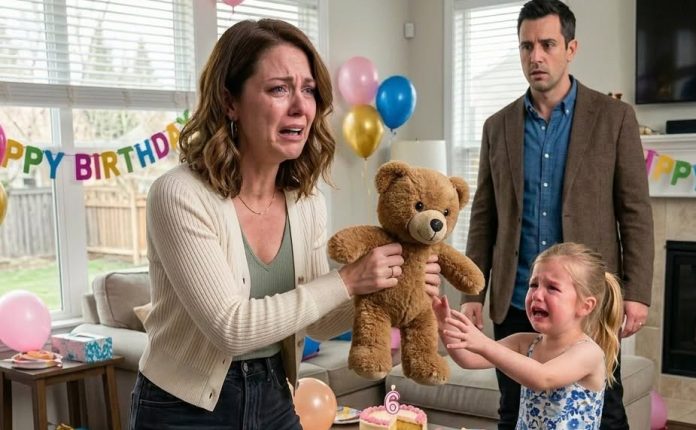
When I opened it, I didn’t see him. Instead, there stood a woman I didn’t recognize, her face pale and tired, her eyes carrying something I couldn’t immediately name. Beside her was the little girl—the same child he had brought weeks ago. She clutched the woman’s hand, looking smaller than I remembered, her bright energy replaced by something more cautious, more uncertain.
“Are you…?” the woman began, her voice hesitant. I nodded before she could finish. She swallowed hard, then said, “I need to talk to you. It’s about him.”
I stepped aside without thinking. Something in her expression told me this wasn’t about revenge or confrontation. It was something else—something heavier. She walked in slowly, as if unsure she was allowed to be there, and the little girl followed, her eyes scanning the room with quiet curiosity.
We sat down in the living room, the air thick with tension. My children peeked from the hallway, confused but silent. The woman took a deep breath, her hands trembling slightly in her lap. “He didn’t tell you the truth,” she said.
A bitter laugh almost escaped me. “That wouldn’t be new.”
She shook her head. “No… I mean, he didn’t tell anyone the truth. Not even me. Not until recently.”
There was a pause, long enough for my mind to start racing through possibilities. Illness? Debt? Trouble? I didn’t want to care, but I couldn’t stop myself from listening.
“He’s in serious trouble,” she continued, her voice breaking. “Legal trouble. Financial trouble. He’s been hiding it for years. When he came to you… it wasn’t just about babysitting. He was trying to find someone stable. Someone safe.”
I felt something twist in my chest—not sympathy, not yet, but something close to understanding. “So he thought I’d just step in and fix everything?” I asked, my tone sharper than I intended.
“He thought you were the only one who could,” she said quietly.
The room fell silent again. The little girl had wandered closer, now standing near the edge of the couch. She looked at me—not with accusation, not with expectation, but with a kind of quiet hope that made my heart ache in a way I hadn’t prepared for.
“I can’t do this,” I said finally, more to myself than to her. “I spent years picking up the pieces he left behind. I can’t go back to that.”
“I’m not asking you to take him back,” the woman said quickly. “I’m asking… for her.” She glanced at the child, her eyes filling with tears. “I can’t give her the life she deserves right now. And he… he may not be around to try.”
That was the moment everything shifted. This wasn’t about him anymore. It wasn’t about the past or the pain or the anger I had carried for so long. It was about a child who had no say in any of it—just like my own had once had no say.
I looked at my children, standing quietly in the hallway, watching everything unfold. They had grown up without their father, had learned resilience in ways no child should have to. And yet, they were kind. Strong. Whole in ways I had fought hard to ensure.
“Do you know what you’re asking?” I said softly.
She nodded, tears slipping down her cheeks. “Yes. And I hate myself for it. But I don’t know what else to do.”
The little girl stepped closer then, her small hand resting lightly on the edge of the couch. “I can be good,” she said in a small, careful voice. “I won’t be trouble.”
That broke something in me.
Because I knew that voice. I had heard it before—in my own children, in moments when they were afraid of being too much, of being a burden, of not being enough. No child should have to promise to be “good” just to feel safe.
I closed my eyes for a moment, letting the weight of everything settle. When I opened them again, I knew the decision I was about to make wouldn’t be easy. It wouldn’t erase the past. It wouldn’t fix everything overnight.
But it would mean something.
“Stay for tonight,” I said finally. “We’ll figure out the rest… together.”
The relief on the woman’s face was immediate and overwhelming. She nodded, unable to speak, while the little girl’s shoulders seemed to relax for the first time since she had walked in.
That night, as I watched all three children sitting together—awkward at first, then slowly finding common ground—I realized something I hadn’t expected. This wasn’t about forgiving him. It wasn’t about forgetting what he had done.
It was about choosing who I wanted to be in the aftermath of it all.
And maybe, just maybe, his threat had nothing to do with regret the way I had imagined. Maybe the real regret would have been turning away from a child who needed someone—anyone—to choose her.
In the end, I didn’t help him.
I helped her.
And that made all the difference.