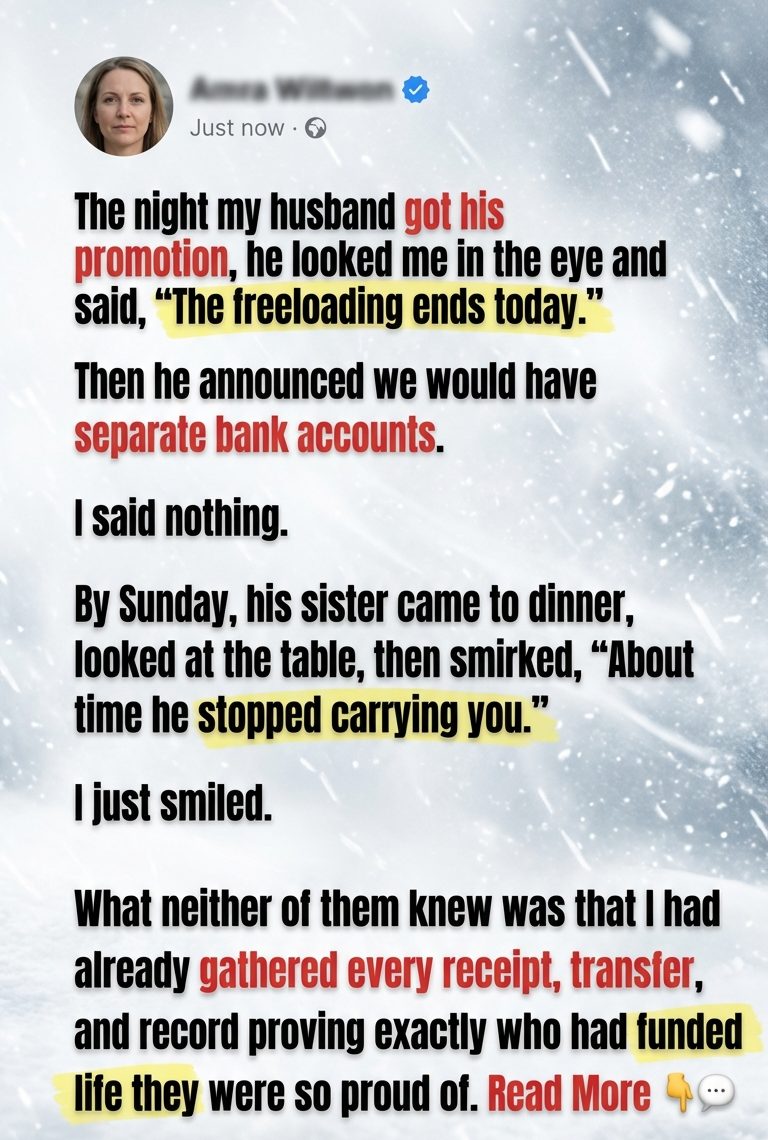
“The freeloading ends today,” my husband Jake said, tossing his new company badge onto the kitchen island like it was a trophy. The promotion email was still glowing on his laptop screen, and the bottle of champagne I had bought that afternoon sat unopened in the fridge, waiting for a celebration that died before it started. I was standing at the counter slicing a bell pepper for dinner when he said it, and for a second I honestly thought I had misheard him. But then he folded his arms, gave me that tight, self-satisfied look he always wore when he felt important, and explained that from now on we would have separate bank accounts. His tone wasn’t angry. That would have at least been human. It was colder than that—practical, managerial, as if he were announcing a policy change in a department meeting rather than humiliating his wife in her own kitchen.
I asked, “Separate accounts?” mostly because I needed to hear him say it again and be forced to recognize his own words. He nodded and kept going. He said he was tired of being my ATM. He said he had worked too hard for his promotion to keep “carrying the weight” while I figured out my “little freelance thing.” That phrase landed harder than anything else. My “little freelance thing” was the graphic design business that had paid our mortgage during the first three years of our marriage, back when his salary barely covered gas and student loans. It was the same business that kept money coming in after I was laid off from my tech job last year, the job whose salary and stock options had helped pay for his MBA. It was the same “little freelance thing” that covered groceries the month his commission check came in short and the same “little freelance thing” he praised publicly whenever people admired the branding work I’d done for his side consulting projects for free. But I didn’t say any of that. I just wiped my hands on the dish towel, looked at him, and said, “Okay. If that’s what you want.”
He was almost disappointed that I didn’t fight him.
That told me a lot.
He had clearly prepared for resistance. Maybe even wanted it. A loud argument would have let him feel righteous. It would have let him tell himself he was simply setting healthy boundaries against an emotional wife who didn’t understand money. Instead, my agreement forced him to keep speaking plainly. He said we’d split everything fifty-fifty now: utilities, groceries, mortgage, internet, all of it. His car payment was his responsibility, mine was mine. No more joint checking. No more “black hole of house stuff.” The phrase was almost funny in its ignorance. House stuff. Like the emergency washer we had to buy when the old one died mid-cycle. Like the extra insurance I insisted on. Like the dining chairs his sister cried over and borrowed money for, and then somehow never repaid. Like the weeks I quietly floated us when his mother’s medical bills stacked up faster than anyone expected. But again, I said nothing. I told him I would move my direct deposits the next day. He nodded like a man who had just won something.
By Sunday, the bank paperwork was done.
I had moved my accounts, updated my billing, and created three folders on my laptop: Past, Now, and After. Jake thought separate finances meant he was finally freeing himself from some vague burden he’d decided I represented. What he didn’t know was that I had always been better with records than he was. Not out of distrust at first. Just habit. I am the kind of person who saves invoices, backs up receipts, labels transfers, and keeps copies of every shared expense in case something gets disputed or forgotten. Over time, especially once his family started treating my contributions like a natural extension of his generosity, that habit became a kind of quiet protection. I didn’t yet know if I would need it. But I had it.
His sister Ashley came over for dinner that Sunday night.
She didn’t so much arrive as sweep in, taking up emotional space before she even put her bag down. Ashley always carried herself like someone who had been overpraised for being “brutally honest” when really she was just mean with good hair. She wore ripped jeans, an oversized sweatshirt, and the expression of a woman who believed every room should rearrange itself around her entrance. She gave Jake a hug first, then air-kissed me, and her eyes started moving immediately—over the table, the wine, the candles, the roasted chicken, the side dishes, and finally my face. I knew that look. She was assessing. People like Ashley are always gathering material, looking for shifts in mood or furniture or confidence that they can later use to confirm whatever story they prefer.
Dinner went smoothly for almost ten minutes.
Jake was in a good mood, which in his case meant slightly louder than usual and overly confident about things he only half understood. He kept mentioning the promotion in ways designed to sound casual but weren’t. Ashley, of course, fed it. She told him she always knew he was meant for bigger things. She asked whether the raise was substantial. She laughed at every bland thing he said about leadership. Then, while spearing a piece of asparagus, she glanced at the table again, then at me, and smirked.
“About time he stopped,” she said.
I looked up. “Stopped what?”
She smiled into her wine. “You know. Carrying everything.”
Jake didn’t correct her.
That was the moment I understood this conversation had been happening elsewhere before it happened in my kitchen. Maybe over drinks. Maybe through texts. Maybe with his mother chiming in from the sidelines. Ashley kept going, because silence is oxygen for people like her. She said it was good Jake was finally protecting himself. She said men get taken advantage of all the time in marriage and don’t realize it until they’re drained dry. She said freeloading has a way of disguising itself as partnership when you’re too nice to notice. She never used my name while saying these things, which somehow made it uglier. It gave her the performance of plausible deniability. Jake sipped his wine and let it happen.
I smiled.
That made both of them slightly uneasy.
I could see it in the way Jake’s hand paused near his glass and the way Ashley’s shoulders shifted. They expected embarrassment. Maybe tears. At the very least, some defensive explanation about my income or workload or contribution to the household. Instead, I stood, walked to the sideboard, and came back with a slim black folder I had printed and assembled that afternoon. I set it beside my plate and took another bite of dinner first, slowly enough that Ashley actually frowned.
Then I opened it.
“I’m glad you brought that up,” I said.
Jake laughed once, too casually. “Brought what up?”
“The carrying.”
I slid the first page across the table toward Ashley, mostly because she had appointed herself audience and prosecutor. It was a summary sheet, neat and simple, covering the past four years of household contributions. Mortgage payments by source. Utility payments. emergency repairs. grocery totals. loan transfers. health expenses. family support. Color-coded. dated. exact. Ashley looked down, read the first few lines, and then glanced at Jake. He didn’t move. So I handed him the second sheet.
His smile disappeared almost immediately.
The truth about money is that it becomes very quiet when written down.
There is no room on a spreadsheet for attitude. No room for swagger. No room for vague male declarations about “carrying the weight” when the actual numbers sit there in black and white. For the first three years of our marriage, I had contributed more than he did to our household. Significantly more, some years. After my layoff, that percentage narrowed, but it never vanished. Even in the months when my income dipped, I was still covering recurring expenses he liked to call invisible. Worse for him, I had also listed every family-related transfer that came out of my personal savings or freelance income—not “our money,” not joint gifts, but funds directly traceable to me. Ashley’s car repair. His mother’s prescription gap. The washer. The furniture down payment Ashley cried over and never repaid. The plane ticket for his cousin after the funeral. The software subscription he used for side work and forgot I paid.
Ashley’s face went stiff.
Jake looked at the pages as if the numbers might reorganize themselves into a version where he still seemed generous. They didn’t. I gave them a minute. Then I reached for the third packet. This one was smaller, but sharper. It was a breakdown of what fifty-fifty would actually mean under the rules Jake had just announced. Not his imagined version, where my income magically covered domestic labor and flexibility and emotional management for free, but the real one. Half the mortgage. Half the insurance. Half the utilities. Half the maintenance fund. Half the groceries. Half the annual home tax reserve. And because we were now, apparently, quantifying fairness, I added one more page: the average monthly market value of unpaid household administration, appointment scheduling, meal planning, travel booking, family gift purchasing, vendor coordination, and the branding work I had done for his professional materials at no charge.
Ashley actually said, “This is ridiculous.”
“No,” I said. “This is itemized.”
Jake finally found his voice. “Emily, what is this supposed to prove?”
I looked at him steadily. “That if the freeloading ends today, you may want to define who exactly was doing it.”
That shut him up.
He tried anger next. Men often do when facts embarrass them. He said marriage isn’t a business. He said I was making us look petty. He said no one tracks contributions like this unless they’re trying to keep score. The irony almost made me laugh, because the only reason I had brought the file to the table was that he and his sister had already turned our marriage into a scoreboard. I told him I agreed that marriage shouldn’t feel like an audit. But once one spouse announces the end of shared finances by calling the other a freeloader, documentation stops being petty and starts being self-defense.
Ashley pushed her chair back slightly, as if distance from the table might save her from the discomfort of having helped start something she was no longer enjoying. She muttered that she didn’t come over for drama. I told her that was unfortunate, because she had arrived just in time for correction. Then I handed Jake the final page.
That one wasn’t historical.
It was forward-looking.
A schedule of my revised contributions under his new arrangement. I had already run the numbers. If we were truly splitting fixed costs fifty-fifty and no longer using joint discretionary funds, then I would no longer be covering anything connected to his extended family, any unplanned household extras he initiated, or any business-adjacent expenses not legally mine. I had also listed the amounts he now owed me from previously “temporary” transfers if he wished to continue describing us as financially separate adults. Nothing inflated. Nothing emotional. Just dates, amounts, and repayment options.
His face changed then in a way I won’t forget.
Not because he suddenly understood my hurt. Because he finally understood his exposure.
That was the thing he had never fully grasped about me: I could survive being underestimated emotionally. But financially, organizationally, structurally—I was never the weaker person in the room. I was simply quieter about it. Jake had always liked the story where he was the hardworking husband supporting a wife in transition. It made him feel masculine, generous, in control. The problem was that reality had never cooperated with that story, and once I stopped protecting it for him, it collapsed embarrassingly fast.
Dinner ended shortly after that.
Ashley left first, all brittle energy and muttered excuses about an early morning. She didn’t hug anyone on the way out. Jake stayed at the table for a long time after the door closed, staring at the pages spread in front of him like evidence from a trial he hadn’t realized he was in. Finally he looked up and said, very quietly, “You’ve been waiting to do this.”
I considered that.
Then I said, “No. I’ve been prepared.”
There’s a difference.
Waiting implies hunger for revenge. Prepared means you noticed the ground shifting under your feet and chose not to be the last one surprised when it gave way. Jake went to bed without finishing his wine. I stayed downstairs, cleaned the kitchen, closed my laptop, and put the folder back in the drawer where I keep warranties, deeds, and every other document people don’t think they’ll need until the exact day they do.
We did keep separate accounts after that.
But not in the way he imagined.
For the first month, Jake struggled immediately. Not because he was poor—his promotion was real and the raise was decent—but because he had built his idea of independence on the assumption that I would continue quietly filling every gap he didn’t notice. Groceries cost more than he thought. Utilities fluctuated. The home tax reserve annoyed him. He forgot the pest control bill twice. He was startled by what decent car insurance actually cost once it wasn’t just “something that came out automatically.” And when his mother called crying about another financial emergency, he came to me with that same careful tone men use when trying to reverse a principle without admitting they were wrong.
I told him no.
Not cruelly. Clearly.
He asked if we were really going to act like strangers over money. I said no, we were going to act exactly like what he requested: two adults with separate finances and defined obligations. He didn’t like hearing his own language handed back to him without the part where I subsidized his comfort. That is also a form of education.
Things never really went back after that.
Not dramatically. We didn’t scream every night or throw divorce around the kitchen. But something had been exposed too cleanly to cover over with apologies. Jake did eventually say he was sorry for calling me a freeloader. He even admitted Ashley had been in his ear more than she should have been. But apologies after contempt have a different weight. They can matter. They can soften. They cannot fully restore what was taken for granted while the contempt was active.
The strangest part is that I think he truly believed the promotion made him powerful enough to redraw our marriage without checking the foundation first. That’s what arrogance does. It confuses a raise with authority, a title with wisdom, a bigger paycheck with the right to narrate history however you like. But history, when documented well, has a way of surviving people’s preferred versions of themselves.
So yes, on the night my husband got promoted, he looked me in the eye and declared that the freeloading ended that day. He separated the accounts. He split the bills. He let his sister smirk over dinner and talk about how much he’d been carrying.
And by the time I finished serving roasted chicken and handing out spreadsheets, both of them understood something they should have known from the start:
The person they were mocking had been holding far more of their life together than either of them was ready to admit.