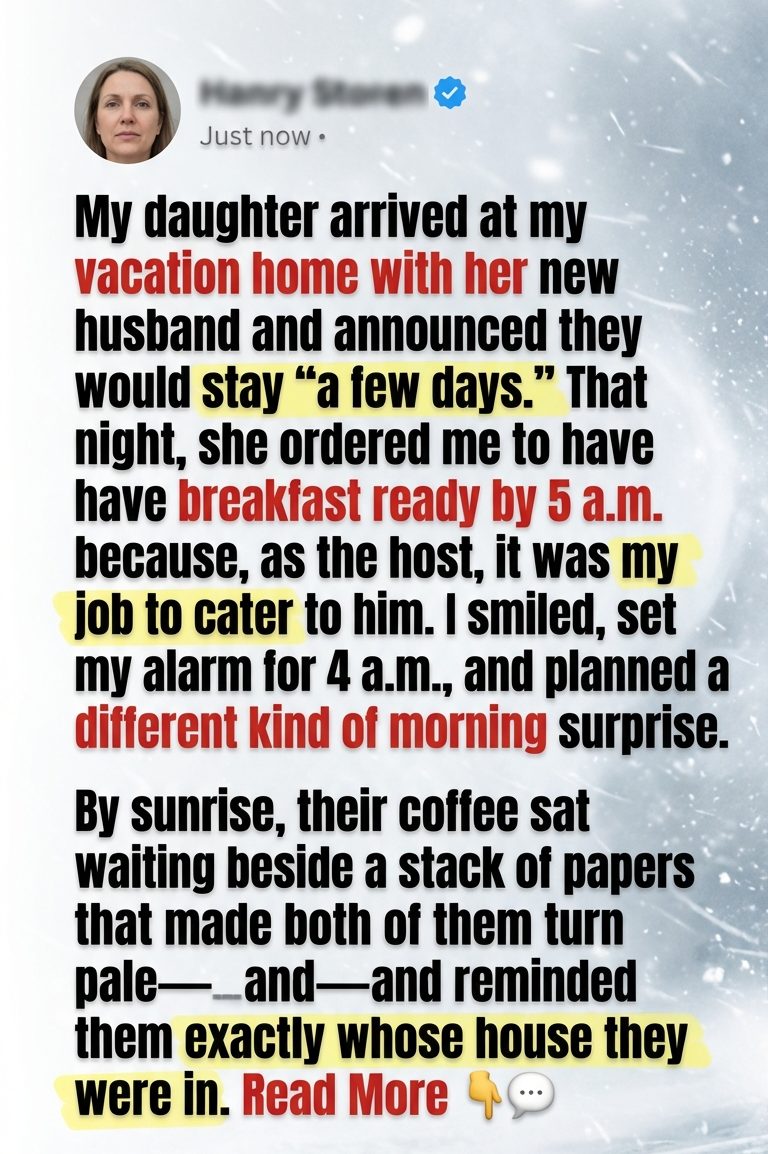
My name is Patricia Whitmore. I’m fifty-two, divorced, and I live alone in the Malibu beachfront house I fought like hell to keep when my marriage ended. It isn’t just property to me. It is the first thing I have ever owned that feels entirely earned. Every window, every quiet morning, every bill paid on time, every hard boundary that house represents—I bought all of it back from a life that used to ask me to apologize for taking up space. So when my daughter Sophia arrived uninvited with her brand-new husband, three oversized suitcases, and the kind of energy that announces trouble before anyone says a word, I knew this wasn’t some sweet newlywed detour.
She didn’t knock.
She didn’t call first.
She used the spare key I had once given her for emergencies, swept through the front door like she was late for something important, and said, “Good, you’re here,” while Derek followed behind carrying bags and wearing that polished, agreeable smile men use when they’ve already decided how to work a room. He shook my hand like we were strangers at a fundraiser and told me my house was “spectacular.” Then, in the same breath, he started scanning the walls, the floors, the sight lines to the ocean, the imported fixtures I saved years to install. He wasn’t admiring the place. He was assessing it.
Sophia kissed the air near my cheek and dropped her purse on the entry table without asking if this was a good time, if I had plans, or if I even wanted company. “We just need to stay a few days,” she said. “The condo isn’t ready, and honestly, this makes more sense anyway.” That anyway was doing a lot of work. It was the kind of word people use when they have already decided your consent is just a decorative extra. I looked at the luggage, then at the man beside her, then back at my daughter—the same daughter I raised mostly alone after her father discovered that freedom was easier than parenting—and I felt that old familiar pinch of disappointment. Sophia had always confused confidence with entitlement, and somewhere along the way, I had mistaken indulging her for loving her well.
Derek sat down before I invited him to.
That was the first little thing.
He took the best chair in the living room, crossed one ankle over his knee, and asked what it “runs yearly” to maintain a place like this. Not what a lovely view. Not thank you for having us. Just numbers. Taxes. Insurance. Maintenance. The carrying cost of peace. I gave him a vague answer on purpose, and he laughed as if we were now sharing some sophisticated conversation about assets. Sophia, meanwhile, had already opened my wine fridge and poured herself a glass of a bottle I’d been saving for a friend coming the following weekend. She took a sip, made an approving face, and said they were “concerned about my living situation.”
That almost made me laugh.
Concerned.
There is no phrase more insulting than false concern delivered from someone standing in your kitchen uninvited, drinking your best wine. I asked what exactly there was to be concerned about. Sophia leaned back into my sofa—the cream linen one she was never allowed to eat on as a teenager because she ruined everything soft she touched back then too—and said, “You’re alone out here. It’s a lot of house. A lot of responsibility. We just think maybe you need more support than you admit.” Derek nodded solemnly beside her like this had been rehearsed in the car.
I knew then this was not a visit.
It was reconnaissance.
Still, I said nothing. One of the advantages of getting older is that you learn the value of letting greedy people keep talking. They always reveal more than they intend if you don’t interrupt too early. So I let them settle in. I let Sophia complain about traffic. I let Derek ask whether the guest suite had its own bathroom. I let them speak in that careful, sugar-coated tone people use when they believe they are the first ones to think strategically around a woman they’ve already decided is softer than she is.
That evening, over the takeout they insisted I should order because “you always know the good places,” Sophia finally said the quiet part out loud. She set down her chopsticks, dabbed her mouth with one of my linen napkins, and announced, “I want breakfast ready by 5 a.m. tomorrow. Derek wakes up early and likes everything his way. As the host, you’re responsible for this.” She said it with the flat certainty of a hotel guest who has mistaken a mother for staff. Derek didn’t correct her. He just smiled into his glass and said, “Coffee strong, eggs soft, toast dry. I’m simple.”
I looked at both of them for a long second.
Then I smiled and said, “Of course.”
That seemed to please them.
People like Sophia and Derek are always most relaxed when they think the person in front of them has accepted the assignment. Sophia even tossed the house keys onto the dining table as if that tiny gesture carried authority. “Perfect,” she said. “I knew you’d understand.” She used to do that as a teenager too—frame my surrender as proof of her maturity. Derek asked whether I could also put out fruit because he liked to “start clean.” I told him I’d handle it.
Twenty-four hours earlier, if someone had told me my own daughter would order me to wake before dawn and cook for the man she married three months ago, I might have felt heartbreak first. But sitting there watching them make themselves at home in my sanctuary, what I felt was clarity. Not rage. Not even surprise. Just the calm, precise understanding that they had finally overplayed whatever quiet little plan they’d been building. This wasn’t about breakfast. It was about hierarchy. About seeing whether I would slide into the role they had already written for me: aging mother, useful hostess, eventual dependent, temporary obstacle between them and whatever version of my life they imagined would one day become theirs.
So yes, I set my alarm for 4 a.m.
But what I planned to put next to their morning coffee wasn’t breakfast.
It was a dose of reality.
At 4:05, the house was black and silent except for the soft mechanical hum of the refrigerator and the ocean beyond the glass. Malibu before sunrise has a particular kind of stillness—expensive, yes, but also deeply honest. No performance yet. No visitors. No sunlight making everything look gentler than it is. I wrapped a robe over my nightgown, tied my hair back, and went straight to my study instead of the kitchen. From the locked drawer of my desk, I took out a folder I hadn’t needed in months: trust documents, deed records, insurance authorizations, estate directives, and one updated letter from my attorney that had arrived the week before. I had not expected to use any of it so soon, but life does love timing when children start acting like creditors.
By 4:40, the dining table was set.
Not beautifully.
Deliberately.
Two mugs. A silver coffee carafe. A plate of dry toast I knew Derek wouldn’t touch. And in the center of each setting, neatly aligned with the napkins, a stapled packet. On Sophia’s place, I left a copy of the deed showing the house was held in a private trust that neither she nor any spouse of hers had any future claim to without my active, notarized consent. On Derek’s, I left the letter from my lawyer outlining trespass and unlawful occupancy standards under California law, plus a highlighted note that guests staying beyond the host’s invitation could be removed formally if necessary. Between the coffee and the fruit bowl, I placed one more sheet for them both to read: a typed page that said, simply, This house is not a family asset. It is not transitional housing. It is not a retirement plan. And I am not your staff.
At exactly 5:03, I heard the bedroom door upstairs open.
Then footsteps.
Then Derek’s voice, lower than usual, already annoyed. “I said five.”
I remained in my chair at the head of the table, wearing one of my best silk robes and reading glasses, with my coffee already poured. The sunrise had just begun to soften the edge of the horizon outside the wall of glass. When they entered the room, they stopped so quickly it was almost satisfying. Sophia looked from the table to me and then to the packets with the instant suspicion of someone who knows arrogance has finally met administration. Derek pulled out his chair but didn’t sit. He picked up the top page, skimmed two lines, and all the confidence went out of his posture.
Sophia read faster.
Her face flushed bright red by the second paragraph.
“What is this?” she asked.
“Breakfast,” I said. “Or rather, the only part of it I thought you truly needed.”
Derek let out a short humorless laugh. “You’re joking.”
“No,” I said. “You made it clear last night that you appreciate things done properly.”
Sophia stared at the trust paperwork as if the words might rearrange themselves into something less final if she glared hard enough. “Why are there legal documents on the table?” she snapped.
“Because you arrived here without asking, spoke about my home as if it were a management problem, ordered me to wake before dawn to serve your husband, and started circling a conversation about my future like vultures in linen.”
That landed.
Hard.
For a second, neither of them moved. Then Sophia said, “We are your family.”
I nodded. “Which is why you should have known better.”
She hated that answer. I could see it. What she wanted was either guilt or submission. Not calm. Never calm. Calm forces people like her to hear their own behavior without the distraction of a bigger emotional storm to hide inside. Derek tried a different angle. He set down the papers, straightened, and said, “I think there’s been a misunderstanding. We were just trying to make sure you’re okay out here on your own.”
I took a sip of coffee.
“Then let me reassure you. I’m more than okay. I own this house outright through a protected trust. I have full-time security monitoring, updated medical directives, a standing legal arrangement, and absolutely no intention of handing over one inch of my life because my daughter married a man who mistakes manipulation for leadership.”
Sophia actually recoiled.
“Wow,” she said. “So this is what you think of us?”
“No,” I said. “This is what you showed me.”
The room went quiet again. Outside, the first full line of sun touched the water. Inside, my daughter looked suddenly much younger than thirty and much less impressive than she believed herself to be. I saw, beneath the sharpness, a woman who had learned too much from the wrong people—her father’s charm, my own old habit of over-accommodating, the family culture that treated my stability as something eternally available for use. Derek, meanwhile, looked offended in the deep personal way entitled men do when they discover a woman they dismissed has paperwork.
Sophia threw the top packet back onto the table. “You’re being dramatic.”
“No,” I said. “I’m being clear. Dramatic was arriving with luggage and demands. Dramatic was informing me I’d be serving your husband before sunrise in my own house.”
She opened her mouth again, but I didn’t let her take the room back.
“You both have until noon to pack and leave. If you need a hotel recommendation, I’m happy to provide three. If you need me to call a car, I can do that too. What I will not do is continue this performance where you mistake my kindness for access and my motherhood for service.”
Derek looked at Sophia as if expecting her to smooth it over. She looked at him as if expecting him to dominate the moment. Neither of them was getting what they wanted. Finally he said, “This is insane. Over breakfast?”
And there it was again.
The insistence on shrinking the issue down to whatever detail makes them feel least guilty. As if this were about eggs. As if the insult were domestic and small. I leaned back in my chair and said, “No. Over boundaries. Breakfast was just the moment you made your assumptions audible.”
Sophia started crying then.
Not softly. Not honestly either. Angry tears. The kind she used as a child whenever consequence arrived and she wanted to reposition herself as the injured one before the room settled. In other years, I might have softened. I might have reached for her hand, apologized for my tone, suggested we all start over. But I looked at my daughter standing there crying over a house she did not own, beside a husband who let her speak to me like hired help, and I understood something with painful certainty: love without boundaries is how women like me end up erased inside our own lives.
So I did not back down.
By 10:15, their suitcases were lined up in the foyer again.
Sophia avoided my eyes. Derek tried once more before the final bag left the guest room, saying they had only come because they were “worried” I might someday need more support than I realized. I told him that if concern was ever real, it would know how to knock first. He didn’t answer that because there is no polished way to recover once a woman stops pretending not to see exactly what you are.
At 11:48, the car service I ordered for them arrived.
My daughter stood at the door with her sunglasses on, though the day was gray and cold. “You didn’t have to humiliate us,” she said.
I looked at her for a long moment and said, “No. I didn’t. I could have just let this continue. This was me stopping it early.”
That was the closest thing to mercy I had left.
After they were gone, I walked through the house slowly, opening windows, straightening cushions, putting my wine back where it belonged, reclaiming the quiet one room at a time. The ocean looked exactly the same. That was the best part. Nature has no interest in family power struggles. The tide came in. The gulls circled. The sunlight moved across the floorboards as if no one had tried to turn my home into a stepping stone overnight.
Later that afternoon, Sophia texted a long message full of accusation, hurt, and selective memory. She said I embarrassed her husband, treated them like criminals, and made her feel unwelcome in her own mother’s home. I read it twice, then answered with one sentence: A home stays a home only as long as the people inside it still know how to behave like family.
She didn’t reply.
Not for three weeks.
When she finally did, the message was shorter. Less polished. No mention of Derek. No mention of “support” or my “living situation.” Just: I was out of line. He was too. I’m sorry about Elsie’s room—I know I left it a mess. It wasn’t enough to fix anything, but it was the first honest sentence she’d sent me in years. I replied that honesty was a start and left it there.
As for Derek, I never heard from him again.
That, too, told me everything.
Because men like him are only interested in relationships where access comes easy and resistance is framed as cruelty. The second a woman produces structure, they lose interest in pretending to care.
So yes, I set my alarm for 4 a.m. the morning after my daughter ordered me to serve her husband breakfast.
But what I placed beside their precious coffee was far more nourishing than eggs or fruit.
It was ownership.
It was proof.
It was the cold, hard reality that my home was not available for repurposing by people too entitled to ask and too shallow to love me without imagining what they might inherit.
And by noon, they were gone.