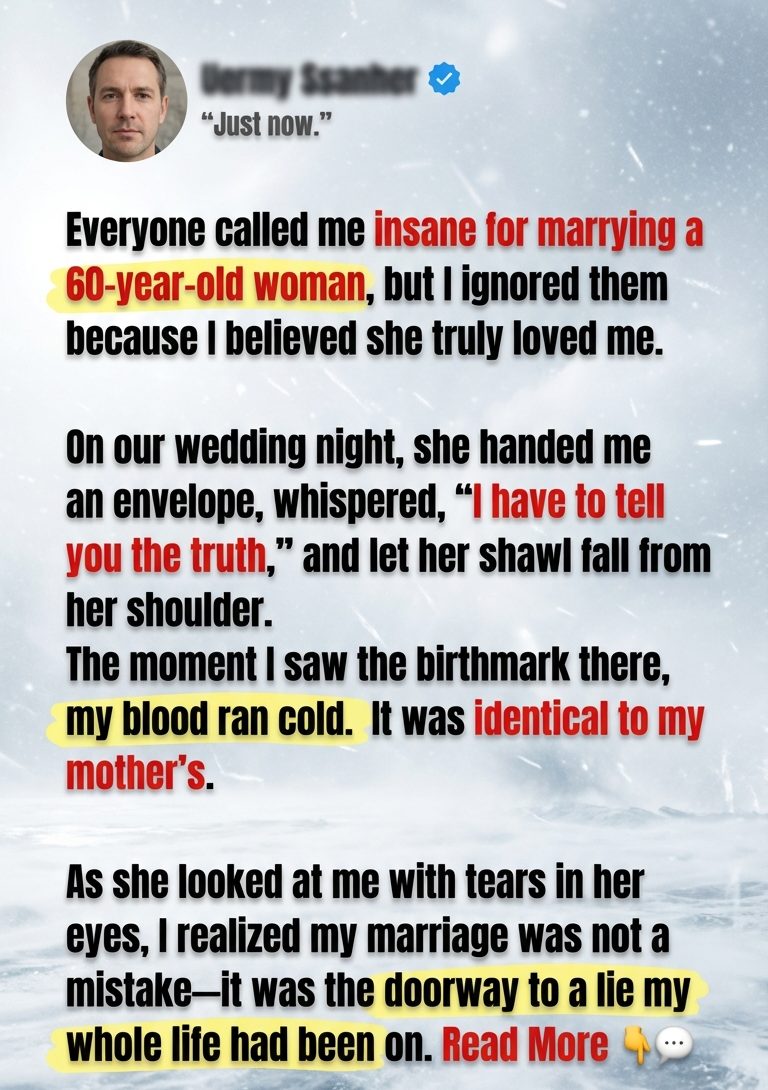
Everyone called me insane for marrying a sixty-year-old woman, but none of them understood what it felt like to be seen by her.
Not because of her dresses. Not because of her house. Not because of her money. If I’m being honest, all of that embarrassed me more than it impressed me. I came from a family where every favor was counted, every mistake was remembered, and every dream had to survive someone else’s ridicule before it was allowed to exist. Celia was the first person who ever listened to me as if what I felt mattered before what I could provide. When I talked, she did not interrupt to correct me. When I was unsure, she did not laugh. When I failed, she did not store it like ammunition for later. To a man who had spent most of his life being treated as either a disappointment or a tool, that kind of tenderness can feel dangerously close to salvation.
My family hated her before they even met her.
When I told them I wanted to marry her, they acted as if I had announced a crime. My aunt said I had been bewitched. My cousin laughed in my face and told me what I wanted was a mother, not a wife. My father did not laugh at all. That hurt more. He just stared at me as if I had personally humiliated him and said, in a voice full of wounded pride, that a woman like Celia would use me and throw me away once I had served whatever purpose rich people invent for poor men. No one asked whether I loved her. They all assumed the answer had to be greed, confusion, dependency, weakness—anything but love. And because they assumed that, I held on harder. I defended her louder. I mistook my own stubbornness for proof that I was doing something noble.
The town wasn’t much kinder.
People talk when a younger man marries an older woman, especially when she has property, influence, and a past nobody can quite explain. In our part of Jalisco, people don’t need facts to build a full story. They only need a visual that feels scandalous enough to repeat over coffee. I became that story for months. Some said I was chasing inheritance. Some said I had a secret debt. Some decided she must be lonely and desperate. Others said worse things, especially men who could not understand why a woman with money and presence would choose someone like me at all. I told myself none of it mattered. I told myself love was enough. Looking back, I think I was also trying to prove that my life could finally become larger than the version my family had assigned me.
The wedding took place at an old hacienda outside town, the kind of place people rent when they want history to make their event look more respectable than it really is. The stone walls were lit by candles and soft lanterns. White flowers were arranged everywhere with a precision that felt almost severe. Musicians played in the courtyard while guests moved through the arches speaking in low voices and expensive shoes. It should have felt romantic. Instead, from the moment I arrived, something about the whole evening felt more controlled than joyful. There were too many men dressed in black standing near the doors. Too many discreet earpieces. Too much security for what everyone kept calling a simple ceremony. I noticed it, yes. But I was so determined not to sound like one more suspicious person in Celia’s life that I said nothing.
She looked beautiful that night, though not in a young or fragile way.
Celia had a face that made people assume she knew more than they did, and most of the time that assumption was correct. She wore ivory silk, no veil, and the kind of calm expression women wear when they have already endured enough to understand that ceremonies rarely change what matters. When she took my hand at the altar, her fingers were cold. I thought it was nerves. I squeezed them gently, and she looked at me with an expression I couldn’t understand then—something like love mixed with grief, tenderness mixed with apology. I should have recognized it. But I was standing in the center of the most contested decision of my life, surrounded by people who doubted me, and I wanted so badly for the evening to mean what I had fought for it to mean.
The reception passed like a dream I was too exhausted to interpret properly.
There was food, music, congratulations, formal toasts, and the constant feeling that half the people around us knew a version of the story I had not been told. Several older guests kissed Celia on both cheeks and looked at me with pity so slight it might have been my imagination. A man in a gray suit shook my hand and called me brave in a tone that did not sound complimentary. Once, near the side veranda, I noticed one of the security men speaking quietly into his sleeve while watching me, and when I looked directly at him, he turned away too quickly. If I had been less in love, I might have left then. Or at least asked questions. Instead, I kept smiling, accepting congratulations from strangers, and telling myself every family has its odd rituals, every wealthy household its precautions, every marriage its mysteries at the beginning.
By the time we were finally alone, I was more relieved than excited.
The bedroom was huge, old, and carefully restored, with dark beams overhead and heavy curtains half-drawn against the courtyard lights. There were fresh flowers on the dresser, a silver tray with glasses and mineral water, and a silence so complete it felt staged. Celia closed the door herself instead of letting one of the attendants do it. That struck me as strange too. Then she walked to the table near the window and placed a thick envelope and a ring of keys on the polished wood. “It’s your wedding gift,” she said. “One million pesos and a truck.” I laughed from pure nerves and pushed the envelope back toward her. “I don’t need any of that,” I said. “Having you is enough for me.”
She looked at me then in a way that made my skin go cold.
It was not affection. Not exactly. It was sorrow wearing discipline. The face of someone standing at the edge of a truth they have postponed too long. “Son…” she said first, then stopped herself so abruptly that for a second I thought I had imagined it. Then she corrected: “I mean, Efraín… before this goes any further, I need to tell you something.” A chill ran through my body so fast it felt physical, like a draft had moved through the room even though every window was closed.
She lifted her hands to her shawl.
Slowly, carefully, she let it slide from her shoulders.
And when my eyes fell on the mark near her left collarbone, the room changed.
It was dark, round, slightly irregular at the edges. Not just similar. Not the kind of birthmark many people might share if you looked hard enough. It was the same. In the same place. The exact mark my mother had always carried high on her chest, just beneath the collarbone, visible in summer dresses and old photographs and every childhood memory I had of helping her brush out her hair before church. My body reacted before my mind did. I took one step back. My hand lifted toward Celia without touching her. “That mark,” I said, my voice shaking. “Why do you have it?”
Celia closed her eyes.
When she opened them again, she looked less like a bride than a woman finally surrendering to a sentence she had delayed for years. “Because I cannot stay silent anymore,” she whispered. Then she sat down on the edge of the bed as if her legs had stopped trusting her and told me to sit too. I didn’t. I remained standing there like a fool with his wedding jacket half-unbuttoned, waiting for the room to turn back into what it had been ten minutes earlier. It never did.
She said she knew my mother.
Not vaguely. Not socially. Not from church or the market or some old neighborhood connection that had faded into coincidence. She knew her in the deepest, most dangerous way two women can know each other when the world around them offers no mercy for truth. They had grown up together. Worked together for a short time in Guadalajara when they were young. Lived together for a while after my mother left home under circumstances nobody in my family ever explained clearly. According to Celia, the story I had always been told—that my mother was a difficult, restless woman who made bad decisions and was later rescued into respectability by my father—was not just incomplete. It was built to hide something.
My mother did not fall in love with my father first.
She fell in love with Celia.
I think I stopped breathing for several seconds.
Even now, writing that sentence in my mind, I can still feel the strange pressure that filled my chest that night. It was not just shock. It was the collapse of an entire architecture. My mother had died when I was nineteen. She left behind too many silences, too many habits that looked like fear once I was old enough to name them, and a marriage to my father that always seemed built more on duty than tenderness. But never—not once—had I allowed myself to imagine another possibility. Not because it was impossible. Because in the house I grew up in, such possibilities didn’t exist in language. They were erased before they became thoughts.
Celia spoke quietly, without trying to dramatize anything.
She said they had loved each other when they were young in the fierce, terrified way people do when their whole future feels illegal. It was the late 1980s. They worked in the same textile business. They rented a room together for nearly a year and told people whatever story was most convenient. Then my mother got pregnant. Not with me, as I first assumed in a rush of confusion, but before me. The pregnancy ended badly. She nearly died from complications and was sent back to her family under a cloud of shame and secrecy. According to Celia, my father came into her life after that—practical, respected, determined, and very aware of how vulnerable she was. He offered marriage, legitimacy, and protection. In return, he expected silence about everything that came before him.
I felt sick.
Not because of Celia. Because all at once, moments from my childhood began reordering themselves into something uglier and more coherent. The way my father controlled photographs. The way my mother stopped singing after he entered a room. The way certain names were never spoken in the house. The way she looked at women sometimes—not with envy, but with a kind of aching attention I only now understood. I remembered once, when I was fourteen, finding an old snapshot in one of her sewing books of her standing beside another woman outside a bus station, both of them laughing at something outside the frame. My father saw it in my hand and took it so fast he bent the corner. He said it was nothing. He threw it away that same night. I had forgotten that until Celia started talking.
Then she told me the part that nearly broke me.
After my mother died, Celia came to the funeral.
I had no memory of her, but she said she stood at the back in a plain black dress and watched my father accept condolences like a man who had played his part correctly. She didn’t approach me because she didn’t know if I knew anything. She didn’t approach him because she knew exactly what kind of power he still held over the story. Years passed. She built her business. Expanded into hospitality. Learned how to survive in a world that only respected women when they looked untouchable. But she never entirely stopped watching from a distance. When she saw me years later, already grown, carrying my mother’s face in the ways a son often does without noticing, she knew who I was immediately. I asked why she didn’t tell me then. Her answer was simple and devastating: “Because I thought the truth would destroy you before you were strong enough to survive it.”
I wanted to hate her for that.
Part of me did.
Because what kind of woman lets a man marry her without telling him she once loved his mother? What kind of person allows a whole town to mock him, allows his family to call him pathetic, allows him to defend her as if he understands what he’s fighting for, when all the while she knows she is standing on the edge of detonating his history? But even as the anger rose, another part of me could see the terror in her face. Celia had not married me as part of some game. That much became obvious the longer she spoke. She had fallen in love with me, and that love was tangled with memory, guilt, tenderness, and a resemblance she had probably tried too hard not to notice.
“No,” I said finally, hearing the word come out harsher than I intended. “No. Don’t say that.” Because by then I understood what was happening in my own mind, and it horrified me more than anything she had already said. I was trying to place her. Not as a lover. Not as a wife. Somewhere else. Somewhere impossible. The whole room felt contaminated by wrongness, not because she had done something monstrous, but because truth had arrived too late for innocence. She started crying then, not loudly, but with the exhausted grief of someone who knows every next sentence will cost them what little remains.
She told me she never meant to let it go as far as the wedding.
That, more than anything, sounded real. She had planned to tell me weeks earlier. Then days earlier. Then after the engagement dinner. Then before the ceremony. Each time she convinced herself there would be a better moment, a cleaner one, a version of the truth that would wound less. But there is no such version. Not with something this large. Not when a man has already fought his entire family for you and placed his dignity beside yours in public. By the end, she said, she couldn’t bear to humiliate me before the town, but she couldn’t bear to sleep beside me as my wife either. So she waited until the door closed and the room could belong only to the truth.
I sat down then because standing had become impossible.
For a long time neither of us spoke. I could hear music from the courtyard below, still going on because weddings do that—the world continues to perform joy even while the people at the center of it are splitting open upstairs. I looked at the envelope on the table, the keys, the careful arrangements of a life I thought I was entering, and all of it suddenly looked absurd. One million pesos and a truck. What kind of wedding gift was that except payment or apology? She must have seen the thought move through my face, because she said immediately that the money was not meant to buy my silence. It was meant to free me. “If you leave tonight,” she said, “you leave with enough not to crawl back to anyone who mocked you for loving me.”
That sentence undid me in a different way.
Because it was the first truly practical kindness anyone had offered me in months.
I asked her if my mother had ever loved my father.
Celia took longer to answer that than anything else.
Finally she said, “She respected him. She was grateful to him. She feared him sometimes. She tried very hard to become the woman everyone expected. I think, in her own way, she did care for him. But no… not like that.” I stared at the floorboards for a long time after that. Not because I had never imagined my parents’ marriage was imperfect. No one grows up in a house like mine and thinks romance lives there. But to hear it spoken so plainly—that my mother’s life had narrowed into duty after beginning in something fierce and forbidden—made me feel as though I had inherited not just her face, but the wreckage of her choices.
By dawn I had already decided to leave.
Not dramatically. Not because I hated Celia. Not even because I believed she had tricked me in the vulgar way my family would later claim. I left because I could not build a marriage on a foundation that had rearranged my dead mother’s memory into something I had never been allowed to know. I left because every look between us would now be crowded by too many meanings. I left because whatever tenderness existed between us had become inseparable from grief. Before I went, I asked her one last question: “Did you ever love me for me?” She answered without hesitation. “Yes. That is what made this unforgivable.”
I took neither the envelope nor the truck.
I left the hacienda just after sunrise in the same suit I married in, carrying only my bag and the taste of old lies in my mouth. By the time I reached the road, my phone had started exploding with messages from my family. Some had already heard I’d left. In towns like ours, disgrace travels faster than weather. When I finally told them the wedding was over, no one asked first whether I was all right. They asked whether I had found out she was using me. That was the version they preferred, because it preserved every prejudice they had spent months sharpening. I told them it was more complicated than that. My father kept pressing, demanding details in a voice that sounded too controlled. When I finally said my mother knew Celia before him, the line went dead quiet.
Three days later, I went to my father’s house.
Not to fight. To look at him while I asked what kind of marriage he gave my mother and what exactly he thought he had buried. He denied everything at first. Then he minimized. Then he got angry. Classic stages of a man who has survived by controlling the order in which truth arrives. But when I mentioned the photograph from the sewing book, and the bus station, and the way my mother used to sit outside after dark smoking only when he was asleep, something in his face changed. He knew he was no longer arguing with a child. He admitted enough to confirm the outline if not the full shape. He said my mother had made choices that needed “correcting.” He said the world was different then. He said he gave her a respectable life. He said love is not the same thing as stability, as if that ended the matter. I left before he finished because I understood by then that some people confuse possession with rescue so thoroughly they die without ever learning the difference.
Months have passed since then.
I did not go back to Celia, though I met her once in a café in Guadalajara because some endings deserve witness, not just absence. She looked older, smaller somehow, without the architecture of wealth and command around her. We spoke quietly. She told me she had never meant to become one more person who withheld the truth from me. I believed her. Believing her did not make reunion possible. Some loves are real and still unlivable. That is one of the crueler adult truths nobody tells you when you’re young.
People in town still talk.
Some say she deceived me. Some say I lost my chance at a life of comfort out of pride. Some say my family was right all along. Let them. They are working with a story small enough for them to manage. Mine is larger now. Stranger. Sadder. More human. I didn’t marry a sixty-year-old woman because I wanted money. I married her because for the first time in my life I felt seen. And on our wedding night, I learned that even that feeling had roots reaching backward into a history I was never meant to know.
The mark on her shoulder changed everything.
Not because it proved some dramatic scandal fit for gossip, but because it opened a door into my mother’s real life—a life hidden under obedience, retold by others until it no longer sounded like hers at all. I went into that bedroom thinking I was beginning a marriage against the judgment of everyone I’d ever known. Instead, I found out my whole life had been built on a lie older than me, quieter than me, and strong enough to survive until the exact moment I thought I had finally escaped it.