The first thing people noticed about Harbor Key was the water, because from a distance it looked almost unreal, a hard clear blue that made the island seem less like a place off the coast of Maine and more like a photograph someone had edited to make it look richer than life. The second thing they noticed was the silence. Once the ferry pulled away from the private dock, the world felt far away in a way that money often tries to imitate and rarely achieves. Harbor Key did it naturally. No traffic, no tourist noise, no nearby houses crowding the shoreline. Just the long cedar lodge, the smaller guest cottages tucked into the pines, and the low steady sound of waves meeting stone. My younger sister, Piper, called it magical the second she stepped onto the dock. My mother called it exclusive. My father spent most of the first afternoon telling anyone who would listen that Piper’s fiancé’s family must be “operating on another level” to afford a wedding weekend like this. I let them believe that. I stood on the wide veranda outside the main lodge in a slate-blue dress simple enough for my mother to quietly disapprove of and expensive enough to amuse me privately, while staff moved through the crowd with trays of sparkling water and champagne. No one in my family knew I owned the island. No one knew I had paid every invoice attached to the weekend—the ferry charters, the flowers, the chef, the musicians, the tents, the rooms, the transportation, the welcome gifts, the linens, the emergency weather backup. Just under two million dollars, transferred through North Spire Hospitality, signed off by me, and never once mentioned.
That was not an accident. My family had always preferred a smaller version of me. Manageable. Useful. Easy to underestimate. They still thought I worked a modest finance job in Boston, rented a nice apartment, and “did fine for myself” as a divorced mother with more discipline than glamour. That story suited them because it preserved their favorite hierarchy: Piper, the adored younger daughter who glowed in every room, chose well, married up, and moved through life as if ease were a virtue she had earned; me, Rowan, the older sister who was reliable, practical, a little too direct, good with paperwork, never quite impressive enough to threaten the shape of the family mythology. I learned years ago not to correct them unless it was necessary. People tell you far more when they think you need less protection from the truth.
“Rowan, don’t stand there looking miserable,” my mother said as she drifted past me in a pale green gown that managed to be both costly and desperate for attention. “This is your sister’s wedding, not a board meeting.” I told her I wasn’t miserable, just staying out of the way, which made my father laugh into his drink. He adjusted his cuff and said I ought to learn from Piper because she “knew how to choose,” and that whatever else could be said about her fiancé, his family clearly understood how to live. I looked past him toward the lawn where Piper was being photographed under a cream fabric canopy while two assistants fixed the fall of her veil and held a reflector under her face. For one second, I saw not the woman she had become, but the girl she once was: twelve years old, knees scraped from climbing a stone wall she’d been told not to climb, crying over a cheap silver bracelet because she thought broken things could simply be willed whole again. Somewhere after that, our parents began rewarding every selfish instinct in her as if it were confidence. By thirty, she had learned that charm worked best when other people were paying for it.
My daughter, Elsie, was the only reason I was there in spirit and not just financially. She was six, thoughtful, observant, and still young enough to believe adults mostly meant what they said. I had nearly declined the invitation because I knew what weekends like this brought out in my family: comparison, performance, old insults repackaged as jokes. But Elsie wanted to see the island. She wanted to wear the yellow dress we picked together, with the tiny stitched flowers along the collar, and she asked if there would be “boats and stars and maybe one fancy dessert.” I told myself I could survive three days of my family if it gave her one beautiful memory. Besides, I had planned the whole thing carefully. Piper would never know until after the honeymoon. The island staff had strict instructions to treat me as any other guest unless there was an emergency. I would sit through the speeches, smile through the assumptions, watch my parents praise the imaginary wealth of another family while standing on land I owned, then go home. It was a slightly bitter sort of entertainment, but a safe one. Or so I thought.
The rehearsal dinner on Friday set the tone. My mother complained that the lobster risotto was too rich and then ate every bite. My father praised the wine three separate times, each time more loudly, as if speaking with confidence might attach him to the cost of it. Piper accepted every compliment as if she had personally built the place plank by plank and grown the roses herself. Her fiancé, Graham, was a decent enough man in the quiet, slightly overmanaged way some men become after years spent adapting to stronger personalities. He looked tired even before the ceremony, which I noticed because tired men often tell the truth more accidentally than rested ones. His parents were polite, wealthy, and so carefully neutral that I immediately distrusted their marriage. No one mentioned me beyond the usual surface things. Had I come far? Was work busy? Had Elsie started first grade? It was easy to be invisible when people had already committed to not seeing you clearly.
Saturday morning was cold and bright. Harbor Key always looked most expensive under bad weather light. The gray sky sharpened the green of the grass, the silver of the ocean, the ivory flowers wired into the ceremony arch. Staff worked around the lawn and terrace in dark uniforms, adjusting heaters, checking glassware, resetting place cards the wind wanted to disturb. I took Elsie down to the rocky edge after breakfast and let her toss bits of driftwood into the tide. She asked me if Aunt Piper was happy. I said I thought she was excited. Elsie considered that and said, “That’s not the same.” There are moments when children sound so completely like themselves that you realize they have been watching far more carefully than you imagined. I kissed the top of her head and told her she was right.
By midafternoon the ceremony began. It was beautiful, in the expensive restrained way people pay professionals to make beauty look effortless. Piper walked down the aisle in silk and lace with our father beside her, smiling the exact smile he used in every family photo where he most wanted to be admired later. Graham waited at the front with his hands folded too tightly. The vows were tender enough, though Piper’s voice carried more confidence than feeling. I watched from the second row with Elsie beside me swinging her white-shoed feet, and for a little while I allowed myself to hope the worst part of the weekend might simply be overblown family performance. Then came the reception.
The reception tent had been built on the lower lawn overlooking the west side of the island, where sunset usually caught the water in long strips of copper. Round tables in cream linen, white taper candles, low arrangements of roses and eucalyptus, crystal so thin it almost disappeared in the light. The dance floor sat beneath a suspended canopy of fabric and tiny overhead bulbs. It should have felt warm. Instead it felt staged, as most expensive family events do once old resentments are seated. Elsie sat between me and one of Graham’s cousins at the family table, eating buttered rolls and asking whether the string trio knew any songs from her piano book. Piper, moving table to table with that bridal energy that is half adrenaline and half ownership, had already corrected two servers and snapped at the photographer once about angles. My mother defended her as “stressed.” My father called her a perfectionist, which in our family was always just another word for rude behavior people found inconvenient to challenge.
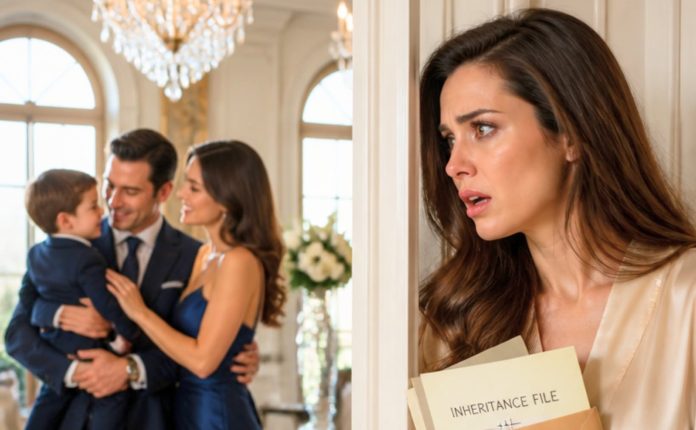
The moment everything changed was so small that if you were not looking directly at us, you might have missed it. Piper had just swept back toward the head table after taking photographs with a cluster of college friends. Elsie, who had been trying to step carefully around the back of a chair to show me a shell she found tucked near the stone path earlier, misjudged the hem of Piper’s dress. The heel of Elsie’s shoe came down on the outer silk layer for half a second. It did not tear. It did not even pull meaningfully. The fabric simply caught, shifted, and slid free. Any decent adult would have turned, seen a little girl startled by a mistake, and laughed it off. Piper spun around like someone had struck her.
“What is wrong with you?” she snapped.
Elsie froze.
The entire table went still. I began to rise, but Piper was already bending down, one hand gripping the sides of her skirt, her face sharpened into something ugly and bright. “Do you have any idea how much this dress cost?” she demanded. Elsie stammered an apology instantly, eyes wide, voice already wobbling, but Piper wasn’t interested in the apology. She wanted the audience. She wanted the dominance. “Of course not,” she said loudly. “Why would you? Nobody teaches children like this to be careful.” Then she looked at me. Not my daughter. Me. “Honestly, Rowan, if she couldn’t behave for one day, you should have left her in the cottage.”
There it was. The familiar family move: a child makes a mistake, and somehow I become the flaw.
Elsie’s bottom lip trembled. She was trying not to cry, which made the whole thing worse. I stood fully then, slid my chair back, and put my hand on her shoulder. “She said she was sorry,” I said. My voice was calm, maybe too calm. Piper laughed the way she always had when she wanted to make me sound humorless. “That’s not the point.” My mother joined in immediately, telling Piper not to let “a little chaos” ruin her day, while looking at me in a way that suggested chaos had, naturally, arrived with me. My father muttered that children either understand boundaries or they don’t. Not one of them looked at Elsie with tenderness. Not one. She was six years old, standing in white shoes on grass she would remember for all the wrong reasons, and the adults who should have known better were choosing hierarchy over humanity in real time.
I picked her up.
She was getting a little big for that now, all long limbs and stubborn dignity, but she wrapped herself around me immediately like she had been waiting for permission to stop being brave. Her face pressed into my neck. I could feel her trying to hold the crying in. Piper said something else—about me always making scenes, I think—but by then I had stopped hearing her as family. She was just noise. I carried Elsie out of the reception tent and across the lawn toward the main lodge without looking back. It was not dramatic. I did not announce anything. I did not threaten to leave. I just chose my child over the event with the same speed I would choose air in a burning room.
In the lodge foyer, I sat her down on the old blue settee beneath the window and crouched in front of her. She was crying now in earnest, ashamed of crying and trying to apologize for that too. “I really didn’t mean to, Mama,” she whispered. “I know,” I said. “I know.” I smoothed her hair, wiped her face with my napkin, and asked if she wanted to go back to the cottage for a little while. She nodded hard. Before I even stood up, my phone buzzed. Not from family. From Miriam, my operations director.
Need your call. Immediate. Staff issue? it read.
I stepped into the side hall, called her, and within thirty seconds understood what she meant. One of the banquet supervisors had overheard enough at the family table to understand that my daughter had been humiliated, not simply scolded. Word had spread quietly among the staff, and because hospitality workers know more than anyone what disrespect looks like, they were angry on my behalf. Miriam, who knew exactly whose wedding this was and exactly who had funded every piece of it, had done what I hired her to do. She had not panicked. She had not improvised emotionally. She had simply asked whether I wanted the event to continue under normal service, reduced service, or executive review. In any other context, that language might have sounded absurd. In mine, it meant: How far do you want to let this go?
I looked back at my daughter curled small on the settee, yellow dress bunched in her fists, still trying to become invisible after being shamed for a child’s mistake.
Then I made the only decision that felt honest.
“Executive review,” I said.
Miriam went quiet for one beat. “Understood.”
What happened next left the entire wedding speechless, not because it was loud, but because it was controlled. Within seven minutes, the music stopped between songs and did not resume. The open premium bar quietly shifted to beer, wine, and soft service only. The late-night seafood tower scheduled for after the speeches was held back. The special firework clearance that had cost more than my parents’ first home was canceled. The on-call charter extension for Sunday brunch departures was suspended, meaning everyone would leave on the standard ferry windows unless alternative payment was arranged directly. Most visibly, the maître d’, who had until then been flawlessly invisible in the way great service often is, walked directly to the head table and asked to speak with “Ms. Rowan Mercer” at once.
My mother answered first, because of course she did. “She’s not at this table,” she said sharply. “Can’t this wait?” The maître d’ replied, very clearly and very professionally, “No, ma’am. Ownership authorization is required now.”
Ownership.
That word moved through the tent like a dropped knife.
By the time I walked back in carrying Elsie on my hip, everyone was already turned toward the head table. Piper looked annoyed, my father confused, my mother suspicious in the way she always did when events drifted outside her control. Graham looked almost hopeful, though he didn’t yet know why. I crossed the dance floor slowly, not to make an entrance, but because Elsie was still upset and I wanted her to feel me steady. Miriam was there now too, having come up from service operations with a leather portfolio in hand. She gave me one look, saw my daughter’s face, and her own expression hardened.
“Ms. Mercer,” the maître d’ said, “we need confirmation on how you’d like to proceed.”
I took the folder from Miriam.
My sister laughed lightly, trying to rescue the room through mockery. “What is this?” she asked. “Are we really doing office work at my wedding?” No one laughed with her. My father looked from me to the staff to the folder and back again, and for the first time that weekend I watched certainty leave his face. I set Elsie gently on her feet, keeping one hand in hers, and turned to the table.
“You all assumed Graham’s family paid for this weekend,” I said. “They didn’t.”
Nothing dramatic in my tone. Just truth.
My mother frowned. “What are you talking about?”
“I’m talking about Harbor Key,” I said. “The island. The lodge. the event contract. The ferry service. The accommodations. The food. The flowers. The rehearsal dinner. The reception. Every single invoice attached to this wedding weekend was approved and paid by North Spire Hospitality.”
There was a pause.
Then my father, still trying to sound amused, said, “And why exactly are you telling us this?”
“Because I own North Spire Hospitality.”
That ended the room.
Not metaphorically. Physically. The silence that followed was so complete you could hear canvas shifting in the wind outside the tent. Piper stared at me like I had begun speaking another language. My mother’s lips parted and stayed that way. My father actually sat down harder in his chair, as though his knees had briefly forgotten their purpose. Across from them, Graham’s mother lowered her champagne flute without taking her eyes off me. It was not surprise in her face. It was sudden understanding. Pieces rearranging.
Piper found her voice first, and naturally she used it badly. “You’re lying.”
I handed the folder to Graham instead of her.
Inside were the master event contract, payment approvals, the island holding documentation, and the operating authorization sheet with my signature on every major line item. Graham scanned the first page, then the second, and looked up at me with the expression of a man realizing he had been standing in a story written by someone else the whole time. He passed the pages to his father, who read more slowly, then handed them to my father without a word.
My mother whispered, “Rowan…”
I looked at her. “You all spent two days praising wealth you thought belonged to someone else. That was apparently easier than treating me with ordinary decency.”
Piper rose halfway from her chair, face flushed bright with anger and panic. “This is unbelievable. You’re doing this because of one tiny accident with a dress?” I almost smiled then, not from pleasure, but from the clarity of hearing her reduce her cruelty to something accidental and small. “No,” I said. “I’m doing this because you humiliated my daughter for behaving like a child while all of you behaved like people who’ve never once had to earn the things you feel entitled to.”
My father started talking then, quick and clumsy, saying there must be some misunderstanding, that this wasn’t the place, that family shouldn’t air matters publicly. Family. The word nearly made me tired. “You’re right,” I said. “Family shouldn’t do that publicly. Which is why you should have thought of it before you all sat there and let a six-year-old be shamed over a wrinkled hem.”
Then I turned to Miriam.
“Resume base service only,” I said. “End premium features and close the event under standard contracted terms at ten p.m. Any additions beyond that may be billed directly to the bride and groom if they choose.”
Piper looked stunned. “You can’t do that.”
I held her gaze. “I just did.”
The rest of the evening moved with the awful stiffness that follows exposed truth. People still ate, because people always do. They still whispered, because shame needs witnesses. But the glow was gone. No fireworks. No dramatic after-party menu. No extended music set. Just candles, ordinary service, and the long uncomfortable awareness that the person they had dismissed all weekend was the one who had paid for the entire fantasy. My mother cried once, quietly and strategically. My father attempted one apology that sounded more wounded pride than remorse. Piper never truly apologized at all. She only said some version of “I was stressed” and “you didn’t have to humiliate me back,” which told me she still didn’t understand the difference between consequence and revenge.
Graham came to find me near the cottage path just before sunset fully disappeared. Elsie had fallen asleep on the bed, exhausted from crying and salt air and too much adult ugliness. He stood awkwardly outside the screen door and said, “I didn’t know.” I believed him. “I know,” I said. He looked out toward the dark shape of the lawn and said, “I’m not sure I know what I’m marrying anymore.” That, finally, sounded like the first honest sentence spoken by anyone attached to the wedding besides me. I didn’t answer for a moment. Then I said, “Then don’t let a dress and a venue distract you. The answer was at the table.”
The wedding itself remained legally intact. They said their vows. They took the photographs. They cut the cake. But everyone there knew the weekend had changed shape. It was no longer a glossy family triumph. It had become a reckoning. Not just for Piper, but for my parents too—who finally had to stand inside the truth of how readily they had admired a lie when they thought it came from the right direction. The whole time they had been praising “another level,” they had been standing on land I bought, sleeping in rooms I restored, drinking wine I selected, and dismissing the daughter who made any of it possible.
The next morning, the island looked different. Or maybe they did. People were quieter at breakfast. My father couldn’t quite meet my eyes. My mother alternated between forced sweetness and stunned silence. Piper wore sunglasses even indoors and spoke only to the bridesmaids. Graham’s family was polite, but measured now, as though recalculating the woman their son had married. The ferry left on time. No upgraded departures. No added indulgence. Just the regular crossing back to the mainland, carrying guests who had come expecting a luxury fairy tale and left with something more expensive: perspective.
Before we boarded, Elsie held my hand and asked, “Are you still in trouble?” I crouched in front of her and said, “No, baby. I wasn’t the one who was in trouble.” She considered that solemnly, then nodded as if storing it away for later. Children understand dignity faster than adults do when someone finally models it clearly enough.
I never intended to reveal any of it. Truly. I had planned to pay, smile, stay invisible, and let my family continue believing whatever version of me made them most comfortable. But there comes a point when silence stops being grace and becomes permission. Watching my daughter shrink under my sister’s voice brought me to that point faster than any insult aimed at me ever could. They thought I would do what I had always done: smooth the moment over, protect the event, protect them from the discomfort of what they were. Instead, I carried my child away. And what happened next left the entire wedding speechless, because for the first time in our family, the truth arrived with invoices attached.