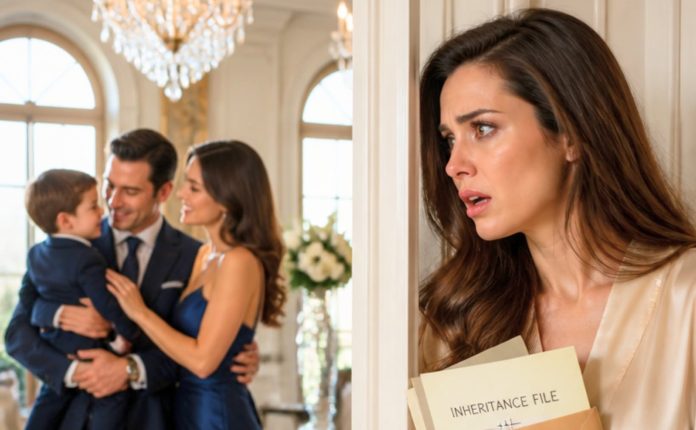
I never told my sister-in-law that I was the Principal of the elite private school her son was applying to, because I had learned long ago that some people reveal their truest nature only when they believe no one important is watching. Helena was one of those women. She was polished, loud, strategic, and endlessly obsessed with status. To her, every room was a ladder, every relationship a transaction, and every child an extension of a parent’s ambition. She liked to talk about class, pedigree, and “standards” as if she had personally invented them. And because she thought I was just a struggling single mother trying to rebuild a modest life after loss, she never once bothered to hide what she was.
The admissions interview day at Crestwood Meridian Academy was supposed to be special for my daughter. Isla was only seven, small for her age, with soft brown curls and the kind of quiet intelligence that made adults lean in when she spoke. She had practiced for weeks, sitting at our kitchen table in her socks, answering pretend interview questions with her hands folded neatly in her lap. We had saved carefully for the white dress she wore that morning, a simple one with delicate embroidery at the collar that made her feel, in her own words, “smart and brave.” I told her she did not need to be perfect, only herself. What I did not tell her was that the school she was interviewing for was already mine to shape and protect.
Helena arrived at the admissions building as if she were stepping onto a stage designed solely for her. Her son, Tristan, trailed beside her in a navy blazer, nervous and over-rehearsed, while she scanned the other families the way women like her always do—measuring, ranking, dismissing. The second she spotted Isla and me near the entry hall, her face changed. Not to surprise exactly, but to irritation. I could almost see the thought forming behind her eyes: What are they doing here? She gave me one of those brittle little smiles that contains no warmth at all and said, loudly enough for another family nearby to hear, “Oh. You applied here too? How… ambitious.” I smiled back and said nothing. Silence often encourages the cruel to keep going, and sometimes that is useful.
I had kept my position private for very practical reasons. When I took over Crestwood Meridian Academy eighteen months earlier, I made a decision to attend public-facing admissions days in plain clothes whenever possible and observe anonymously from the edges before formally introducing myself later in scheduled sessions. It told me far more about families than official presentations ever could. The way they treated reception staff, the way they spoke to other children, the way they handled stress, disappointment, and perceived competition—those things mattered as much to me as recommendation letters. Helena, of course, had no idea any of that was true. She assumed influence always announced itself. That assumption would be her undoing.
The interview morning moved smoothly at first. Staff checked families in, children were escorted in small groups toward assessment rooms, and parents were invited to wait in the adjoining lounge with coffee and polite smiles. Isla sat beside me, smoothing the front of her dress every few minutes, excitement and nerves dancing across her face in equal measure. Helena, meanwhile, kept making small pointed remarks about “fit” and “legacy expectations,” pretending to speak generally while aiming everything directly at me. She said some children simply “aren’t raised for elite environments.” She said schools like this were not for people trying to “climb by sympathy.” Every sentence was crafted to sound social rather than vicious. That is her favorite kind of cruelty—the kind she can deny later if cornered.
When Isla whispered that she needed the restroom before her group was called, I kissed her forehead and told her I’d be right nearby. The family lounge opened into a corridor with two restrooms just past the interview suites, and I watched her skip carefully down the polished hall, one hand holding the hem of her dress. I remember smiling then, because despite all the tension in the room, she still moved through the world with trust. That trust is what haunts me most. A child should never have to learn, inside a school hallway, that adults can weaponize jealousy against innocence.
A few minutes passed. Then ten. Then more. I looked toward the corridor again and didn’t see her returning. At first I told myself she had simply taken longer than usual. Then I stood, apologized to the receptionist, and went to check. The hallway felt strangely quiet compared to the soft noise of the waiting lounge. As I neared the restroom, I heard something that stopped me cold: muffled sobbing. Not loud. Not dramatic. The terrified, breathless crying of a child trying not to make too much noise because she is already scared of what more noise might bring.
The restroom door slammed open the moment I shoved against it, and what I saw froze my heart. Isla was curled in the corner against the tiled wall, trembling so violently her teeth were nearly chattering. Her white dress—the one I had carefully saved money to buy—was completely soaked, clinging to her thin little body. Water dripped from her hair down the side of her face and onto her shoes. One of her little patent straps had come loose. Her cheeks were red and streaked with tears. Standing over her was Helena, plastic cup in hand, expression twisted into something so ugly that for one disorienting second she did not look like family at all. She looked like someone stripped down to pure malice.
“Stay still, you little brat,” Helena sneered. “You think you can compete with my son? Look at you. You look like garbage.” Then she lifted the cup again.
“Helena!” I shouted as I rushed forward.
But I was too late to stop the last pour. She emptied freezing water over Isla’s head. My daughter gasped, curling tighter into herself, and the sound that came out of her was not just crying—it was fear breaking open. Helena turned toward me with absolutely no remorse. She dropped the cup, brushed off her hands like she had touched something unclean, and said with horrifying calm, “Oh, Emily. I was just helping her clean up. She looked too unfit to even enter an elite interview. Know your place and take her home. You’re embarrassing my family.” As she passed me, she leaned in and whispered, “You’re both pathetic.”
I dropped to the floor and gathered Isla into my arms. She was ice-cold and shaking hard enough that I could feel it in my ribs. “Mommy,” she cried, voice cracking, “I want to go home… I’m scared…” I held her against me and closed my eyes for one second, because the rage that surged through me was so sharp I knew I had to control it before I stood up. Helena had already started down the corridor, shoulders loose, face smug, completely convinced she had solved her problem. She believed she had removed the competition. She believed I was powerless. She believed this was a story she would tell herself later as clever and necessary. She had no idea the woman holding that trembling child was far more than just a mother.
I wiped Isla’s face with my handkerchief, stood slowly, and reached into my pocket. My fingers closed around the gold key card to Crestwood Meridian Academy—the master administrative access credential, engraved with my name and role. I had not planned to reveal myself that morning until the final family session. I certainly had not planned to do it like that, in a wet corridor with my daughter clinging to me and my pulse roaring in my ears. But some moments demand truth not as information, but as correction.
I walked back toward the lounge carrying Isla in one arm, the key card visible in my other hand. Conversations softened as parents turned. Some looked confused at Isla’s soaked dress. Some looked alarmed. Helena was already seated again beside her son, crossing one leg over the other, serene as a woman who thought she had won. When she saw me approach, she gave a tiny smile meant to communicate finality. Then her eyes dropped to the gold card in my hand. I watched the exact moment recognition hit—not because she knew my title, but because she had seen senior faculty use those access credentials earlier that morning. Her smile flickered.
I walked straight past her to the front of the lounge, where the admissions coordinator stood sorting folders. “Call the board liaison,” I said clearly. “And have security hold Mrs. Helena Mercer and her son in the conference room.” The coordinator looked up, startled for one second, then saw the key card, straightened instantly, and nodded. The entire room changed. Parents fell silent. Staff moved. Helena stood halfway, face losing color. “Excuse me?” she snapped. “What is this supposed to mean?”
I turned to face her fully. “It means,” I said, my voice calm enough to cut, “that you assaulted a child on school property during an admissions event. It means you locked my daughter inside a restroom, poured water over her, verbally abused her, and attempted to interfere with another applicant through intimidation and humiliation.” Helena laughed once—too high, too brittle. “Your daughter? Emily, don’t be ridiculous. You can’t make accusations like that here.” I lifted the gold card between two fingers. “I can,” I said, “because I am the Principal of Crestwood Meridian Academy.”
If she had been slapped, she could not have looked more shocked.
For one strange second, even Tristan forgot to breathe. The room around us seemed to contract. Helena stared at me, then at the key card, then at the coordinator who had already picked up the internal phone. “No,” she said flatly. “No, you’re lying.” I stepped toward her. “My office is on the third floor. My name is on the charter wall in the east atrium. My signature is on every acceptance letter that leaves this building. And in ten minutes, my legal team will be reviewing the camera footage from the corridor you just walked out of.”
That broke her composure at last.
She began talking all at once—saying it was a misunderstanding, that Isla had an “accident,” that she was only helping, that emotional single mothers always distort everything. The ugliness poured out faster now that fear had replaced certainty. But fear also makes careless people forget what rooms they’re in. She did not realize she was saying these things in front of admissions staff, parents, faculty, and families who had just watched her son’s future disintegrate in real time.
I handed Isla to the school nurse, who had arrived with a blanket, then looked at Helena and said the words that ended her performance: “Your son’s application is withdrawn effective immediately.” Tristan’s face crumpled before Helena’s did. That, more than anything, almost moved me. Because he was still a child, and no child should pay for a parent’s monstrosity. But Crestwood was not merely a place of grades and prestige. It was a community built on trust, safety, and character. If his mother could weaponize a school interview to attack another child, then the damage had already entered through the front door.
Helena lunged verbally before she lunged physically. “You can’t do that!” she shouted. “Do you know who we are? My husband donates to—” “Not enough,” I said. “And not to me.” That silenced her just long enough for security to arrive. When they asked her to come with them, she tried to make it theatrical, tried to turn herself into a victim of jealousy and class resentment. But no one in the room believed her anymore. Too many people had seen Isla. Too many had heard me mention footage. Too many had watched staff react to me with the immediate obedience reserved for institutional authority.
Then came the final part she truly did not anticipate.
I requested the interview process be paused and asked all waiting families for five minutes of grace while an urgent child welfare matter was handled. Then I turned to the coordinator and said, in front of Helena, “Please also contact local police and child services. A formal incident report needs to be filed. Assault of a minor on campus will not be handled privately.” Helena made a choking sound. “Police?” she whispered. “Emily, don’t be insane.” I looked her dead in the eye. “No,” I said. “What’s insane is locking a seven-year-old in a restroom to improve your son’s chances.”
The footage was worse than I imagined.
By the time I changed Isla into spare clothes from the nurse’s office and sat her wrapped in a soft blanket in my private suite, the security director had already reviewed the hallway and restroom entry cameras. Helena had watched Isla walk down the corridor, followed her in after checking that no staff were nearby, then blocked the door with her body for several minutes before exiting alone to refill the cup from the water station and going back in. Even without audio, it was damning. With Isla’s statement, my own eyewitness account, the nurse’s condition notes, and multiple parent witnesses placing Helena nearby, there was nothing for her to hide behind except panic.
She panicked exactly as expected.
First she demanded I reconsider “for family’s sake.” Then she cried. Then she threatened. Then she tried Logan-style damage control through her husband over the phone, but by then school counsel was already present, and every word out of her mouth only deepened the record. Her husband arrived furious, not at what she had done, but at the possibility of public scandal. That told me everything I needed to know about the house Tristan was being raised in. When he realized I was not just an offended relative but the Principal, and that the school had video, medical notes, and external reporting obligations already activated, his entire tone changed. Suddenly it was “surely there’s a way to resolve this.” There wasn’t.
I sat beside Isla for over an hour after the officers left, stroking her damp curls while she slowly stopped shaking. She kept asking if she had done something wrong. That question nearly destroyed me. I told her no, over and over, until she finally believed me enough to rest her head against my shoulder. Then she looked up and whispered, “Am I still bad for the school?” I kissed her forehead and said, “No, baby. Today the school failed to protect you quickly enough. But I won’t fail you again.” That promise mattered more to me than any title on my office door.
We completed her admissions evaluation another day, privately, without spectacle, without competition, and without Helena anywhere near the building. Isla walked in wearing a new dress, chin lifted, hand in mine, still a little nervous but brave in that quiet way only truly strong children are. She was accepted on merit, exactly as she deserved. Tristan, I later learned, was placed elsewhere after Helena’s family spent months trying to spin the story. But institutions like Crestwood keep records for a reason, and some reputational stains do not wash out, no matter how expensive the soap.
As for Helena, the smug expression she wore when she left that restroom never fully left my memory. It stayed with me because it captured something essential about cruelty: it blooms most confidently in people who think their victim has no power. She thought I was just a powerless single mother. She thought my daughter was easy to frighten. She thought the world would tilt naturally in favor of her child because she had money, audacity, and the instinct to strike first. She never imagined the trembling child she drenched on a restroom floor belonged to the woman who held the gold key card to the entire institution.
The restroom door had slammed open, and what I saw froze my heart. But what happened after that taught me something I will never forget. Power doesn’t always announce itself in silk, status, or sharp voices. Sometimes it comes wrapped around a frightened child, carrying a towel in one hand and a gold key card in the other—just in time to show a bully that the moment she thought she had won was the exact moment she destroyed herself.