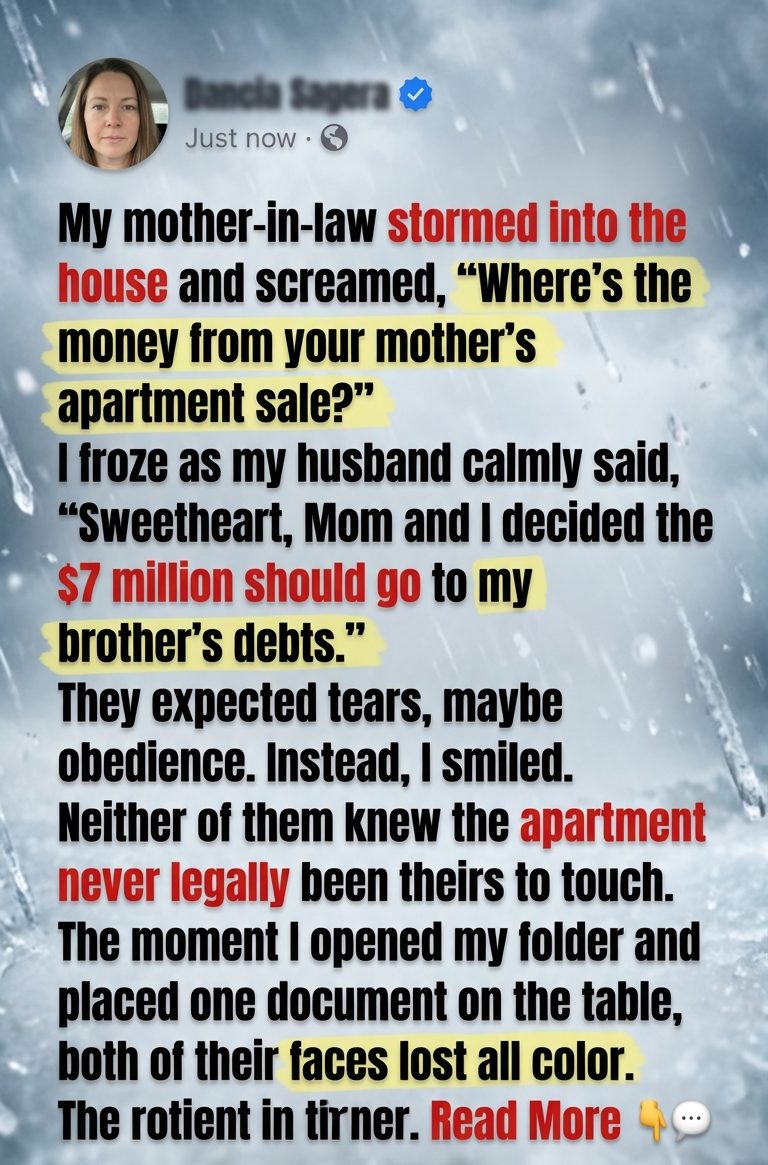
My mother-in-law stormed into the house just after noon, slammed her handbag onto the marble kitchen island, and screamed, “Where’s the money from your mother’s apartment sale?”
I froze for only a second.
Not because I was shocked she wanted the money. That part, sadly, was predictable. My husband’s family had been circling my mother’s estate ever since the funeral flowers started wilting. No, what stunned me was her sheer boldness. She had not come to ask. She had not come to hint. She had come into my home breathing fury and entitlement, as if seven million dollars had somehow become family property the moment my mother died.
Before I could even answer, my husband walked in behind her, calm as ever, carrying a glass of sparkling water like this was an ordinary domestic discussion about dinner plans. He glanced at me, then at his mother, and said in that soft, infuriatingly reasonable tone he always used when delivering betrayal dressed as practicality, “Sweetheart, Mom and I decided the seven million should go to my brother’s debts.”
Just like that.
No conversation. No warning. No shame.
I stared at him across the kitchen, trying to understand how the man I had married could stand there so composed while discussing my late mother’s money as if it were a family convenience fund. My brother-in-law, Daniel, had been drowning in debt for years—bad investments, gambling disguised as “risk tolerance,” and a spectacular talent for turning every financial disaster into a temporary setback somebody else should help cover. My mother-in-law had spent most of his adult life rescuing him with tears, guilt, and manipulation. Apparently, now that my mother was gone, they had decided her apartment sale would be the next life raft.
They expected me to cry.
I saw it in both their faces.
My mother-in-law’s eyes were glittering with the anticipation of drama. She wanted tears, resistance, maybe even a breakdown she could later describe as selfish hysteria. My husband expected something quieter but equally satisfying—perhaps a wounded argument, perhaps pleading, perhaps an emotional surrender he could frame as maturity. Men like him always count on women being too shocked to respond strategically in the first few seconds.
Instead, I smiled.
That smile changed the room.
My mother-in-law’s expression tightened first, because cruel people grow uneasy when their target refuses the script. My husband’s brows drew together slightly, just enough for me to know I had interrupted whatever neat little victory scene he had rehearsed in his head. He knew enough about me to recognize that I only smiled like that when the truth was about to arrive wearing sharp shoes.
What neither of them knew was that the apartment had never legally been theirs to touch.
That was my mother’s final act of protection, though at the time I did not fully appreciate it. She had loved me fiercely, but she had also watched my marriage with clearer eyes than I did. She never trusted my husband’s family. She saw how my mother-in-law asked too many questions about valuations and titles, how Daniel always joked about “inheriting the good stuff,” and how my husband laughed just a little too easily when people referred to my mother’s apartment as “eventually part of your future.” A year before she died, she quietly restructured everything with her attorney. I knew some of it, not all. Enough to sign where I was told, enough to understand I was protected, but not enough to predict the exact moment that protection would become a weapon.
My mother-in-law stepped closer. “Don’t stand there looking smug,” she snapped. “Your husband is trying to handle this fairly. Daniel is family. He needs help now. Your mother is dead. She doesn’t need luxury property money anymore.”
There are sentences so ugly they make the whole room feel contaminated.
That was one of them.
My hands were steady when I walked to the sideboard and picked up the navy folder that had been sitting there since the morning. I had not placed it there because I expected this confrontation. I had placed it there because my mother’s attorney had sent the finalized post-sale documentation the day before, and I had been planning to review it properly that evening. But life has a strange sense of timing. The folder felt almost warm in my hands, like fate with tabs and signatures.
My husband saw it and frowned. “What’s that?”
I came back to the table, opened the folder slowly, and laid a single document between us.
Silence.
Not the ordinary pause before an argument continues. A real silence. A room-level silence. The kind that falls when confidence meets paperwork it didn’t know existed.
My mother-in-law snatched the page first. I watched her eyes move across the heading, then the paragraphs beneath it, then the signature block at the bottom. All the color drained from her face so quickly it was almost theatrical. My husband took it from her hand, and as he read, the same thing happened to him—jaw tightening, shoulders stiffening, the calm draining out of him in visible increments.
The document was simple enough in plain English.
The apartment had not passed directly to me on my mother’s death. It had been transferred into a protected asset trust eighteen months earlier, with me as lifetime beneficiary but not personal titleholder until specific conditions were met. The proceeds from the sale had already been disbursed into a restricted trust vehicle controlled by independent trustees, not by me, not by my husband, and certainly not by his desperate brother. More importantly, the trust included explicit language excluding marital claims, family debt diversions, spousal access, and any transfer requested under domestic pressure. My mother had not just protected the money from strangers. She had protected it from the family I had married into.
My husband looked up first.
“That’s not possible,” he said.
I almost laughed.
Not because it was funny, but because liars always say that when they finally meet a reality they didn’t authorize. I folded my hands on the table and said, “It’s not only possible. It’s already done.”
My mother-in-law slammed her palm on the counter. “She tricked us!”
“No,” I said. “She anticipated you.”
That landed exactly where I wanted it to.
Because that was the truth no one in that room could bear. My mother had seen them coming. She had looked at my husband’s soft greed, at his mother’s open appetite, at Daniel’s permanent financial rot, and she had quietly built a wall they could never climb. They were not robbed. They were simply denied access to something they had already stolen in their imagination.
My husband recovered enough to try a different angle. He lowered his voice, turned to me with wounded husband eyes, and said, “Why didn’t you tell me?”
I held his gaze.
“Because none of this was ever yours to plan.”
He flinched.
That one sentence stripped away the performance faster than any shouting could have. Suddenly he was no longer the calm mediator trying to guide his emotional wife toward a sensible family compromise. He was just a man caught discussing the redistribution of money that was never legally available to him, with witnesses, in my kitchen, while his mother stood beside him like an accomplice who wore too much perfume.
My mother-in-law started talking fast then, which told me panic had set in. She said families share. She said my mother would have wanted to save Daniel. She said my refusal was proof I had never truly accepted them as my own. It was all very dramatic, very familiar, and very useless. Because beneath all the emotional noise lay a document drafted by an attorney who charged more per hour than Daniel had probably earned in three months.
Then my husband made his fatal mistake.
He said, “Fine. If the money is tied up, we can still challenge it. As your spouse, I have standing.”
The room went cold in a new way.
Because that sentence told me something I had not fully allowed myself to believe until then: this was not opportunistic greed. This was coordinated intent. He had already looked into options. He had already imagined a legal path to my mother’s estate. He had already been standing somewhere—perhaps with his mother, perhaps with his brother, perhaps with all of them—discussing how to get around whatever barriers existed.
I reached into the folder again.
And placed a second document beside the first.
His face changed before he even picked it up.
This one was from my mother’s attorney too, but it had been sent privately to me months ago and I had almost forgotten it existed because I never imagined needing it. It was a signed memorandum summarizing my mother’s concerns about spousal coercion and familial pressure, prepared after a meeting in which she explicitly named my husband, my mother-in-law, and Daniel as individuals from whom she wished the estate insulated. Their names. On paper. Dated. Witnessed. She had not merely protected me generally. She had documented exactly who she feared would try to interfere.
My mother-in-law actually took a step backward.
My husband went white.
Neither of them spoke for several seconds, and in that silence I felt something I had not felt since my mother died: her presence. Not in some mystical sense. In a practical one. In signatures, legal foresight, hard-earned intelligence. She had loved me enough not only to leave something behind, but to leave it in a form that predators could not sentimentalize their way into.
“What did you tell her?” I asked my husband quietly.
He stared at me.
“Nothing.”
That was a lie, and we both knew it.
Maybe he had asked too many questions. Maybe his mother had. Maybe Daniel had made one too many jokes in front of the wrong person. However it happened, my mother had seen enough to act. And now her judgment sat between us more eloquently than any accusation I could have made with my own voice.
My mother-in-law found hers first. “This is disgusting,” she hissed. “You let an old woman turn you against your own family.”
“No,” I said. “She stopped my family from turning on me.”
Her mouth actually opened and closed without words. I don’t think anyone had spoken to her that directly in years. Certainly not in a tone that offered no room for negotiation. She was used to tears, not facts. Used to intimidation, not boundaries. Used to being the loudest person in the room and mistaking that for authority.
My husband tried once more to reclaim control. He came around the island, softened his face, and reached toward me in that practiced way men do when they want to re-enter a scene through intimacy after losing ground through arrogance. “Let’s calm down,” he said. “We can talk about this privately.”
I stepped back before he touched me.
“No,” I said. “We can’t.”
He froze.
And because truth deserves light once it has finally been dragged into the room, I gave him all of it. I told him I heard him the night before on the phone with Daniel discussing “timing.” I told him I recognized his mother’s voice in the background saying, “She’ll hand it over once it’s framed as family.” I told him that before either of them walked into my kitchen that afternoon, I had still been hoping I was misunderstanding what kind of man he had become. But now I knew. Now he had said it plainly, in front of me, with his mother standing beside him, as though my mother’s life work was simply waiting to be repurposed for his brother’s failures.
He looked stunned.
Not by guilt.
By the fact that I had heard enough to end the ambiguity.
And once ambiguity dies, marriages like ours often die with it.
I walked to the drawer beside the refrigerator, took out another envelope, and set it on the counter. His eyes dropped to it automatically. Inside were copies of messages I had printed after overhearing that call, along with the business card of the divorce attorney I met that morning. I had not gone to her because I was certain. I had gone because I needed to know my options if certainty arrived. It had.
My mother-in-law looked from the envelope to my husband and whispered, “You told her?”
He didn’t answer.
I did.
“No. You showed me.”
That was when the room finally broke.
My mother-in-law started crying first, but they were furious tears, the kind that accuse even while falling. She ranted about disloyalty, manipulation, bad timing, my mother poisoning me against them from beyond the grave. My husband, meanwhile, seemed to be shrinking in stages. The certainty, the entitlement, the calm—all of it had evaporated, leaving behind a man who suddenly understood that he had misjudged not just the estate, but me.
I told him to leave.
Not tomorrow. Not after a conversation. Not after we “processed this.” That day.
He said I was overreacting.
I said he walked into my house and calmly informed me that he and his mother had already decided what would happen to my mother’s seven million dollars. There are some acts so revealing they end the need for further discussion. That was one of them.
He asked where he was supposed to go.
I looked at his mother.
“Perhaps Daniel has room. After all, you’re all handling his debts together.”
My mother-in-law gasped like I’d slapped her.
But no one could argue with the logic, and that was the beauty of it.
By evening, he was gone.
His mother left with him, still muttering about legal challenges and family betrayal and what people would think. But the truth about greedy people is this: they only worry about appearances after they’ve failed to get what they wanted. Before that, they call it practicality.
The next week was messy in all the expected ways. My husband sent long messages swinging between apology and blame. Daniel texted once to say I was “destroying the family over money,” which was rich coming from a man willing to be rescued by a dead woman’s apartment. My mother-in-law called three times from blocked numbers and left voice notes soaked in moral outrage, all of which I saved and forwarded to my attorney. Because once people show you exactly what they are when they think you are powerless, you should never again give them the benefit of privacy.
The final irony came two weeks later.
Daniel’s debt situation was even worse than they had admitted. Creditors began circling. One of his “temporary setbacks” turned out to involve personal guarantees my husband had quietly co-signed months earlier. In trying to steal access to my mother’s protected wealth, my husband had also exposed himself to his brother’s financial collapse. The same greed that sent him into my kitchen so confidently ended up dragging him toward the ruin he thought he could avoid by using me as a shield.
My divorce attorney called it poetic.
I call it earned.
As for me, I went to my mother’s attorney’s office one last time and sat in the same leather chair where she must have sat when she put all of this in motion. He handed me the full trust file, and for the first time I read every page slowly. In the margins of one draft, beside a clause about excluding coercive marital claims, my mother had written in her sharp blue handwriting: My daughter is kind. Please make sure kindness does not become vulnerability.
I cried then.
Not because of the money.
Because even at the end of her life, she was still protecting me from people I was trying too hard to love.
So yes, when my mother-in-law stormed into the house and demanded the money from my mother’s apartment sale, they expected tears. Maybe obedience. Maybe some wounded little argument they could overpower with numbers and guilt. Instead, I smiled. And the moment I opened my folder and placed that document on the table, both of their faces lost all color—because for the first time, they realized my mother had seen exactly what they were long before I did, and she had made sure they would never get away with it.