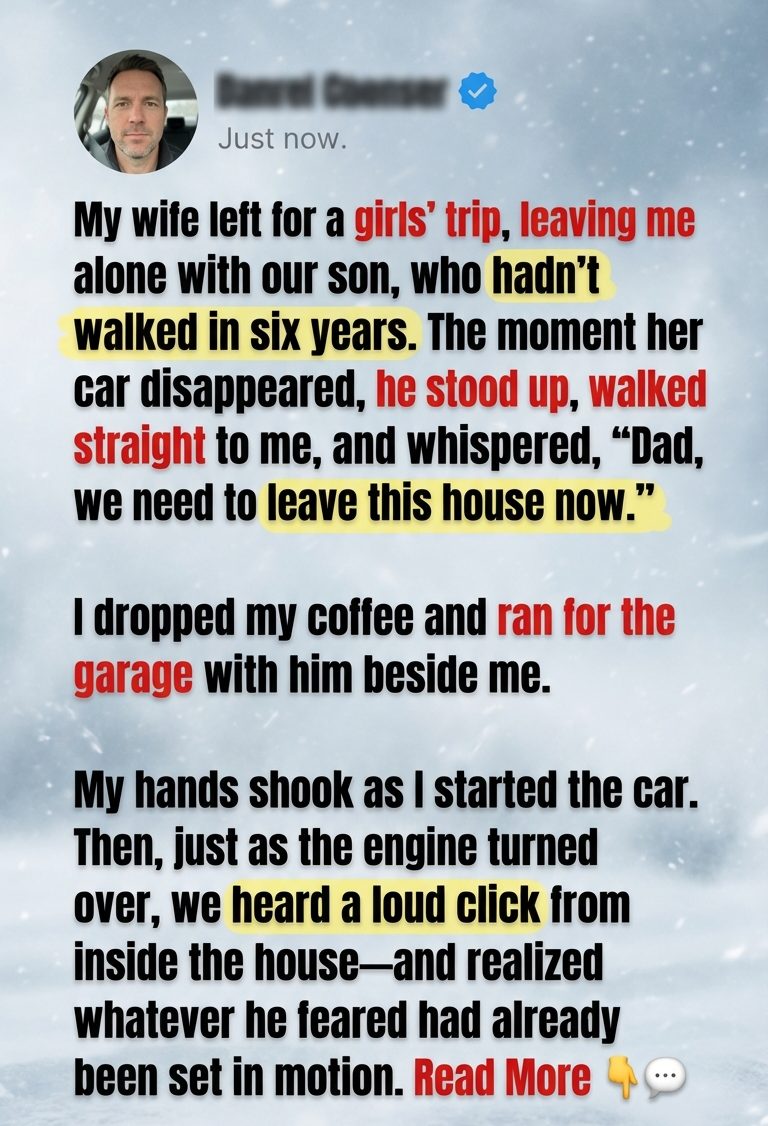
My wife left for a “girls’ trip” on a Friday morning, kissed our son on the forehead, waved at me from the driveway, and drove off smiling like nothing in the world was wrong.
I stood at the kitchen window with my coffee in my hand and watched her taillights disappear at the end of the street.
Then I heard my son’s voice behind me.
“Dad.”
There was something in the way he said it that made me turn too fast.
Our son, Owen, was twelve years old and had not walked in six years.
Not since the accident.
That was the word everyone used, anyway. Accident. A clean, blunt word that made terrible things sound almost organized. Six years earlier, we were told a fall down the basement stairs had damaged his spine so badly that standing again was unlikely. My wife, Melissa, had collapsed into tears in the hospital. I had collapsed into guilt. And Owen—sweet, quiet Owen—had learned how to live from a chair before he even fully understood what had been taken from him.
So when I turned around and saw him standing there, my mind rejected it before my eyes could accept it.
He was pale.
Shaking.
But standing.
One hand braced against the kitchen island, the other reaching toward me like he had crossed some impossible border just to get where I was.
My coffee cup slipped in my hand.
“Dad,” he whispered again, “we need to leave this house now.”
The mug shattered on the floor.
For one frozen second, I could do nothing but stare. My son, who should not have been able to stand, took two limping steps toward me with pure terror in his face. It was not triumph. Not excitement. Not even relief. Fear had dragged him to his feet.
That fear moved me faster than reason ever could.
I ran to him, caught him under the arms, and said, “Owen—what happened? How are you—?”
“No time,” he said, voice breaking. “Please. Please, Dad. Garage. Now.”
The way he said it killed every question.
I got his arm over my shoulder and half-carried, half-guided him through the mudroom toward the garage. He was trembling so hard I could feel it through both our bodies. Every step looked painful, unnatural, like muscles long asleep were waking under panic alone. I fumbled with the interior garage door, threw it open, and hurried him to the car.
My hands were shaking so badly I dropped the keys twice.
I got Owen into the passenger seat, ran around the front of the car, and slid behind the wheel. My chest felt tight enough to burst. I jammed the key into the ignition.
Then we heard it.
A loud click from inside the house.
Not random.
Not settling pipes or old wood.
A sharp, deliberate sound.
Both of us froze.
Owen turned his face toward the mudroom door with such naked dread that my blood went cold. “She already did it,” he whispered.
I stared at him. “Did what?”
His answer came out in a rush.
“She said if you ever found out, we wouldn’t get another chance.”
I didn’t understand.
Not really.
But some animal part of me already did.
I turned the key. The engine caught. I slammed the car into reverse—
—and the garage door opener above us gave a dead, useless hum.
The door didn’t move.
I pressed the remote clipped to the visor.
Nothing.
Again.
Nothing.
Owen made a strangled sound. “She disabled it. She told me she would.”
For one impossible second, the garage felt like a coffin.
I threw the car into park, jumped out, and ran to the garage door track. The release cord. My fingers slipped once, then caught. I yanked it hard. The opener disengaged with a jolt. I grabbed the bottom of the door and hauled upward with everything I had.
It rose six inches.
Then stopped.
My heart slammed.
A metal clamp had been bolted onto the side track.
From the inside.
Not old. Not accidental. Fresh.
I looked back at Owen, who was crying now without making a sound.
That was the moment the shape of my life changed.
Not because of the clamp.
Because of his face.
My son had not dragged himself out of a chair and across the kitchen because he was confused. He had done it because he knew something I didn’t. And whatever it was, it had lived in this house for longer than I wanted to believe.
I ran to the wall cabinet, grabbed a hammer and wrench, and attacked the clamp with a desperation that made everything blur. Two bolts. One stripped. One jammed. My palms were slick with sweat. Behind me, Owen whispered, “She keeps it in the basement.”
I stopped just long enough to say, “Keeps what?”
“The records,” he said. “And the medicine.”
I nearly missed the bolt entirely.
Medicine.
Records.
My wife.
The so-called accident.
The pieces didn’t fit. Not yet. But they were starting to scrape against one another in ways that made me want to scream.
The clamp finally gave.
I threw the garage door up the rest of the way, jumped back into the car, and sped out so fast one side mirror clipped the frame. I didn’t stop at the end of the driveway. I didn’t slow until we were three blocks away and my lungs remembered how to pull in air.
Only then did I pull over.
I turned to Owen.
He looked smaller in the passenger seat now that the adrenaline had dropped, all thin shoulders and terror and effort. His legs were trembling uncontrollably. I reached for him, but he flinched so hard that I snatched my hand back like I’d touched fire.
That hurt worse than anything else.
“Owen,” I said as gently as I could, “look at me.”
He did.
And in his eyes I saw something no child should ever carry: the exhaustion of being afraid for too long.
“I need you to tell me what’s happening.”
He swallowed hard. “Mom said if I ever told you, you’d die too.”
The world tilted.
I gripped the steering wheel until my knuckles hurt. “Why would she say that?”
He stared at his knees. “Because the stairs weren’t an accident.”
Everything in me stopped.
No, not stopped. Split.
There are truths so catastrophic that the mind refuses them on arrival. It sends them back like unopened mail. My son hadn’t walked in six years because of a fall. A fall I had replayed in nightmares. A fall I had blamed myself for because I was in the shower when it happened and Melissa was the one who screamed first.
“She pushed me,” Owen said.
I made a sound I did not recognize as my own.
He kept going because once horror starts moving, it doesn’t pause for mercy.
“I heard you fighting that day,” he whispered. “She was mad. She said you were going to take me and leave her. I went to the stairs because I heard yelling. She saw me there and grabbed me, and I thought she was pulling me back but she—” His voice broke. “She shoved me.”
My hands slipped off the wheel.
I bent forward, forehead nearly hitting it, because if I sat upright I thought I might come apart so violently I’d frighten him more. My wife. My son. Six years. Six years of hospital rooms, specialists, therapy, adaptive equipment, pity from neighbors, casseroles, anniversaries, medications, helplessness—
—and she had done it.
“She told me not to say it,” Owen whispered. “She said nobody would believe me because I was little and confused. Then later she said if anyone knew I could feel more than I pretended, they’d make me leave you.”
I looked up sharply.
“What?”
He started crying again. “Dad… I can walk a little.”
My chest caved in.
Not fully. Not normally. But some. Enough. Apparently enough for fear to pull him across a room. He told me in broken pieces that his improvement had started almost a year ago. Tiny movement first. Then standing during therapy with support. Then at night, when Melissa thought he was asleep, he practiced in secret because he wanted to surprise me when he got better.
But Melissa found out.
And everything changed.
“She got angry,” he said. “Not like regular angry. Quiet angry. She said if people knew, they’d start asking questions about the injury and the doctors and the medicine and the reports.”
The records.
The medicine.
His legs.
My God.
“What medicine?”
He told me she gave him pills sometimes before appointments. Said they would help with nerve pain. Said not to mention them because doctors “never understood anything.” They made him sleepy. Weak. Heavy. And after he started getting stronger, she gave them more often.
I stared at my son and realized I was meeting parts of him for the first time—his fear, his caution, the way children learn to survive adults who should protect them. I also realized, with sickening force, that I had failed him in the most intimate way possible. I had loved him. Cared for him. Fought for him. But I had not seen what was right in front of me because I trusted the woman beside me in bed more than the possibility of evil in my own house.
That shame never really leaves.
I drove straight to the emergency room.
Not our local one.
A different hospital two towns over, where Melissa had no connections and no chance of arriving before I could speak. I carried Owen inside because the effort had drained him, and when the triage nurse asked what brought us in, I said four words that changed everything.
“I think my wife—”
Then I stopped.
Because I wasn’t thinking anymore.
I knew.
The next twelve hours broke the rest of my life open.
Doctors examined Owen. Blood work was run. A social worker came in. Then another. Then a child abuse specialist. Then police. I told the story in fragments at first, ashamed of how impossible it sounded. But Owen told his part too—haltingly, bravely, with the precision children use when they’ve had years to rehearse the truth in silence. He described the pills, the warnings, the threats, the basement cabinet, the stair push, the clamp on the garage door.
And then the bloodwork came back.
Sedatives.
Not enough to kill him. Enough to weaken him.
Enough to interfere with rehab progress, muscle control, alertness.
Enough to keep a half-healed child looking more damaged than he might really have been.
I threw up in a hospital bathroom after that.
The police got a warrant before sunrise.
They searched the house while Melissa was still two states away, or so she thought. In the basement, behind paint cans and storage bins, they found labeled medication bottles not prescribed to Owen, appointment notes with altered symptoms, therapy records with strange inconsistencies, and a locked metal box full of handwritten journals.
Her journals.
According to the detective who later sat across from me with a face carved out of professional restraint, Melissa wrote everything down. Not because she wanted to confess. Because she wanted to control the narrative. She wrote about my “weakness,” Owen’s “dependence,” the fear that if he improved too much I would “leave and take the only person who ever belonged to me.” She wrote about resenting every therapist who said progress was possible. She wrote about the pills, about adjusting doses, about how easy it was to make a child doubt his own body if you reached him young enough.
And she wrote about that Friday morning.
The girls’ trip was fake.
She had booked it as cover, planning to return late Sunday after setting something in motion inside the house.
That click we heard in the garage?
It wasn’t just the disabled door.
It was the timer on a gas line valve she had loosened in the basement utility area, rigged crudely enough that investigators later called it unstable and escalating. Maybe it wouldn’t have exploded. Maybe only poisoned the air. Maybe sparked when the furnace cycled.
There are few gifts in life darker than learning you were later to your own destruction than your child.
If Owen had stayed in his chair.
If he had stayed afraid.
If he had believed her one day longer.
We might have died inside that house with a story ready-made for public sympathy: tragic father, disabled son, terrible accident while Mom was away.
They arrested Melissa at a highway motel outside Indianapolis.
I wasn’t there.
I was in a hospital room watching my son sleep under clean sheets, free for the first time in six years from the person who had called herself his mother. He looked younger asleep. That’s what safety does to children. It gives them back years fear has been stealing in secret.
When he woke, the first thing he asked was, “Did I do the right thing?”
I started crying before I could answer.
I told him yes.
I told him he was brave.
I told him none of it was his fault.
And then, because truth matters after so much poison, I told him one more thing:
“I should have seen it sooner.”
He took my hand.
“No,” he whispered. “She was good at it.”
That mercy from a child is something I don’t know how to deserve.
The months after were ugly in all the ways you’d expect. Court hearings. Experts. Statements. Family members who wanted to know how this could happen and whether there were “signs.” There were signs, of course. There always are. But signs look different when you’re standing inside the house instead of studying its wreckage from the street.
Owen began real rehabilitation with a new team.
Not miracles. Not movie magic. But truth-based medicine instead of sabotage. Strength tests. New scans. Revised plans. His body had endured genuine injury, yes, but also years of deliberate interference. Recovery was possible in ways we had been denied permission to imagine. The first time he walked twelve steps with braces and parallel bars while I stood at the end crying into both hands, every therapist in the room pretended not to notice.
I noticed.
I noticed everything after that.
The way he laughed more loudly. The way he stopped flinching at sudden sounds. The way he slept through the night once he knew locked doors meant safety, not control. The way he still sometimes looked at me as if making sure I was real and staying.
I stayed.
Melissa took a plea eventually, though no number of years would ever feel like language big enough for what she took from him. From us. Some people asked if I hated her. I do not know if hate is the word. What I feel is colder. Cleaner. The permanent absence of whatever once made her human in my memory.
What remains is Owen.
And that morning.
My wife leaving for a girls’ trip.
My son standing for the first time in six years.
His whisper: Dad, we need to leave this house now.
The dropped coffee.
The shaking keys.
The click.
And the terrible realization that whatever he feared had already been set in motion.
He saved my life that day.
More than that.
He dragged both of us out of a lie so carefully built that I might have died inside it still calling it home.