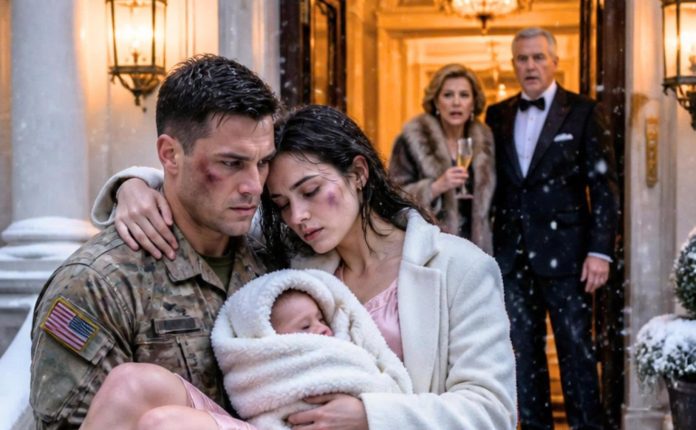
My grandpa died alone in a small Ohio hospital while my parents sat at home calling him difficult.
That is the sentence I still cannot say without feeling something bitter rise in my throat.
To them, he was a burden by the end. Too quiet. Too stubborn. Too old-fashioned. He never learned how to soften himself for people who only loved what was easy, and my parents had long since decided that anything requiring patience was someone else’s responsibility. So when the hospital called to say his condition had worsened, they muttered something about him being “dramatic again” and stayed home.
I went.
By the time I got there, the nurse was already speaking in that careful voice people use when they know they are delivering the final version of a story. My grandfather lay still in the narrow hospital bed, the room dim and humming softly with machines that were no longer needed. One hand rested outside the blanket as if he had been reaching for something—or someone—and run out of time.
I was twenty-four years old and had never felt so ashamed of my own blood.
I stood there beside him, staring at the face that had frightened me a little as a child because he was so stern, then steadied me as a teenager because beneath that sternness lived more loyalty than anyone else in the family had ever given freely. He was not warm in a loud way. He did not tell long stories or hand out easy praise. But he taught me how to change a tire, how to stand still when people tried to humiliate me, how to sharpen a knife, how to shake a hand properly, and how to tell the truth even when it made life harder.
He also never talked much about the war.
Only that he served. Only that some things do not become easier to remember just because other people demand a story.
My parents did not come to the funeral either.
My mother said she “couldn’t handle that kind of atmosphere.” My father claimed he had work, though it was a Saturday and he spent most of it at home watching television. So I stood alone at the graveside with a folded program in one hand while the minister spoke over a coffin hardly anyone had cared enough to stand beside.
There were only five of us there if you counted the minister, the funeral director, and the two cemetery workers waiting at a respectful distance.
That was all my grandfather got.
No long line of mourners. No military honors. No old friends. No one from whatever life he had lived before shrinking into a quiet man in an Ohio house with squeaky floors and a coffee tin full of screws he insisted were still useful.
After the burial, I went back to his house.
My parents had already started talking about selling it. Not grieving. Selling. They moved through his things like scavengers with bad manners, arguing over tools, the truck, whether the kitchen table was worth refinishing. I could barely breathe in the middle of it. So I went upstairs to his bedroom and shut the door.
His room still smelled like him—soap, old paper, cedar, and something metallic that reminded me faintly of winter air.
I opened the top drawer of his dresser because I do not know what else I expected grief to let me do. Inside were neatly folded handkerchiefs, an old wallet, two army photographs, and a small velvet ring box tucked beneath a stack of yellowed letters.
I opened it.
Inside was a ring I had never seen before.
It was heavy, old, and unlike anything my grandfather would ever have worn in ordinary life. Dark gold, maybe brass, with a black enamel face and an engraved crest I did not recognize. The inside band held initials so worn I had to tilt it into the light to make them out. On either side of the crest were tiny symbols—an eagle on one side, crossed branches on the other. It did not look decorative. It looked official. Personal. Important.
And hidden.
That was what stayed with me.
My grandfather kept almost nothing of value for himself, and yet this ring had been wrapped, boxed, and hidden at the back of a drawer like something too meaningful to discard and too dangerous to explain. I slipped it into my pocket without telling anyone. At the time, I told myself I was only keeping one last piece of him.
I had no idea I was carrying a key.
Three weeks later, I attended a military ceremony on behalf of a friend from college who had just been promoted. It was held at a large base auditorium two states away, full of pressed uniforms, polished shoes, brass music, and the kind of formal seriousness that makes even civilians sit straighter without knowing why.
I wore my best dark suit.
And the ring.
Not because it matched anything. Not because I even understood why I was doing it. Just because it was my grandfather’s, and some part of me wanted him there in the only way I still could.
The ceremony was nearly over when it happened.
People had begun mingling afterward in small groups. Officers were greeting families. Cameras flashed. My friend had wandered off toward his parents, and I was standing alone near a display of old regimental photographs, absently turning the ring around my finger, when a general stopped walking.
Not slowed.
Stopped.
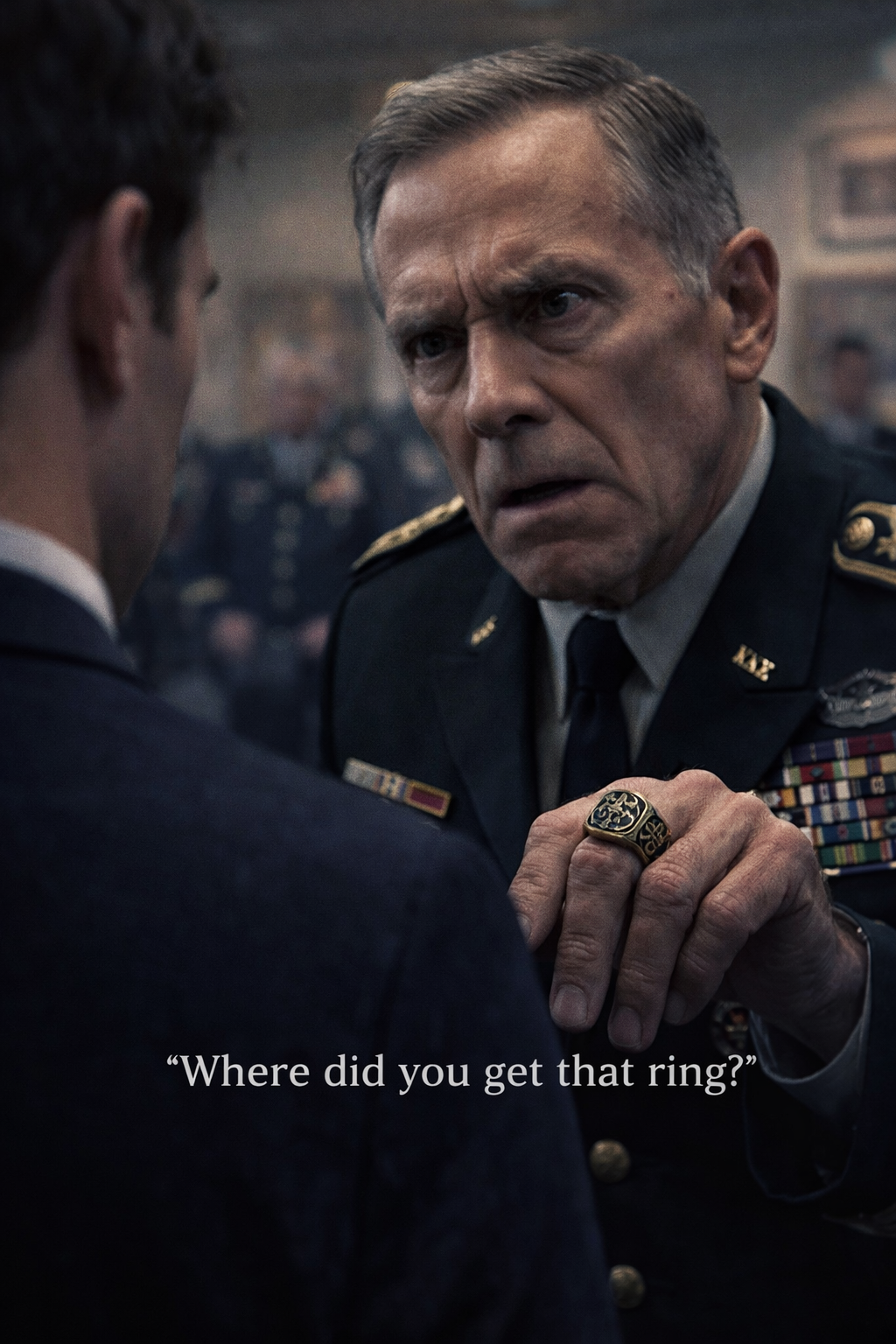
He was a tall man in his sixties with a chest full of ribbons and a face disciplined enough that most emotions probably died before reaching the surface. But the second his eyes landed on the ring, every trace of polite ceremony left him. He stared at my hand so hard I instinctively curled my fingers.
Then he looked at me.
And went pale.
He crossed the room faster than I thought someone his age would move and said, in a low, controlled voice that somehow made my blood run cold, “Where did you get that ring?”
I tried to answer normally, but something in his expression made the room feel suddenly smaller.
“It was my grandfather’s.”
The general did not blink. “What was his name?”
“Walter Hayes.”
That hit him too.
Not with recognition exactly. More like confirmation. The terrible kind. He glanced around once, then put a hand lightly but firmly on my elbow and said, “Come with me. Now.”
He took me to a side corridor off the main hall where the noise from the ceremony faded into muffled echoes. Once we were alone, he turned and asked the question that changed everything.
“Did your grandfather ever tell you why he was never allowed to be buried under his real name?”
I felt every drop of blood leave my face.
“What?”
The general stared at me for a long moment, as if measuring whether ignorance that complete could possibly be genuine. Apparently, he decided it was. His voice softened by half a degree.
“That ring,” he said, “does not belong to an ordinary enlisted man from Ohio. That ring was issued only to members of a wartime unit whose records were sealed under executive authority. Most people in the military have never seen one in person.”
I looked down at it like it had just become heavier.
“My grandfather was Army,” I said. “He served in Europe. That’s all I know.”
The general exhaled through his nose. “That is not all he was.”
He asked my grandfather’s birthdate. Then where he died. Then whether I had any photographs, letters, or service papers. I told him about the box in the dresser, the hidden ring, the old photos. He listened without interrupting, but his face kept growing stranger—less skeptical, more grimly certain.
Finally he said, “Walter Hayes was not his original name. At least not during the war.”
I laughed once, because the alternative was to panic. “That’s impossible.”
“No,” he said. “It’s classified.”
There are moments when reality does not break all at once. It peels. One thin layer at a time. That was what this felt like. My grandfather—the man who fixed lawnmowers and watched storms from the porch and hated mayonnaise with almost moral seriousness—was suddenly being discussed like a ghost inside official history.
The general asked me to sit.
I did.
Then he told me what he could.
Near the end of World War II, a small joint operations unit had been assembled for missions so sensitive that even their casualties were often reported under false designations. Some were tasked with extraction. Some with sabotage. Some with recovering individuals or items the government later pretended had never existed. The ring, he said, identified one of the field officers attached to that unit—not by rank, but by internal recognition. It should have been taken back decades ago.
“It wasn’t,” I said weakly.
“No,” he replied. “Which means one of two things. Either your grandfather was the last surviving holder and kept it illegally… or the people meant to retrieve it never found him.”
Neither option sounded human-sized anymore.
Then the general asked another question.
“When your grandfather died, were there any federal personnel at the hospital?”
I shook my head.
He looked relieved. Genuinely relieved. Which terrified me more than anything else he had said.
I asked him point-blank what my grandfather had done.
The general was silent for several seconds.
Then he said, “The better question is what he refused to do.”
That sentence lodged in me like glass.
According to the fragments he was willing to share, the unit my grandfather belonged to had been involved in the final days of the war and the first years after it—particularly operations concerning scientists, informants, and certain lists of names both Allied and Soviet intelligence wanted very badly. Something happened in Austria in 1947. Something involving a transfer, an order, and a decision one officer made that changed the chain of custody of a person—or possibly a file. Records were incomplete, heavily redacted, or missing entirely. But one name surfaced in internal disputes again and again.
Not Walter Hayes.
A different name.
My grandfather’s first silence had not been trauma alone.
It had been survival.
I sat there feeling as if the floor under my entire life had gone unreliable. “Are you telling me my grandfather was some kind of spy?”
The general’s face tightened. “I’m telling you your grandfather appears to have been part of an operation the government buried so deeply that even asking the wrong archivist can trigger flags. And if he kept that ring, he either wanted someone to find the truth after he died… or he knew someone still might be looking.”
The corridor suddenly felt cold.
I thought about his quiet habits. The deadbolts. The way he never sat with his back to a window. The fact that he once told me every man should know at least two exits from any room and refused to explain why. I had always filed those things under old soldier habits.
Now they rearranged themselves into something else.
The general asked for my number.
I hesitated.
He noticed. “Smart,” he said. “Keep hesitating. But listen carefully: do not show that ring to anyone else. Do not post photos of it. Do not mention this conversation online. And if there are letters in that bedroom, read them before anyone sells the house.”
That snapped me back to motion.
I drove to Ohio that same night.
My parents were furious when I arrived after midnight, mostly because I interrupted their sorting. My mother complained I was being dramatic. My father said the house contents would be divided whether I liked it or not. I barely heard them. I went straight upstairs, shut the bedroom door, and pulled every drawer out onto the floor.
Behind the dresser, taped to the underside of the lowest drawer, I found another envelope.
It had my name on it.
Not written recently. Not after his death. The paper was old. The ink slightly faded. But it was unmistakably addressed to me, not because he expected to die soon, but because he must have written it long ago and updated the hiding place whenever the room changed.
Inside was a short letter.
He wrote that if I was reading it, then “the wrong kind of silence” had finally ended. He said he had lived under a name that was not always his because one decision made overseas had placed a target on him and anyone who knew what he carried. He said the ring was proof, but not the most dangerous proof. He said there was a second box hidden beneath a loose floorboard in the closet, and that if the ring had already attracted attention, I was to choose very carefully whom I trusted next.
My hands shook so badly I nearly dropped the page.
I found the floorboard in less than a minute.
Under it was a metal lockbox, small and cold and heavier than it looked. Inside were photographs, military papers with blacked-out sections, a passport under another name, and one leather folder tied with string. On the top page was a single sentence handwritten by my grandfather:
I disobeyed a lawful order because the man they wanted to erase was innocent.
I sat on that closet floor until dawn reading.
The truth, or enough of it, came in pieces. My grandfather had been ordered to deliver a captured translator-scientist—someone useful, compromised, and politically inconvenient—to a postwar team whose allegiance shifted depending on which file you believed. Instead, after learning the man’s family would be disappeared and the transfer records falsified, my grandfather rerouted him through a church network and recorded evidence implicating an American officer in an unauthorized deal with Soviet intermediaries.
In other words, he chose conscience over command.
And then he ran.
Not dramatically. Quietly. Efficiently. With help from exactly one superior who made his official death possible and his new name necessary. He married later. Settled in Ohio. Became the difficult old man my parents could never understand because they had no idea he had already lived through the kind of moral terror that makes normal cruelty seem small.
The next afternoon, the general came to the house.
I had not called him.
Which meant he had either expected me to find what I found, or he had been watching more closely than he first admitted. To his credit, he looked almost relieved when he saw the lockbox still closed on the kitchen table and not spread across some lawyer’s office or journalist’s desk.
He read the top pages in silence.
Then he took off his cap, set it down very carefully, and said, “Your grandfather saved lives. And was punished for embarrassing men who preferred obedience to honor.”
I asked whether anyone would ever know.
He looked around the shabby kitchen, at the cheap curtains and chipped linoleum and my parents whisper-fighting in the next room about whether this could somehow become their problem. “Some already do,” he said. “But not publicly. Not yet.”
That might have been enough for some people.
It wasn’t enough for me.
I told him my grandfather died alone in a hospital bed while the people who should have loved him called him difficult. I told him he got a nearly empty funeral. I told him if there was any justice left in the system he gave his whole life to, then the least it could do was restore his real record before the house was sold and his story buried all over again.
The general looked at me for a long time.
Then he nodded once.
Six months later, I stood in a very different ceremony.
Smaller than the first. Private. But real.
There was an honor guard this time. A folded flag. A corrected service file. Not fully unsealed, not completely public, but enough. Enough for a citation recognizing “extraordinary moral courage under covert postwar conditions.” Enough for a military burial marker under both names. Enough for someone in uniform to say aloud that Walter Hayes had lived with distinction, and that distinction had once required silence.
My parents came to that one.
Of course they did.
People always show up when honor becomes visible.
But I barely looked at them.
I wore the ring in my pocket, not on my hand, because by then I understood it was not a keepsake. It was a burden, a witness, a reminder that the quietest people sometimes carry histories too large for the rooms they die in.
And I thought about the general’s face the first time he saw it. The way he went pale. The way he pulled me aside. The question that made my blood run cold:
Did your grandfather ever tell you why he was never allowed to be buried under his real name?
He hadn’t.
But now I know why.
And sometimes, late at night, that knowledge still rearranges the shape of him in my mind—not into a stranger, but into someone larger than the lonely old man my family dismissed. He was not difficult. He was burdened. He was not bitter. He was carrying a truth too dangerous to explain to people who had already proven they did not deserve it.
In the end, the ring was never just the last piece of him I had left.
It was the first real piece of him I had ever been given.