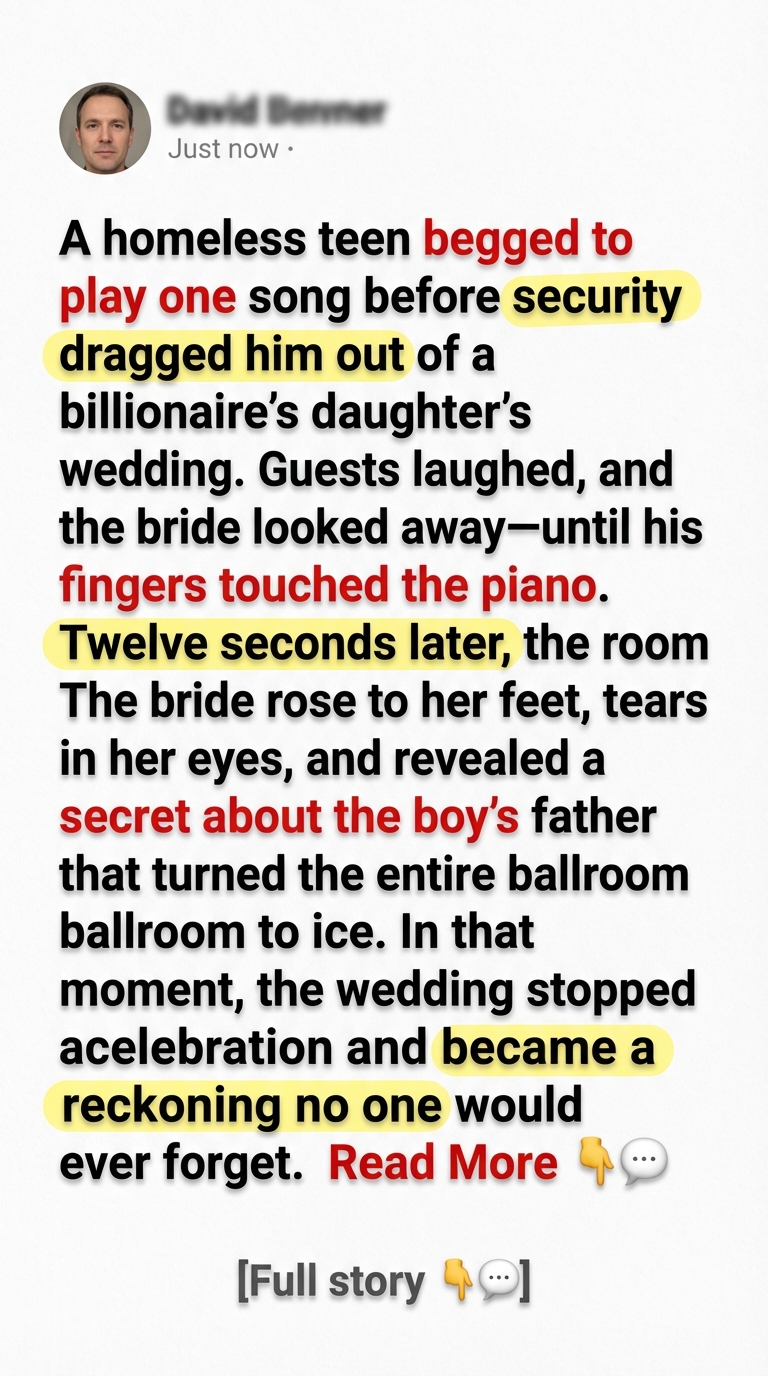
The homeless teen appeared at the edge of the ballroom just as the string quartet was finishing and the guests were settling into the lazy confidence of people certain the night belonged to them.
He could not have been more than seventeen.
His suit jacket was too thin for the weather, one sleeve torn at the cuff, his shoes scuffed white at the toes. His hair looked as though he had cut it himself with a dull pair of scissors, and he held himself with that awkward, defensive stillness of someone used to being watched with suspicion before he even spoke.
At first, most people assumed he had wandered in by mistake.
This was the wedding of Celeste Whitmore, daughter of billionaire hotel magnate Robert Whitmore, and every detail of the evening was designed to remind people of exactly how much money was in the room. Crystal chandeliers. White roses cascading from gold stands. Champagne older than the bride. A grand piano gleaming under soft light near the center of the ballroom like it was part of the décor rather than an instrument anyone might actually touch.
The teen stepped toward it anyway.
Security moved fast.
One of the guards grabbed his arm and started steering him toward the side doors while guests turned in their seats, already smiling in that cruel, bored way wealthy people sometimes do when an unexpected human inconvenience interrupts their evening. A few laughed openly. Someone muttered, “Unbelievable.” Another guest lifted a phone, probably hoping for a humiliating clip to share later.
Then the boy spoke.
“Please,” he said. “Just one song.”
His voice did not shake, which somehow made it sadder.
The guard tightened his grip. “You need to leave.”
The teen looked not at the guests, not at the groom, not even at the security staff. He looked straight at the bride. “Please,” he said again. “Just one song. Then I’ll go.”
Celeste Whitmore barely glanced at him.
She sat at the head table in a gown that looked like moonlight stitched into silk, one hand resting beside her untouched champagne glass, her face composed in that polished expression people mistake for peace. She was beautiful in the expensive, distant way magazine covers are beautiful—perfectly arranged, impossible to reach. At first, she looked away.
And that should have been the end of it.
But something about the boy’s face kept pulling at the edges of the room. Not because he was dramatic. He wasn’t. He looked exhausted, hungry, and strangely determined, like someone who had walked too far with too much to lose. There was dirt on the hem of his trousers. A bruise darkened one cheekbone. And still, all he wanted was the piano.
The groom gave an annoyed little laugh. “This is insane.”
Guests chuckled with him.
The guard tugged harder, and the boy stumbled, catching himself on the piano bench with one hand. The sound of it scraping against the floor cut through the room. Some laughed again. One older woman actually said, “Get him out already.”
Then, unexpectedly, the bride spoke.
“Wait.”
The room quieted.
It was not a shouted command. It was soft, almost weary. But it carried. The guard paused. Celeste stared at the boy now in a way she had not before, her eyes narrowed slightly as if some small part of him had unsettled her.
“You said one song?” she asked.
The teen nodded once.
Her father leaned toward her immediately. “Celeste, no.”
But she did not look at him. She just said, “Let him play.”
A murmur moved across the ballroom. Half amusement, half irritation. The kind of whisper rich guests make when they are confident whatever spectacle is about to unfold will still end in their favor.
The guard released the boy with obvious reluctance.
He sat at the piano bench slowly, almost like he expected someone to stop him at the last second. For a moment he just looked at the keys. His fingers hovered above them, pale and trembling, and several guests were already smirking, ready for the disaster. The groom actually leaned back in his chair, grinning as though this would become a funny anecdote for future cocktail parties.
Then the boy played.
The first notes were so delicate they almost disappeared into the room.
But they didn’t.
In twelve seconds, every sound in that ballroom died.
No forks clinked. No fabric rustled. No one whispered. It was as if the entire room had been caught by the throat. Because what came out of that piano was not clumsy, not amateur, not the hopeful noise of a desperate kid begging for mercy. It was exquisite. Precise. Devastating. The melody moved through the ballroom like memory finding a locked door and opening it anyway.
And the bride stood up.
Not gracefully. Not like a woman admiring talent. She rose so abruptly her chair tipped back behind her. Tears filled her eyes with terrifying speed. Her hand flew to her mouth, and the color drained from her face.
The boy kept playing.
Celeste took one step toward him, then another, as if she were walking into a dream she did not want but could no longer deny. By then, the groom had stopped smiling. Robert Whitmore had gone still in the way powerful men do when they sense something slipping beyond their control.
When the song ended, no one clapped.
No one even breathed.
The boy lowered his hands and looked at the bride with the exhausted expression of someone who had finally delivered the only proof he had left. Celeste’s voice came out broken.
“Where did you learn that?”
The teen swallowed. “My father taught it to me.”
Robert Whitmore stood so quickly his napkin fell to the floor. “Enough,” he snapped. “This is over.”
But Celeste turned on him with a look so sharp the room seemed to recoil. “No,” she said, louder now. “No, it isn’t.”
Then she looked back at the boy. “What is your father’s name?”
He hesitated.
Not because he did not know. Because saying it aloud in that room was clearly the whole reason he had come and also the reason he was afraid. When he finally answered, the name hit the ballroom like glass shattering.
“Gabriel Vale.”
A woman near the back gasped.
Someone dropped a fork.
And Robert Whitmore looked for the first time that night like a man who had just seen his own ghost.
Celeste began crying openly now. “That’s impossible,” the groom said quickly, too quickly. “Gabriel Vale is dead.”
The boy nodded. “That’s what they told everyone.”
The bride turned slowly toward her father. The room followed her gaze. She looked less like a bride than a daughter watching an old lie pull itself up from the grave. “Dad,” she whispered, “tell me I’m wrong.”
Robert Whitmore did not answer.
And silence, in a room like that, is an answer louder than confession.
The teen stood up from the piano bench. Up close, people could see how thin he really was. How long hunger had likely lived in his face. But there was something else there too—something startling beneath the exhaustion. He had the same dark eyes Gabriel Vale had in the old newspaper photos, the same severe mouth, the same stillness before movement. People in the room were beginning to realize that the music was not the only inheritance standing before them.
“My father wasn’t a thief,” the boy said.
Now the ballroom truly froze.
Because everyone knew the story of Gabriel Vale. Twenty years earlier, he had been Whitmore Hotels’ most brilliant pianist-in-residence, a rising composer, a quiet prodigy from nothing who had become a favorite in elite circles. Then came the scandal. Money missing. Jewelry gone after a charity gala. Security footage “lost.” Gabriel blamed. Gabriel fired. Gabriel disgraced. A week later, reported dead after disappearing with the evidence. That had been the story.
But the boy’s voice cut through it cleanly.
“He loved someone he wasn’t supposed to love,” he said. “And when she was forced to choose, he was buried under a lie so the right family name could survive.”
Celeste made a sound that was almost a sob.
The groom stared at her. “What is he talking about?”
She turned to him, tears on her face, and whatever she saw in his expression must have made the truth impossible to hold back any longer. “Gabriel wasn’t just my father’s employee,” she said. “He was my mother’s first love.”
The room erupted—not loudly, but in waves of stunned disbelief.
Celeste kept going, words shaking now, years of family silence cracking apart in public. Her mother, years before marrying Robert Whitmore, had been in love with Gabriel Vale. Really in love. But Gabriel was poor, gifted, inconvenient. Robert was powerful, useful, approved. When Celeste’s grandfather discovered the affair, it was ended brutally. Then, months later, when Celeste’s mother tried to break off her engagement, Gabriel was accused of theft, discredited, and made to vanish from society. Shortly afterward, Robert stepped in as the stable rescuer and married her.
The groom backed away from her like the dress, the flowers, the whole wedding had suddenly become contaminated.
Celeste looked at the boy again, trembling. “Your father told you this?”
The teen shook his head. “He wrote it.”
He reached inside his torn jacket and pulled out a thick envelope, edges softened by time and handling. “He died three months ago,” he said. “Not twenty years ago. He was alive. He was sick. And before he died, he gave me this and told me if I ever wanted the truth to live longer than him, I had to bring it to the wedding. He said this family only ever cared about appearances, so the truth had to arrive where appearances mattered most.”
Robert Whitmore lunged forward then, for the first time showing real panic. “Do not open that.”
Too late.
Celeste took the envelope with shaking hands.
Inside were letters. Old photographs. Copies of bank records. A notarized statement from a former Whitmore executive. And one final handwritten confession from Celeste’s late mother, written before her death and hidden for years. Guests near the front could see enough to understand the shape of the ruin even if they could not yet read every word.
Gabriel had been framed.
The missing money had been moved through a shell account linked to one of Robert Whitmore’s own men. The jewelry theft had been staged. The scandal had been manufactured to destroy a poor pianist who loved the wrong woman and knew too much about the wrong family. Gabriel had fled not because he was guilty, but because staying would have gotten him killed. He lived in obscurity, broke and disgraced, raising a son with a name the world never learned—until now.
The bride lowered the papers slowly.
Then she turned to her father with a face so cold it seemed to drain the warmth from the ballroom. “You destroyed him,” she said. “You destroyed her. And you let the world bury him as a criminal while you built an empire on top of his grave.”
Robert Whitmore opened his mouth, but no sound came.
And in that moment, the wedding stopped being a celebration.
It became a reckoning.
The groom took off his ring before the cake was even cut.
Guests who had laughed at the boy minutes earlier now avoided his eyes. Some looked ashamed. Others looked hungry for scandal in that ugly, fascinated way crowds always do when they realize they have witnessed the exact second power loses its mask. Lawyers began getting called before the band had even packed up. Someone from the press—there is always someone—slipped out to make a call.
And Celeste?
She stepped down from the stage, crossed the room, and stood directly in front of the homeless teen everyone had wanted thrown out.
Then, in complete silence, she knelt before him.
Not for drama. Not for show. For sorrow.
“I’m sorry,” she whispered.
The boy looked as if he did not know what to do with that. Maybe because apologies from people like her arrive too late too often to feel real. But Celeste was crying too hard now to fake anything. “He should have had his name back while he was alive,” she said. “And you should never have had to walk in here alone.”
The teen’s chin trembled once. “I didn’t come for pity.”
“I know,” she said. “You came for truth.”
By the end of the night, the ballroom had emptied into frightened clusters of whispers, canceled reservations, and reputations already starting to crack. But no one who was there would ever forget the moment it changed: the instant a homeless boy touched a grand piano, twelve seconds passed, and a bride realized the man her family had erased had returned in the face of his son.
What those guests expected was entertainment.
What they got was judgment.
And long after the flowers wilted, the champagne went flat, and the wedding itself became a scandal no amount of money could contain, people still talked about the same thing.
Not the billionaires.
Not the ruined marriage.
Not even the confession.
They remembered the boy at the piano—and how truth, when it finally arrives, does not ask whether the room is ready.