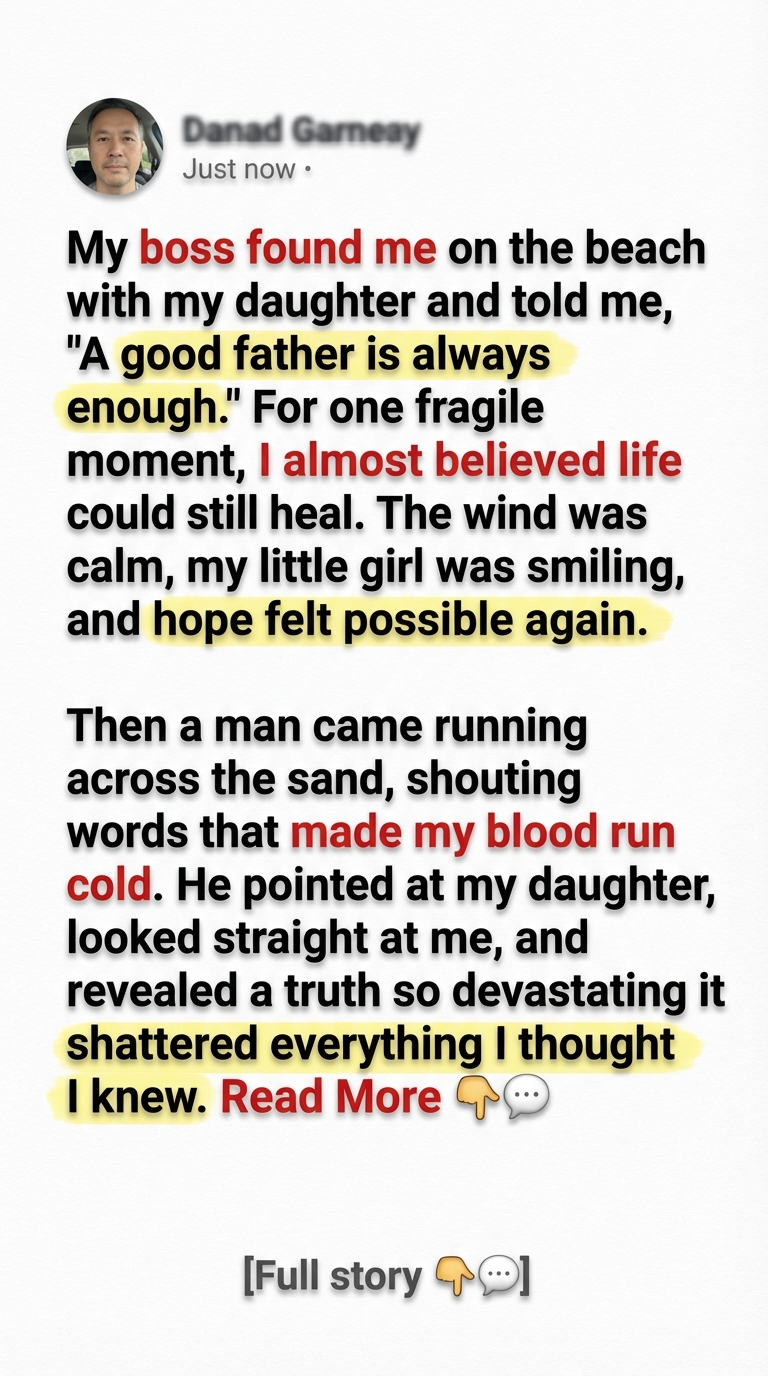
My boss found me on the beach with my daughter on a gray Sunday afternoon when I had gone there for one reason only—to keep from falling apart in the apartment where every wall still echoed with my wife’s absence.
My little girl, Rosie, was six years old and knee-deep in wet sand, building a crooked castle with a red plastic shovel. She kept looking up at me every few seconds to make sure I was watching, and each time I forced a smile because that is what fathers do when they are trying to keep a child from seeing the crack running through them.
The wind was calm that day.
Not cold, not warm, just soft enough to make the ocean look deceptively kind. The tide rolled in quiet breaths. Seagulls drifted overhead. Rosie hummed to herself while decorating her sandcastle with broken shells she called treasure. For one fragile moment, life seemed almost gentle again.
Then I heard someone say my name.
I turned and saw my boss, Graham, standing a few feet away in khakis and loafers completely unsuited for sand. He looked uncomfortable in the way wealthy men often look when they step into ordinary sorrow and do not know where to put their hands. Graham had always been demanding at work, but not unkind. Since my wife’s funeral two months earlier, he had called more than once to tell me to take whatever time I needed.
That afternoon, he looked at Rosie, then back at me, and said quietly, “A good father is always enough.”
I do not know why those words hit me the way they did.
Maybe because I had spent weeks feeling like half a parent, half a man, half alive. Maybe because grief makes even simple kindness feel unbearable. Whatever the reason, I looked out at my daughter laughing at the ocean and almost believed him. Almost believed I could keep her safe. Almost believed love might still be stronger than what death had taken from us.
For one small, dangerous second, hope felt possible again.
Then someone started shouting.
At first it was just noise carried by the wind. Sharp, frantic, getting closer. Graham turned before I did. Rosie stopped playing and looked up. I rose to my feet slowly, already feeling that strange instinctive dread that comes before disaster has a shape.
A man was running across the sand toward us.
He was tall, unshaven, wild-eyed, with one sleeve rolled up and his shoes in his hand as though he had abandoned a car somewhere and sprinted the rest of the way. People nearby turned to stare. A couple gathered their children closer. The man kept shouting, but the sound was broken apart by distance and surf.
Then he got close enough for the words to land.
He pointed straight at Rosie.
And looked directly at me.
“That girl is not your daughter!”
The world stopped.
Rosie flinched and backed toward me. Graham took a step forward like he meant to block the man if he came closer. My entire body went cold so fast it felt like my bones had been dropped into ice water.
“What did you just say?” I asked.
The man bent over, hands on his knees, trying to catch his breath. His face was bright red, his chest heaving. When he looked up again, his eyes were wet. Not angry. Desperate. Broken in a way I did not understand.
“I said,” he choked out, “that little girl is not yours.”
I moved in front of Rosie instinctively.
“Stay away from her.”
He straightened and raised both hands to show he meant no harm. “I’m not here to hurt her,” he said. “I’m here because I can’t live with this anymore.”
Graham’s voice hardened. “You need to leave right now before I call the police.”
But the man did not look at him. He kept his eyes on me.
“You were married to Hannah,” he said.
The sound of my wife’s name in a stranger’s mouth hit like a blow.
“Yes,” I said slowly.
He swallowed hard. “My name is Daniel Mercer.”
I had never heard it before.
He took one shaking breath after another and said, “Hannah and I were together. Before you. Then during part of your marriage too.”
Rosie grabbed the back of my shirt.
I could feel her fingers tightening in the fabric as if my body were the only solid thing left on the earth. My mind rejected the words before I could even process them. My wife was dead. Grief had already turned her into something too sacred to fight with. And now a stranger was trying to drag mud across her grave.
“That’s a lie,” I said.
“I wish it were.”
Graham stepped closer. “This is not the place for this.”
“No,” Daniel said hoarsely. “It isn’t. But I found out she died before I could do anything, and when I saw him here with the girl—” He looked at Rosie, and his face crumpled. “She has my mother’s eyes.”
I think I would have hit him if Rosie had not been there.
Instead I stood frozen, shaking with rage so violent it made my hands numb. “You need to shut your mouth right now.”
Daniel reached into his jacket and pulled out a weathered envelope.
“I brought proof.”
My heart was hammering so hard I could hear it in my ears. Graham told me not to take it. Told me this could be some kind of scam, some kind of extortion. But Daniel looked like a man standing inside his own punishment. Whatever this was, he had not come for money. He had come because silence had become impossible.
I took the envelope.
Inside were photographs.
Old ones first. Hannah in a yellow sweater I remembered. Hannah smiling in front of a diner I remembered her mentioning once from “a college road trip.” Hannah standing beside Daniel, closer than friends stand, with her face turned toward him in a look I had never seen directed at me.
Beneath the photographs was a stack of printed emails.
My fingers trembled as I flipped through them. Dates. Hotel reservations. Messages full of apologies, longing, panic. One line made my vision blur:
If he ever finds out about Rosie, it will destroy him.
I could not breathe.
Rosie looked up at me and whispered, “Daddy?”
That word almost killed me.
Daniel’s voice broke behind the roaring in my ears. “I didn’t know for sure at first. She told me the baby was yours. She said it had to be that way. Then when Rosie got older…” He wiped a hand over his face. “I knew. But Hannah made me promise to stay away. She said you were a good man. She said you’d give Rosie a stable life I couldn’t.”
Graham took the papers from my limp hands and scanned them with a grim face.
“They could be fake,” he said, though there was less certainty in his voice now.
Daniel nodded quickly. “There’s more. I filed a preserved paternity petition two years ago but never served it. I have copies. I have letters from her. I have—” He stopped, choking on whatever came next. “I have a lock of Rosie’s baby hair Hannah sent me in a birthday card. I tested it last month. Ninety-nine point nine percent.”
The sand beneath me seemed to tilt.
Everything I thought I knew about my life—my marriage, my grief, my daughter’s first cry, the nights I rocked her through fevers, the promises I made to my dying wife in that hospital room—suddenly cracked open. There are pains so large they do not arrive as pain at first. They arrive as emptiness. A hollowing. A silence so complete you can hear your entire identity collapse inside it.
Rosie tugged my hand.
“Daddy, who is he?”
I looked down at her.
At her damp curls, her wide frightened eyes, the seashell still clutched in her tiny fist. She did not look like a lie. She looked like my child. Every scraped knee I bandaged, every birthday candle I lit, every bedtime story, every laugh, every nightmare she climbed into my bed to escape—none of that felt less real because a stranger had run across sand with documents and grief.
And yet something inside me had already shattered.
I could not answer her.
Graham crouched beside her and said gently, “Sweetheart, why don’t you go sit on the towel for a minute?”
But Rosie would not let go of me.
Daniel saw that and began crying openly. “I didn’t come to take her,” he said. “God, that’s not why I’m here. I just couldn’t watch from a distance anymore. Hannah told me to disappear if anything happened to her, but then she died and I realized I was letting you live inside a lie she created for both of us.”
I turned on him then.
“You think this helps?” I said, my voice shaking. “You think running up to a beach and blowing up a child’s life is some act of courage?”
He flinched but did not argue.
“No,” he whispered. “I think it’s too late to do this well.”
That silenced even me.
Because he was right.
There was no good way. No gentle version. No clean truth waiting patiently to be discovered in a therapist’s office with tissues and measured breathing. There was only this: the sea, the wind, my daughter clutching my hand, and the dead woman I had loved suddenly revealed as the keeper of a betrayal large enough to survive even her.
I asked the only question left.
“Did Hannah know she was dying?”
Daniel nodded slowly.
“She came to see me three weeks before the accident.”
The accident.
Even now, that phrase clawed at me. My wife had been killed by a drunk driver coming home from a conference. I had believed her final months were ordinary, even tender. But Daniel’s next words tore that illusion apart too.
“She told me she wanted to confess,” he said. “She said Rosie deserved the truth someday. But she was terrified you would hate her more than you loved the child.”
I laughed once. It sounded ugly.
“Then she should have tried honesty before dying.”
Rosie started crying then—quiet, confused tears, because children always know when the adults around them are standing on broken glass even if they cannot yet see the blood.
I lifted her into my arms.
She buried her face in my neck the way she had as a baby, trusting me with the blind faith only a child can give. And that trust finished what Daniel’s words had started. Because in that moment, I knew one thing more clearly than I had ever known anything:
Whatever truth had just been revealed, whatever blood said, whatever my wife had hidden, Rosie was still mine in every way that mattered to the girl trembling against my shoulder.
I looked at Daniel over her head.
“If you ever do something like this in front of her again,” I said quietly, “I will bury you.”
Graham inhaled sharply, but Daniel only nodded.
“I deserve that.”
Maybe he did. Maybe Hannah did too. Maybe I deserved some blame for not seeing what had been right in front of me all along. But none of that mattered as much as the child in my arms.
The rest happened slowly and terribly.
Lawyers. DNA confirmation. Family court meetings. Explanations given in rooms with soft chairs and too many tissues. Daniel was the biological father. There was no doubt. He never tried to take Rosie away, just as he had promised. What he wanted, eventually, was contact. A place in her life. A truth acknowledged before it curdled into another inherited lie.
I hated him for existing.
I hated Hannah for dying before she could answer a single question.
I hated myself most at night, in the hours when Rosie slept and I would sit outside her room wondering whether fatherhood lived in blood or in years or in the quiet repetition of love.
One evening, months later, Rosie asked me, “Did Mommy tell a bad secret?”
Children have a way of stepping over every adult attempt to soften reality.
I told her, “Yes. But grown-ups can make very big mistakes and still love very much.”
She thought about that, then asked, “Are you still my daddy?”
I cried in front of her for the first time.
I said, “Always.”
And that, in the end, became the only part I refused to let the truth take from me.
My boss had found me on the beach and told me a good father is always enough. At the time, I thought he was offering comfort.
I understand now that he was giving me a warning.
Because minutes later, a man came running across the sand and shattered everything I thought I knew. He pointed at my daughter, looked straight at me, and revealed a truth so devastating it split my life into before and after.
But the deeper truth—the one that survived the ruin—was this:
Blood may tell you how a child began.
Love tells you who stayed.