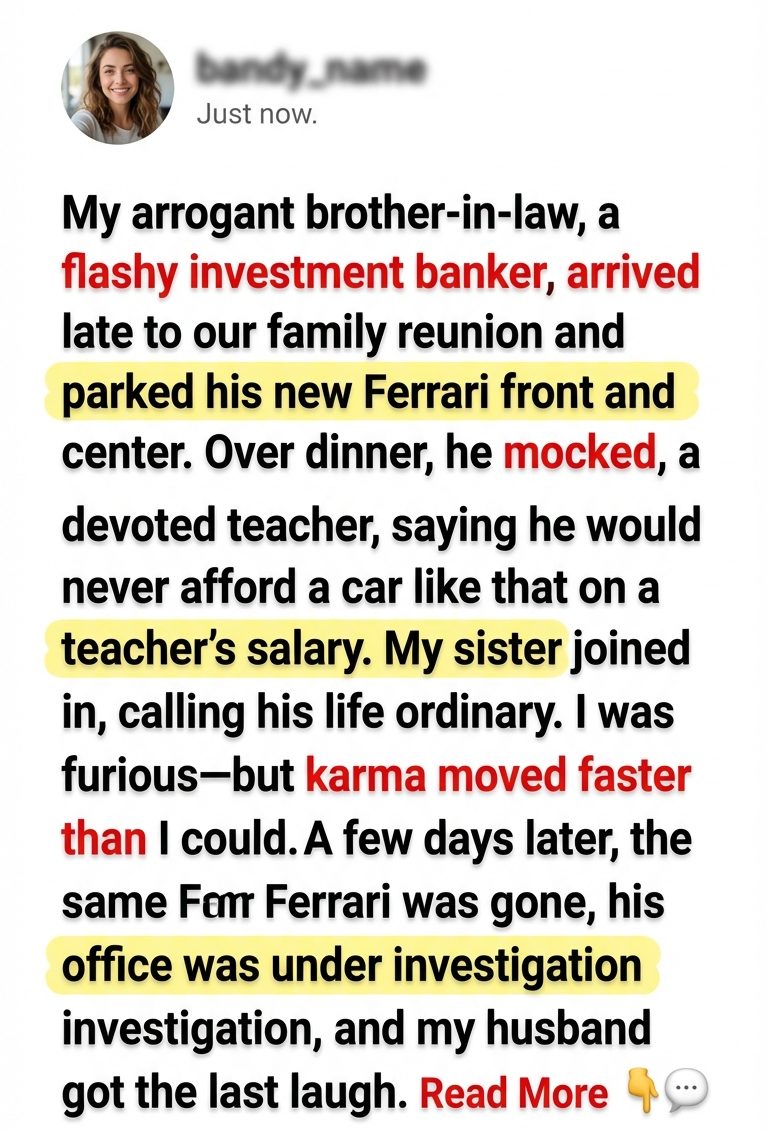
My arrogant brother-in-law made sure everyone heard him before anyone even saw him.
We were halfway through setting bowls of salad and bread on the long patio table at our family reunion when the roar of an engine ripped through the quiet neighborhood. Heads turned. Children ran toward the driveway. And then there he was—my sister’s husband, Evan—sliding out of a brand-new red Ferrari like he was stepping onto a movie set instead of arriving two hours late to a family barbecue.
He parked it front and center.
Not near the curb. Not off to the side. Right in the most visible spot in front of my parents’ house, angled so the setting sun bounced off the paint and into everyone’s eyes. He took a full five seconds to remove his sunglasses, glance around, and wait for people to admire him.
My sister, Vanessa, climbed out after him with the expression of a woman who believed she had married up and wanted the rest of us to remember it.
Meanwhile, my husband Daniel was in the backyard helping my father fix a loose deck board.
That was Daniel in every room he entered—quietly useful, never loud, never showy. He taught seventh-grade history at a public middle school and somehow came home every day with enough patience left to help our daughter with homework and enough kindness left to call his mother every Sunday. He was the sort of man flashy people underestimated because they mistook gentleness for weakness.
Dinner started pleasantly enough.
There were grilled vegetables, chicken, corn, too many side dishes, and the usual family noise layered over clinking glasses and laughter. My mother was happy. My nieces were chasing each other with popsicles. For one whole hour, I almost believed Evan might behave like a normal human being.
Then Daniel told a story.
One of his students had been struggling all year—bad grades, trouble at home, always angry. Daniel had stayed after school for weeks helping him prepare for a scholarship interview. That afternoon, the boy had come back just to tell him he got in. Daniel smiled as he described how proud the kid had looked, trying so hard not to cry.
It was a sweet story. The kind that should have warmed a table.
Instead, Evan let out a short laugh and leaned back in his chair.
“You’ll never afford a car like mine on a teacher’s salary.”
The table went silent.
Daniel blinked once, clearly surprised by how ugly the remark was. Before he could even answer, Vanessa gave a little shrug and added, “Seriously, Daniel, why did you settle for such a mediocre job? If you had any ambition, you wouldn’t have to live such an ordinary life.”
I felt heat shoot through my body so fast I nearly stood up.
Mediocre.
Ordinary.
Those words landed on the table like something rotten. My husband, who spent his days shaping children nobody else had the patience to reach. My husband, who had once used our vacation savings to help his school buy winter coats for students. My husband, who had more integrity in one finger than Evan had in his entire over-tailored body.
I looked at Daniel, waiting for the flicker of hurt I knew had to be there.
But he only set down his fork and smiled in that infuriatingly calm way he has when other people are determined to embarrass only themselves. “I like my life,” he said. “And I sleep well at night.”
Evan smirked. “That’s one way to cope.”
I wanted to throw my drink at him.
Instead, I said, “It’s easy to sneer at decent people when you measure worth by leather seats and engine noise.”
Vanessa rolled her eyes. “Oh, please. Don’t be dramatic. We’re just saying Daniel could have done more with himself.”
My father shifted uncomfortably. My mother stared at her plate. That was the worst part—how bullies like Evan and Vanessa always rely on other people’s discomfort to get away with cruelty. They say something vicious, then act as though everyone else is too sensitive for noticing.
Daniel reached under the table and squeezed my hand once.
That single squeeze said everything: Let them dig their own grave.
So I swallowed my anger and let the dinner limp onward, though nothing tasted right after that. Evan kept talking about markets, clients, bonuses, and some Hamptons weekend like he was reciting a hymn to himself. Vanessa laughed too loudly at every sentence. And all I could think was how desperate people must be to keep proving they matter.
When they finally left, Evan revved the Ferrari again on purpose.
The children covered their ears. He grinned.
Three days later, karma arrived.
Not the vague, poetic kind people talk about to make themselves feel better. Real karma. Precise karma. The kind that lands with paperwork, headlines, and handcuffs.
It started with a phone call from my sister at 6:12 in the morning.
I almost ignored it. Vanessa never called that early unless it was important or catastrophic, and she did not believe in important unless it affected her directly. Her voice, when I answered, was ragged and panicked.
“Have you seen the news?”
I sat up in bed. “What happened?”
She was crying so hard I could barely understand her. “It’s Evan. Something’s happened at his firm. There are reporters outside. They froze accounts. I don’t know what’s going on.”
Daniel was already awake beside me, reaching for his phone.
Within minutes, we found it.
A federal investigation into fraudulent investment products, client fund misappropriation, and falsified reporting at Evan’s boutique banking firm. Several executives were named. Evan was one of them. The article said authorities suspected they had been inflating asset values to lure investors while siphoning millions through shell entities.
Millions.
My first reaction was disbelief. My second was a cold, shameful flash of satisfaction I tried not to enjoy too much.
By noon, the story had spread everywhere. Evan’s smug face appeared in online articles above words like fraud, deception, and probe. The same man who had mocked my husband’s “ordinary life” now had reporters asking whether he had built his extraordinary one on lies.
Vanessa called again that afternoon, this time begging us to come over.
We went, mostly because Daniel insisted family is still family when the walls start falling down. I did not argue, though part of me wanted her to sit alone in the mess she had decorated with arrogance.
Their house looked different somehow when we arrived.
Not physically. It was still enormous, polished, full of marble and glass and expensive things chosen to impress strangers. But fear changes a house. It strips glamour from surfaces. It reveals where comfort was never actually living.
Vanessa opened the door in sweatpants, mascara streaked, hair unwashed. I had not seen her look human in years.
Evan was in the kitchen on his phone, barking at someone about compliance, exposure, and “temporary misunderstandings.” But the swagger was gone. His shirt was wrinkled. His hands shook. When he saw Daniel, he looked away almost instantly.
Good.
For the first time since I had known him, he looked like a man who understood that money could no longer edit the room in his favor.
Vanessa started rambling. She said it was all blown out of proportion. She said jealous coworkers had set him up. She said these things happen in finance. She said people with real wealth are always targeted.
Then the doorbell rang.
Evan went pale.
Two agents were standing outside.
I will never forget that moment. The Ferrari was still in the driveway, gleaming like a ridiculous red trophy, while two federal investigators asked to come in and speak with him about records, devices, and transactions. It would have been funny if it had not been so devastatingly pathetic.
Vanessa grabbed my arm so hard it hurt. “Say something,” she whispered.
But what exactly was there to say?
That mocking honest people is dangerous when your own life is one audit away from collapse?
That a teacher’s salary may not buy a Ferrari, but it also does not usually end with agents at the door?
That “ordinary” can look pretty glorious when the alternative is criminal exposure and public humiliation?
Daniel, because he is Daniel, spoke before I did.
He told Evan to cooperate, get a real lawyer, and stop lying to his own family if he wanted any chance of surviving what came next. Evan nodded once without meeting his eyes. That was the closest thing to humility I had ever seen from him.
Things got worse fast.
By the end of the week, more details emerged. The Ferrari was leased through the company. The vacation house was not theirs. Several luxury purchases had been made on lines of credit tied to inflated bonus projections that no longer existed. Their accounts were restricted. Clients were suing. Coworkers were turning on one another. The entire glittering empire was basically a stage set with the lights suddenly turned on.
Vanessa came to our house five days later with two suitcases and her six-year-old son.
She stood on our porch—this woman who had called my husband mediocre—and asked if they could stay “just until things settle down.”
I waited for anger to rise again.
It did.
But before I could answer, Daniel stepped forward and took her bags.
“Of course,” he said.
That nearly undid me.
Because there it was, the final difference between them. Evan had money and contempt. Daniel had character. And when life stripped everything decorative away, only one of those things was still worth anything.
Vanessa cried the first night at our kitchen table after the children were asleep.
She said she had not known how bad it was. Maybe that was true. Maybe it was not. But she admitted she had loved being admired. She had mistaken wealth for proof of intelligence, status for proof of value, and noise for proof of success. She said hearing Evan ridicule Daniel at the reunion had made her uncomfortable, but she joined in because that was easier than challenging the man who paid for the life she enjoyed.
Daniel said nothing for a long time.
Then he told her quietly, “You should never measure a person’s life by what can be repossessed.”
That line stayed with me.
A month later, the Ferrari was gone.
Towed.
I happened to be there when it happened because Vanessa had asked me to come with her while she sorted through more legal documents. We stood in the driveway, side by side, watching the car being lifted onto a truck while neighbors peeked through curtains.
Vanessa looked like she might be sick.
I thought about that reunion, the revving engine, the smug grin, the insult at the dinner table. I thought about my husband in his worn loafers, grading papers late into the night, never once needing applause to know who he was.
And I smiled.
Not because another person’s ruin is noble. It isn’t. But because truth had finally caught up with performance, and for once, it had done so publicly.
Evan now faces charges.
Vanessa is trying to rebuild her life, though for the first time she is doing it without sneering at everyone else’s. Their son adores Daniel, who helped him with a school history project last week and never once mentioned any of this within the boy’s hearing. That is the kind of man I married.
As for the family reunion, no one talks about it openly.
They do not need to.
Every single person at that table remembers exactly what Evan said: You’ll never afford a car like mine on a teacher’s salary.
He was right.
My husband never could.
What my husband could afford was self-respect, clean hands, a peaceful night’s sleep, and the kind of life that does not collapse when someone starts asking for receipts.
And in the end, that turned out to be worth a lot more than a Ferrari parked front and center.