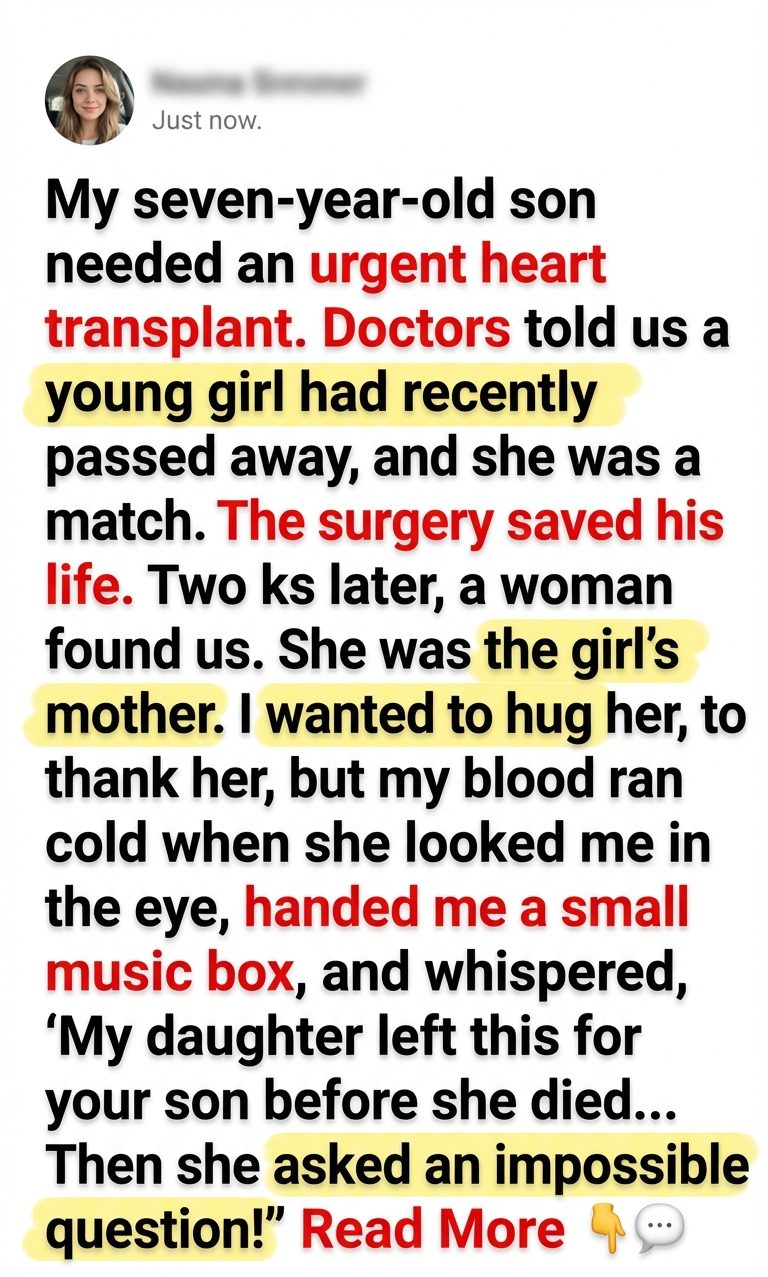
My seven-year-old son needed an urgent heart transplant, and by the time the doctors finally said the word match, I was too exhausted to celebrate the way people imagine you do in miracles.
For months, our lives had been reduced to hospital corridors, antiseptic air, whispered updates, and the kind of fear that lives in your bones long after the moment passes. Every time a machine beeped too sharply, I stopped breathing. Every time a doctor entered the room, I searched their face before they spoke.
My son, Liam, was so small in that hospital bed. Tubes, wires, pale skin, brave little smiles—he was seven years old and already fighting harder than most people ever have to. Sometimes he would look up at me and ask, “Mom, when can we go home?” and I would smile while my heart quietly broke.
Then one rainy Tuesday morning, the transplant coordinator came in with tears in her eyes and told us a young girl had recently passed away. Her heart was a match.
I remember the strange collision of emotions. Relief so intense it felt like dizziness. Gratitude so huge it was painful. And beneath both of them, a crushing grief for a family I had never met, who had just lost everything while mine was being given another chance.
The surgery lasted hours that felt like entire lifetimes. I sat in that waiting room praying, bargaining, unraveling, rebuilding, and unraveling again. When the surgeon finally came out and said, “He made it,” I dropped into my chair and sobbed so hard I could barely hear the rest.
The days after that were slow and fragile. Every small improvement felt sacred. Better color in his cheeks. Stronger pulse. The first time he squeezed my hand with real energy again, I nearly cried. The first time he laughed, the nurses laughed with him.
Two weeks later, we were finally home.
The house still smelled faintly like the flowers neighbors had sent and the soup people kept dropping off. Liam was curled on the couch under a blanket, thinner than before but alive, gloriously alive, turning the handle on his favorite toy truck with a seriousness only children can give to small things.
That was when the knock came.
I opened the door expecting another casserole or another sympathetic smile. Instead, I found a woman standing there in a gray coat, her face pale and composed in a way that looked more dangerous than tears. She held something in both hands, wrapped in a white cloth.
“I’m sorry to come unannounced,” she said softly. “My name is Elena.”
There was something in her voice that made the air change.
Then she said, “My daughter was your son’s donor.”
My hand flew to my mouth.
For a second, I could not speak. This was the mother. The woman whose child had died so mine could live. I had imagined this moment in a hundred ways—if it ever happened at all. In every version, I embraced her. I thanked her. I cried with her. But when I looked into her eyes, something inside me went cold.
Not because she looked angry.
Because she looked like someone carrying a truth too heavy to set down.
She glanced past me toward the living room where Liam was resting, then held out the bundle in her hands. It was a small wooden music box, old-fashioned and delicately carved, with tiny painted stars around the lid. “My daughter left this for your son before she died,” she whispered.
My throat tightened. “Left it… for him?”
Elena nodded once, but her fingers didn’t let go right away. It was as if handing it over cost her something. When she finally released it, I felt how carefully it had been protected. This was not just an object. It was a message.
I invited her inside.
She stepped into our home slowly, as if entering another family’s joy required permission from her grief. Liam looked up from the couch and smiled shyly. She stared at him so intensely that I thought she might collapse, but instead she sat down in the armchair opposite him and folded her hands tightly in her lap.
“She was nine,” Elena said after a long silence. “Her name was Sofia.”
I sat beside Liam and listened.
“She knew she was dying,” Elena continued, her voice trembling now. “Not immediately. Not at first. But in the end… she understood more than anyone wanted her to.” She swallowed hard and looked at the music box in my hands. “A few days before she passed, she asked me to give that to the boy who got her heart, if there ever was one.”
Tears burned behind my eyes.
Then Elena said the words that changed everything.
“She also made me promise to ask him something.” Her gaze lifted to Liam’s face, and for the first time I saw fear mixed with grief. “She said that if he survived… I had to ask whether he remembered the song.”
The room went silent.
I felt Liam go still beside me.
At first I thought the question was just the desperate poetry of grief. The kind of thing a devastated mother clings to because reality is too cruel to face directly. But before I could gently answer, Liam whispered, “The lullaby?”
Every hair on my arms stood up.
Elena’s face drained of color. “What did you say?”
Liam looked confused, like he had said something ordinary. “The lullaby,” he repeated. “The one about the moon and the birds.” Then he frowned. “I heard it in my dream.”
I could not move.
Elena made a sound I will never forget—something between a gasp and a sob. Her hands flew to her mouth. “That was her song,” she whispered. “I used to sing it to Sofia every night. I made it up when she was a baby. I never wrote it down. No one else knew it.”
I turned to Liam so fast my neck hurt. “Honey… what song?”
He looked from me to her, suddenly nervous. “The pretty one,” he said softly. “The girl with the braids sang it. She said not to be scared because the birds always come back in the morning.”
The music box slipped in my grip.
Elena was crying openly now, shaking so hard I thought she might fall apart right in front of us. She asked him, in a whisper so thin it barely existed, “What did she look like?”
Liam answered without hesitation. “She had long dark hair. Two braids. And a yellow sweater.” He smiled faintly. “She was sitting in the garden.”
Elena let out a broken cry and bent forward, covering her face. “That’s what she was wearing the last afternoon before she was admitted,” she sobbed. “Her favorite yellow sweater.”
I wanted to explain it. Coincidence. Hospital talk. Fragments from overheard conversations stitched into a child’s imagination. I reached desperately for anything logical. But then Elena looked up again and said, “Open the music box.”
With trembling hands, I lifted the lid.
A tiny ballerina turned in place as a melody filled the room—soft, delicate, aching. Liam’s eyes widened instantly. And then, before either of us could react, he began humming along.
Not vaguely.
Not clumsily.
Exactly.
The same pauses. The same tiny rise before the final note. It was not just a tune he liked. It was recognition.
Elena stared at him like the universe had cracked open in her living room. I felt my own body go numb. Liam kept humming, then smiled and said, almost happily, “That’s the one. She told me if I got better, I had to tell her mommy she wasn’t alone.”
I stopped breathing.
Elena looked at me, tears pouring down her face, and whispered, “That was the impossible question.”
I barely managed to speak. “What question?”
She pressed a trembling hand to her chest. “Before Sofia died, she asked me, ‘When my heart goes to the little boy, will he know I loved my mom too much to leave without saying goodbye?’”
I covered my mouth and began to cry.
Liam, still innocent and quiet and recovering from the surgery that had saved him, looked between us and said in the gentlest voice, “She said she had to go. But she said her heart would keep singing.”
No one in that room spoke after that.
The music box kept turning, the little ballerina spinning under the faint afternoon light, while three lives—one spared, one shattered, one somehow bridged by love and loss—sat in the silence it left behind.
I had expected gratitude to be the hardest thing I would ever carry.
I was wrong.
The hardest thing was realizing that sometimes miracles do not arrive alone. Sometimes they come hand in hand with grief, mystery, and a final message from a child who somehow found a way to make sure her mother heard her one last time.
And as Elena reached for my son’s hand and he took it without fear, I understood why my blood had run cold the moment I opened that door.
She had not come only to bring us a gift.
She had come to find out whether her daughter’s goodbye had survived the journey.