My son was only thirty-three when the doctors stopped using hopeful words and started speaking in careful, softened tones that felt worse than the truth itself.
One by one, the plans he had for his life disappeared. The promotions, the vacations, the ordinary little dreams people assume they have time for—all of it was swallowed by hospital rooms, test results, and the cruel mathematics of a body failing too soon.
His wife came to see him once after the diagnosis turned grim. She stood at the foot of his bed, arms folded, staring at him as if he were already gone. Then she said the words I will hear for the rest of my life: “I won’t waste my life watching him turn into a vegetable.”
My son was too weak to answer her. I was not.
I stood up so fast my chair slammed against the floor. I told her to get out, told her that if she had even a grain of decency left in her body, she would never speak to him that way again. But she only rolled her eyes, picked up her handbag, and said, “Someone has to be realistic,” before walking out of the room like she was leaving a boring appointment.
That was the last real act of marriage she ever performed. After that, I became everything. I became his nurse, his cook, his driver, his advocate, and the pair of hands that held him together when the pain made him shake so hard he could not lift a glass of water.
I sold my house to pay for what insurance would not cover. Every room I had built a life in, every memory, every bit of security I had left in this world—I traded it all for more time, better care, and one more chance to ease his suffering. I do not regret it. Not for one second.
There were nights when he could not sleep because the pain was clawing through him, and I sat beside him until dawn, wiping his face, changing sheets, whispering stories from his childhood just to anchor him to something gentler than what was happening to his body.
And through all of that, she stayed gone.
No warm meals. No late-night vigils. No hand to hold during chemo. No tenderness. Sometimes she sent a text asking for updates, but even those felt less like concern and more like someone checking the status of a delayed package.
My son knew it too. I saw it in his eyes every time her name flashed on his phone and he turned the screen face down. He stopped asking where she was. That hurt more than if he had cried.
When the end came, it was quiet.
He took his last breath with my hand in his, and the room felt unbearably still after months of alarms, machines, medications, and movement. I remember leaning over and kissing his forehead, still warm, and thinking that no mother should ever have to outlive her child.
Then came the funeral, and with it, the performance.
She arrived in black, wearing dark glasses and a face full of staged grief. She clung to people, accepted condolences, and cried in elegant little bursts that somehow never smudged her makeup. Guests whispered about what a devoted wife she must have been, and I stood there in stunned silence, too hollow to correct them.
I thought that after burying my son, nothing could humiliate me more.
I was wrong.
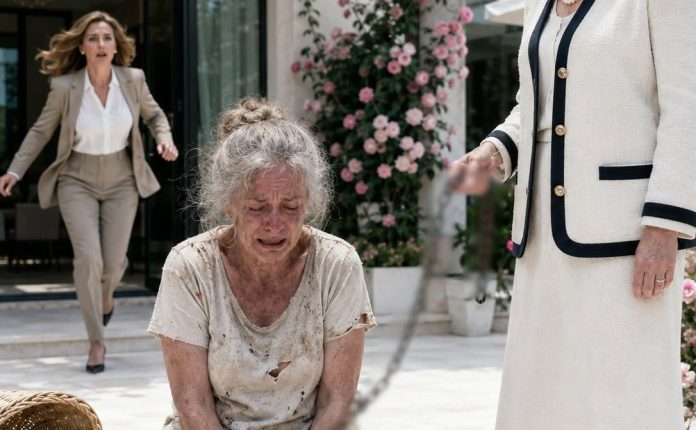
Three days after the funeral, she sat me down in the house I had helped preserve during my son’s illness and announced that everything now belonged to her. The house. The accounts. The car. The furniture. All of it. Then, with a flat voice and cold eyes, she told me I had two days to leave.
I stared at her, certain I had misheard. “Leave?” I said. “After everything I did for him? For both of you?”
She shrugged. “You chose to do those things. No one asked you to sell your house. And frankly, I need space to move on.”
Move on.
That phrase hit me harder than grief had. I told her she had abandoned her husband while he was dying, that she had forfeited every moral right to speak of moving on in a home paid for by his suffering and my sacrifice. She stepped closer and hissed that if I made trouble, she would tell everyone I was unstable, controlling, and trying to steal from a grieving widow.
I wanted to slap her.
Instead, I packed.
Every sweater I folded felt like a surrender. Every framed photo I wrapped in newspaper felt like another theft. I moved through my son’s bedroom last, because I knew once I touched his things, this nightmare would become final.
That was when I found the shoebox.
It was shoved far beneath his bed, taped shut, hidden so carefully that I knew at once it had been meant for a later moment—one he must have realized might come without him. My hands were shaking so badly I could barely peel the tape away.
Inside were documents, letters, a flash drive, and a sealed envelope with my name on it.
My heart stopped.
The first thing I opened was the letter. It was written in my son’s handwriting, weaker than I remembered, but unmistakably his. He said he had discovered the truth about his wife months before he died. She had not simply emotionally checked out. She had been planning for his death.
He wrote that she had been seeing another man for over a year. Worse, she had been pressuring him—subtly at first, then aggressively—to sign updated legal documents while he was medicated and exhausted. When he resisted, she began disappearing for days at a time, hoping guilt and weakness would wear him down. He had pretended not to notice because he needed time.
Time for what?
The flash drive answered that.
On it were recordings, scanned bank statements, copies of emails, and a video message he had made for me in secret. I sat on the floor among half-packed boxes and watched my dying son explain, in a trembling voice, that he had changed everything before he lost the strength to act.
The will she had shown everyone after the funeral was not the real one.
My son had discovered she was forging paperwork with the help of a man she was involved with—a man who, to my horror, turned out to be a clerk in the same law office that handled his estate documents. The shoebox contained proof that the version benefiting her had been switched after his death. My son had anticipated it. He had gathered evidence, recorded conversations, and hidden the originals where he believed only I would find them.
But that was not even the biggest secret.
At the bottom of the box was one more envelope, marked For Mother—Open Last.
Inside was a legal deed, a trust certificate, and a note that made me break all over again. Months before he died, my son had transferred the house and the remainder of his private investments into a protected trust in my name, with instructions that they be released only if his wife attempted to evict me or claim sole inheritance through fraudulent means.
He knew exactly what she was.
And he had laid a trap.
The next morning, I did not leave quietly. I walked into that kitchen with the shoebox in my arms, called my son’s real attorney from the number in his letter, and put the call on speaker. I will never forget her wife’s face as the attorney explained that the documents she had filed were already being challenged, that fraud investigators had been notified, and that any attempt to remove me from the property was now legally dangerous.
She went white.
Then red.
Then wild.
She screamed that I was lying, that I had manipulated a dying man, that I had no right to anything. I screamed back that she had abandoned my son, waited like a vulture for him to die, and then tried to throw his mother into the street. I told her she was not a widow. She was a thief who happened to wear black well.
By the end of that week, police had copies of everything from the flash drive. The forged paperwork, the altered signatures, the messages with her lover, the plans to liquidate assets quickly after the funeral—it was all there. She had not inherited a victory. She had inherited a criminal investigation.
And the house?
It was never hers.
My son had made sure of that.
So when she was finally ordered to leave the very home she had thrown me out of, I stood in the doorway and watched her drag her expensive suitcases down the path with the same cold silence she had once used on a dying man. She looked at me like I had destroyed her life.
I had not.
She had done that herself.
What destroyed me was losing my son at thirty-three. What nearly finished me was watching the woman who deserted him try to profit from his death. But what saved me, in the end, was the truth he left behind in that battered shoebox under his bed.
He could not stay.
He could not fight much longer.
But with his last strength, my son made sure I would not lose everything.
And when I closed the front door behind her for the last time, I finally understood what he had kept secret from all of us:
He had seen the betrayal clearly before anyone else did—and even dying, he was still protecting his mother.