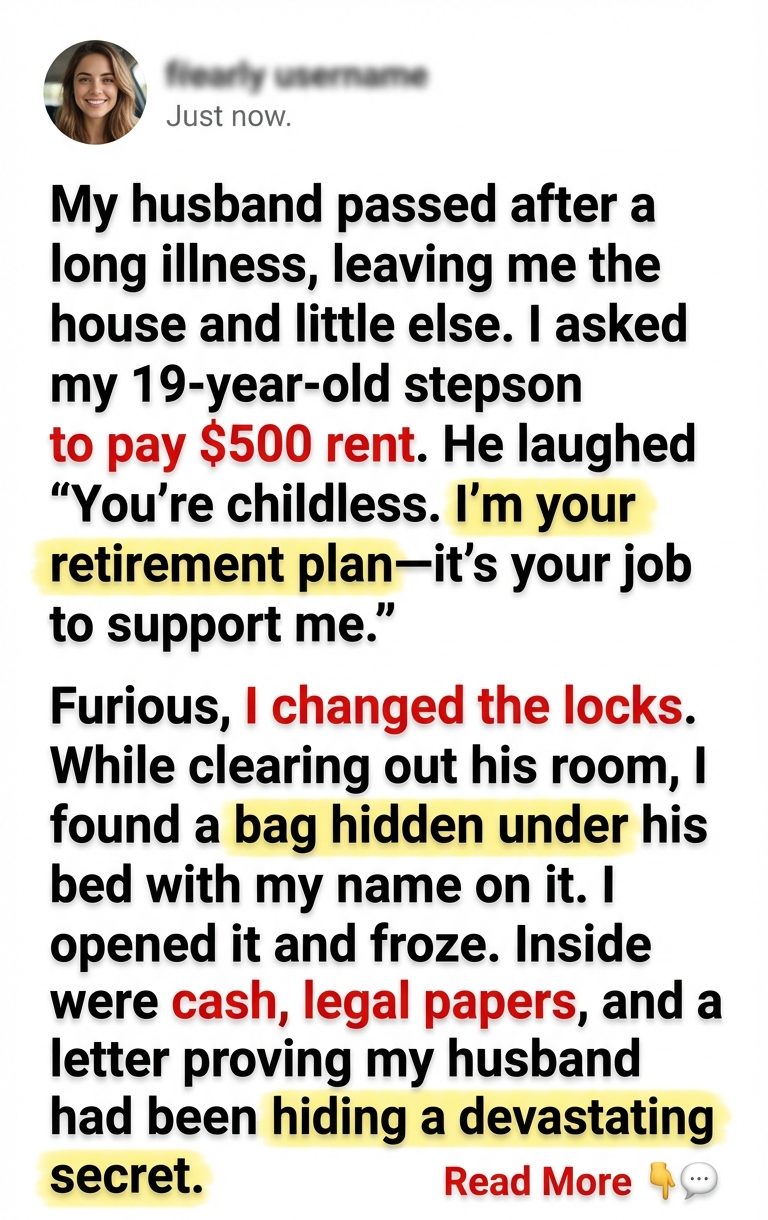
My husband passed after a long illness, leaving me the house and little else. I asked my 19-year-old stepson to pay $500 rent. He laughed and said, “You’re childless. I’m your retirement plan—it’s your job to support me.” Furious, I changed the locks. While clearing out his room, I found a bag hidden under his bed with my name on it. I opened it and froze. Inside were cash, legal papers, and a letter proving my husband had been hiding a devastating secret.
The day my husband died, the house went quiet in a way I had never known before.
Not peaceful quiet. Not the gentle hush that settles over a home at night. This was a hollow, unnatural silence, the kind that presses against your ears until you almost want to turn on the television just to prove the world is still moving. For eleven months, our lives had been built around medication alarms, doctor visits, oxygen tanks, whispered conversations in the kitchen, and the slow, cruel routine of watching illness take what it wanted. Then suddenly, all of it stopped.
And I was alone.
Well, not completely alone.
My stepson, Ryan, still lived in the house. Nineteen years old, tall like his father, sharp-featured, handsome in the careless way some young men are without ever appreciating it. He had his father’s eyes but none of his gentleness. Where my husband had been steady, Ryan was restless. Where my husband listened, Ryan performed. Even grief seemed to become an audience for him.
At the funeral, he cried loudly, accepted sympathy like gifts, and spoke about his dad as if they had shared some deep and sacred bond. I stood beside the casket in a black dress that suddenly felt too tight across the ribs and said almost nothing. I had no strength left for speeches. I had spent nearly a year caring for my husband through every ugly, humiliating stage of sickness, and by the end, words felt small compared to what love had required.
After the casseroles stopped arriving and the condolence messages slowed, real life returned with a vengeance.
Bills sat in neat accusing stacks on the kitchen counter. Insurance covered less than I had hoped. The savings we once had were mostly gone, eaten up by treatments, specialists, prescriptions, and modifications to make the house easier for my husband to navigate in those last months. When the lawyer confirmed that the house was mine, I should have felt relief. Instead, all I could think was that a house can still become a prison when you are too broke to keep up with the cost of living inside it.
I did the math three times.
Property taxes. Utilities. Groceries. Insurance. Maintenance. Medication debt that still lingered from those desperate months when we paid first and worried later. The numbers never softened. I could survive, but barely, and certainly not while carrying another adult who contributed nothing.
So one evening, I asked Ryan to sit down with me at the kitchen table.
He came in wearing headphones around his neck, still smelling faintly of whatever cologne boys his age drown themselves in to feel older. He dropped into the chair across from me and looked irritated before I even spoke. On the table between us sat two mugs of coffee gone lukewarm, a legal pad filled with figures, and a kind of quiet dread I had been carrying for days.
“I need to talk to you about expenses,” I said.
He leaned back. “Okay.”
“I can’t keep paying for everything alone,” I told him carefully. “You’re nineteen now. If you’re going to stay here, I need you to contribute. Five hundred a month. That covers part of the utilities, groceries, and your room. It’s less than you’d pay anywhere else.”
He stared at me for one long second.
Then he laughed.
Not nervous laughter. Not surprise. A real laugh—sharp, mocking, almost delighted.
“You’re serious?” he asked.
“Yes.”
He shook his head slowly, like I was the one being unreasonable. “You’re childless,” he said. “I’m your retirement plan. It’s your job to support me.”
The words landed so hard I actually thought, for one wild second, that I had misheard him.
I just looked at him.
He must have mistaken my silence for weakness, because he kept going.
“Dad would never have charged me rent,” he said. “You should be grateful I’m even here. What else are you going to do? Grow old in this house by yourself? I’m the one who’ll be around when you need help.”
I felt something inside me go cold.
Not hot. Not explosive. Cold.
There are moments when anger burns, and then there are moments when it clarifies. When it strips away hesitation and leaves only truth. I had spent years trying to be patient with Ryan. Years excusing the entitlement, the laziness, the cutting remarks dressed up as jokes. I had told myself he was grieving the divorce his mother dragged him through, then the remarriage, then adolescence, then the chaos of his father’s illness. I had bent and bent and bent, hoping maturity would come if I just gave him enough grace.
But sitting there at that kitchen table, looking at his smirk, I understood something painful.
Grace had become permission.
I stood up so abruptly my chair scraped the tile.
“No,” I said.
Ryan blinked. “No what?”
“No, I am not your retirement plan. No, it is not my job to fund your life while you mock me in my own kitchen. And no, you will not stay here another day if that is how you see me.”
His expression hardened. “You can’t kick me out.”
“I can,” I said. “And I am.”
He laughed again, but there was less confidence in it this time. “Where am I supposed to go?”
“That,” I said, “is the first adult problem you’re going to solve on your own.”
He stormed out, slamming his bedroom door so hard a framed photo in the hallway tilted sideways on the wall. I stood there shaking, one hand pressed flat against the counter, breathing through the ache in my chest. It hurt—not because I doubted my decision, but because some part of me still wished he had chosen differently. Some part of me still wanted him to reveal a hidden softness, an apology, a flicker of decency.
It never came.
The next morning, while he was out, I called a locksmith.
By noon, the front and back locks had been changed. I packed two boxes with his clothes, shoes, gaming equipment, and toiletries and stacked them neatly on the porch. I left a short note taped to the top: You are no longer welcome to live here. Your belongings are outside. Do not enter the house without permission.
When he came back and discovered he was locked out, the shouting started immediately.
He pounded on the front door. Called me every name he could think of. Accused me of theft, cruelty, emotional abuse. Neighbors peeked through curtains. A dog barked somewhere down the block. I stood just inside the foyer, hearing every word through the wood, and felt strangely calm. Eventually the noise stopped. Tires squealed as he tore away from the curb. And then, once again, there was silence.
This time, I welcomed it.
Three days later, I decided to clean out his room.
Part of me wanted to wait. Part of me wanted to avoid the physical evidence of another family fracture. But grief had already taught me a brutal lesson: delay changes nothing. So I opened the bedroom door and stepped inside with a trash bag, cardboard boxes, and the kind of weary determination that only comes after too much loss.
The room looked exactly like Ryan’s life felt—half-finished, self-indulgent, and vaguely hostile. Dirty laundry in piles. Fast-food wrappers shoved into desk drawers. An expensive pair of sneakers placed carefully in the center of the floor while unpaid phone bills and final notices were crumpled under the bed. On the wall hung framed posters his father had bought him years ago when they still had long talks about music and basketball and plans for the future.
I tried not to think about that version of him.
I stripped the bed, opened the dresser, boxed what remained. Then I knelt to check beneath the frame for anything left behind.
That was when I saw the bag.
It was tucked far back in the shadows against the wall, hidden behind a broken storage bin and an old gym duffel. Plain black canvas. Zippered shut. Too deliberate to be random. My first thought was that it held something illegal—cash from bad decisions, maybe, or pills, or stolen electronics. My pulse kicked up as I dragged it into the light.
There was a white envelope taped to the top.
My name was written on it in my husband’s handwriting.
For a second, I could not breathe.
I sat down right there on the carpet, staring at those familiar letters. My husband had been dead for six weeks. In all that time, I had replayed our final days endlessly, wondering what he meant to say when morphine and exhaustion got between his thoughts and his voice. Wondering if there had been things he wanted me to know and no time left to say them. And now here, hidden under his son’s bed, was an answer I had never expected.
My hands shook as I opened the bag.
Inside were bundled stacks of cash, several legal documents in a waterproof folder, and the letter.
I froze.
The cash alone was enough to make my stomach drop. Tens and twenties and fifties, bound with rubber bands, packed tightly in uneven stacks as if gathered over time. I counted twice before I believed it. Nearly thirty thousand dollars.
Underneath it sat property papers, bank records, and copies of documents I had never seen before. One was a loan agreement signed only by my husband. Another was a deed-related filing. Another was a notarized statement dated just four months before his death.
Then I opened the letter.
My love, it began. If you are reading this, then I failed to find the courage to tell you this face-to-face. For that, I am deeply sorry.
By the second line, tears blurred the page.
My husband wrote that years before he got sick—long before the diagnosis, long before the hospital beds and pills and fear—he had made a terrible mistake. Ryan’s mother, his first wife, had not simply “moved on” after the divorce the way he had always claimed. She had blackmailed him for years. Not over infidelity, not over money, but over a secret tied to Ryan himself.
Ryan was not his biological son.
I read that sentence three times.
My husband explained that he discovered the truth when Ryan was seven, after a medical issue required testing that revealed an impossible blood-type mismatch. When he confronted his first wife, she admitted she had known all along. She begged him not to leave, said Ryan loved him, said biology should not matter after all those years. My husband wrote that he had looked at the little boy he had raised and realized it did not matter—not in the way people think. He stayed Ryan’s father in every sense that counted.
But the truth poisoned everything around it.
His ex-wife used it whenever she needed leverage. Money. Favors. Silence. Then, after she died unexpectedly when Ryan was sixteen, my husband intended to tell him. He intended to tell me too. But by then Ryan had become volatile, entitled, and increasingly cruel, and my husband feared that revealing the truth would not heal him. He feared it would weaponize him.
The next pages explained the cash.
For years, my husband had been secretly setting aside money in case Ryan ever turned on me after his death. He had noticed things I had tried to excuse away—the manipulation, the contempt, the way Ryan talked about the house as if it were already his. My husband wrote that he had hidden the bag in Ryan’s room on purpose because, ironically, it was the one place he believed I would never search unless things had gone terribly wrong.
Then came the part that truly shattered me.
The legal papers were proof that the house had once been jointly tied to a lien I knew nothing about. During the early years of our marriage, when finances were tight, my husband had quietly taken a second loan against the property to pay off debts left over from his first marriage and protect Ryan from the fallout of his mother’s financial wreckage. He repaid most of it over time, but not all. The remaining balance, combined with medical debt, was why he had left me the house and “little else.” There had never been savings to inherit. He had spent years bleeding himself financially to contain a past he was too ashamed to explain.
I pressed the letter to my mouth and sobbed.
Not just because of the secret. Not just because of the betrayal of being kept in the dark. But because all at once, so many things I had never understood snapped into focus. The unexplained withdrawals. The tension in my husband’s shoulders when Ryan demanded money. The quiet arguments I overheard but never fully heard. The way my husband had looked at me, in those last weeks, with a sorrow that felt bigger than illness alone.
He knew.
He had known Ryan might come after me with entitlement sharpened into obligation. He had known the house was less secure than I believed. He had known he was leaving me with a burden disguised as a gift. And from whatever strength he had left, he had tried to leave me protection.
At the end of the letter, he wrote:
You were the best thing that ever happened to me. I should have trusted you with the truth sooner. Use this money to protect yourself. Use these papers to understand what I could not say aloud. And whatever Ryan tells you, remember this: love made me raise him, but guilt made me hide him. Do not let my guilt become your burden.
I sat on the floor for a very long time after that.
Evening settled across the room, dimming the corners one by one. Somewhere outside, a car passed slowly down the street. The house creaked softly, the way old houses do when temperatures shift. And I thought about the man I had loved. About how good people can still make cowardly choices. About how love and secrecy can tangle together until they become impossible to separate cleanly.
My husband had not lied because he did not love me.
He lied because he was afraid that once spoken aloud, the truth would destroy what little peace remained. He was wrong, of course. Secrets do not prevent pain. They only postpone it and hand it a sharper blade.
The next week, I took the documents to an attorney.
What followed was ugly, but clarifying. The papers confirmed the remaining lien and outlined exactly what needed to be done to secure the property. The cash gave me breathing room for the first time in months. Enough to catch up on utilities, make the next tax payment, and begin untangling the debt without losing the house. The attorney also confirmed something else: Ryan had no automatic claim to the home while I was alive, no matter how loudly he insisted otherwise.
When Ryan eventually returned, demanding to know whether I had “found anything important” in his room, I finally understood the full shape of his confidence.
He knew about the bag.
Maybe not all of it, but enough.
He stood on the porch with his jaw set and his hands shoved into his pockets, trying to look older than nineteen and succeeding only in looking mean. “Dad promised he’d always take care of me,” he said.
I opened the door just enough to face him. “Your father took care of you your entire life.”
“You don’t get it,” he snapped. “This house should be mine someday.”
“Someday is not today.”
His eyes narrowed. “You think you won.”
I almost laughed, but there was nothing funny in any of this.
“No,” I said quietly. “I think your father lost years of peace trying to protect everyone from the truth. And I think I’m done paying for that.”
For the first time since I had known him, Ryan looked uncertain.
Not remorseful. Not soft. But shaken.
Maybe some part of him had always sensed the secret at the center of his life. Maybe entitlement had been the armor built around that wound. Maybe cruelty was easier than asking whether he had ever truly belonged. I do not excuse him. Pain does not grant permission to become monstrous. But I finally saw that his arrogance had roots deeper than laziness. It had been fed by instability, by lies, by a father too guilty to set boundaries and too afraid to tell the truth.
Still, understanding someone is not the same as surrendering to them.
I told him I would pay for one month of a studio apartment and the deposit if he agreed to start over somewhere else, with counseling and conditions. No access to my finances. No living in the house. No more threats disguised as family duty. He stared at me for so long I thought he might spit in my face.
Instead, he said, “You always liked pretending you were my mother.”
The words stung more than I expected.
But I held the doorframe, lifted my chin, and answered honestly. “No. I liked hoping you might one day let me care about you.”
He said nothing after that.
Some stories end with dramatic revenge, public apologies, courtroom speeches, or hidden fortunes big enough to erase every hurt that came before. Mine did not. The secret in that bag did not make me rich. It did not bring my husband back. It did not magically turn a broken boy into a decent man.
What it did was something smaller and, in its own way, more powerful.
It told me the truth.
It showed me that the life I thought I understood had cracks running through it long before illness arrived. It revealed that my husband’s silences had weight, history, consequence. It gave me the means to protect the one thing he had managed to leave me—the house—and the wisdom not to confuse guilt with love ever again.
I still live here.
The windows need repainting. The porch leans a little on the left side. Some nights the loneliness still hits hardest around dusk, when shadows lengthen across the living room and I half expect to hear my husband cough from the hallway. But the house is mine in a way it never truly was before. Not because paper says so. Because now I understand the cost of keeping it. The truth of it. The burden and the blessing both.
Sometimes I think about that bag under Ryan’s bed and how close I came to missing it.
How many lives are built on things hidden just out of sight? Under beds. Inside walls. In locked drawers. In the pause before someone says, There’s something I should have told you years ago.
My husband left me the house and little else.
Or so I thought.
What he really left me was a final, imperfect act of love: enough money to survive, enough truth to wake up, and enough proof to stop sacrificing myself at the altar of other people’s secrets.
And that, I have learned, is worth more than inheritance.