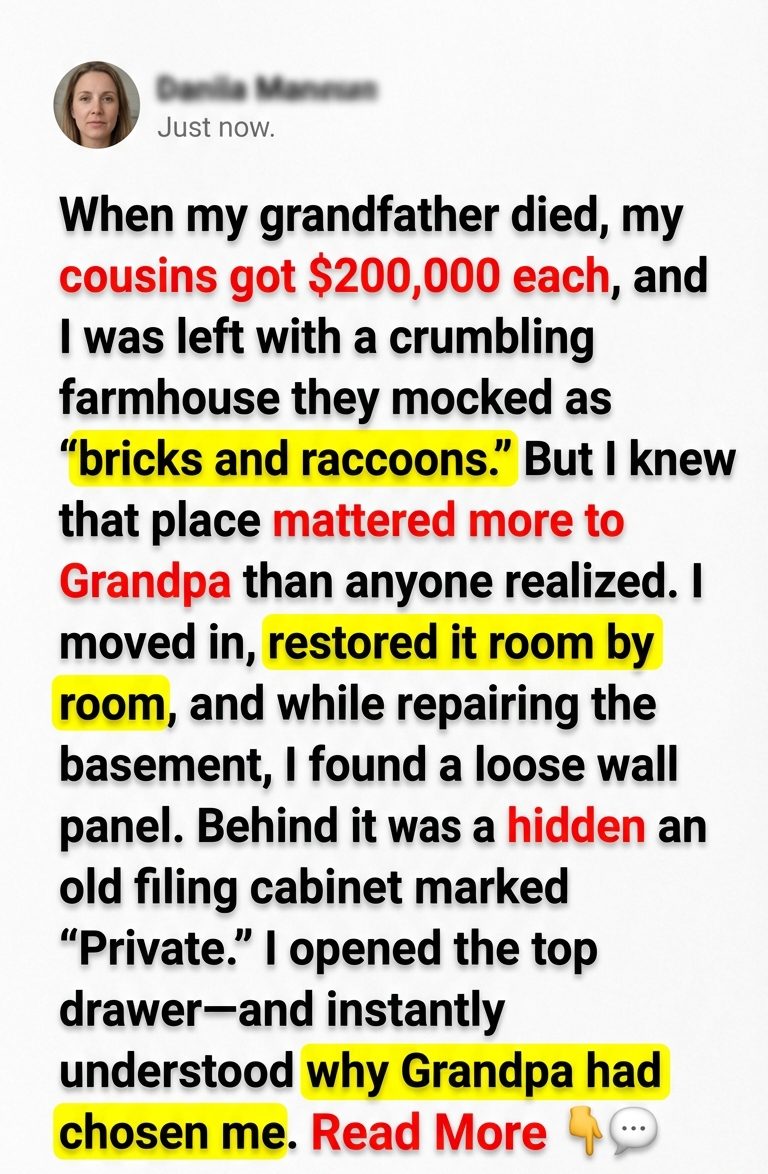
When my grandfather died, my cousins got $200,000 each, and I was left with a crumbling farmhouse they mocked as “bricks and raccoons.” But I knew that place mattered more to Grandpa than anyone realized. I moved in, restored it room by room, and while repairing the basement, I found a loose wall panel. Behind it was a hidden room and an old filing cabinet marked “Private.” I opened the top drawer—and instantly understood why Grandpa had chosen me.
The day the lawyer read the will, the air in the room felt heavy with perfume, polished wood, and greed. My cousins sat across from me in black designer clothes, dabbing at fake tears that disappeared the second the numbers were mentioned. When they heard they were each getting $200,000 in cash, they lit up like children on Christmas morning. Then the lawyer adjusted his glasses, cleared his throat, and announced that Grandpa had left me the farmhouse on Miller’s Creek Road.
For one long second, nobody said anything.
Then Brandon laughed first. A loud, cruel, barking kind of laugh. Melissa joined in, covering her mouth as if she were trying to be polite, which only made it worse. “The farmhouse?” she repeated. “You mean that collapsing shack with the busted porch and moldy roof?” Brandon shook his head and smirked. “Well, somebody had to get the garbage.”
I forced a smile, but deep down, their words stung.
The farmhouse was old, yes. Falling apart, yes. But it had been the one place in the world where I had always felt seen. While my cousins spent holidays glued to their phones or complaining about being bored, I followed Grandpa through the orchard, the tool shed, the creek path behind the barn. He taught me how to patch screen doors, sharpen a blade, grow tomatoes, and listen more than I spoke. That house held his fingerprints in every corner.
So while Brandon and Melissa celebrated their money by posting beach photos and shopping sprees online, I packed my things into my aging hatchback and drove out to Miller’s Creek Road. The farmhouse stood exactly as I remembered and somehow worse. The front steps sagged. Paint peeled in long strips from the siding. One upstairs window had been boarded over. Tall weeds swallowed most of the front walk, and something small and gray darted under the porch the moment I parked.
“Bricks and raccoons,” I muttered to myself.
Maybe they were right. But the second I stepped out and heard the wind moving through the trees, I felt something settle inside me. This place wasn’t trash. It was a challenge. And maybe, just maybe, it was also a message.
The first month was brutal.
The roof leaked in three places. The kitchen sink backed up every time I ran the water longer than a minute. The wallpaper in the hallway peeled back to reveal water damage, and the basement smelled like wet earth and rust. I slept on a cot in the one bedroom I could make halfway livable and kept a flashlight beside me because the wiring was unreliable. More than once, I sat on the porch steps after dark, exhausted, wondering if my cousins had been right to laugh.
But every time doubt crept in, I remembered Grandpa’s voice. He had always said that worthwhile things rarely looked worthwhile at first. “Most treasure,” he used to tell me, “comes disguised as work.”
So I kept going.
I stripped wallpaper. Patched plaster. Sanded floors until my arms trembled. I found old mason jars behind cabinets, a collection of rusted keys in the mudroom drawer, and a faded photograph tucked into the frame of the bathroom mirror. In it, Grandpa stood beside the farmhouse as a young man, shoulder to shoulder with a woman I didn’t recognize. On the back, in his neat handwriting, were the words: The beginning of everything.
That photo lingered in my mind.
By the third month, the house had started to change. Light came through the windows instead of grime. The kitchen smelled like lemon cleaner instead of mildew. I had repaired the porch railing, replaced cracked tiles, and cleared enough of the yard to uncover the stone path leading to the old barn. Neighbors began stopping by. Some brought pies, some brought stories. They all seemed surprised that someone had finally come back to stay.
An elderly woman named Ruth, who had known Grandpa most of her life, stood in my kitchen one afternoon holding a basket of peaches. She looked around slowly, her eyes soft. “He always hoped it would be you,” she said.
I turned to her. “What do you mean?”
She hesitated, then smiled in a private sort of way. “Your grandfather believed some people see land for what it can sell for. Others see it for what it’s worth.”
That sentence stayed with me.
Late in the fall, I started working in the basement. It was the last major disaster zone in the house—cold, damp, dim, and crowded with decades of junk. Broken chairs, canning equipment, warped shelves, cracked picture frames, boxes of receipts and yellowing newspapers. I worked section by section, sweeping out dust, hauling trash, sorting what could be saved.
That was when I noticed the wall.
It was at the far end of the basement behind a leaning shelf of paint cans and old tools. At first glance it looked like ordinary wood paneling, dark with age and water stains. But one piece didn’t sit flush with the others. It jutted out just slightly, enough to catch my eye. When I pressed my fingers against it, the board shifted.
My heartbeat quickened.
I set down the flashlight, braced both hands against the panel, and pushed. It resisted for a moment, then gave way with a dry groan, swinging inward and releasing a gust of stale, trapped air. Behind it was a narrow doorway I never knew existed.
I stood frozen.
There, hidden behind the basement wall, was a small room no larger than a walk-in closet. No windows. Concrete floor. One naked bulb hanging from the ceiling, surprisingly still intact. And in the center of the room sat an old metal filing cabinet, dull green and dust-coated, like it had been waiting for someone to find it.
Across the top drawer, in faded black marker, was one word:
Private
My hands trembled as I stepped inside.
There are moments in life when your instincts know something before your mind catches up. I felt that then—deep in my chest, like the room itself carried a pulse. This wasn’t random storage. This was deliberate. Hidden. Protected. I reached for the cabinet handle, half expecting it to be locked, but the drawer slid open on the first try with a metallic screech that echoed around the tiny room.
Inside were folders.
Dozens of them, neatly labeled in Grandpa’s handwriting. Property records. Survey maps. Old correspondence. Bank documents. Legal notices. And then, beneath the first stack, tied with a faded blue ribbon, a thick bundle of letters addressed to my grandfather from people whose names I didn’t know.
I carried the first folder into the light and sat on an overturned crate.
What I read made the entire world tilt.
The farmhouse property was far larger than anyone in the family believed. Hidden in the paperwork were original land surveys showing that the farmhouse wasn’t just attached to the few ragged acres everyone talked about. The legal boundaries extended behind the orchard, past the creek, and into a wide stretch of undeveloped land that had never been updated in county records after a decades-old clerical error. Nearly forty extra acres.
Forty.
I kept reading, my breathing shallow.
The letters explained the rest. Years earlier, a development company had tried to pressure Grandpa into selling, believing he either didn’t know the land’s full value or was too old to fight them. But he knew. He had documented everything, appealed the record discrepancies, and gathered proof. He never finished the process publicly. Instead, he hid the evidence. He must have known that once he was gone, the wrong people would sell the farmhouse in a week if they understood what sat beneath it.
And then I found the final envelope.
It had my name on it.
Not typed. Not formal. Just written in his familiar hand: For my granddaughter, if she is the one who stays.
I stared at it for a long time before opening it.
Inside was a letter, only two pages, but by the time I finished reading it, I was crying so hard I could barely see. Grandpa wrote that he had watched the family for years and understood exactly what money would do to most of them. He said cash disappears fastest in the hands of people who never learned to build anything. He said the farmhouse was never a punishment. It was a test of patience, heart, and vision.
Then came the line that broke me: I did not leave you what was easiest. I left you what was greatest.
According to his letter, the extra acreage contained not only timber and fertile land but also mineral rights he had quietly preserved. He believed the property, if handled wisely, could support generations. But only if it remained in the hands of someone who loved it first and valued profit second. Someone who would restore instead of strip. Protect instead of flip.
Someone who would stay.
For a long time, I sat in that hidden room with the letter in my lap, listening to the hum of the old bulb overhead. Every splinter I had sanded, every leak I had patched, every lonely dinner I had eaten in that half-finished kitchen suddenly felt like part of something much bigger. Grandpa had known exactly what he was doing. He hadn’t chosen me because he pitied me. He had chosen me because he trusted me.
News traveled fast once I hired a lawyer and had the records verified.
Brandon called first, trying to sound casual. “So, I heard the property might be worth more than people thought.”
Melissa called the next day, her voice sweet in the artificial way people use when they want something. “Honestly, we always knew Grandpa was sentimental about you.”
I let both of them talk.
Then I told them the same thing: Grandpa made his choice, and I intended to honor it.
They were furious, of course. Brandon hinted that maybe the estate should be reconsidered. Melissa suggested it was “unfair” that I should benefit from information nobody else had. But fairness had never been the point. Grandpa had seen what each of us valued, and he responded accordingly. They got money. I got responsibility. And in the end, responsibility turned out to be the greater gift.
Spring came early the following year.
Wildflowers returned along the creek bank. The orchard, which I had nearly given up on, bloomed again in pale pink clouds. I repaired the barn roof, planted vegetables in the back garden, and worked with a conservation advisor to protect part of the land from developers. I converted one room downstairs into a small study where I kept Grandpa’s letters, maps, and photographs. The hidden room in the basement stayed exactly as I found it, except cleaner. I wanted to preserve it—not as a secret anymore, but as proof.
Proof that not all inheritances glitter at first glance.
Some arrive disguised as work boots, peeling paint, and years of doubt. Some look like burdens until love and patience reveal what they really are. My cousins spent their inheritance quickly. New cars, luxury trips, bad investments. Within two years, most of it was gone. What Grandpa gave me only grew.
Sometimes, on quiet evenings, I sit on the rebuilt porch and look across the land as the sun lowers behind the trees. The farmhouse no longer looks broken. It looks alive. The windows glow warm at dusk. The porch boards are strong beneath my feet. The weeds are gone, replaced by rows of lavender and rosemary. The place everyone mocked as “bricks and raccoons” became the center of my life.
And every now and then, I think back to that room at the lawyer’s office. To Brandon’s laughter. To Melissa’s smirk. To the pity in their eyes when they thought I had been cheated.
They were wrong.
Grandpa didn’t leave me less.
He left me the truth buried beneath appearances. He left me land, history, trust, and a future no envelope of cash could ever buy. Most of all, he left me the chance to prove that the things worth having are often the things other people are foolish enough to overlook.
So yes, my cousins got $200,000 each.
And I got the farmhouse.
I got the hidden room, the letter, the land, and the reason behind it all.
I got the real inheritance.
If you want, I can also turn this into an even more cinematic version with a stronger hook and more emotional suspense.