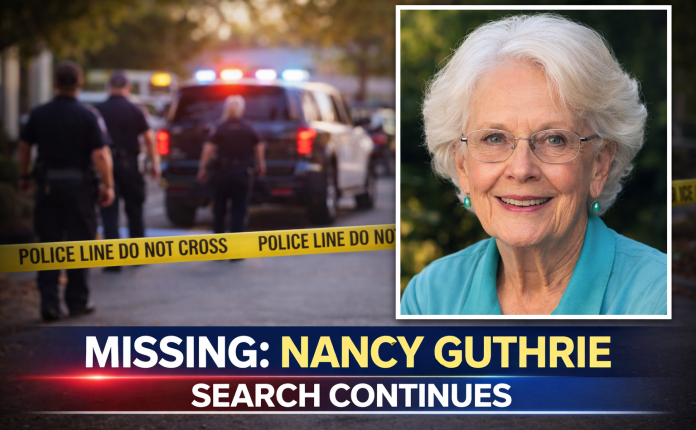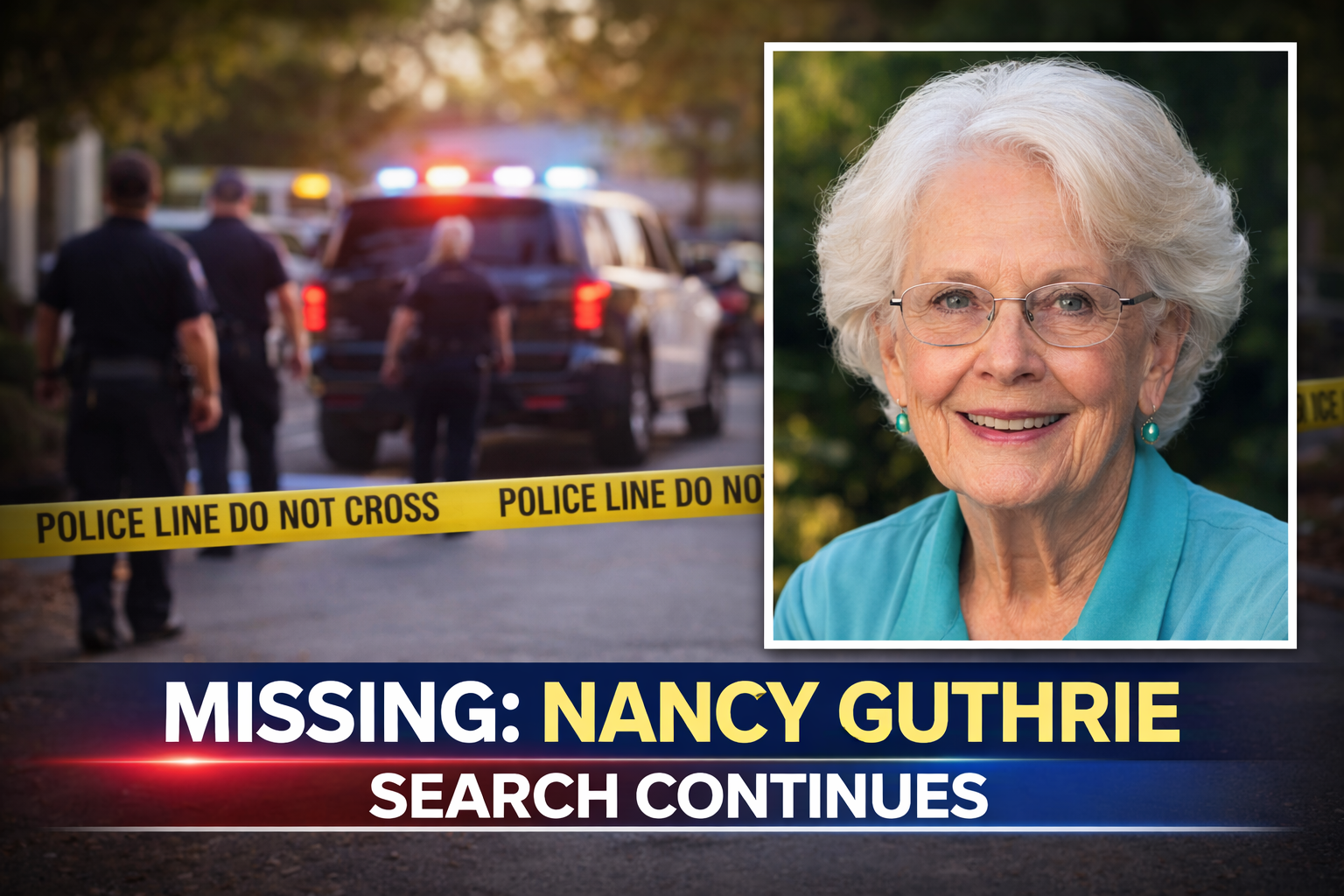
The disappearance of Nancy Guthrie, an 84-year-old Arizona woman reported missing from her home, continues to draw public concern as investigators work to understand what happened during the final hours she was known to be at her residence.
What began as a missing-person case has steadily developed into a broader investigation shaped by unanswered questions, limited confirmed details, and growing public attention. Authorities have made clear that the case remains active, and while certain pieces of information have emerged, much of the evidence has not yet been fully explained in public.
That uncertainty has kept Nancy Guthrie’s case in the spotlight.
Family members first raised the alarm after Guthrie could not be located at her home, prompting law enforcement to respond and begin the difficult process of reconstructing her last known movements. According to early reports, she was officially reported missing on February 1, and investigators believe the events surrounding her disappearance likely unfolded during late-night or early-morning hours.
Those early hours are now central to the case.
As is standard in investigations involving a missing person, officers began by securing the scene, examining the home and surrounding area, documenting anything potentially relevant, and interviewing relatives, neighbors, and others who may have had information about Guthrie’s condition, routine, or recent activity. These initial steps are often crucial because they help establish the foundation for every phase that follows.
In cases like this, timing matters.
Investigators typically focus first on the last confirmed point at which the missing person was known to be safe, then work outward from that moment. Every detail becomes important: the physical condition of the home, signs of movement, any unusual disturbances, the statements of witnesses, and even the absence of expected activity. The goal is not simply to gather information, but to build a reliable timeline that can withstand careful scrutiny.
One of the most closely watched details in Guthrie’s case is the report that small traces of blood were found near her home and were confirmed to belong to her. That fact alone has raised serious concern, but authorities have not publicly stated how the blood appeared, how much was found, or whether it directly explains what happened to her.
That distinction is important.
Forensic evidence can be significant, but it rarely tells a complete story on its own. Blood evidence, in particular, must be interpreted with extreme caution. Specialists often examine the amount, location, shape, and distribution of blood traces in order to determine whether they may reflect injury, movement, transfer, or another event entirely. Even then, conclusions are often tentative until laboratory testing, scene reconstruction, and broader investigative context are taken into account.
This is why officials are often careful with public statements in ongoing cases.
Releasing information too early can create confusion, compromise investigative strategy, or encourage speculation that later proves misleading. In high-profile disappearances, law enforcement often balances two competing needs: informing the public enough to generate useful tips while withholding certain specifics that may be critical to confirming the truth later.
As public interest in the case has grown, experts from several fields have weighed in — not to speculate about Guthrie’s specific disappearance, but to explain the kinds of factors investigators may consider in cases involving older adults.
One topic that has received attention is sleep inertia, a general medical phenomenon describing the grogginess, confusion, and slowed reaction that can occur immediately after someone wakes suddenly. During this brief period, a person may not think clearly, respond quickly, or fully understand what is happening around them. Sleep specialists note that older adults can sometimes experience these effects differently because aging often changes normal sleep patterns, including the depth of sleep, frequency of waking, and overall sleep-wake rhythm.
Still, experts have stressed that these are only general scientific observations.
They do not prove what happened to Nancy Guthrie, nor do they establish that she was awakened suddenly, disoriented, or responding to some disturbance. They simply help explain one of several possible human factors investigators may consider when analyzing a case rooted in overnight or early-morning events.
Another detail that has surfaced in reports is that Guthrie had a cardiac pacemaker. That has led to discussion about whether a medical episode could have played some role in her disappearance. But once again, specialists caution against drawing conclusions from limited information. A pacemaker is a medical device used to help regulate heart rhythm, and its presence alone does not confirm a health emergency, incapacity, or any direct connection to a missing-person event.
Without verified medical findings, that detail remains only part of the broader background.
This careful separation between confirmed facts and unanswered questions is what defines much of the case right now. Authorities appear to be following a methodical process rather than rushing toward a public theory. That approach may feel slow from the outside, especially to those following the case closely, but it is common in investigations where physical evidence, personal circumstances, and timelines all need to be reconciled before reliable conclusions can be made.
Forensic review remains one of the most important elements moving forward.
In cases involving blood evidence or possible signs of a struggle, specialists often examine not just what is visible at the scene, but what may be revealed through chemical enhancement, laboratory analysis, and microscopic review. Surfaces, environmental conditions, and even the way blood dries or transfers can affect interpretation. What seems dramatic at first glance may turn out to be limited in significance — or, in other cases, a small trace may become central once analyzed alongside other evidence.
Investigators also generally expand beyond the immediate physical scene.
Witness interviews play a major role in missing-person cases, especially when the missing individual is older and may have had regular habits, known routines, or recurring contacts. Neighbors may have seen or heard something unusual. Family members may provide information about recent conversations, behavior, health, or concerns. Even small details that seem insignificant on their own can become meaningful when placed into a larger timeline.
Digital evidence is another major component of modern investigations.
Depending on the circumstances, authorities may review surveillance footage, phone records, home security systems, location data, or other electronically stored information to better understand movement and activity around the time of the disappearance. In some cases, these records help eliminate possibilities. In others, they reveal patterns or gaps that redirect the entire course of the investigation.
That broader, evidence-driven approach is especially important when public attention is intense.
Cases involving elderly missing persons often generate strong emotional responses because of the urgency and vulnerability involved. Communities tend to rally quickly, volunteers become eager to help, and online discussion can spread rapidly. While public engagement can be helpful, authorities also repeatedly warn that rumors, assumptions, and unsupported claims can complicate an investigation and place added strain on loved ones.
Public cooperation, however, remains valuable when it is responsible and fact-based.
Investigators often ask residents to review security footage, report unusual activity, and come forward with anything that may help establish a more complete picture of the missing person’s final known hours. Sometimes a tip that appears minor at first can help confirm a timeline, identify a vehicle, clarify movement in a neighborhood, or eliminate false leads.
In Nancy Guthrie’s case, the concern extends beyond one family.
Her disappearance has resonated more broadly because it raises questions that many people find deeply unsettling: how someone can vanish during the quiet hours of the night, what physical evidence can and cannot reveal, and how long it can take before a fragmented set of clues begins to form a coherent narrative. That tension — between urgency and uncertainty — is part of what continues to keep this case in public view.
For now, the investigation appears to remain focused on patience, evidence, and verification.
Authorities have not publicly provided a final account of what happened, and there is still no confirmed public explanation that resolves the central questions surrounding Guthrie’s disappearance. Instead, the case continues to move through the slow but necessary stages of evidence review, witness analysis, and follow-up investigation.
That means the most important developments may not always be immediate or dramatic.
Sometimes progress in a case like this comes not through a single breakthrough, but through the gradual accumulation of verified facts: one timeline clarified, one witness re-interviewed, one piece of forensic evidence better understood. Investigations often advance quietly before any major public update is released.
Until then, the disappearance of Nancy Guthrie remains an open and troubling case.
The search for answers continues, driven by the same goal that defines all serious missing-person investigations: to determine what happened, follow the evidence wherever it leads, and provide clarity for the family and community left waiting for the truth.
At this stage, that truth has not yet been publicly established.
But the case remains active, the questions remain urgent, and investigators continue the work of piecing together the events surrounding the disappearance of Nancy Guthrie — one fact at a time.