After my mother-in-law passed away, I went to the reading of her will—only to find my husband sitting there with his mistress… and a newborn in her arms. They didn’t even look embarrassed. Like they’d been waiting for me to crumble. But when the lawyer opened the envelope and began reading her final words, the room went dead quiet—and my husband’s face drained of color.
For three days after Eleanor Whitmore’s funeral, I barely slept.
Grief moved through me like cold water, settling into my bones no matter how many blankets I pulled over myself. I would close my eyes and see her hands folded in the church pew, the way she used to tap her fingers softly when she was thinking, the faint smile she wore whenever she caught me biting my lip during an argument with her son. My husband, Daniel, had always said his mother was difficult. Sharp. Demanding. Impossible to please.
But to me, Eleanor had always been the only person in that family who looked directly at me and seemed to see more than what I could do for them.
So when her attorney called and said the family would be gathering for the reading of her will on Monday morning, I went because it felt like the last thing I could still do for her.
I told myself that was the only reason.
Not because Daniel had barely been home for six months.
Not because he had become a stranger in our bed long before he started sleeping in other places.
Not because some wounded part of me still wanted one final explanation for why my marriage had been quietly rotting while I smiled through dinners, holidays, and carefully staged photos.
The law office sat on the twelfth floor of a gray building downtown, all polished glass and muted carpets that swallowed the sound of footsteps. I remember standing outside the conference room door for a moment longer than necessary, smoothing the wrinkles from my black dress and adjusting the simple pearl earrings Eleanor had given me on my wedding day.
“Real pearls,” she had whispered then, fastening them into my ears herself. “Because if you’re marrying into this family, you’ll need at least one thing that’s genuine.”
At the time, I had laughed.
Standing outside that conference room, I realized she might not have been joking.
When I opened the door, every bit of air seemed to vanish from the room.
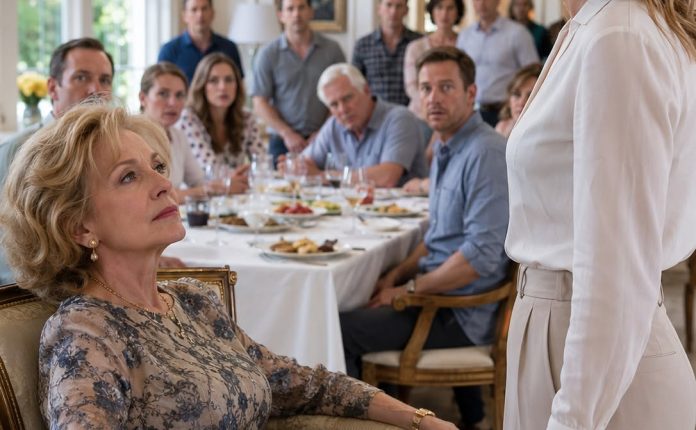
Daniel was already seated at the far end of the long mahogany table, one arm draped possessively across the back of the chair beside him. In that chair sat a woman I had never met but recognized instantly for what she was. She was young, elegant in a too-soft cream blouse, with glossy dark hair falling over one shoulder and the unmistakable posture of someone who had been privately reassured she belonged. In her arms, wrapped in a pale blue blanket, was a newborn baby.
For one surreal second, my brain refused to understand what my eyes were showing me.
Then the baby stirred, making a small sleepy sound, and the woman looked down with a smile that was far too intimate, far too practiced.
Daniel lifted his eyes to mine.
Not guilty. Not ashamed. Not even nervous.
Calm.
Almost relieved.
Like a man who had grown tired of managing lies and decided the truth, however cruel, would now save him effort.
I stayed standing by the door, my hand still wrapped around the brass handle, because if I let go I was afraid I might fall.
The woman offered me a cool little nod. Daniel did not rise. He didn’t stammer or rush into excuses. He just looked at me as if this were unfortunate timing, an awkward administrative detail that would sort itself out once emotions stopped being inconvenient.
“Clara,” he said, in that maddeningly level voice I had once mistaken for steadiness. “You made it.”
You made it.
Not I’m sorry.
Not we need to talk.
Not please sit down.
I think that was the moment something inside me went very still.
Not broken. Not yet. Just still.
I took the nearest empty chair and sat without speaking. My pulse was thudding so loudly I could hear it in my ears. Across the table, Daniel’s younger sister, Vanessa, avoided my eyes and stared at her folded hands. Beside her sat her husband, looking like a man who had accidentally walked into a war zone. The attorney, Mr. Hale, cleared his throat softly, shuffled the papers in front of him, and gave Daniel one hard look that suggested whatever was happening here had not been approved in advance.
“Shall we begin?” he said.
No one answered.
The baby made another soft sound, and the woman—mistress, because there was no point using gentler words—adjusted the blanket with a tenderness that sliced through me more deeply than if she had smirked.
I kept staring at Daniel.
Ten years.
Ten years of marriage.
Ten years of holidays with his family, of balancing checkbooks and hosting dinners and covering for his absences with explanations that got thinner every season. Ten years of telling myself that his distance was stress, that his temper was pressure, that his lack of affection was temporary. Ten years of hearing, from Eleanor alone, “You are far more patient than my son deserves.”
I had thought it was ordinary mother-son criticism.
Now I wondered how much she had known.
Mr. Hale adjusted his glasses and began with the formalities. Eleanor Whitmore, being of sound mind, making her final wishes known, revoking prior versions. The words floated past me at first, legal and dry and incapable of competing with the image of that infant in another woman’s arms.
Then Mr. Hale paused.
“There is also a personal statement Mrs. Whitmore requested be read aloud before the asset distribution.”
That got everyone’s attention.
Daniel shifted in his seat for the first time since I had arrived. The mistress glanced at him, then back at the attorney. Vanessa finally looked up.
Mr. Hale opened a sealed envelope separate from the will itself. The paper crackled in the silence.
He began to read.
“If you are in this room, then I am gone, and perhaps that is the only reason some of you found the courage to sit together in daylight.”
No one moved.
Even the baby seemed to settle.
Mr. Hale continued, his voice measured but carrying every syllable with brutal clarity.
“To my son, Daniel: if you have brought that woman into this meeting, then you are even more arrogant than I feared. If you have also brought the child, then you intend cruelty as theater, which confirms what I spent years refusing to say aloud: you have grown into a weak man who mistakes selfishness for strength.”
The room changed temperature.
Daniel’s face emptied.
Not red. Not angry.
White.
The mistress straightened sharply, as though she had been slapped by a ghost.
I felt my fingers tighten around the arms of the chair.
Mr. Hale went on.
“To the young woman sitting beside him, I will not insult you by pretending ignorance. I know who you are. I know when this began. I know how long my daughter-in-law has been lied to under the roof of a marriage she honored far beyond reason.”
Daniel leaned forward. “This is inappropriate.”
Mr. Hale did not even look up. “Mrs. Whitmore was explicit that the statement be read in full.”
Vanessa covered her mouth with one hand.
I couldn’t breathe.
Eleanor had known.
Not just suspected.
Known.
The attorney read on.
“Clara, if you are present, then I suspect you have just learned the truth in the most humiliating way possible. For that, I am sorry—not because of what my son has done, but because I did not act sooner. I believed, foolishly, that shame might yet reform him. It did not. Shame requires a conscience.”
The words hit me harder than any blow could have.
I had spent so many months feeling foolish, needy, suspicious, dramatic. And now here was Eleanor, from beyond the grave, naming what I had not been allowed to say without sounding bitter.
Mr. Hale lifted the next page.
“I began revising this will eighteen months ago, shortly after I confirmed Daniel was maintaining a second household while allowing his wife to continue managing the first. I hired investigators. I reviewed bank records. I saw enough. This letter is not written in anger. It is written in clarity.”
Daniel stood so quickly his chair rolled back with a violent scrape.
“That’s enough,” he snapped. “This is a private family matter.”
Mr. Hale finally looked up, cool and unimpressed. “Sit down, Daniel.”
What surprised me was that Daniel did.
Because for the first time in years, he had lost control of the room.
And everyone knew it.
The mistress shifted the baby higher against her chest, but some of her polish had evaporated now. Her jaw was tight. Her eyes flickered once toward the door, measuring escape.
Mr. Hale continued.
“To my children: integrity is not proven by what you claim in public. It is proven by what you do when betrayal would be easy and profitable. Daniel has failed that test in every imaginable way.”
Vanessa began crying silently.
I looked at her and suddenly understood something I had missed for years: this wasn’t news to her either. Maybe not every detail. Maybe not the baby. But enough. Enough to explain the awkward silences at Christmas. Enough to explain why she had stopped inviting us to dinner unless her mother insisted. Enough to explain the long hugs Eleanor used to give me in the kitchen after everyone else had gone outside.
Memory rearranged itself in real time.
All the signs I had swallowed.
All the moments I had filed under stress.
All the glances that now looked like pity.
Mr. Hale turned the page.
“Now to my estate. I leave my jewelry to Vanessa, except for the pearl earrings and sapphire bracelet already in Clara’s possession, which were always intended to remain with the one woman in this family who understood loyalty.”
My throat tightened.
The pearl earrings were in my ears.
Instinctively, I touched one.
Daniel noticed.
His expression shifted—first anger, then calculation, then something uglier when he realized the room had tilted beyond his recovery.
“The lake house,” Mr. Hale said, “the majority of my investment portfolio, and controlling shares in Whitmore Holdings shall pass not to my son, but into a trust administered solely for the benefit of Clara Bennett Whitmore, with full authority transferring to her immediately upon my death.”
No one breathed.
I heard Vanessa whisper, “Oh my God.”
Daniel did not speak at first, which was the clearest sign of shock I had ever witnessed from him.
Then, hoarse and disbelieving: “What?”
Mr. Hale reread the clause, slower this time, every word landing like a hammer.
The lake house. The investments. The controlling shares.
Not Daniel.
Me.
The woman he had apparently expected to humiliate in a conference room while sitting beside his mistress and their newborn child.
The woman he assumed would crumble.
I did not crumble.
I sat perfectly still because my body seemed incapable of movement. Eleanor’s final act was unfolding like a locked door swinging open in a burning house.
Daniel pushed back from the table. “She can’t do that.”
“She did,” Mr. Hale replied.
“I’m her son.”
“And according to the documents before me,” said the attorney, “you were also repeatedly using company funds to support undisclosed personal expenses while representing yourself as the future executor of her business.”
Silence.
Then a different silence.
One with teeth.
The mistress turned slowly toward Daniel.
So that was new information to her.
Interesting.
Mr. Hale folded his hands over the papers. “Mrs. Whitmore included an addendum. If Daniel contests the will, all remaining personal bequests assigned to him are to be forfeited and donated to the Ashford Women’s Legal Recovery Fund.”
For the first time, I almost laughed.
It was so exquisitely Eleanor.
She hadn’t just disinherited him.
She had cornered him with consequences.
Daniel’s mouth opened, then closed. He looked at me then—not as a wife, not even as an enemy, but as someone he had fatally underestimated.
“Clara,” he said, lowering his voice into something he probably thought still sounded persuasive. “You know this is ridiculous. My mother wasn’t well. We can work this out.”
There it was.
The pivot.
From shock to charm. From exposure to negotiation.
That old familiar instinct in him to press on the place where women are taught to soften.
But the room had changed, and so had I.
I looked at him across the polished table, at the man I had loved with embarrassing sincerity, the man who had let me walk into that room blind while he sat beside another woman holding evidence of his second life, and I felt something I had never expected to feel in that moment.
Not devastation.
Not even rage.
Clarity.
The kind Eleanor had written about.
Mr. Hale resumed reading. There were charitable allocations, a scholarship fund, specific heirlooms, and formal instructions regarding the company transition. Eleanor had arranged for an interim board review. Daniel would retain a salary for six months, then undergo audit-based review for continued employment. She hadn’t burned the empire down.
She had simply removed his assumption that it was his by right.
By the time the reading ended, the room looked like the aftermath of a storm.
Vanessa had mascara streaks down her cheeks. Her husband was staring fixedly at the table as if any movement might trigger an explosion. The mistress looked furious, but not at me. At Daniel. At the man whose version of events had apparently failed to include the possibility that his dead mother had outmaneuvered him.
And Daniel—
Daniel looked exactly like a man who had stepped confidently onto a stage only to discover the script had been rewritten without him.
Mr. Hale closed the folder. “That concludes the reading.”
No one stood immediately.
I was the first.
My legs felt surprisingly steady.
Daniel rose too, fast, and moved around the table. “Clara, wait.”
The mistress said nothing, but I felt her watching us with the hard stare of someone trying to calculate whether she had attached herself to the wrong future.
I picked up my handbag.
“Clara,” Daniel repeated, quieter now. “Don’t do this here.”
I turned to him.
The absurdity of that sentence almost took my breath away.
Don’t do this here.
As though I had caused the scene.
As though I had brought a mistress and a child to a will reading.
As though humiliation had been something I staged instead of something he curated.
“What exactly am I doing?” I asked.
His voice dropped lower. “You know my mother could be vindictive. She always liked drama.”
Mr. Hale made a faint sound that may have been disgust.
I looked Daniel straight in the face. “Your mother wasn’t dramatic. She was thorough.”
The mistress flinched.
Good.
Daniel’s expression hardened. “We need to talk privately.”
“No,” I said.
It came out calm. Almost gentle.
And that gentleness seemed to disturb him more than anger would have.
“Clara, don’t be naïve,” he snapped. “You can’t run a company.”
Vanessa inhaled sharply. Even now. Even now, with his mother’s words still hanging in the air and the legal documents signed, witnessed, undeniable—even now he thought insult would return me to the smaller version of myself he preferred.
I smiled then.
A small one.
Not kind.
“Neither, apparently, can you.”
Vanessa actually laughed through her tears.
Daniel turned red.
I walked past him toward the door. My hands were still trembling, but not from weakness. From adrenaline. From disbelief. From the dizzying sensation of watching a life crack open and discovering there might be sky on the other side.
Behind me, I heard him call my name again.
I kept walking.
In the elevator, my reflection looked unfamiliar. Same black dress. Same pearl earrings. Same tired face. But something had shifted in my eyes. For years, I had moved through my marriage like a woman trying to earn stability from a man already spending it elsewhere. I had apologized for needs, edited myself to avoid conflict, and called endurance love because I couldn’t bear to call it fear.
Now fear had burned off.
Not all at once. Not cleanly. Pain still waited for me, I knew that. There would be lawyers and explanations and nights of ugly crying on the bathroom floor. There would be whispers once the story spread. There would be practical questions about divorce, property, the company, the house, the unraveling of ten years.
But underneath all of that, for the first time in a long time, there would also be truth.
And truth, I was beginning to understand, is lighter to carry than humiliation.
Outside, the city air was sharp and bright with late afternoon wind. I stepped onto the sidewalk and stopped beside the black town car that had once driven Eleanor to lunches and board meetings and charity galas. Her driver, Thomas, stood waiting by the curb.
He opened the rear door and said softly, “Mrs. Whitmore instructed me that if today went badly, I was to take you to the lake house.”
Something in me almost broke again.
Not because I was fragile.
Because Eleanor had known me so well.
I nodded and got in.
As the car pulled away, I looked back once at the office building’s mirrored windows. Somewhere up there, Daniel was still trying to gather the pieces of a future he had assumed belonged to him. Somewhere up there, that other woman was probably discovering that arrogance is a poor foundation for security. Somewhere up there, Eleanor’s final words still lingered in the conference room like a judgment no one could appeal.
The road curved toward the outskirts of the city, toward water and trees and a house Daniel had wanted but would never own.
I leaned back against the leather seat and closed my eyes.
Grief was still there. Sharp. Real. Eleanor was gone, and no inheritance, no victory, no perfect revenge could soften that loss. I would still miss her voice, her dry humor, the way she always seemed to know when I was pretending to be stronger than I felt.
But underneath the grief was something else now.
A strange, steady warmth.
The feeling of being believed.
The feeling of being seen, perhaps for the first time in my marriage, not as an accessory to a man’s life but as someone capable of holding her own name, her own future, her own power.
At the lake house that evening, I stood on the back porch as the sun sank into copper light over the water. The wind moved through the reeds with a soft, whispering sound. Inside, one of the house staff had lit lamps in the foyer, and somewhere in the kitchen, I could hear Thomas asking whether I’d eaten.
I hadn’t.
Not really.
Not in months, if I was being honest.
Not enough truth. Not enough dignity. Not enough peace.
I touched the pearl earring at my left ear and looked out across the still water.
“They were always intended to remain with the one woman in this family who understood loyalty.”
I whispered the line aloud, just once.
Then I let it go into the evening air.
Because Eleanor’s last gift hadn’t been the house. Or the company. Or even the money.
It was this:
She had refused to let my humiliation be the final version of the story.
And when the room went dead quiet and my husband’s face drained of color, it wasn’t because he had finally felt shame.
It was because, for the first time, he understood that I was no longer the woman he could betray and still keep.
That woman had been buried with his mother’s lies.
What remained was someone far more dangerous.
Someone with the truth.
Someone with the will.
And now, finally, someone with everything.