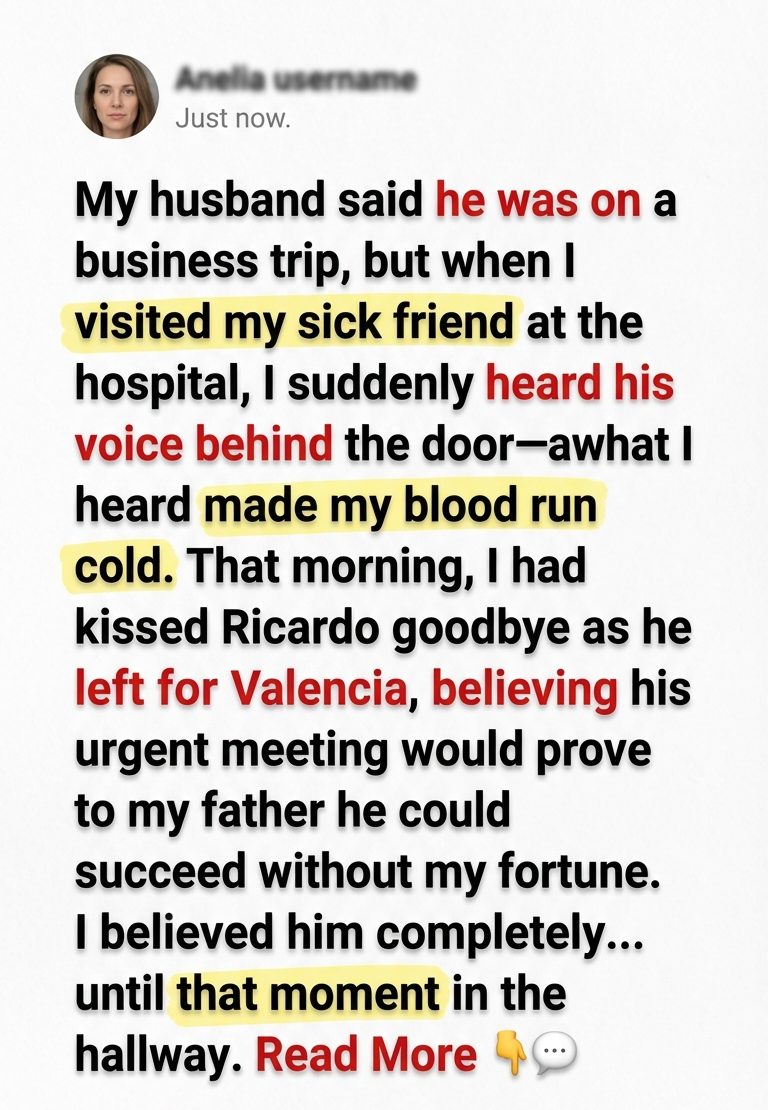
That morning, I kissed Ricardo before he left and adjusted his tie in front of the mirror of our mansion, convinced that I was the luckiest woman in the world. He told me he had to travel urgently to Valencia for an important meeting—a meeting he needed to prove to my father that he could succeed without relying on my fortune. And I believed him.
I believed him because, for seven years, Ricardo had mastered the art of sounding sincere. He had that calm, steady voice that made every lie feel like a promise and every excuse feel like a sacrifice. Even when my father doubted him, even when my friends warned me that Ricardo cared too much about appearances and too little about substance, I had defended him. I told everyone they misunderstood him. I said ambition did not make a man cruel. I said pride did not make him dishonest.
That morning, the house had glowed with the pale gold light of early spring. Our bedroom windows were open, and the air smelled faintly of orange blossoms from the garden below. Ricardo stood in front of the long mirror, smoothing the sleeves of his navy suit while I fastened the silver cufflinks I had bought him for our anniversary. He looked elegant, polished, impressive—the kind of man who could walk into any room and belong there instantly. When he turned to me and smiled, I felt that familiar warmth in my chest, the foolish comfort of a woman who thinks love has made her safe.
“Three days,” he said, brushing a strand of hair behind my ear. “That’s all. Then I’ll come back with good news.”
“I know you will,” I replied.
He kissed my forehead, grabbed his leather briefcase, and walked downstairs with the quick, confident stride I had once found irresistible. I stood at the balcony and watched his car disappear through the iron gates. I remember smiling to myself, imagining the look on my father’s face when Ricardo returned successful, self-made, vindicated. I had no idea that by sunset, everything I thought I knew about my marriage would be broken open.
The day unfolded quietly at first. I had lunch alone in the sunroom, answered a few messages, and tried to read, but my thoughts kept drifting. My best friend, Elena, had been admitted to St. Gabriel’s Hospital the night before with a severe kidney infection. She had texted me late, apologizing for not calling sooner and insisting it was nothing serious, but I knew her too well to trust those words. By mid-afternoon, worry had settled into me like a weight, and I decided to visit her.
The hospital stood across the city, all white stone and reflective glass, clean and severe against the cloudy sky. Inside, the air was cool and smelled of antiseptic and stale coffee. Elevators chimed in the distance. Nurses moved quickly through the hallways with clipped voices and practiced expressions. I carried a bouquet of pale roses and a small bag of Elena’s favorite chocolates, though I knew she might not be allowed to eat them. It was the kind of unnecessary, comforting gesture that friendship demands.
As I stepped off the elevator onto the private care floor, I felt strangely uneasy. I told myself it was just the hospital atmosphere, the low hum of machines and the hush that always makes grief feel close. Elena’s room was near the end of the corridor. I was only a few doors away when I heard a man’s voice from one of the rooms to my right.
I froze.
At first, I thought my mind was playing tricks on me. Hospitals are full of echoes, and memory can be cruelly persuasive. But then I heard the voice again—low, familiar, unmistakable.
Ricardo.
My heart stopped so suddenly it almost hurt. Every part of me went cold. For one confused second, I convinced myself there had to be an explanation. Maybe the trip had been delayed. Maybe he had returned unexpectedly. Maybe he was visiting someone for business before leaving town. But then I moved closer to the door, and what I heard next shattered every gentle explanation my heart tried to invent.
“She still believes everything,” Ricardo said, followed by a soft laugh I had never heard from him at home. “I told her Valencia, and she looked at me like I was some tragic hero trying to prove himself.”
A woman laughed in response. Not a nurse. Not a colleague. A woman whose voice was warm, amused, intimate.
“You’re awful,” she said.
“Maybe,” Ricardo murmured. “But I’m close. Once her father signs the transfer papers, none of this will matter. A few more weeks, maybe less.”
I gripped the bouquet so hard the paper crinkled in my hands.
The woman spoke again. “And what about your wife?”
There was a brief silence, and I leaned so close to the door that my breath fogged the small glass panel beside it.
“What about her?” he answered. “Camila is useful. Sweet, emotional, loyal. She wants so badly to believe I love her that she never asks the right questions.”
Something inside me gave way then—not loudly, not dramatically, but with the quiet, devastating crack of trust dying in real time. I could not breathe. The corridor seemed to tilt. My fingers went numb around the flowers, and for one humiliating second, I thought I might faint right there on the polished floor like some fragile, foolish wife from a tragic novel.
But then I heard the woman again.
“And after the papers?”
Ricardo’s answer came without hesitation. “After the papers, I’ll be free.”
Free.
The word burned hotter than the rest. Not because it was cruel, but because it was so casual. So certain. As if our marriage were nothing more than a locked door he intended to open once he had taken what he wanted.
I stepped back from the room before they could hear me, my pulse thundering in my ears. I looked at the door number, memorized it, and forced myself to keep walking. I do not know how I reached Elena’s room without falling apart. By the time I entered, I had arranged my face into something that almost resembled calm.
Elena was propped against her pillows, pale but alert, an IV attached to her arm. The moment she saw me, she smiled weakly and opened her arms. “You look terrible,” she said. “Did someone die in the hallway?”
I set the roses down too quickly and tried to laugh, but the sound cracked. Elena’s expression changed at once. She had known me since university. She could read me the way some people read storm clouds.
“Camila,” she said quietly. “What happened?”
I looked at her, and the truth rose in my throat like blood. I wanted to deny it, to pretend everything was still intact until I had time to think, but I had just lost the luxury of illusion. I sat beside her and told her everything in a whisper—the voice, the room, the woman, the papers, the word free. By the time I finished, Elena’s face had hardened into something sharp and furious.
“That bastard,” she said.
“I need to know who she is,” I whispered.
Elena glanced toward the door, then back at me. “You said the room number?”
I nodded.
She reached for her phone on the bedside table. “My cousin works administration downstairs. If that room is registered under a patient or private booking, we can find out.”
I stared at her. “You’d do that?”
She gave me a tired, incredulous look. “Camila, I have a kidney infection, not a moral objection to revenge.”
For the first time since the hallway, I almost smiled.
An hour later, while rain began tapping softly against the hospital windows, Elena’s cousin sent the name. The room was booked under Valeria Montes. The name meant nothing to me until Elena searched her social media and turned the screen toward me.
I felt the floor vanish beneath me again.
Valeria Montes was not just some mistress. She was the daughter of one of my father’s oldest business rivals. Beautiful, poised, and very publicly involved in corporate development. In one recent photo, she stood beside Ricardo at a charity gala from six months earlier. They were not touching, but the look between them was enough. It was the look of people who shared secrets.
My first instinct was to cry. My second was to call Ricardo and scream. But a colder instinct arrived after that—quieter, smarter, stronger. If Ricardo had lied to me, manipulated me, and used my love as a bridge to my father’s money, then tears would only nourish him. I needed facts. I needed proof. And most of all, I needed to stop being the trusting wife he thought he could outmaneuver.
So I did not call him.
Instead, I left the hospital after making sure Elena was stable, and I sat in my car under the parking structure while the rain thickened into a silver curtain. My hands shook as I unlocked our shared accounts on my banking app. There it was: unusual transfers over the last eight months, small enough not to trigger immediate concern, but regular enough to form a pattern. Payments to shell consulting firms. Travel expenses I had never heard about. Luxury hotel charges in Madrid, Seville, Barcelona—always on dates Ricardo claimed to be working late, attending conferences, meeting investors.
I stared at the screen until the numbers blurred.
Then I called my father.
He answered on the second ring. “Camila?”
I had not planned what to say. My father and I had been strained for years over Ricardo. He believed Ricardo married me for access. I accused him of being controlling and classist. More than once, I had chosen my husband over him. Pride made swallowing that history almost impossible. But pain has a way of burning pride down to ash.
“Papa,” I said, and my voice broke. “You were right.”
There was a long silence on the line.
Then my father spoke, and for once there was no triumph in his voice. Only concern. “Where are you?”
By evening, I was sitting in my father’s study, wrapped in a wool blanket I did not need, while he and his attorney examined the account statements, the booking records, and the social media screenshots. The room smelled of cedar and old paper. Rain tapped against the tall windows. My father looked older than he had that morning, but also gentler.
“He’s been preparing,” the attorney said carefully. “This is coordinated. Not impulsive.”
“With her family?” I asked.
“Possibly,” he replied. “At minimum, he’s been trying to position himself inside your father’s financial structure.”
I closed my eyes. “So what do I do?”
My father leaned forward, his expression steady. “You stop reacting. You start moving first.”
Those words changed everything.
That night, instead of going home, I stayed in the guest suite at my father’s estate. His legal team began freezing access to any account that required my authorization. The transfer papers Ricardo had been pressuring my father to sign were voided pending review. A forensic accountant was brought in before midnight. By dawn, the private investigator my father had hired sent the first report: Ricardo had never booked a train or flight to Valencia. He had checked into a luxury recovery wing at St. Gabriel’s under an alias linked to Valeria’s company.
When Ricardo finally called the next morning, I almost admired the smoothness of his performance.
“Amor,” he said warmly, “the meeting ran late. I may have to stay one more night.”
I let the silence stretch.
“Camila?” he asked.
I imagined him standing by that hospital window, confident, composed, already calculating his next move. Then I pictured the hallway, the door, the word free.
“Don’t come home,” I said.
He went quiet.
“I know about the hospital,” I continued. “I know about Valeria. I know about the accounts. And I know exactly what I was to you.”
For the first time in seven years, Ricardo had nothing ready to say.
When he finally spoke, his voice had changed. The sweetness was gone. “You’ve made a mistake.”
“No,” I said. “I’ve corrected one.”
He began to talk fast after that—excuses, blame, outrage, denials. He said Valeria was a client. He said the money was temporary. He said I was overreacting, that my father had poisoned me against him, that marriages survive misunderstandings like this all the time. But once a lie is exposed in full light, it loses the power it once had in shadow. I listened without interrupting, then ended the call.
He was served by noon.
The weeks that followed were ugly, but they were honest. Ricardo tried everything. He sent flowers, letters, apologies written in the careful language of a man who still believed manipulation could be mistaken for remorse. He claimed he loved me. He claimed Valeria meant nothing. He claimed pressure had driven him to make “temporary decisions.” But evidence kept surfacing, each piece colder than the last. There were messages between them stretching back nearly a year. There were plans for joint ventures built on anticipated access to my family’s assets. There were even private jokes about how “easily sentimental” I was.
That one hurt more than I expected.
Still, pain changed shape over time. It stopped being a blade and became a scar. Something I could touch without bleeding.
Months later, on a bright morning with no rain at all, I returned to St. Gabriel’s Hospital to pick up Elena after a follow-up appointment. We stood near the entrance where taxis lined up under the awning, and she linked her arm through mine.
“Funny,” she said, looking up at the building. “Your whole life changed because of this place.”
I looked at the glass doors, the shining floors visible beyond them, the strangers moving in and out with their private griefs and private hopes.
“No,” I said quietly. “My whole life changed because I finally heard the truth.”
Elena squeezed my hand.
I had once thought the worst kind of betrayal was being lied to by the person you love most. But I learned something harder and more valuable than that. The worst betrayal is abandoning your own instincts just to keep a beautiful illusion alive. I had done that for years. I had called loyalty what was really fear. I had called trust what was really denial. I had loved Ricardo, yes—but I had also loved the story I told myself about him.
Now that story was over.
And strangely, that was not the tragedy I once would have believed it to be.
It was freedom.
Real freedom—not the kind Ricardo whispered about behind a hospital door while plotting how to use me, but the kind that begins when a woman stops begging for the truth and starts building her life around it. The mansion was sold. The divorce was finalized. My father and I, bruised by years of distance, slowly rebuilt something stronger than what we had before. Elena recovered. I returned to work. I laughed again without forcing it. I slept through the night.
And sometimes, when I think back to that morning at the mirror—the cufflinks, the kiss, the soft light, the certainty in my chest—I do not hate that version of myself anymore.
She was naïve. She was wrong. She was heartbreakingly blind.
But she walked into that hospital believing a lie, and she walked out ready to survive the truth.
That is the part of the story I hold onto.
Because in the end, what made my blood run cold did not destroy me.
It woke me up.