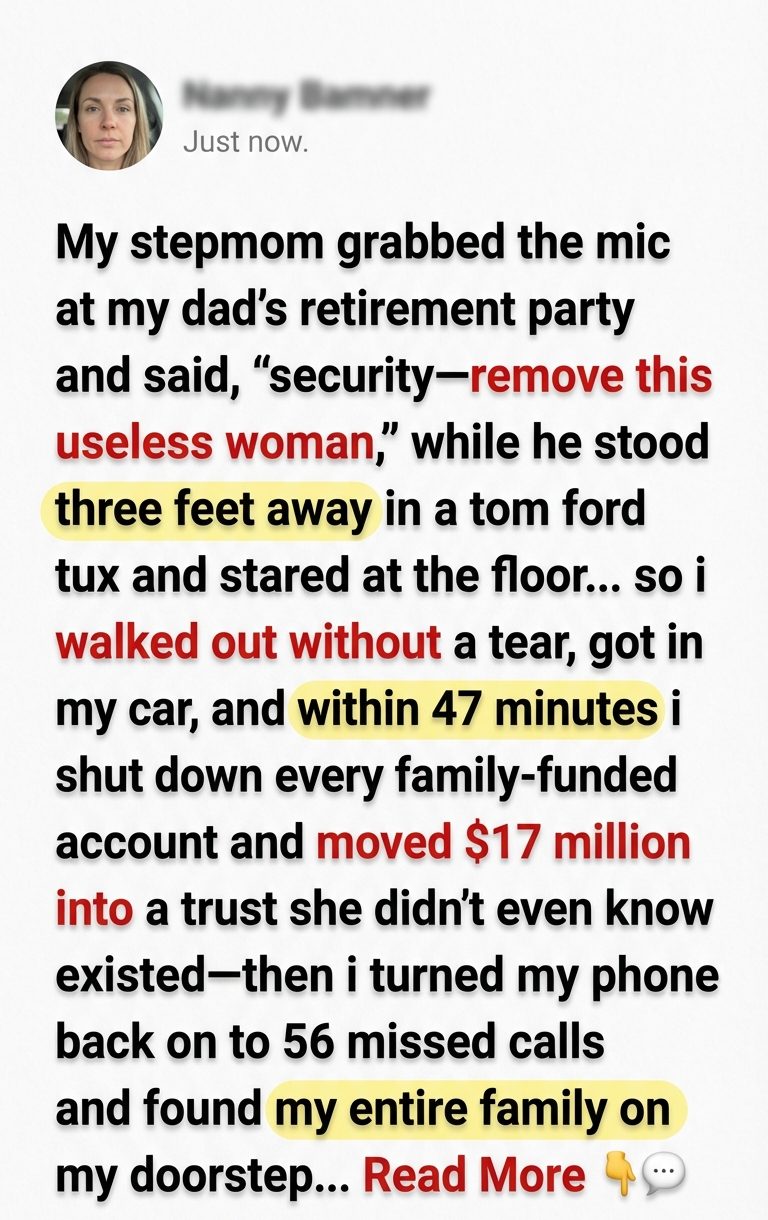
“Security. Remove this useless woman.”
That was the sentence that split Laura Paxton’s life in two. Her stepmother, Diane, said it into a microphone at Richard Paxton’s glittering retirement party in front of two hundred guests. The ballroom was full of diamonds, black tuxedos, crystal chandeliers, and polite people who loved wealth more than truth. Laura’s father stood just three steps away in a custom Tom Ford tuxedo and said nothing.
He did not stop Diane. He did not claim Laura as his daughter. He did not defend her. He looked down at the carpet and let the humiliation happen.
Laura did not scream or cry. She did not throw the velvet gift box she had brought for her father. She simply set it down, looked at him, and said, “I came for you, Dad. Not for her. But I see your choice.” Then she walked out while hotel security escorted her away with practiced politeness. Behind her, Diane calmly resumed the evening as if a minor inconvenience had just been handled.
Outside in the cold October air, Laura gave herself exactly sixty seconds to feel it all—the humiliation, the anger, the loneliness, and the final confirmation of something she had known for years but never fully accepted. Then she stood up, called attorney Thomas Aldridge and fiduciary manager Rebecca Stone, and told them she was ready to proceed.
Within forty-seven minutes, Laura legally transferred $17 million in segregated trust funds into a trust her stepmother didn’t even know existed. The rest of the family trust, which Diane had been using as if it were hers, immediately fell below its required collateral threshold. Accounts froze. Cards stopped working. The illusion of control Diane had built for years began collapsing in real time.
When Laura turned her phone back on, she had fifty-six missed calls. Soon after, her father, Diane, and her stepsister Meredith were standing outside her Brooklyn brownstone, desperate and panicked. But they were not there to apologize. They were there because the legal structure Diane had counted on had just shifted under her feet.
To understand why that moment mattered so much, Laura reflected on the architecture of her life. Her mother, Catherine Hail, had died when Laura was eleven after a short battle with ovarian cancer. Before she died, Catherine taught Laura to see the world through structure—through floor plans, hidden supports, and the unseen beams that hold beautiful things together.
Laura grew up believing her mother was unstoppable and her father loved her enough to protect her memory. She was only half right. Eight months after Catherine’s funeral, Richard married Diane Hartwell, who entered the family not as a warm replacement but as a precise, strategic force who slowly reorganized the household around herself and her daughter Meredith.
Diane’s cruelty was never loud at first. It came disguised as logistics, refinement, and “what’s best.” Laura was moved to smaller tables at holidays, excluded from Christmas cards, pushed from her own bedroom into a guest room, and gradually treated like an inconvenient remnant from Richard’s life “before.” Meredith, meanwhile, was presented as the family’s true daughter.
Richard was not openly cruel. That made the damage worse. He loved Laura in weak, insufficient ways. He occasionally showed signs that he remembered Catherine and his daughter, but every time Diane applied pressure, he folded. Laura learned young that silence was the price of surviving in her own family.
She left home, carried her mother’s memory in a battered cardboard box, and became a restoration architect. While Meredith grew into a glossy, social-media-ready favorite, Laura built a serious career restoring neglected historic buildings. She earned well and lived independently, but the Paxton family dismissed her profession as unstable or unimportant. Diane constantly belittled her work, and Richard almost always let her.
Everything changed eleven months before the retirement party, when Laura finally opened the box her mother had left behind. At the bottom she found a cream envelope labeled, “For Laura, when she’s ready.” Inside was a letter and a business card for trusts-and-estates attorney Thomas Aldridge. Her mother had instructed her to find him.
Laura met Aldridge in his office and learned a truth that rearranged everything she thought she knew about her family. Catherine had not been merely a homemaker with artistic interests. She had been a licensed architect with her own professional identity and family inheritance. Before she died, she had legally placed $17 million of Hail family money into segregated funds within the Paxton trust, protected from the rest of the estate.
Even more important, Catherine amended the trust shortly before her death so that Laura would become the sole beneficiary of those segregated funds at age thirty. No co-signature. No trustee approval. No Diane. No Meredith. Laura was now thirty-four. The money had always been hers. Richard had known all along.
Aldridge also told Laura that Diane had been trying to access the trust provisions and had been acting as though the full Paxton trust belonged to the family generally. In reality, Diane had no legal right to the segregated portion. Worse, Diane had leveraged the broader trust to support loans and family lifestyle costs, assuming the full trust balance would remain intact.
Laura did not act immediately. She wanted to give her father one final chance to choose her. She called him, asked to meet, and tried repeatedly to reach him before the retirement party. Diane intercepted, delayed, and maneuvered. Laura saw signs that Diane was already laying the groundwork to discredit her publicly, including lies that Laura was unstable, unemployed, or dependent on Richard.
At the same time, Laura learned Diane had been exploring a draft trust amendment designed to push Laura aside and redirect Catherine’s money toward Meredith. Diane was not just excluding Laura socially. She was actively preparing to erase her legally.
Laura still went to the party. She dressed simply and beautifully, wearing her mother’s pearl earrings. She wanted one clear answer from her father. If he claimed her, introduced her properly, or defended her even once, she was prepared to let the trust remain untouched. But instead, Diane humiliated her in public, security was ready in advance, and Richard chose silence.
That choice activated everything Catherine had built decades earlier.
When Richard, Diane, and Meredith arrived at Laura’s apartment, Laura let them in and finally presented the documents. Calmly, with total clarity, she explained that the $17 million had never belonged to Richard or Diane. It was her mother’s inheritance, legally segregated, and now legally transferred to Laura’s own trust. Diane accused her of stealing. Laura corrected her: she had reclaimed what was already hers.
Then Laura revealed something even worse. She knew about Diane’s attempted trust amendment. She knew Diane had been contacting fiduciary firms behind the scenes. And she had proof that Diane wrote to her own lawyer about moving quickly “before Laura finds out,” adding that Richard “doesn’t have the spine to stop us.”
That email shattered the room.
Richard finally understood not only what Diane had done financially, but how openly she had manipulated him, Catherine’s legacy, and Laura’s place in the family. When Diane insulted Catherine again, Richard, for the first time in twenty-three years, stopped her. It was late, but it was real.
Laura laid out four conditions for any future relationship with her father. The money would remain in her trust. The draft amendment had to be formally voided. Richard needed his own independent lawyer. And if he wanted to rebuild a relationship with Laura, it would happen directly, not through Diane.
Richard agreed.
What followed was a financial collapse for Diane’s carefully curated world. The withdrawal of the segregated funds triggered a margin call. The trust was suddenly far below the collateral threshold Diane had been depending on. Commercial properties had to be sold. Cards were frozen. Country club memberships and luxury spending structures stopped working. Meredith’s lifestyle was exposed as dependent on a financial machine she didn’t understand.
A deeper legal review found that Diane had authorized about $2.3 million in so-called “family expenses” over fifteen years, many of which were personal luxury costs, travel, spa retreats, and money directed toward Meredith’s life. Diane faced civil liability and trustee consequences. The empire she had built on silence, image, and other people’s money began falling apart.
Richard, at last, began behaving like a man emerging from a long moral sleep. He met Laura privately. He returned the restored gift she had once made him and confessed that he had kept it hidden from Diane. He admitted Catherine had been his compass and that he had let someone else steer his life. Laura did not excuse him, but she accepted that he was finally showing up.
Diane later appeared at Laura’s door alone, smaller and stripped of glamour. She did not apologize. Instead, she admitted that she had feared Laura for twenty-three years—that one day Laura would return and take everything away. Laura answered with the truth: she had not taken anything that belonged to Diane. She had simply reclaimed what Diane never had a right to.
Months later, Laura stood on another stage, this time not as a humiliation target but as a woman fully in possession of her name, her work, and her inheritance. Using part of the trust, she launched the Catherine Hail Foundation to restore endangered historic buildings in underserved communities. She honored her mother not through revenge, but through creation.
At that event, Richard publicly supported her. He stood first during the applause. Later, he returned the restored architectural rendering Laura had once made for him, revealing that he had kept it on his wall all along, even if hidden. It was not full redemption, but it was a beginning.
Meredith eventually wrote Laura a sincere letter of apology. Laura has not answered yet. Some restorations take time. Not every damaged structure can be repaired quickly, and some require careful study before anyone touches the load-bearing walls.
In the end, Laura realized her greatest inheritance was not the $17 million. It was the structure her mother built around her—legal, emotional, and moral. Catherine had protected not only Laura’s wealth, but her right to stand in her own life without being erased.
Laura once believed strength meant enduring humiliation quietly. Now she understands that true strength is different. It is not sitting at the smaller table forever. It is not surviving on scraps of belonging. It is not waiting endlessly for someone else to see your value.
It is seeing yourself clearly, claiming what is yours, and refusing to disappear just because other people found your invisibility convenient.