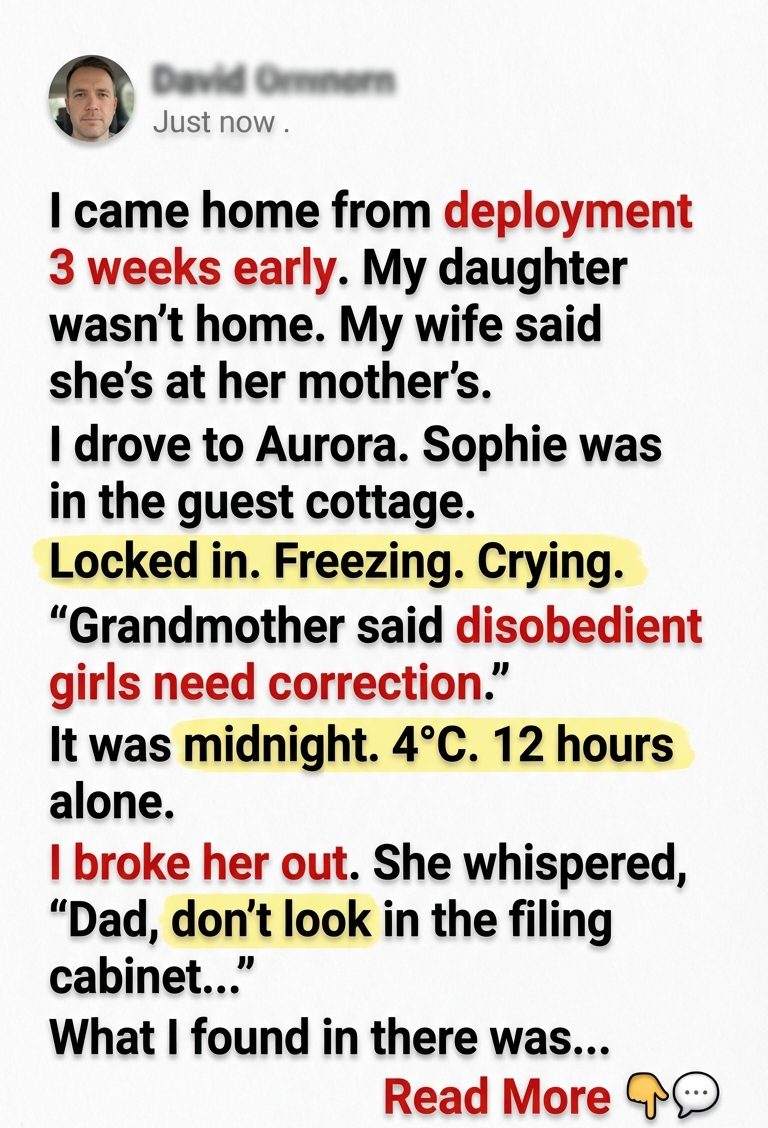
I came home from deployment 3 weeks early. My daughter wasn’t home. My wife said she’s at her mother’s. I drove to Aurora. Sophie was in the guest cottage. Locked in. Freezing. Crying. “Grandmother said disobedient girls need correction.” It was midnight. 4°C. 12 hours alone. I broke her out. She whispered, “Dad, don’t look in the filing cabinet…” What I found in there was…
I came home from deployment three weeks early. I had no idea how much my life was about to change.
The moment I stepped through the door of my house, something felt off. The air inside seemed still, too quiet. There was an unsettling emptiness that lingered, even though my wife, Laura, was standing in the kitchen. Her body was stiff, her eyes avoiding mine. Normally, I would’ve been greeted with warmth and affection, but instead, Laura was visibly startled by my early return, giving me a tight, unnatural smile that never quite reached her eyes.
“Where’s Sophie?” I asked, trying to push down the strange feeling in my gut. It didn’t make sense. She was always so excited when I came home.
“She’s at my mother’s place for the weekend,” Laura replied quickly, a little too quickly. “They’re doing a sleepover. It’s just me tonight.”
I blinked, the knot in my stomach tightening. My daughter, Sophie, should have been running into my arms by now. But instead, I was standing here with an overwhelming sense of dread, watching Laura shift uncomfortably as if she were hiding something.

Evelyn, my mother-in-law, was… different. Rigid, traditional, and in my mind, far too harsh in her methods. Sophie and I had always been close, and I had my concerns about Sophie spending too much time there, but Laura reassured me time and again that everything was fine.
But something wasn’t right.
“I’m driving to Aurora,” I said. “I want to see Sophie. She should already be asleep by now.”
Laura’s eyes widened for a split second, and then she quickly recovered. “Now? It’s late.”
“Exactly,” I said. “I’ll just check on her and make sure everything is fine.”
I could feel the tension in the room growing thick as I grabbed my coat. Laura didn’t argue, but I could see the unease in her eyes. The house felt like a cage, and I couldn’t shake the feeling that something was terribly wrong. I couldn’t let it go. I wasn’t going to ignore this nagging sense of urgency.
The drive to Aurora was cold, and the snow began to fall lightly across the road. My mind was spinning with questions, none of which made any sense. Why was Sophie staying at Evelyn’s? Why hadn’t she called me when I got back? Where was my little girl?
When I arrived at Evelyn’s house, the lights were out, and the place looked empty. Not a single light illuminated the windows. I knocked on the door several times, and there was no answer. I circled the house, my unease growing with every step. Then, I heard it.
A faint sound, a sob, carried on the wind.
“Sophie?” I called, my voice tight with worry.
“Dad?” came the shaky response from behind the guest cottage. I recognized her voice immediately. Sophie.
I rushed toward the sound, my heart racing. The guest cottage wasn’t meant to be a place for Sophie to sleep, but I’d never thought twice about it before. It was a small storage space behind the main house, often used for miscellaneous items. But the door was locked from the outside.
I fumbled around the cottage, my mind screaming at me. I found a crowbar in the yard and used it to force open the lock. The door creaked open, and an icy gust of air hit me, almost knocking me back. Sophie was sitting on the cold, hard floor, shaking uncontrollably, her face streaked with tears.
“Oh God, Sophie!” I cried as I rushed to her side, wrapping my arms around her. She clung to me with desperate strength.
“Grandmother said disobedient girls need correction,” Sophie whispered, her voice breaking. “She left me here for twelve hours.”
Rage boiled inside of me. I pulled Sophie into my arms, holding her tightly, trying to shield her from the cold, from whatever had just happened. “Where is Evelyn?” I asked, my voice a low growl.
“She left,” Sophie said. “She said she’d be back tomorrow.”
I could barely think straight. Twelve hours? How could she leave her granddaughter like this? How could she do this to Sophie?
I picked Sophie up and carried her to the car. As I fastened her into the seat, she grabbed my sleeve, her eyes wide with fear.
“Dad,” she whispered, her voice trembling, “don’t look in the filing cabinet in the cottage. Please… don’t.”
The warning stopped me in my tracks. I froze, staring at her, confused.
“What’s in the filing cabinet?” I asked softly, my heart racing.
She shook her head, her eyes filled with dread. “Please don’t, Dad. I don’t want you to see it.”
I nodded, trying to reassure her, but my own heart was pounding in my chest. Whatever it was, Evelyn didn’t want me to find it. And that was exactly why I had to see it. I had to know what had been hidden from me.
I returned to the cottage, each step heavier than the last. The door creaked as I pushed it open again, and I walked straight to the filing cabinet that Sophie had warned me about. My hands were shaking as I opened the drawer.
What I found inside made my world shift on its axis.
There, in the cabinet, was a folder labeled SOPHIE – BEHAVIORAL RECORDS. At first, I thought it might be some petty notes about Sophie’s misbehavior, perhaps Evelyn keeping track of minor things like not finishing meals or raising her voice. But as I flipped the pages, I felt a sickening wave wash over me.
It was far worse than I could have imagined.
Each page detailed every minor mistake Sophie had made over the past year. Not finishing her meal. Talking back. Crying. Laughing too loudly. The notes were meticulous—each “misstep” was followed by what Evelyn considered “correction.”
Ice baths. Isolation. Withholding meals. Physical punishment.
I felt my stomach churn. But the worst part? Evelyn had documented everything. The dates, the times, the exact form of punishment. She had made a chart to track Sophie’s “progress,” noting the moments Sophie “broke” under the pressure.
My hands shook violently as I turned the pages, unable to believe what I was seeing.
Then I found the envelope—small and taped inside the folder. My heart stopped. Inside, there were photographs—photographs of Sophie in the freezing cold, her cheeks flushed blue, curled up on the concrete floor of the cottage. Sophie crying next to the locked door, looking so small, so vulnerable.
I wanted to scream. To destroy everything Evelyn had done. To run back and get Sophie to safety.
But I didn’t.
I grabbed the folder and shoved it under my jacket, then ran back to the car where Sophie was waiting, still shivering and half-asleep.
I drove straight to the nearest hospital. I didn’t care about anything else at that moment—just getting Sophie the help she so desperately needed. The doctors reacted immediately. They confirmed what I already knew: Sophie was suffering from mild hypothermia, dehydration, and extreme emotional shock.
And then, when I showed the contents of the folder to a social worker, I realized just how serious this was. The abuse wasn’t just cruel—it was systematic. And it had been going on for far too long.
The sterile smell of the emergency room was a stark contrast to the chaos boiling inside me. Sophie had drifted into a fitful sleep as the doctors worked to warm her up, her body still shivering in the blankets despite the heated IV fluids. I stayed close, my fingers curled around her small hand, watching as the team of doctors moved swiftly around her. They barely spoke to me directly, so focused on their work, but I could hear the words they exchanged—the concern in their voices, the haste in their movements. Sophie was in bad shape, but she was going to survive.
I felt like a stranger in my own skin. I had been deployed for months, fighting overseas to protect lives, but none of that compared to the gut-wrenching fear that coursed through me as I stared at my daughter, fragile and broken. I wasn’t there when she needed me the most. I wasn’t there to protect her.
As the minutes ticked by, my mind kept returning to that folder—those photos. The ice baths, the isolation, the physical punishment Evelyn had subjected Sophie to. I couldn’t understand how anyone could treat a child like that. Let alone a grandmother who was supposed to love and protect her.
I thought back to the warning Sophie had given me before I left the cottage: “Don’t look in the filing cabinet.” The fear in her voice still echoed in my mind. What had Evelyn been hiding all this time? And how long had Laura known? Had she seen the same thing I had? Or had she been blind to it? My heart wavered with confusion, and a new anger began to build inside me—a rage that was different from anything I’d ever felt before. This wasn’t just about Sophie’s abuse anymore. It was about betrayal—by Laura, by Evelyn, by everyone I thought I could trust.
The hospital room door creaked open, and a social worker entered. She was an older woman, her face kind but hardened, as if she had seen it all before. Her name was Grace. She introduced herself softly and then sat down beside me, her voice quiet but firm.
“Mr. Anderson,” she began, “I’ve reviewed the documents you provided, and I want to say this clearly: What your daughter has been through is severe. This is a case of child abuse—emotional, physical, and neglect.”
I nodded, my throat tightening.
“We’ll need to report this to the authorities immediately,” Grace continued. “We’ll be working with the police, but I want to assure you that Sophie will be safe from now on.”
“But Evelyn…” I said, struggling to find the words. “She’s… she’s my mother-in-law. She’s been doing this to Sophie. How did this go unnoticed for so long?”
“I don’t know,” Grace replied gently, “but that’s something we’ll need to investigate. Your daughter is safe now, and that’s what matters. But we’ll need to speak with her more, make sure she’s not afraid to tell us everything.”
I felt the room spinning. It was too much. I couldn’t wrap my mind around it. My head was clouded with questions, guilt, and a growing sense of dread. What was Laura’s role in this? How could she have let it go on for so long?
“Can I see her now?” I asked, my voice barely above a whisper.
Grace nodded. “Of course. But please keep in mind that she’s been through a lot. If she’s ready to talk, she will. But don’t push her.”
I stood up, my legs weak beneath me. As I walked over to Sophie’s bedside, I felt the weight of the moment. I had failed her in ways I couldn’t even begin to comprehend. But I was here now. And I would make sure she never went through this again.
I sat down on the edge of the bed, gently brushing a lock of her hair from her face. Her breathing was shallow, but steady. She hadn’t woken up yet, and I didn’t want to disturb her. I just wanted to be near her, to let her know I was there.
The door opened again, and Laura stepped into the room. Her face was pale, her eyes red from crying. She looked at Sophie, her face crumpling with emotion, but then her gaze flicked to me, and I could see the hesitation in her eyes. She didn’t know what to say. How could she?
Laura had always been a quiet person, reserved, unsure of how to confront difficult truths. I had always loved her for her kindness, her gentle nature. But now, standing before me in this sterile hospital room, I saw her differently. I saw her as a woman who had failed not just me—but her own child. The anger I had felt earlier intensified.
“Daniel,” Laura said softly, her voice cracking. “I… I didn’t know it was that bad. I thought Sophie was exaggerating. I thought she was being dramatic to get attention.”
I stared at her, disbelief flooding my veins. “Exaggerating? Laura, she was locked in that cottage for twelve hours! She was freezing! She had hypothermia! How could you have thought that was ‘exaggerating’?”
“I don’t know,” she whispered, her hands trembling. “I didn’t know what to do. Evelyn has always been so… strong-willed. She told me Sophie was just being rebellious, that she needed to learn discipline. And I believed her. I thought I was doing what was best. I didn’t know it would go this far.”
Tears welled in my eyes, but I refused to let them fall. I couldn’t. Not in front of Sophie.
“You’re her mother,” I said quietly, my voice trembling with emotion. “You’re supposed to protect her.”
“I failed,” Laura whispered, her voice breaking. “I’m so sorry. I never wanted this to happen. I didn’t know.”
I didn’t know how to respond. What could I say? How could I find the words to tell her how deeply she had betrayed me, betrayed Sophie, by letting this happen under her nose?
“I don’t even know who you are anymore,” I said, my voice steady but full of hurt. “You knew what Evelyn was doing. You knew, and you let it happen.”
“I didn’t know it was this bad,” Laura repeated, her voice strained. “I was afraid of what Evelyn would do to me. I didn’t know how to stop it. I thought I could handle it… I thought… I thought maybe I was just being paranoid. I never thought she’d do something like this.”
“You should’ve told me,” I said, my chest tightening. “You should’ve told me what was really going on. I could’ve helped you. We could’ve protected Sophie together.”
“I was too scared,” Laura said softly. “I thought if I stood up to her, I’d lose everything. I didn’t know who else to turn to.”
She collapsed onto the chair next to Sophie’s bed, sobbing quietly. Her hands clutched the hem of her blouse, her shoulders shaking with each sob.
I looked down at Sophie. She was still sleeping, her face relaxed for the first time in hours. She was safe now. She was here, with me, and nothing would hurt her again.
But as I sat there, I couldn’t help but wonder how long it would take for our family to heal from this. How long it would take for Sophie to trust again. And how long it would take for Laura to look herself in the mirror and confront the damage she had allowed to be done.
The rest of the night was a blur of questions, paperwork, and interviews. The police arrived shortly after Laura, taking our statements and beginning their investigation into Evelyn’s actions. Evelyn was arrested the next morning, her house searched for further evidence of her cruel “discipline” methods. She was taken into custody without hesitation.
Sophie was placed under my full custody, and Laura was placed under investigation for neglect. As much as I wanted to protect her, the truth was undeniable: she had been complicit in what happened to our daughter.
The days following the hospital visit felt like I was moving through thick, suffocating fog. Sophie was recovering physically, but I could see the emotional toll this ordeal had taken on her. She spoke little, her eyes constantly flickering with unease, as if she were bracing herself for another round of pain, even though she was no longer in that cold cottage. I could tell she was afraid. She was afraid of everything, but most of all, she was afraid of me—not because she didn’t trust me, but because I was the one who had found her. I was the one who had seen the worst of her suffering.
I tried not to show it, but the guilt I felt gnawed at me. I was supposed to protect her. How had I let this happen? I had been away. I had been doing my job, sure—but I had failed in my most important role: as a father. I hadn’t been there when she needed me. And now, even though I was physically with her, I felt like a stranger. Every time I looked at her, I felt a pang of sorrow, a reminder that I had missed the signs.
The worst part was knowing that Laura, the woman I had trusted with our child, had been complicit in it. How could she not have known? How could she have let her mother’s cruelty go unnoticed for so long? I couldn’t even look at her without feeling anger rising in my chest. But I couldn’t escape her, either. She was here, in this house, constantly apologizing, constantly pleading for forgiveness. I wanted to believe her. I really did. But the words felt hollow. How could I forgive someone who had allowed our daughter to suffer in silence?
I spent most of my time sitting with Sophie, reading her stories, talking to her, trying to re-establish some semblance of normalcy. It was hard, though. Every small thing seemed to unsettle her. A sudden noise made her jump. The slightest hint of an argument between me and Laura made her retreat into herself. She clung to me at night, sleeping with her small hand wrapped around my finger, as if I were the only anchor she had left.
Laura tried to get close to Sophie, but it was clear that Sophie didn’t trust her anymore. She had shut down emotionally, creating walls I didn’t know how to break. She wouldn’t talk to Laura. She wouldn’t let her near. And that silence between them—it hurt me in ways I couldn’t describe. I wasn’t just watching my daughter shut down. I was watching my wife break before me, too. She had lost the one thing she had ever truly cared about. She had lost our daughter’s trust, and no amount of apologies could fix that.
Days turned into weeks. The police investigation continued, and Evelyn remained in custody, facing serious charges of child abuse. We had been given a temporary order of protection, and Evelyn’s lawyer was already fighting the charges, trying to paint her as a misunderstood grandmother who only “wanted what was best for her granddaughter.” But it didn’t matter what they said. The evidence was undeniable. The photographs, the meticulous records—everything painted a clear picture of an abusive, controlling woman who had tortured her own granddaughter for months.
One afternoon, Sophie was drawing in her room. I had been sitting with her, watching over her like a hawk, when the doorbell rang. My heart skipped a beat. Visitors had become a rare occurrence in the past few weeks, and I wasn’t expecting anyone. When I opened the door, I was met by a man in a suit. He introduced himself as a detective assigned to the case, and he wanted to speak with me about the next steps in the investigation.
“Mr. Anderson,” he said, his tone professional but serious, “we’ve found something. There’s more to this than we initially thought.”
A chill ran through me. I stepped back to let him inside.
“What is it?” I asked, my voice tight. I already knew this wasn’t going to be good news. I had learned that much in the last few weeks. There was no such thing as good news when it came to this case.
“We found a set of old records,” the detective explained, sitting down in the living room, his eyes not meeting mine. “They were hidden behind the filing cabinet in Evelyn’s study. We believe they’re connected to her past…and to your wife’s childhood.”
I froze, my pulse thundering in my ears. What could this possibly mean?
The detective opened a manila folder and handed me a set of papers. I skimmed through them, the words making my stomach turn. The first few pages detailed Evelyn’s long history of controlling and punishing her own children. They were notes—sparse, detached, clinical—detailing every infraction Laura had ever made, every mistake, every action that wasn’t in line with her mother’s warped sense of discipline.
Ice washed over me as I read through the pages. It was clear that Laura hadn’t just been the victim of her mother’s cruelty; she had been conditioned to accept it. It explained so much—the hesitation, the denial, the way she had been unable to protect Sophie. Laura had never been given the chance to learn what true love and discipline looked like. She had been raised in a house of fear, and that fear had shaped her into the woman I had married.
My heart ached for her. The woman I had once seen as strong and capable had been broken long before I had ever met her.
The detective watched me closely as I continued to read. “We also found a letter,” he said quietly. “It was addressed to Laura. We don’t know the full context yet, but it’s clear that Evelyn tried to influence Laura’s perception of Sophie.”
I stared at him, confused. “Influence her how?”
“Through manipulation,” the detective replied. “Trying to convince Laura that Sophie was the problem. That she was the cause of all the dysfunction in the family. Evelyn had been laying the groundwork for this kind of behavior for years.”
I couldn’t wrap my mind around it. Laura had been manipulated her whole life—trained to see abuse as discipline, and to believe that anything her mother did to correct her behavior was justified. No wonder she had been blind to what was happening to Sophie.
I looked up from the papers, my chest tight. “Is there anything else? What happens now?”
“We’re continuing our investigation,” the detective said. “We’ve interviewed Laura’s siblings. We’ve gathered more evidence from Evelyn’s past. But this is going to take time. In the meantime, I suggest you continue with the protective order. Keep Sophie safe.”
I nodded, though it felt like I was holding on by a thread. Sophie was safe now. She was with me. But Laura? She was a part of this mess. She had been caught in the web of manipulation, just like I had been caught in the lies she told me about her mother.
I couldn’t forgive her yet. Not for what she allowed to happen to Sophie. Not for her complicity in that house of horrors. But I knew one thing for certain:
I couldn’t give up on my daughter. Not ever again.
The weeks after the detective’s visit passed in a blur of paperwork, police interviews, and moments of overwhelming uncertainty. Laura and I were like strangers living in the same house—silent, distant, and unsure of what to say. She spent most of her time away from Sophie, giving me space to care for our daughter. I had made it clear that Sophie needed stability, and I wasn’t about to let anyone else disrupt that, especially not Laura—at least, not until I understood what had really happened and whether I could ever trust her again.
Sophie’s recovery was slow but steady. She had begun to talk more, but she spoke in hesitant, fragmented sentences, like she was trying to rebuild a language she’d forgotten. At times, she would sit beside me, her eyes wide and cautious, as though expecting me to disappear the way Evelyn had. But I wouldn’t leave. Not again. Not ever.
In those early days, I clung to the small victories. Sophie smiled at something on TV, her face lighting up for a brief moment. She let me tuck her in without asking for reassurance. She reached for my hand when we went outside, letting me pull her into the sunlight. These were the moments I lived for.
But there were also the nights when she woke up crying from nightmares, when the memories of her time in that freezing cottage haunted her. And each time, I would comfort her, whispering that she was safe now, that nothing would ever hurt her again.
Then there were the days when Laura would try, as though nothing had happened, trying to make up for lost time by doing the things she thought would fix everything. She’d cook dinner, she’d clean the house, she’d even try to engage Sophie in playtime—but it was too much, too fast. Sophie wouldn’t even look at her, much less acknowledge her attempts to reconnect. Laura’s touch had become something Sophie recoiled from, like it was foreign. And that hurt Laura more than I could have ever imagined.
But still, Laura tried. And so did I.
It was a strange, fragile dance we were doing—living under the same roof but so far apart, our relationship fraying at the edges as we tried to rebuild what had been destroyed. But Sophie? Sophie was my priority. I would do whatever it took to give her the life she deserved, no matter the cost.
One day, as I was sitting beside Sophie on the couch, a package arrived at the door. It was addressed to me, with no return address. My heart skipped as I opened it, the wrapping paper revealing a folder. Another folder.
I pulled it open slowly, my breath catching in my throat as I scanned the pages. These were more records—detailed notes, but not from Evelyn. These records, these were Sophie’s medical records. And they were from before the abuse. Before the isolation.
I skimmed through the documents—routine check-ups, vaccinations, growth milestones, and then something caught my eye—something I hadn’t expected to see. There, at the bottom of the pages, was a series of behavioral assessments. The dates were months before any of this had started. But they weren’t marked like the typical notes. These were written in a different handwriting. Laura’s handwriting.
My stomach churned as I read the words.
Sophie seems distant lately, not her usual self. She’s been getting upset over small things. Could this be a phase, or is something else going on?
She didn’t respond to my correction last night. She has become so difficult. I’m not sure how to handle it.
Evelyn thinks I should be stricter with her. Maybe I’m too soft. Maybe that’s the problem. She’s just too stubborn.
The more I read, the more the anger inside me built. Laura had been complicit in Evelyn’s conditioning of Sophie. She had seen her daughter struggle—had seen her own flesh and blood suffering—and had done nothing. She had ignored it. And worse—she had written it down, as if to convince herself that Sophie was the problem. That it wasn’t Evelyn. That it wasn’t her own inability to protect her daughter from the toxic influence of her mother.
I stood up abruptly, the folder still in my hand, my mind racing. How could she have let it go on like this? How could she have been so blind? So weak?
Sophie was sitting on the couch, her eyes fixed on me, sensing the tension in the air. “Dad?” she whispered, her voice trembling.
I knelt beside her, trying to calm the rising storm inside me. “I’m sorry, sweetheart,” I said, swallowing the lump in my throat. “I’m so sorry. I’ll never let anything happen to you again. You’re safe now.”
She reached out and grabbed my hand, holding it tightly, as though afraid I would disappear.
And for the first time in weeks, I let myself believe her. I was doing the right thing. I was trying. I would fix this.
The next day, I decided to confront Laura. It was time. There could be no more dancing around the issue. No more pretending everything was fine when it wasn’t. The silence between us had reached a breaking point, and I knew that if we didn’t talk, nothing would ever heal. Our family would never recover.
I found Laura in the kitchen, her back to me as she chopped vegetables. She didn’t hear me approach. I took a deep breath, steeling myself.
“Laura,” I said, my voice firm but controlled.
She turned, startled. “Daniel… I didn’t hear you come in.”
I dropped the folder onto the kitchen table, the contents spilling out. She didn’t need to see the whole thing to know what I had found. She knew.
“You wrote these,” I said quietly. “You saw the signs. You knew something was wrong, but you did nothing.”
Her face drained of color as she stepped back. “Daniel, I—”
“Don’t,” I interrupted. “Don’t tell me you were just trying to be a good mother. You were complicit, Laura. You let her hurt Sophie. You let her manipulate you into thinking this was okay. But it wasn’t. It was never okay.”
She closed her eyes, her hands trembling at her sides. “I didn’t know how to stop it,” she whispered. “I didn’t know how to protect her from my own mother.”
“And you didn’t even try,” I replied, my voice cold. “You let me believe everything was fine. You kept telling me that Sophie was just acting out. But look at what happened.”
Tears welled in Laura’s eyes, and she took a step toward me, her face pleading. “I never wanted this. I never wanted to hurt Sophie. I just didn’t know what to do. I thought… I thought if I stood up to her, I’d lose everything.”
“You already lost everything, Laura,” I said quietly. “You lost Sophie’s trust. You lost my trust. And you almost lost our daughter.”
Her sobs wracked her body, but I couldn’t bring myself to comfort her. Not yet. Maybe not ever. I wasn’t sure.
“I’m sorry,” she gasped, her voice hoarse. “I don’t know how to make this right. I don’t know how to fix everything I’ve broken.”
I stared at her, not knowing what to say. How could I? She had failed us both.
“Maybe you can start by actually being here for her,” I said, my voice still raw. “Maybe you can start by proving to Sophie that she can trust you. But I won’t allow you to hurt her anymore. Not ever again.”
Laura collapsed into a chair, her head buried in her hands, sobbing uncontrollably. I walked out of the kitchen, my mind clouded with anger and confusion.
The truth was, I didn’t know what the future held. I didn’t know if Laura and I would ever be able to rebuild the trust we had lost, or if Sophie would ever truly forgive her mother for the damage that had been done. But what I did know was that I couldn’t let this continue. I couldn’t let my daughter’s childhood be stolen by the cruelty of Evelyn or the weakness of Laura.
Sophie needed me. And I would always be there. No matter what.
The days that followed were some of the hardest I’ve ever lived through. The air in our home was thick with tension, the weight of unspoken words pressing down on all of us. Laura, despite her best attempts to reach out to Sophie, was met with silence—Sophie’s heart closed off, her trust shattered in ways I couldn’t begin to repair. As much as I tried to be the anchor, I couldn’t escape the rawness of the situation. I had failed. I had allowed my daughter to be hurt. And the anger that I had buried for weeks now began to surface in waves, threatening to overtake me.
The first time Sophie looked up at Laura, really looked at her, was the first moment I felt a flicker of hope. It was small—almost imperceptible—but it was there. Laura had been sitting on the couch, folding a pile of clothes, when Sophie approached her cautiously, a crayon still in her hand. She stood there for a long moment, her eyes studying Laura, before she hesitantly handed her the crayon.
“I drew this,” Sophie whispered, her voice barely above a breath. “For you.”
Laura blinked, her eyes filling with tears, and she took the crayon, her hands shaking as she gently reached out to touch Sophie’s cheek. “Thank you, sweetheart,” she whispered back, her voice thick with emotion.
It was the first time Sophie had initiated contact with her since the night of the rescue. A small gesture, but a huge step forward.
But even as I saw this, a part of me couldn’t forget what had happened—what Laura had allowed to happen. The apology she had offered me, the countless tears she shed—it wasn’t enough. It wasn’t enough to undo the damage, and it certainly wasn’t enough to rebuild the trust that had been obliterated.
I found myself thinking about the conversation we’d had days earlier. I had spoken to Laura about rebuilding—about showing Sophie that she could trust her again—but my words had been harsh, and maybe too final. Laura had agreed to counseling and therapy, and for the first time, I saw a glimpse of the woman I had married—the woman who had been hidden behind fear for so long. But I still didn’t know if she would ever be able to break free from the chains her mother had put around her.
The following week, we had our first family therapy session. It was awkward, to say the least. Sophie, who had been so used to staying silent, was still hesitant, and Laura and I sat on opposite sides of the room, each of us wrapped in our own shame. The therapist, a kind middle-aged woman named Dr. Fields, had clearly dealt with situations like ours before. She didn’t rush us, didn’t force Sophie to speak, but she guided the conversation, gently pushing us to confront the hurt, the betrayal, and the path forward.
It was difficult for me. Every time I glanced at Laura, I saw the woman who had failed Sophie—the woman who had been too afraid to stand up to her own mother. But I couldn’t ignore the fact that she had begun to change. She had taken the first step by agreeing to therapy, by acknowledging that she needed help. It wasn’t enough, but it was something.
Over the weeks, things began to shift, ever so slightly. Laura’s efforts to connect with Sophie became more genuine. She tried to spend time with her, even if Sophie pulled away. She stayed patient, even when Sophie refused to let her hug her or be close. It was slow progress, but it was progress nonetheless.
And then, there were the moments when Sophie would curl up next to me, resting her head on my shoulder like she used to. She still cried at night—still woke up from nightmares, her body trembling with fear—but we had a routine. I would sit beside her, my hand on her back, speaking softly to her until she settled into sleep. I reminded her, every night, that she was safe. That I wouldn’t let anyone hurt her again.
But there was still a hole between me and Laura. A deep, insurmountable divide. We weren’t just broken—we were shattered. We had to work through so much before we could even begin to think about rebuilding what we had before. And that thought terrified me. How do you rebuild something that’s been destroyed beyond recognition?

As the weeks turned into months, things began to feel a little more stable. Sophie smiled more. She started to play again, drawing and coloring without hesitation. She started to laugh more freely. I would catch glimpses of her old self—before everything happened, when she was carefree and happy—but it was fleeting. The scars of her trauma ran deep.
Laura and I continued with our therapy sessions. It was painful—every single moment of it. But something about the process, however painful, made me feel like we were moving in the right direction. We were learning how to communicate, how to listen. But I couldn’t pretend that I wasn’t watching her every move, looking for signs that she was still hiding something. I wasn’t ready to forgive her. Not yet. I couldn’t.
One afternoon, as I was sitting in the kitchen, Sophie came running in, holding up a picture she had drawn. “Look, Daddy!” she said, her face lighting up with excitement. “It’s you and me.”
I took the drawing from her, and for the first time in weeks, my heart swelled with warmth. There was still so much work to be done, so much healing to go through. But this—this moment—was everything. I looked at her, and I promised myself, silently, that I would protect her forever. No one would ever make her feel small again.
“I love it, sweetheart,” I said, my voice thick with emotion. “It’s perfect.”
She grinned, her small arms wrapping around my neck. “I’m glad you like it, Daddy.”
As she pulled away, I looked over at Laura, who was standing in the doorway, watching us. She hadn’t said anything, but the way she looked at Sophie—her eyes filled with awe, filled with love—told me everything I needed to know. She was trying. She was trying to be a better mother.
I didn’t know what the future would look like for our family. I didn’t know if Laura and I would ever fully heal. But I did know this: Sophie was safe now. She had a father who would never leave her, and a mother who was finally learning how to be the parent she deserved.
And for the first time in a long time, I allowed myself to believe that maybe, just maybe, we would get through this. Together.