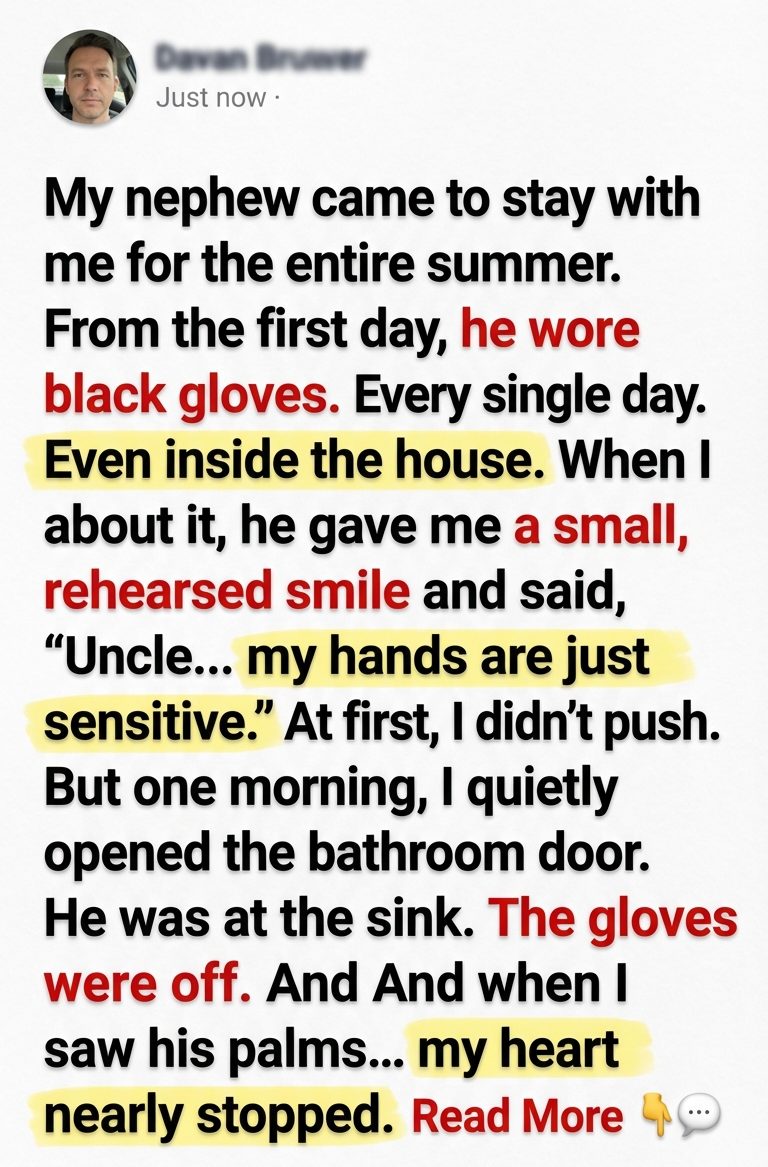
My nephew came to stay with me for the entire summer. From the first day, he wore black gloves. Every single day. Even inside the house. When I finally asked about it, he gave me a small, rehearsed smile and said, “Uncle… my hands are just sensitive.” At first, I didn’t push. But one morning, I quietly opened the bathroom door. He was at the sink. The gloves were off. And when I saw his palms… my heart nearly stopped.
Nate arrived at my house on a bright Saturday morning, the beginning of June. The kind of summer day that felt too good to be true. The sun was high, the air warm but not stifling. A perfect summer day, or so I thought.
I stood at the door, a little nervous. It had been a while since I’d seen him—since that Christmas dinner where he was a quiet shadow in the corner. Nate was my sister’s son, and after her death, he’d bounced from one temporary home to another. He was the kind of kid you’d meet and forget five minutes later, a polite ghost who never fully existed in your world. I was offering him a chance to spend the summer with us, to be a kid again, to have some space away from the unpredictability of his life.
I opened the door to find him standing there, shifting nervously. His backpack looked too light for a whole summer, and the duffel bag slung over his shoulder looked heavy for a kid his age. But it was the gloves that caught my attention. Black leather gloves, snug around his hands. He was wearing them in the heat of June.

“Nate,” I greeted, pulling him into a brief hug before he could step away. He was a tall kid for fifteen, all elbows and awkwardness, shoulders hunched like he was trying to make himself smaller, less visible. “You made it.”
“Yes, sir,” he said quickly, then corrected himself. “I mean… Uncle Ethan.”
I chuckled, though it felt like a thin sound. “No need for formalities here, kid. Come on in.”
As we walked inside, I noticed the way he moved—carefully, as if testing each step, as if the floor might give way under him. He wiped his shoes at the door like he didn’t want to track any dust, even though the house was spotless. He thanked me for the water. He thanked Lila, my wife, for asking about the ride. Even the dog got a “thank you” for being in the room.
But it wasn’t just his politeness. It was the gloves. They stayed on while he ate. Even as he moved the taco around on his plate, his fingers never touched it directly. He used a napkin to pick it up instead, like he was afraid of getting his hands dirty. He seemed to always control the environment around him, as if trying to stay in charge of something, even if it was just how he ate.
At first, I thought it was some kind of weird teenager thing. Sensory issues maybe. Some kids developed odd habits after experiencing difficult things. I didn’t know the specifics of his life before this, but I knew enough to know it wasn’t easy. I told myself to be patient. But the gloves were becoming a symbol, something more than just an accessory. They felt like a wall between him and the world.
Later that night, as Lila watered her herbs on the patio, I watched Nate. He sat on the back step, his back straight, his hands tucked safely inside those gloves. It was as if he was afraid of everything—of us, of the world, of the idea that maybe here, in this quiet suburban house, he didn’t have to be afraid.
“You settling in okay?” I asked, trying to break the silence.
“Yes, sir,” he answered again, before quickly correcting himself. “Yes, Uncle.”
I smiled. “Good. It’s quiet here. Maybe too quiet, but it’s safe.”
Nate nodded, not really listening. His eyes were on the lawn, distant, lost in thought.
I paused, and then gently asked, “The gloves… You don’t have to wear them here, you know. This is your home for the summer too.”
He didn’t respond immediately. His gaze flicked to his hands, then back to the lawn. “It’s nothing,” he said. “My hands just get cold. It helps.”
I could’ve pressed him for more. I could’ve asked why a fifteen-year-old was still wearing gloves when the temperature was pushing eighty degrees. I could’ve asked about the way he acted like the gloves were a shield, something to hide behind. But Lila was still on the patio, watching us with the kind of hope that made my stomach churn. I didn’t want to start a fight over something that might not even matter.
So I let it go.
The next few days passed in a strange kind of rhythm, a quiet pulse that marked the days of summer. Nate stayed in his routine, the gloves never coming off, not even when we sat on the couch and watched TV. His hands remained hidden in the leather, even when he helped Lila with the laundry or folded his clothes in the guest room. I couldn’t shake the feeling that something was wrong. But every time I tried to bring it up, he would give me the same answer: “My hands just get cold.”
It was almost as if he was rehearsing the line. Perfectly measured, perfectly controlled.
One night, just after dinner, Lila and I were cleaning up the kitchen. The sound of Nate’s voice came from the living room. He was watching something on TV, but there was a strain in his words, something off. He was talking to himself in a low murmur, as if he needed to hear his own voice to remind himself that he was still here.
I finished loading the dishwasher and went into the living room to check on him. The house was silent except for the hum of the refrigerator in the background. Nate sat in the corner of the couch, his hands tucked into his gloves, fingers twitching as he gripped the fabric of the couch.
I paused in the doorway. He didn’t notice me standing there, and for a moment, I almost didn’t want him to. There was a certain comfort in just watching him, in observing the way he tried to disappear into the cushions, as if the world around him was too much to handle.
But then, the sound of running water reached my ears.
It was faint at first, so faint that I thought it might just be the tap running somewhere in the house. But then it grew louder, more insistent. A steady stream of water, almost like it was coming from the bathroom.
“Lila,” I called softly, but she didn’t hear me. I had to check.
I walked quietly down the hallway toward the bathroom. The door was cracked, just enough to let a sliver of light escape. As I approached, I heard something else: scrubbing. Slow, methodical scrubbing, like someone was trying to erase something that wouldn’t come off.
I hesitated at the door, unsure of whether I should knock or just step inside. It felt invasive, like I was about to witness something that was meant to stay private. But I couldn’t shake the feeling that something wasn’t right, that this was different from the usual teenage quirks I had brushed off before.
I turned the doorknob gently, and the door swung open.
Nate was standing at the sink, his shoulders bare, his head bowed low. The gloves sat on the countertop, discarded for the first time in days. He was scrubbing his hands with an intensity that felt unnatural, too focused, too deliberate.
At first, I thought it was just a weird phase, something he was doing because of his obsession with cleanliness. But then, as the water ran over his wrists, I saw something. His skin wasn’t just pale. It was raw. Red lines streaked across his palms, jagged and uneven. The kind of marks you’d expect to see after something was pressed into your skin again and again.
But the worst part? In the center of his left palm, there was an emblem. A symbol burned into his skin. It was too clear to be a scar, too deliberate to be a mistake. A police insignia. Not inked, but branded.
I froze in the doorway, my breath catching in my throat. Nate didn’t look up at me immediately. Instead, he just kept scrubbing, the water running over his hands in a futile attempt to wash away the marks that I knew now were meant to stay.
The silence stretched between us for what felt like an eternity.
Finally, he looked up at me through the bathroom mirror. His expression was unreadable, his eyes calm, almost resigned.
“You weren’t supposed to see that, Uncle,” he said softly, his voice barely a whisper over the sound of the water.
I didn’t know how to respond. My mind was racing, trying to piece together what I had just seen, trying to make sense of what was happening. The gloves. The marks on his hands. The police insignia branded into his skin.
“What happened to you, Nate?” I asked, my voice trembling with a mix of confusion and concern.
He didn’t answer. Instead, he lifted his palms higher, as if showing me the marks more clearly, the emblem like a stamp burned into his flesh.
“I don’t want to talk about it,” he said quietly. “Please. Just… don’t ask me about it.”
But I couldn’t stop myself. The questions tumbled out before I could stop them. “Who did this to you? Why didn’t you tell me? Why the gloves? What does it mean?”
Nate took a deep breath, and for a moment, I thought he was going to say something. But then, he just lowered his hands and reached for the gloves, slipping them back on with practiced ease, like it was nothing.
“It doesn’t matter,” he said, his voice cold and distant now. “I’m fine. I don’t want to talk about it, okay? Please, just… just let me be.”
And that was it. The door between us slammed shut. He turned away from me and left the bathroom, disappearing down the hallway without another word.
The next few days felt strange. The normal rhythm of our house—Lila watering her plants, me tinkering with the yardwork, Nate sitting quietly in corners or working through his tasks—had become suffocating. There was a heavy silence in the air, thick with unsaid words and a distance between us that hadn’t been there before.
I tried to act like everything was normal, but I couldn’t shake the image of Nate’s branded palms. The insignia was seared into my mind, a symbol that felt wrong, out of place. I knew what I’d seen, but I didn’t know what it meant. And Nate? He’d built a wall between us. That conversation in the bathroom had been the closest I’d come to breaking through, but I hadn’t. Not really.
It wasn’t until one evening, when Nate was in the backyard and Lila was in the kitchen, that something happened that made me realize just how deep this went.
I was standing in the hallway, staring at the door to the guest room. It had been Nate’s space for the summer, and it had stayed mostly untouched. He had settled into it with that quiet air of detachment, and I hadn’t dared to intrude. But tonight, something was different. There was a feeling in the pit of my stomach that told me I needed to go in.
I walked to the door, my hand resting on the doorknob. I hesitated. Was this an invasion? Was I overstepping? But then I remembered his hands. The insignia. Something was wrong, and I couldn’t ignore it anymore.
I opened the door quietly and stepped inside.
The room was dim, the curtains drawn to keep out the fading daylight. There were clothes scattered across the floor, but everything else was neat enough. Nate’s backpack was perched on the chair by the desk, the zipper half open. My eyes immediately fell on the small filing cabinet in the corner of the room. It was one of those metal ones with a single drawer, the kind you use to store documents or old papers. The drawer was slightly open, just enough to make me curious.
I knew I shouldn’t be snooping. But I couldn’t stop myself.
I walked over to the cabinet and pulled the drawer open slowly. Inside, there were a few old papers—some blank notebooks, a few receipts. But beneath those, there was a small envelope, yellowed with age. I pulled it out, my fingers trembling. The envelope felt oddly heavy, as if it contained something important, something that didn’t belong.
I opened it carefully, almost reverently. Inside, there were several photographs. They were old, faded, and yellowing at the edges. I spread them out on the desk, each image more disturbing than the last.
The first picture was of a group of police officers, standing together in front of a building. They looked stern, serious. But it wasn’t the officers that caught my attention. It was the figure standing among them—Nate.
It was impossible. This was a photo of him, probably taken years ago, but his face was unmistakable. He was standing there, wearing the same haunted expression he’d worn when he first arrived at our house. His eyes were wide, his shoulders slumped, just like he was now.
The second photo was even worse. It was of a small house—familiar, but I couldn’t quite place it. In the foreground, there were two figures: one was a man in a uniform, the other was a woman, standing close to him. She had long dark hair, and her face was obscured by the angle of the camera, but her posture was defensive, like she was trying to shrink away from the man. But the most unsettling part? The man’s hand was resting on the woman’s shoulder, and there was something off about the way he held her—like it was too possessive, too controlling.
My heart raced. This was starting to make sense in a way I didn’t want it to.
The last photograph made everything click into place. It was of Nate, but this time he was much younger, no older than ten or eleven. He was sitting at a kitchen table with a woman—his mother, I realized. She looked tired, broken, but the worst part was what they were doing. They were both sitting there, and the woman had a pen in her hand. In the background, there was a blackboard, and on it, written in chalk, were numbers. Coordinates.
It was as though she had been teaching him something, passing down some kind of twisted knowledge. And the look on Nate’s face in the photo—it wasn’t just confusion. It was fear.
Suddenly, the reality of it all hit me like a wave. The gloves. The insignia. The way Nate had been so distant and guarded. I wasn’t just dealing with a troubled teenager. Nate had been a part of something dangerous, something that had followed him even here. The police insignia wasn’t just a random symbol. It meant something. It meant someone.
I quickly stuffed the photos back into the envelope and shoved it back into the drawer. My mind was racing, spinning with a thousand questions, but one stood above all the rest:
Who had put Nate in that position?
I heard footsteps in the hallway. I quickly closed the drawer and stood up straight. Nate was back. He was standing in the doorway, watching me with those same eyes—guarded, unreadable, like he knew something I didn’t.
“I didn’t think you’d find that,” he said quietly.
I froze. I didn’t know what to say, how to respond. I had just discovered something that changed everything. The photos, the story they told—it was all too much.
But Nate didn’t give me time to ask. He stepped into the room, shutting the door behind him.
“I’m sorry,” he whispered, barely loud enough for me to hear. “I didn’t want you to get involved.”
“Get involved in what?” I asked, my voice barely a whisper. “What is all of this, Nate?”
His eyes flickered to the filing cabinet, to the drawer I’d just opened. He looked back at me, his expression more resigned than I’d ever seen it.
“It’s a long story,” he said. “But if you’re asking who did this to me, you should know—there’s someone who’s been watching me my whole life. Someone who doesn’t let go. And if you don’t stop asking questions, they’ll find you too.”
The words hung in the air like a cloud, thick and heavy, suffocating the space between us. Nate stood there, his hands clasped tightly together, the leather gloves still wrapped around them like a permanent shield. His eyes, wide and fearful, flicked toward the window, then back to me.
For a moment, I wasn’t sure whether I was more frightened by what I had found in the filing cabinet or by the way Nate was looking at me. There was something in his eyes—something desperate, something that told me that whatever this was, it was bigger than I could understand. And it had already found its way into our lives.
I opened my mouth to say something, but the words wouldn’t come. I was overwhelmed, spinning in a whirlpool of confusion and fear. What had I uncovered? What had Nate been hiding all this time?
“Nate, who is this person?” I finally asked, my voice shaky. “What do they want from you?”
He didn’t answer immediately. He just stood there, his gaze locked on mine, as if he was weighing the consequences of telling me everything. The silence stretched out between us, thick and heavy. I could hear my own heartbeat, loud in my ears.
“Nate,” I said, taking a step toward him. “Please. I need to know.”
He flinched slightly, but then something changed in his expression. It was like a wall came down in his eyes, the fear retreating, replaced by something colder, more calculating. It was as if he had made a decision.
“You’re already involved,” he said softly. “There’s no turning back now.”
I took another step forward, my pulse racing. “Involved in what?”
“The police,” he whispered, his voice barely audible. “They’ve been after me for years. My mom… she was in the force too. But it’s not like you think. It’s not… good.”
I felt a chill creep up my spine as the words sank in. My mind scrambled to make sense of it all. “What do you mean?” I asked. “What does that have to do with the symbols? The photos?”
Nate hesitated, glancing nervously around the room as if the walls might be listening. “It’s a long story,” he said, his voice cracking. “But it started with my mom. She was part of a unit, an undercover operation. Something… secret. It was dangerous, and it had to do with a criminal organization, one that even the police couldn’t touch. They were big, way too big.”
He stopped, biting his lip, looking like he was struggling to find the right words. I could see the pain in his eyes, the weight of the years of secrecy pressing down on him.
“She… she wasn’t just a cop. She was more. She was a handler for a group of people—people who worked outside the law. They got things done that regular cops couldn’t, dirty things. Things that aren’t supposed to be in the news, things that get covered up.” His voice dropped to a whisper, and I leaned in, straining to hear every word. “And when I found out… when I found out what she was really doing, I became a target.”
I felt like the ground beneath me was shifting. This wasn’t just a troubled teenager. This was a kid who had been thrust into a world of danger, of deception. A world that had come for him long before I ever opened my door to him.
I swallowed hard. “And the insignia? The burns on your hands?”
Nate nodded, looking down at his gloved hands. “It was part of the process. A way to make sure you didn’t betray anyone. You’re branded, marked for life. You belong to them. They have control over you.”
I felt sick. This wasn’t just a boy hiding from his past; this was someone trapped in a nightmare he couldn’t escape. “So what happened to your mom?”
Nate’s eyes grew darker. “She disappeared when I was ten. One day, she was there, and the next, she was gone. The cops said it was a suicide, but I don’t believe that. I think she was taken. I think they erased her because she was a liability.”
I wanted to ask more, to push for the details. But I could see the pain in his eyes, and something in me told me that asking for more wasn’t going to help him. It would only drive him further away.
“So, you’ve been running ever since,” I said softly. “Hiding from these people.”
Nate nodded. “Yes. And they’ve been watching me this whole time. I thought I could outrun them, but they’re always there, waiting. They’ve got their eyes on me, Uncle Ethan. And they won’t stop until they’ve got me back.”
I took a deep breath, trying to process everything. “What do they want with you? Why are you important to them?”
His gaze shifted to the corner of the room, then back to me. “I don’t know,” he said quietly. “But I think they’re planning something. Something big. And I don’t think I can stop it.”
The silence between us was unbearable now. I could feel the weight of everything he had just told me pressing down on me. What had I gotten myself into? What had I opened the door to?
I needed to think. I needed to figure out what to do. But as I stared at Nate, standing there, vulnerable and yet stronger than I had ever imagined, I knew one thing for sure: there was no going back.
“Nate,” I said quietly, my voice full of determination, “we’ll figure this out. We’ll stop them.”
He looked at me, his eyes dark and filled with something I couldn’t quite read. “It’s too dangerous, Uncle. You don’t understand. They’ll come for you too. I can’t let them do that.”
I shook my head. “We’ll fight this together. Whatever it takes. But you’re not doing it alone.”
He didn’t say anything for a long time, and I thought he might argue more, but instead, he just nodded. It wasn’t the answer I was hoping for, but it was enough. For now.
The next few days felt like they stretched on endlessly. The weight of everything I had learned about Nate’s past hung over me like a dark cloud, constantly threatening to burst open. His words echoed in my mind: “They’re always watching. They’ll come for you too.” I couldn’t shake the fear, the realization that something far more dangerous was lurking just out of sight.
But despite everything, I couldn’t back away. He was my family now, and I couldn’t let him face this alone. The more I thought about it, the more I realized that Nate’s situation wasn’t just about him anymore—it was about us. Our family. And if these people, these shadows from his past, wanted to hurt him, they’d have to go through me first.
Lila noticed the change in me immediately. I’d always been the steady one, the one who handled things when they went wrong, but now, she could see that something was eating at me. She didn’t ask questions at first, but I knew she could feel the tension in the house. I could see it in the way she glanced at Nate, the way she held him a little tighter during the evenings, as if she were afraid something would tear him away from us.
One evening, as the sun was setting, I walked into the kitchen to find Lila and Nate sitting at the table, talking in low voices. I stood in the doorway, listening for a moment, trying to get a read on the situation. But all I could hear was the soft murmur of their conversation and the sound of Nate’s quiet voice, pleading for something—what, I didn’t know.
“Nate,” I said, stepping into the room, “I need to talk to you.”
He turned to face me, his eyes guarded, but not in the same way they had been before. There was a flicker of something in them now—something close to hope. It made my chest tighten, but I didn’t have time to dwell on it.
“We need a plan,” I said, my voice firm. “We can’t keep running. You can’t keep hiding from these people. We have to face them.”
Nate didn’t respond right away. He just stared at me, his expression unreadable. I could see the conflict in his eyes, the weight of everything pressing down on him.
“I don’t want to drag you into this,” he said, his voice barely above a whisper. “It’s too dangerous.”
“I know it is,” I replied, sitting down across from him. “But I’m not backing down. I can’t. You’re my family, and we fight for family. I don’t care how dangerous it gets, Nate. You’re not alone anymore.”
His shoulders slumped as if a weight had been lifted, and he let out a long breath, almost as if he had been holding it for far too long. Slowly, he removed his gloves, setting them on the table, his bare hands trembling slightly as they rested on the surface.
“I don’t know how to fight them,” he said quietly. “They’ve been tracking me for so long. I’ve always been alone in this. But I don’t know how to stop running either.”
I reached across the table, placing my hand on his. It was warm, but I could feel the tension in his fingers. He wasn’t just physically weary—he was emotionally drained too, carrying the weight of his past with him every moment of every day.
“You’re not alone now,” I said, squeezing his hand. “We’ll figure this out together. We’ll find out who’s behind this, who’s been controlling your life all these years, and we’ll make them stop.”
Lila was standing in the doorway, watching us silently. I glanced at her, and she gave me a small, tentative smile, her eyes full of concern but also something else. Maybe hope. Maybe a belief that, just maybe, we could do this.
“I’m with you,” she said softly, stepping into the room and joining us at the table. “We’ll face this together, all of us. We’ll find a way to keep Nate safe.”
For the first time in a long while, I allowed myself to believe that maybe, just maybe, we could do this. We could bring Nate out of the shadows of his past and into the light of something better. The family we had now was strong. Together, we could face whatever dangers lay ahead.
The days that followed were a blur of planning, of strategizing. We researched everything we could about Nate’s mother’s disappearance, the police unit she had been part of, the possible connections to the criminal organization Nate had mentioned. We reached out to old contacts—police officers who had served with her, journalists who had covered similar cases. It wasn’t much, but we slowly pieced together a picture of what had happened, and it was worse than we had imagined.
The organization was vast, its influence reaching into every corner of law enforcement, politics, and business. They had covered their tracks well. Too well. And they had eyes everywhere.
But the more we learned, the more we realized that they had underestimated one thing: family. They had underestimated us. And now, it was time to make them pay.
On the day we finally decided to confront them, everything changed. I looked at Nate one last time, my nephew, my family. He was ready, but more than that, he was no longer the scared kid who had walked into my house months ago. He was strong, and he had something worth fighting for. We all did.
“We’ve got this,” I told him, my voice full of determination.
Nate looked at me, his eyes hard and resolute. “Yeah. We do.”
And with that, we set our plan into motion. Together, we would take down the shadows that had haunted him for so long. Together, we would face whatever came next.